Travel date: Sunday, September 14, 2025
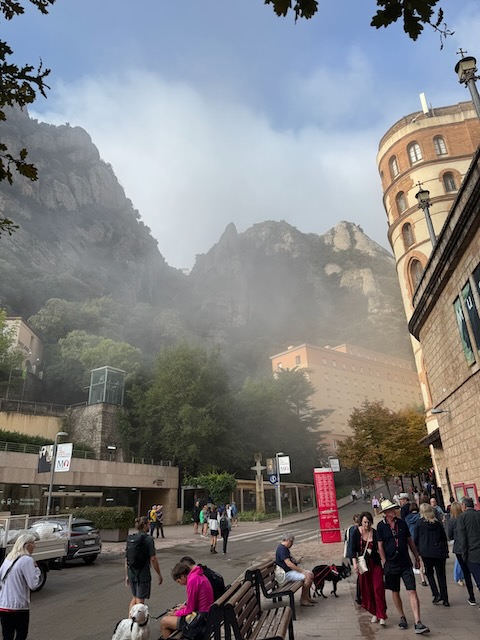
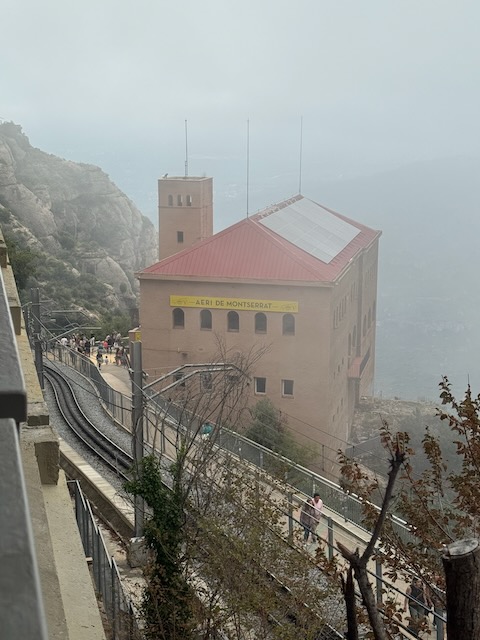
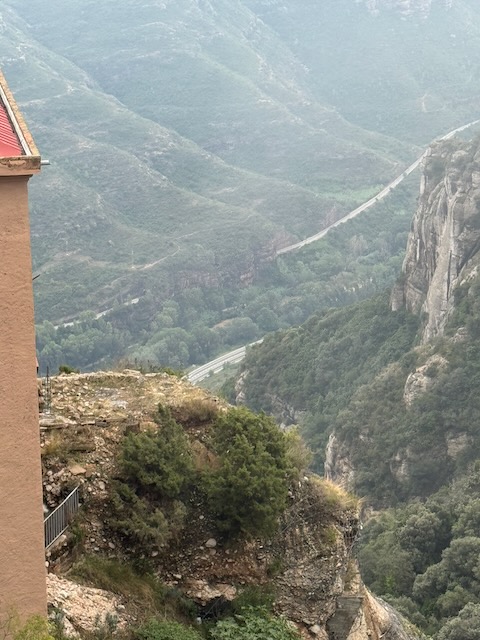
Traces of sunlight through mist and fog put the magical final touches to this excursion. At first we were disappointed to drive into low-hanging clouds as we ascended the mountains northwest of Barcelona toward the Benedictine abbey that was our destination. But in the end, instead of forming an opaque blanket, the clouds fell into shifting curtains of mist that revealed what was ahead of us, behind us, beside us for a few moments or minutes, then hid it away again. It was a haunting, almost otherworldly experience.



Montserrat
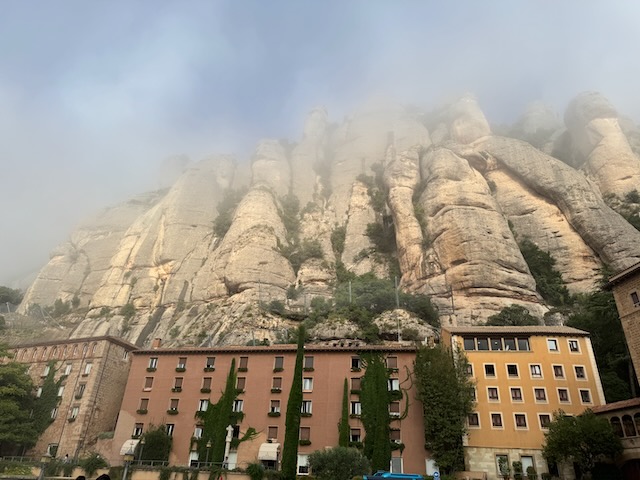
Montserrat (“serrated mountain”), the site of the Benedictine abbey Santa Maria de Montserrat, with its famous “Black Madonna” statue, is located in the Catalan Pre-Coastal Range about 45 km northwest of Barcelona. It is composed of a type of sedimentary rock called “pink conglomerate” that is formed from a mixture of hard and soft fragments including pebbles, gravel and sand, held together with a fine-grained binding compound. Over millennia, erosion – or, more specifically, the ability of this particular rock combination to partially resist it – has given Montserrat a stunningly distinctive appearance, more evocative of the limbs and digits of huge living creatures than of the jagged rock formations they actually are.


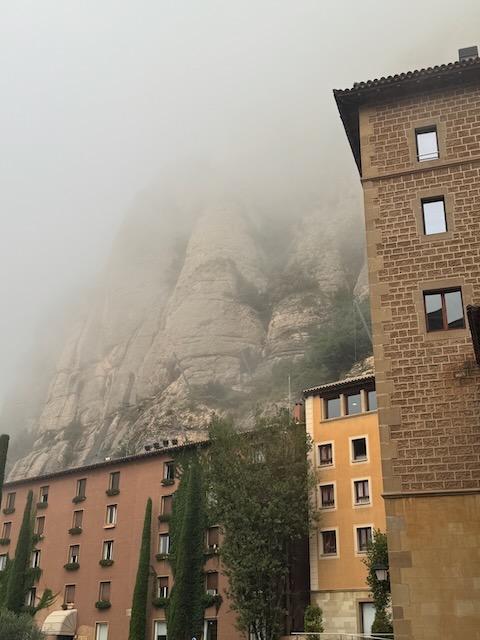

“Montserrat Mountain […] gives the appearance of being higher than it actually is, due to the fact that it rises straight up from the Llobregat River. There are no other mountains in its vicinity that come close to its height – making it look very distinctive in this part of Catalunya” (From the very useful Montserrat Tourist Guide).
The Benedictine Monastery
It is believed that it was during the ninth century that a group of solitary monks – of the variety that don’t talk to one another – started building the chapels that formed the foundations of the Santa Maria Abbey. Little of their work remains, although one of the original chapels – St. Iscle – can still be visited. (I just found this out today, so I didn’t get there in September. Adding it to my list of things to go back and see next time.)


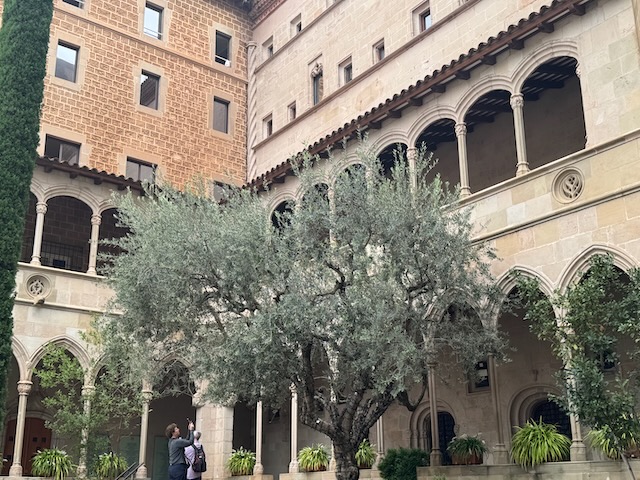
Between the eleventh and thirteenth century, the monastery was officially established with the construction of a church in the Romanesque style, and pilgrims began to come to Montserrat. In 1492, one of the monks from the abbey went to the New World with Christopher Columbus, which is how one of the islands in the Lesser Antilles came to be named “Montserrat.”
The history of Montserrat Abbey is not entirely one of a peace cloaked (like the mist on its mountains) in silence and prayer. In 1811, Napoleon’s army destroyed the abbey; subsequently all of the monks but one left when the property was confiscated under new legislation. Reconstruction did not begin until 1858.

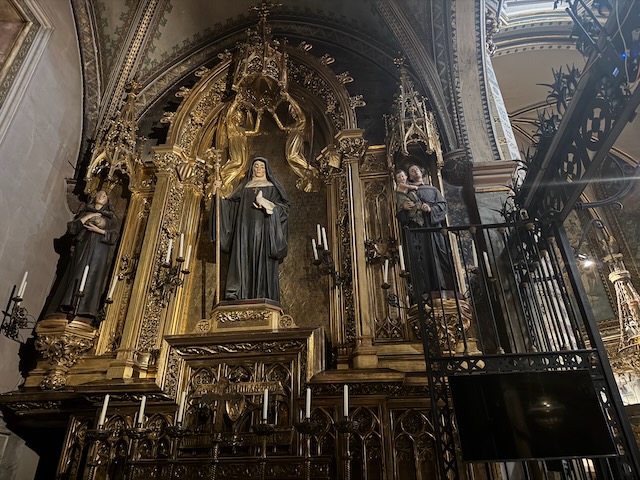

The monks were forced to leave again during the Spanish Civil War (1936 – 1939), and during this period 23 monks were killed. The Catalonia government protected the Abbey as much as it could during this period, and after the war, the monks returned and reconstruction continued. The church now standing on the site is Gothic in design.
The Black Madonna
The Black Madonna, or “Black Virgin” as it is also known, has helped to make the Abbey at Montserrat famous.

The statue, which is carved from wood, is located high above the chancel of the abbey. We did not have time to go up to see it, but we caught a glimpse from the main floor. The online tourist guide tells us that the Madonna figure “sits behind a sheet of glass, but one of her hands that is holding a sphere (which symbolises the universe) is not behind the glass. It is tradition for you to kiss or touch the Virgin’s hand whilst opening out your other hand to Jesus.”
Here is a close-up photo from the Monastery website.
The Montserrat statue is only one of many Black Madonnas found around the world, but it is one of the most famous. Some believe that this sculpture was carved in Jerusalem when Christianity was new (possibly even by Saint Luke), was later given as a gift to monks in Barcelona, and then was hidden in a mountain during a century of Muslim rule. It was ultimately rediscovered only thanks to a miracle involving shepherds who saw light coming from a cave. The name “Black Madonna” comes from the colour of the wood, which was not dark when the statue was carved, but has darkened over time. (According to The Internet, historical analysis suggests that this Madonna sculpture is Romanesque, from the late 12th century.)
The Enthronement of the Image of the Mother of God was celebrated in 1947, and since then the Basilica’s restoration has been completed, a museum has been added, and the site has been visited by a Pope (John Paul II). Many people come to Montserrat each year for meditation and prayer, and a large hostel is located just below the abbey to accommodate these pilgrims.




Sculptors and Artists


My interest in sculptors in general and those from the region we visited in particular was extended when I learned that contributions to the Basilica included the chapel of the Image of the Mother of God, which was completed in 1885 under the direction of Francesc de Paula del Villar i Lozano with the assistance of “a young Antoni Gaudí.” We also saw two pieces by my latest favourite Catalan sculptor, Josep Maria Subirachs.


After we had returned from Montserrat, we and our Trafalgar group headed out for a bus tour of Barcelona that included a walk around the Sagrada Familia. The day concluded with a lovely dinner at a Barcelona waterfront restaurant in which tapas figured largely. During our travels, I became a big fan of tapas, which are called by other names in other parts of Spain. More on that in another post.

Discover more from I'm All Write
Subscribe to get the latest posts sent to your email.
 I'm All Write