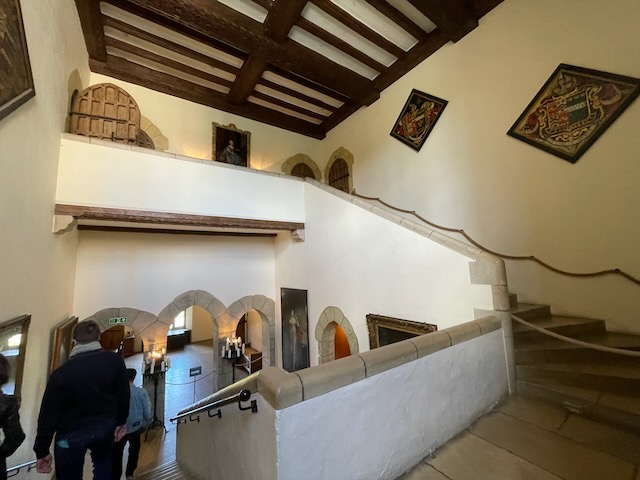
Our second bus tour took us southwest from London to the English Channel at Dover, via Leeds Castle and Canterbury. Leeds Castle is only the second “castle” (as opposed to palaces) I’ve ever visited, the first being Randolph Hearst’s estate at San Simeon, which I toured when I was about twenty. Hearst didn’t have a moat. Leeds has a moat.
[Click on a photo to view the gallery. If you’re reading this in an email, click the link at the top of the email to view it in a browser (or reader) for better views of the images.]
The moatMore moat
“Listed in the Domesday book of 1086, Leeds Castle has been a Norman stronghold, a royal residence for six of England’s medieval queens, a palace belonging to Henry VIII and a country retreat for influential 20th-century figures”(on-site signage).
Luncheon is servedGames RoomWriting RoomMannequins appear in unexpected places
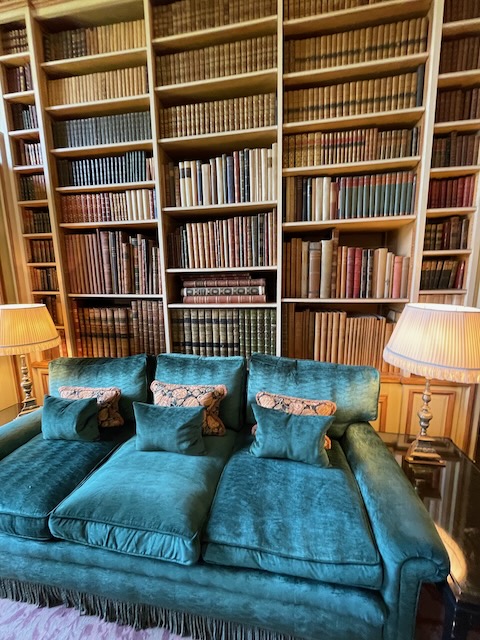
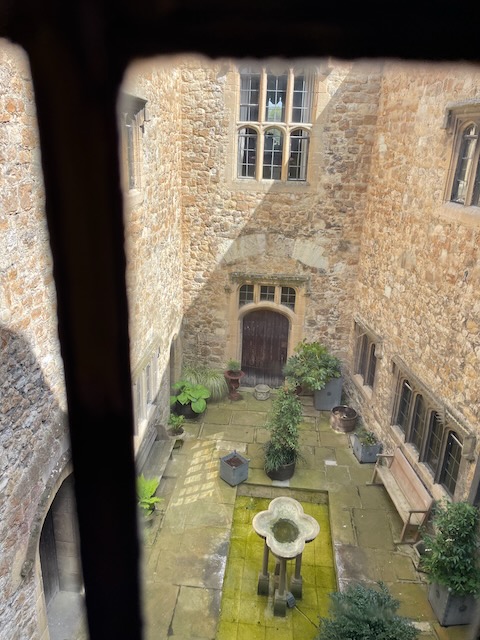
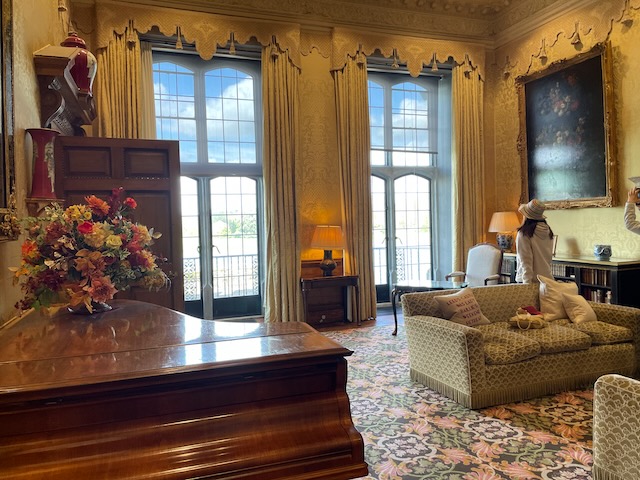
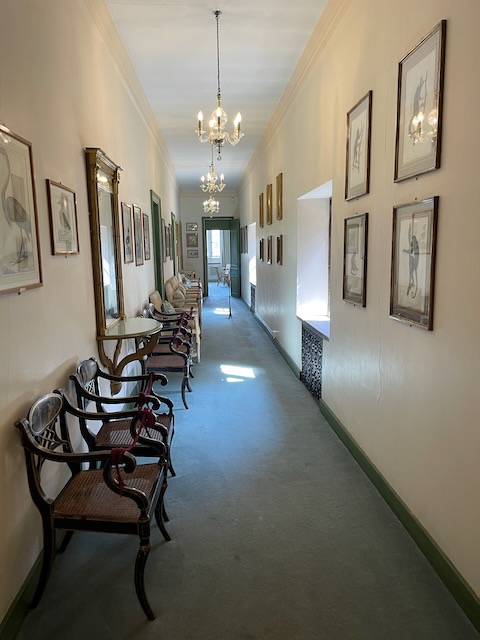
Leeds is a comfortable size for a castle. With the support of a staff of dozens, I think I could quite happily live there. In fact, this castle was in use less than a hundred years ago, when its final owner, Lady Olive Baillie, entertained famous people from all over the world. “Alongside a close circle of friends, Lady Baillie [who purchased the castle in 1923] enjoyed Leeds Castle as her luxurious country house and a weekend retreat before setting up a trust to care for it after her death in 1974” (on-site signage). Thanks to the decor from Lady Baillie’s era (along with some piped in ragtime music), this medieval palace has a Roaring Twenties feel to it.
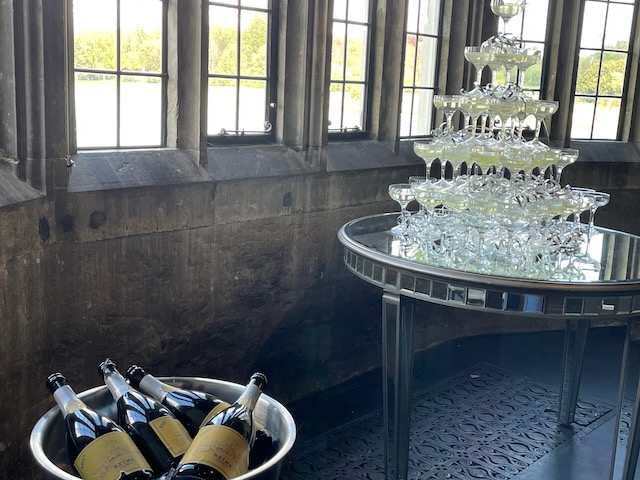
Champagne!Such lovely viewsTelevision roomLady Baillie’s boudoirShoes!This does sound a bit like what happened at the Hearst Castle too.Lady Baillie and her daughters
One of the appealing features of Leeds Castle is the decision by the curation team to embroider some of the historical information onto pillows and to stencil it onto walls.
Katherine of Aragon liked pomegranates. Who knew?Such a comfy-looking wall finish
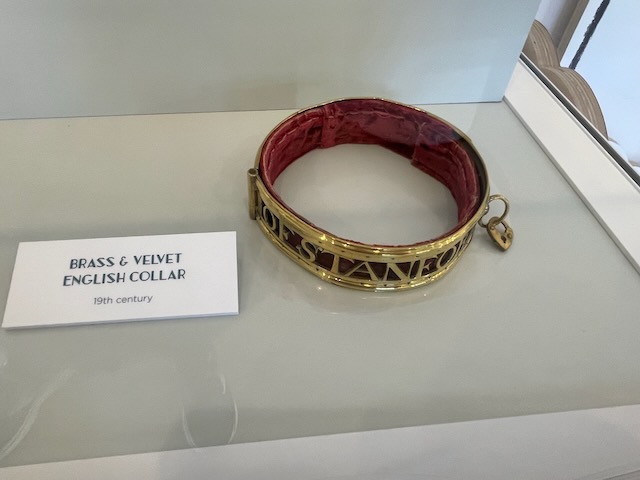
After touring the castle, I wandered past contented waterbirds up to the stable-courtyard area (which now features accommodation (people can stay at the castle overnight), some shops, and food vendors), and checked out what is reportedly the world’s only Dog Collar Museum. (You’re welcome.)
Family outing
Canterbury
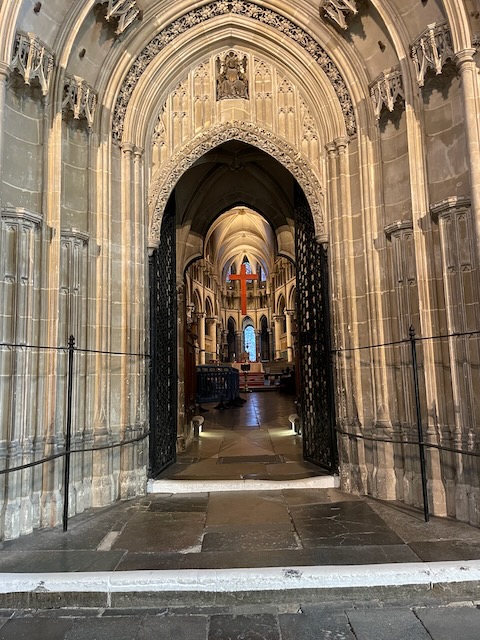
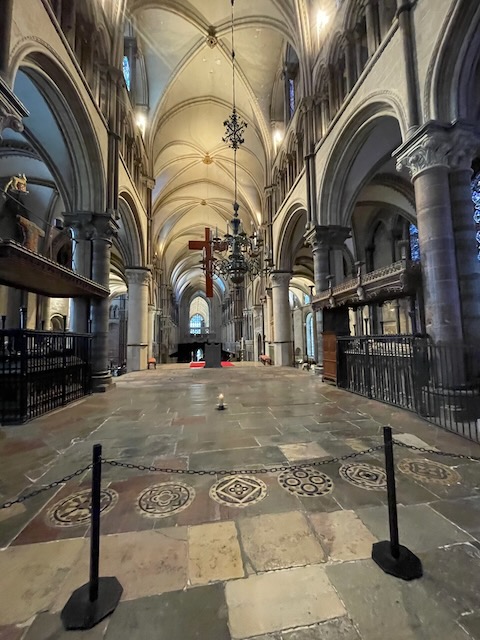
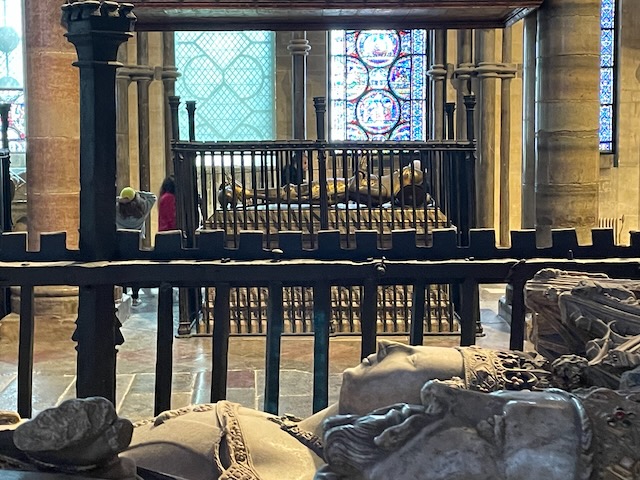
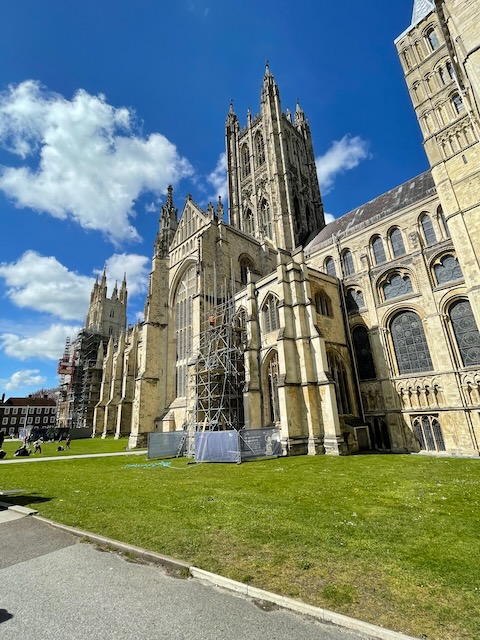
Our next stop was Canterbury Cathedral, a UNESCO World Heritage Site, seat of the Archbishop of Canterbury, an important pilgrimage destination, the location of the tombs of many royals and saints, and the site of the murder of Thomas Becket in 1170.
Canterbury Cathedral features Gothic and Romanesque architecture that dates from CE 597, when it was founded by St. Augustine. It has been modified several times over the centuries.
Thomas Becket, who was Archbishop of Canterbury when he died and Lord Chancellor before that, had a falling out with King Henry II over their differing views on the the powers of the Church vs. the Crown, and was murdered in the Cathedral by supporters of the King in 1170. (It seemed appropriate to purchase a copy of Murder in the Cathedral, the play by T.S. Eliott [1935], in the gift shop. So I did). Becket was canonized by Pope Alexander III and is considered a saint by both Roman Catholics and Anglicans. But neither his death nor his sainthood spared him from ongoing conflict with British royalty. Henry VIII (who had his own ideas on the role of the Church in England and how much control over it the Pope should have, particularly when it came to annulments of the marriages of kings) destroyed Becket’s shrine in 1538. It was recently digitally reconstructed using computer generated imaging.
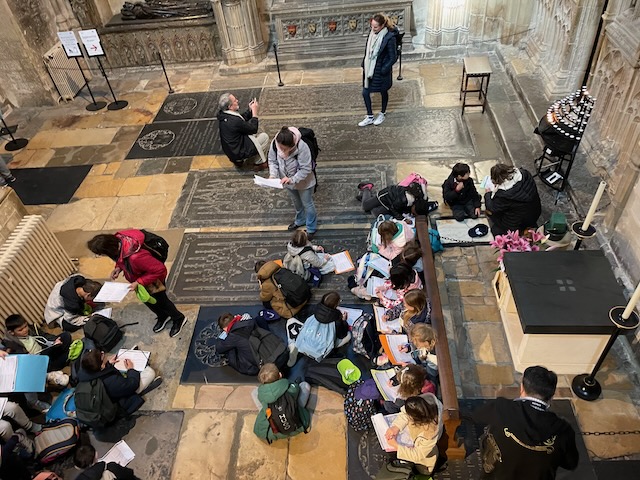
Paschal CandlesJoan of Kent, wife of the Black Prince, first Princess of Wales
The Canterbury Tales by Geoffrey Chaucer (written between 1387 and 1400) imagines stories told as a way to pass the time by 24 pilgrims on their way from London to the Cathedral. “The Wife of Bath’s Tale,” mentioned in the post about our trip to Bath, is one of these.
The small glimpses of the City of Canterbury we caught en route to the Cathedral gave us the impression of a charming, friendly city. We particularly enjoyed the square outside the Cathedral, where we had a very satisfying meal of fish and chips.
Dover and the White Cliffs
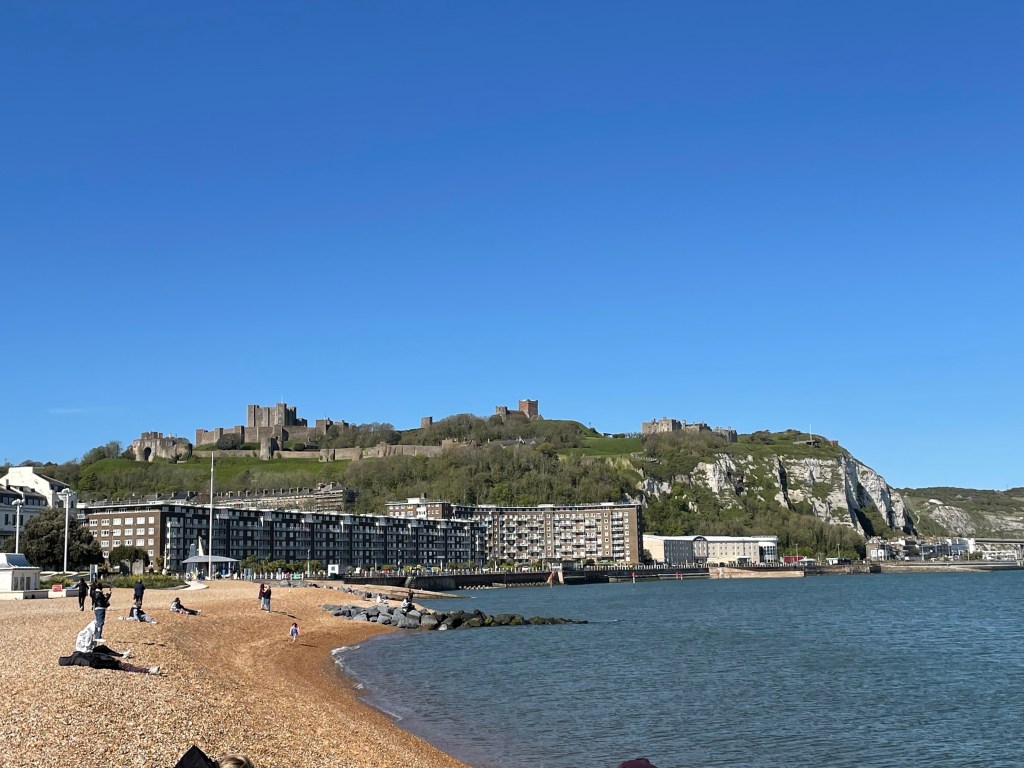
Our bus tour finally took us to Dover for a look at the famous white cliffs. As it turned out we got a better view of them two days later when we took a bus and ferry to France, but we enjoyed the opportunity to wander along the (very stony) beach and to breathe the sea air before we returned to London.
[Note to readers: If you receive these blog posts by email and some of the photos look stretched or squished, I apologize. I recommend you click the link in the upper right hand corner of the email, where it says “Read on Blog or Reader” to read the post online. I think the problem has to do with the aspect ratio of the photographs, but I can’t figure out how to fix it. Please drop me a note if this doesn’t work.]
After a week of industrious touristing, we took it a bit easier on April 28th. I wanted Arnie to see Sir John Soane’s Museum, to which my friend Rhona McAdam had introduced me on my previous trip to London 25 years ago. The museum is close to Covent Garden and Drury Lane, which are part of London’s “West End Theatreland” so we decided to take in a matinee as well as the museum, have dinner and call that a day. (Drury Lane was, of course, also the home address of the famed Muffin Man. Do you know him?)
Sir John Soane (1753-1837) was a highly respected architect whose neo-classical designs included a number of buildings for the Bank of England as well as private commissions. He ultimately taught architecture at the Royal Academy.
Despite the best efforts of two recalcitrant offspring, Soane had a fascinating and productive life (you can get an overview of it on Wikipedia), and he travelled widely. Although the buildings he designed are mostly gone now, he continues to be well known primarily because he turned his house and office in Lincoln’s Inn Fields (really two adjoining houses, to which a third was later added) into a museum, and filled it literally to the rafters with an intriguing and massively diverse collection of antiquities from all over the world, including bronzes, urns, sculptures, tiles, stained glass, busts and even the Sarcophagus of Seti. (Apparently Soane threw quite a party after the sarcophagus was safely delivered.) In addition to all that, he collected paintings – you can see Hogarths, J.M.W. Turners and Canalettos among others at the Soane – and over his life he also acquired nearly 8000 books including illuminated manuscripts, and architectural drawings from around the world.
Hogarth, “The Election”
Having purchased our matinee tickets in advance at the Gillian Lynne Theatre box office, we waited in the rain for half an hour to get into the Soane, then saw as many artifacts as we could before heading off to see the musical Standing at the Sky’s Edge.
Standing at the Sky’s Edge had rave reviews when it was at the National Theatre in London, before it moved to the West End. It also won several awards. It is deeply grounded in the experience of Great Britain in the past seventy years (including Thatcher’s devastations, Brexit, etc.). The profusion of English accents meant that we missed a bunch of lines because our ears didn’t tune into the vernacular/accents quickly enough. But we really enjoyed the production.
“Hailed as ‘the greatest new British musical’ (Daily Express), Standing at the Sky’s Edge is a kaleidoscopic portrait of life on an ever-changing estate, charting the highs and lows and loves and losses of three generations over six tumultuous decades.” – National Theatre
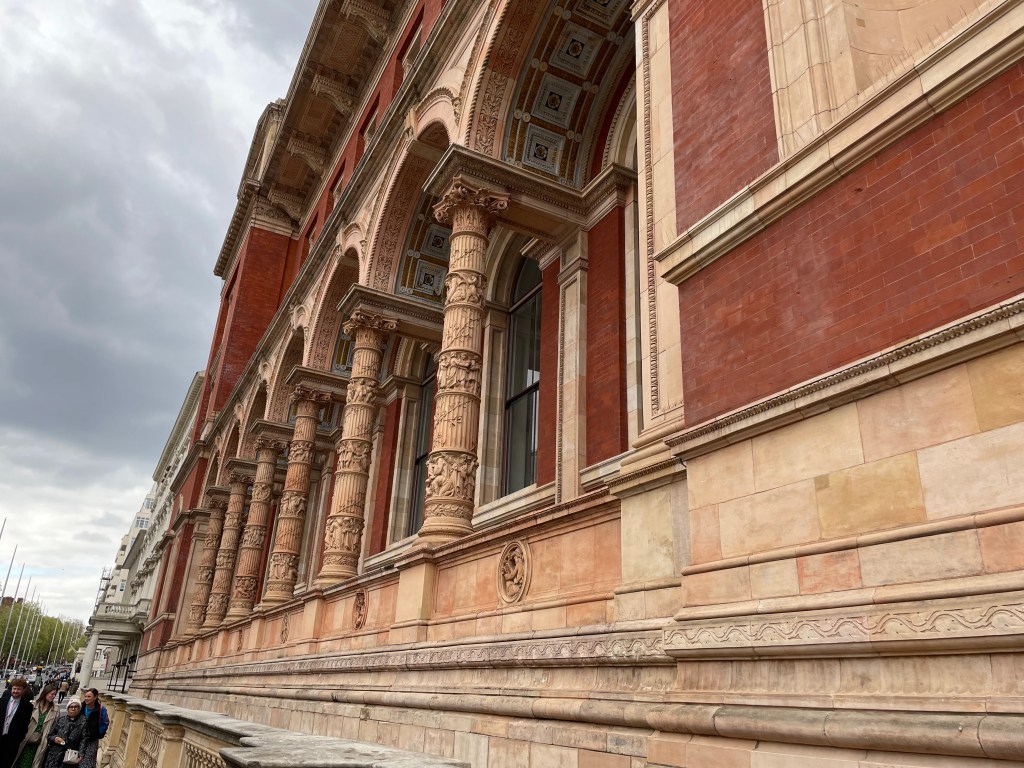
Prince Albert was the Prince Consort from 1857 until his death four years later. He had married his first cousin, Queen Victoria of England, in 1840, three years after her ascent to the throne. Born in Coborg, Germany, Albert died when he was only 42, but he made an impressive number and range of contributions to the arts and sciences in England during his tenure there. Following his death, his widow and her subjects continued to honour his memory by naming things after him, and since Victoria reigned for 63 years, seven months and two days (a record until Elizabeth II’s nearly 72 years), it is no surprise that everywhere you turn in London, you are running into a bridge or a building or a street or a hotel named after Victoria or Albert, or – as in the case of the Victoria and Albert Museum – both. In fact, the neighbourhood in which the V&A is located is known as “Albertopolis” because of the number of edifices and institutions in the area that are associated with him one way or another (including Royal Albert Hall, which we’d be visiting later this same day.)
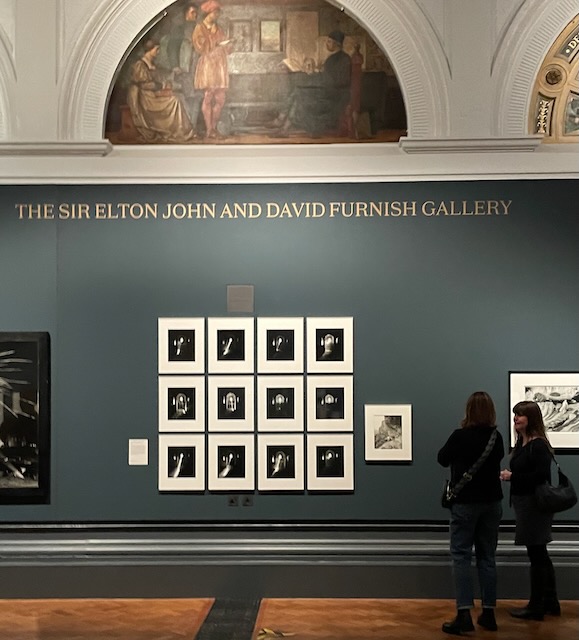
We’d been intrigued by the signs promoting a photography exhibition when we’d visited the V&A’s South Kensington location earlier in the week, but the gallery had closed before we’d had a chance to explore it. So on Saturday, we decided to go back just to look at the Photography Centre, a series of seven galleries on the third level of the museum. The Centre includes about 800,000 photographs dating back as far as 1820. One of the large display rooms is sponsored by Sir Elton John and his husband David Furnish. (A show featuring photographs from their collection, Fragile Beauty , which opened after we had left, is on display until early 2025.)
An interesting multi-shelf display at the entrance to the Centre features hundreds of different kinds of cameras, and it is tempting to try to find a camera you once owned somewhere in that display. (My first was a Brownie box camera with a viewfinder on top. I found cameras like it in the display, but I didn’t find it.)
(Please click on an image to see them in gallery format)
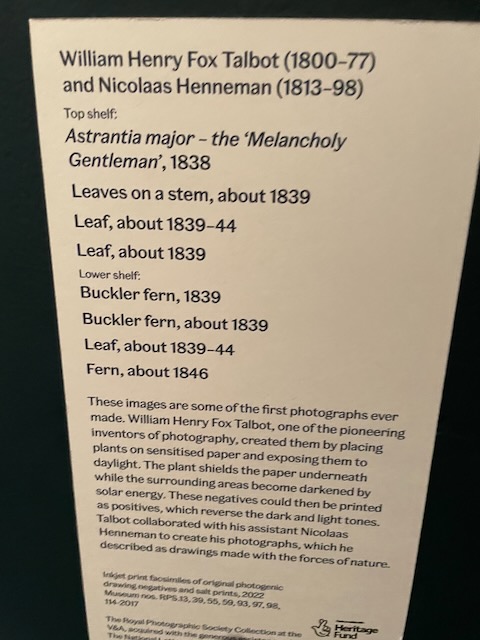
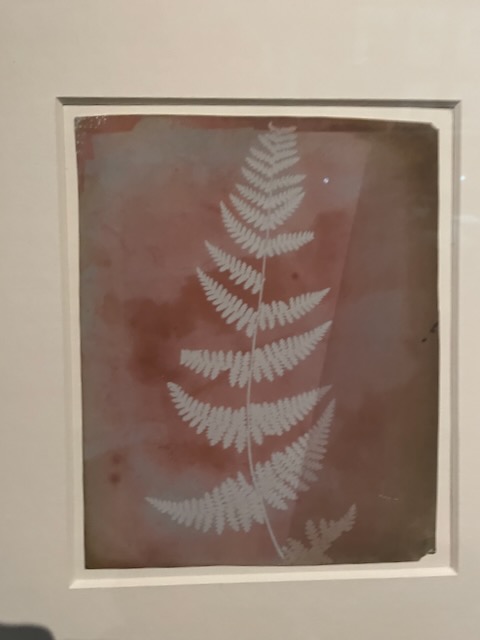
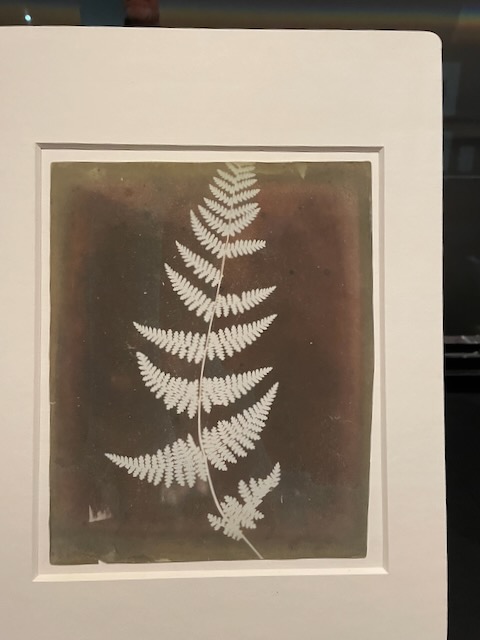
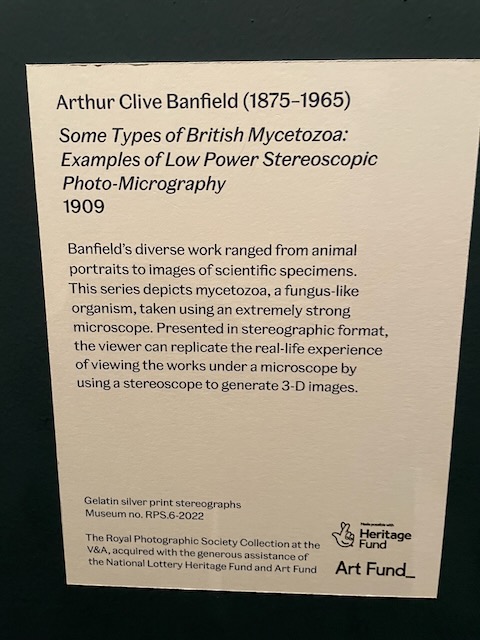
The Photography Centre explores the whole field of photography from a range of viewpoints, from the technical (types of cameras, processes and techniques including black and white, printmaking, vintage 3D, etc.) through the historical, artistic, political, and beyond. Fascinating stuff.
Bath time
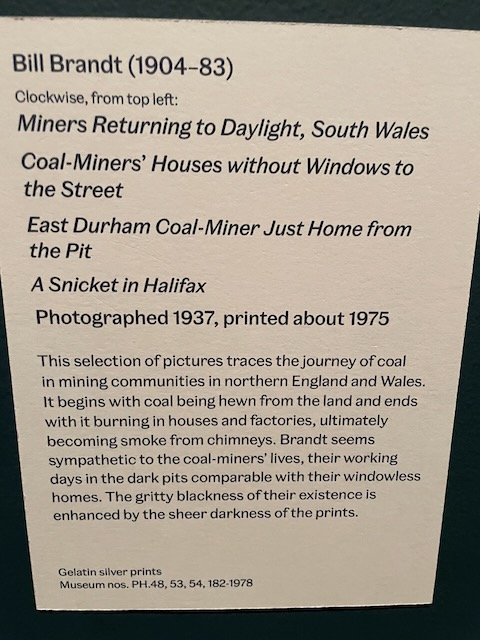
I was particularly interested in the photos of the coal miners, as my father’s forebears also worked in the coal mines. The V&A photos were taken in Durham, England and my father’s family was from Abertillery in Wales, but I’m sure that they had lots in common when they emerged from below the ground at the end of a shift.
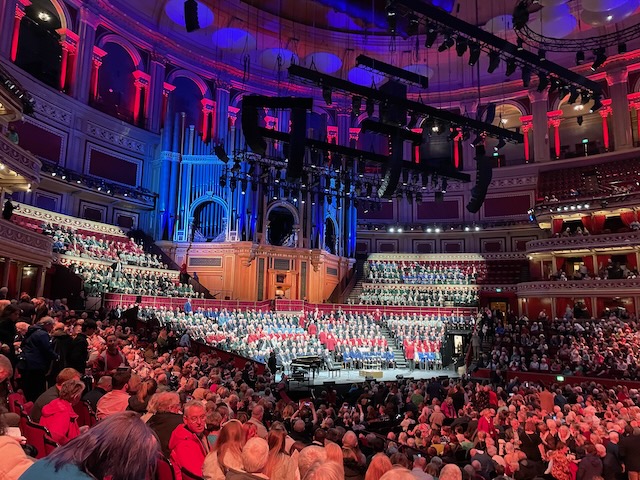
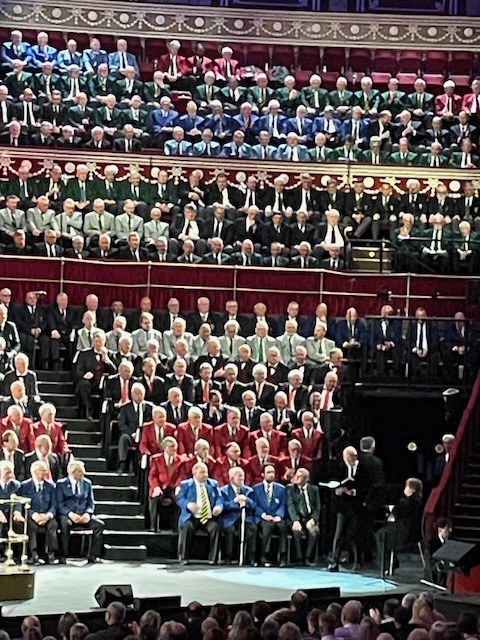
My father died when I was two, and one of the few physical connections I had with him as I grew up was a record from 1963 called Five Thousand Voices: A Nation Sings, recorded on May 3, 1963. That record is worn out now, although I still have it, but imagine my delight when I learned that a concert of “Massed Male Choirs” from Wales would take place at the Royal Albert Hall while we were there.
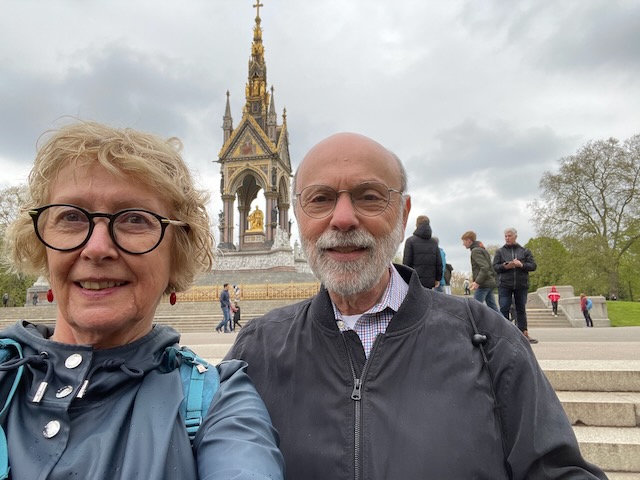
We walked through more of “Albertopolis” on our way to the concert, checking out the lovely neighbourhood where Royal Albert Hall is located and then the Albert Memorial, which stands a few hundred feet in front of the Hall in Hyde Park, not far from Buckingham Palace.
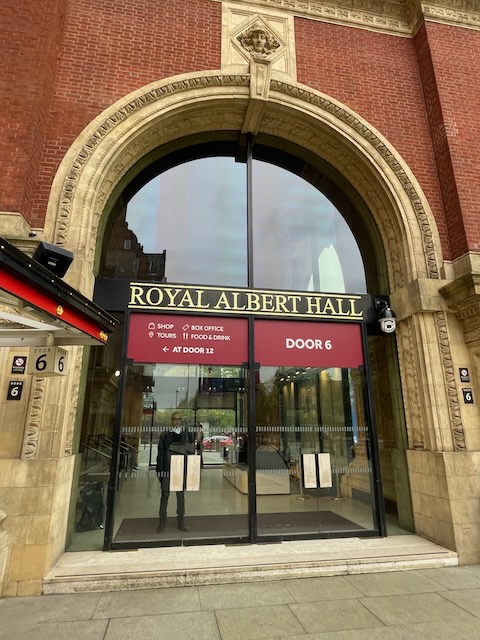
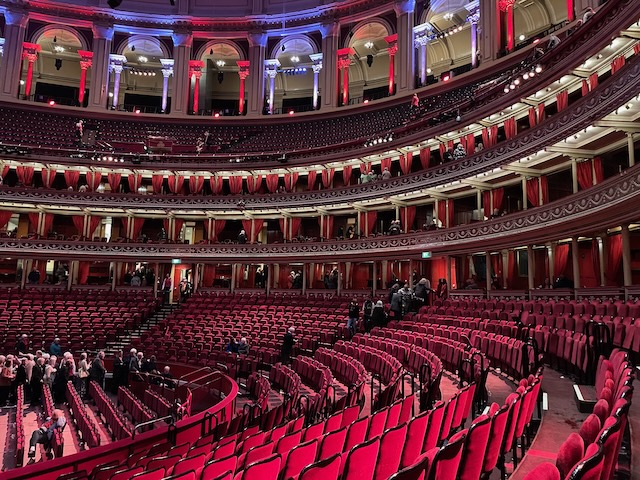
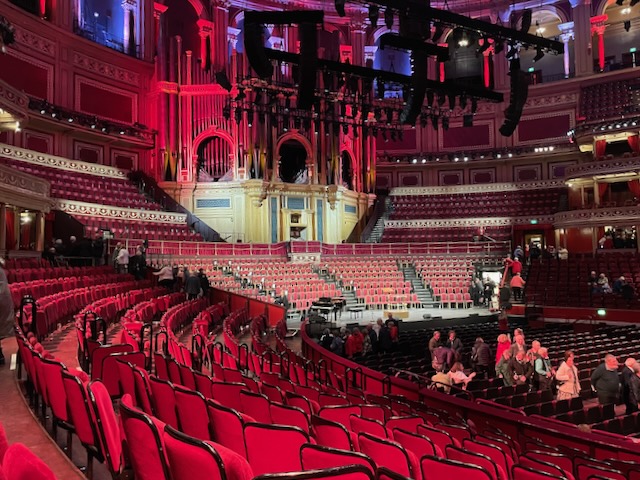
After an outstanding dinner at Verdi, which is located in Royal Albert Hall, we made our way to our (swivel) seats, and were properly overwhelmed. Almost like Stonehenge, I feel like I’ve been aware of Royal Albert Hall for my entire life, particularly because it is such a plum for artists to add the venue to their resumes. (In regard to The Beatles’ line, “Now they know how many holes it takes to fill the Albert Hall,” I just found this: “Papers newly discovered deep under the Royal Albert Hall have revealed that the iconic London venue wrote to the Beatles in 1967 to object ‘in the strongest conceivable terms’ to being named in the Fab Four’s song A Day in the Life.”)
The album of Welsh hymn singing that I own is called “Five Thousand Voices,” and the concert we attended on April 27, “A Festival of Male Welsh Voices” indicates that “more than 500 choristers” were on stage. However, several additional groups joined the event now and then, including a number of female voices, and since the entire audience (except for Arnie and me) seemed to be from Wales and to know the songs, I expect we heard 5000 voices that night too.
It was splendid.
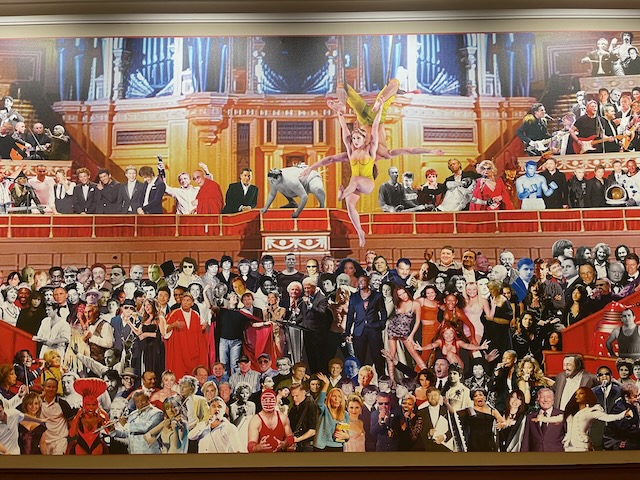
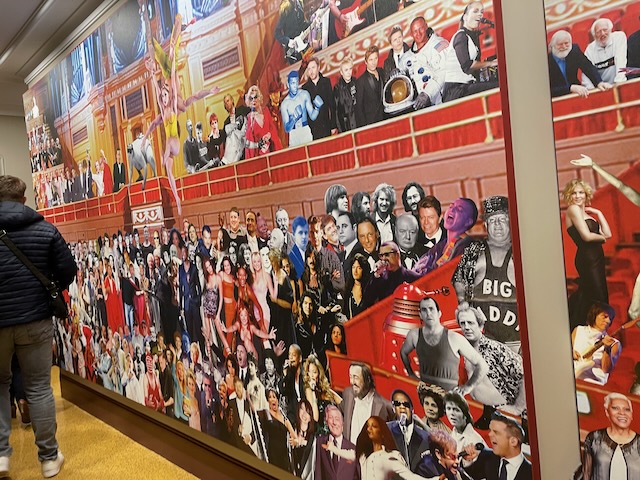
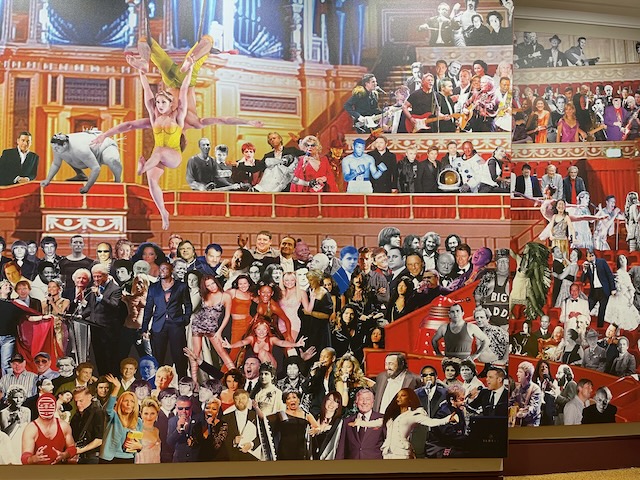
After the concert, we took some time to enjoy the collage/mural by Sir Peter Blake entitled “Appearing at the Royal Albert Hall” which is in the lobby of the building. Unveiled in 2014, it features more than 400 of the singers, dancers and other performers (not to mention scientists, a prime minister, a sumo wrestler and Muhammed Ali) who have appeared at the Hall since it opened in 1871. You can see an interactive version here.
And here are three videos from the concert. Enjoy!
On the first Friday of our trip, we made our way from Paddington to the Victoria Coach Station to join a day tour that would take us to Stonehenge and the City of Bath. The Victoria Coach Station is not, as one might have expected, attached to the Victoria Underground Station, or even to the Victoria Train Station (the latter two being adjacent and loosely connected) but is instead several blocks away. As it turned out, this was useful information for us to have as we would need to make two more trips to that same station before the conclusion of our time in England.
Boarding began at 8 a.m. for the 8:30 tour, and due to the unanticipated quarter-hour walk from the Victoria Underground to the correct gate at the Victoria Coach Station, we were hard pressed to get in a quick breakfast before we boarded. All of the departure-gate doors in the station are locked five minutes before departure in order to prevent people from being driven over by departing buses, which means that if you don’t board early, you are SOL. Also, you are not allowed to take hot food or drink on board with you. On our second tour from VCS the following week, the guide told us that the only downside of her job was the sad spectacle of late-arriving customers banging on the glass doors as they helplessly watched their tour buses driving away without them.
Soon after we pulled away from the station, I saw through the bus window an intriguing little building, decorated with shells, in a park. I learned through an online search that this is one of two huts built during a post-WWII redesign of Grosvenor Gardens (which is the name of the park) by architect Jean Moreux. The shells are from England and France, to symbolize English-French unity. The huts, which are still used to store equipment, are built in the French fabrique style.
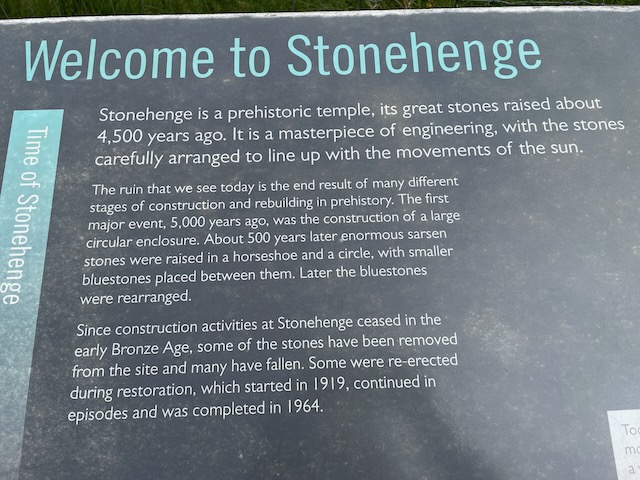
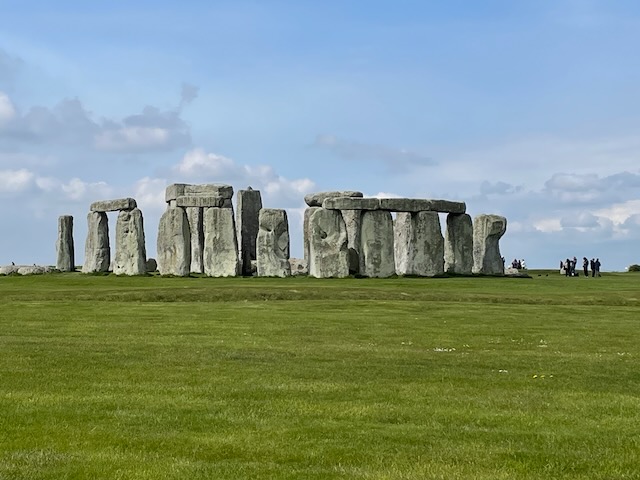
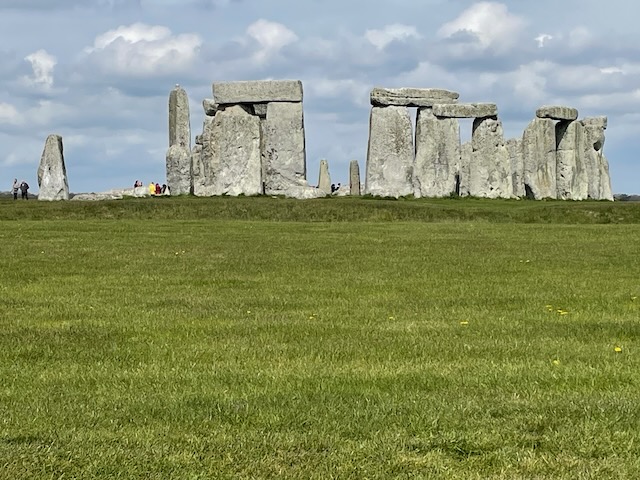
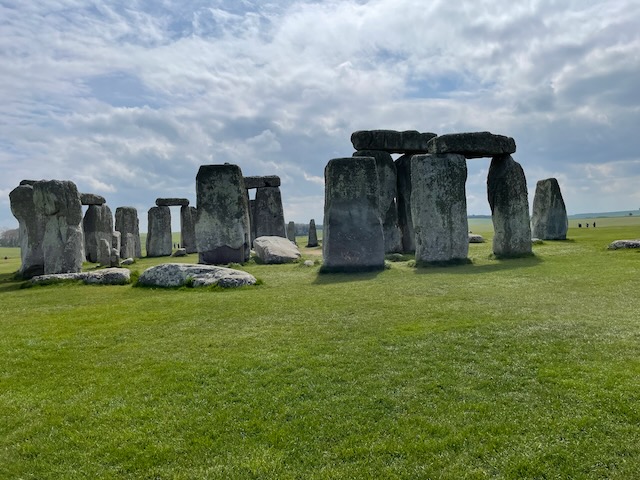
Two hours later, after travelling a little south but mostly west, we arrived at Stonehenge. Believed to have been constructed and in use from about 3700 to 1600 BC., the prehistoric structure is so famous that it must be recognizable to just about everyone on the planet. I’m sure I first saw photos of it when I was still in elementary school. Indeed, I think that much of the dramatic impact of catching a first sight of it (which is dramatic and worth the visit even if you’ve seen too many images of it already) arises from the site’s familiarity.
(Please click on photos to see bigger versions of them in a gallery format.)
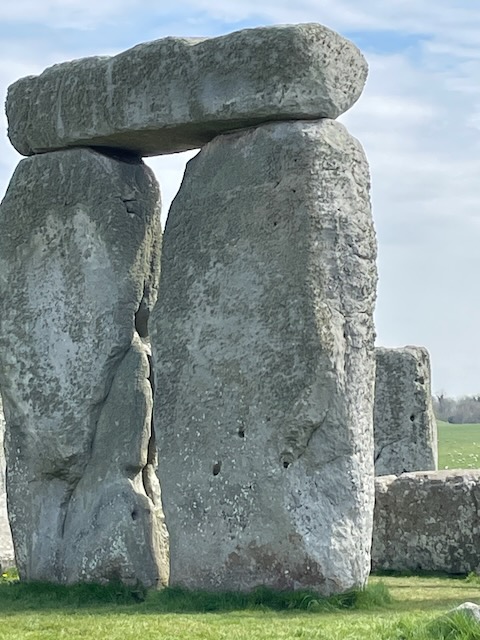
Our visit took place on a cool and windy day but the sun was out and we took our time strolling around the site, trying to imagine how people several thousand years ago could possibly have gathered these immense stones together in one place – some from as far away as southern Wales – standing most of them on their ends and then hoisting the lintel stones into their horizontal positions. The upright stones, most of them “sarcen,” or silicified sandstone blocks, are estimated to weigh about 25 tons each. That’s the other part of the impact of visiting this place: the entire project seems impossible, but there it is, right before your eyes.
“Stonehenge is one of the most impressive prehistoric megalithic monuments in the world on account of the sheer size of its megaliths, the sophistication of its concentric plan and architectural design, the shaping of the stones – uniquely using both Wiltshire Sarsen sandstone and Pembroke Bluestone – and the precision with which it was built.” (UNESCO)
On Facebook, a number of people expressed regret that I did not get to see the site when it was still accessible to visitors. (“Back in the 70s, we could sit on the rocks!” they told me.) But once I realized what I was looking at, I was kind of glad that direct access is restricted. This marvel needs to be left alone so that future generations can see it too. Humans are always tempted to take away a souvenir or leave a mark, and in fact some of the graffiti on the stones already is hundreds of years old.
Rook (Corvus frugilegus)Jackdaw (Coloeus monedula)Feeling rather young, by comparison
We learned that until the early 1900s, stones were still being removed from the site to be used as building materials elsewhere – another great reason for uncontrolled public access to be discontinued. It is still possible to walk into the site twice a year – during the spring and fall equinoxes – but it is necessary to sign up for these carefully controlled visits well in advance. In the meantime, the masses of tourists do not diminish the experience: even when hundreds of us were walking around Stonehenge, the site felt vast and unoccupied. It was easy to imagine how overwhelming the place must be when the visitors have left and only the stones (and the birds) remain. (I know, I know. Who would it overwhelm if there was no one there? But you know what I mean.)
Bath
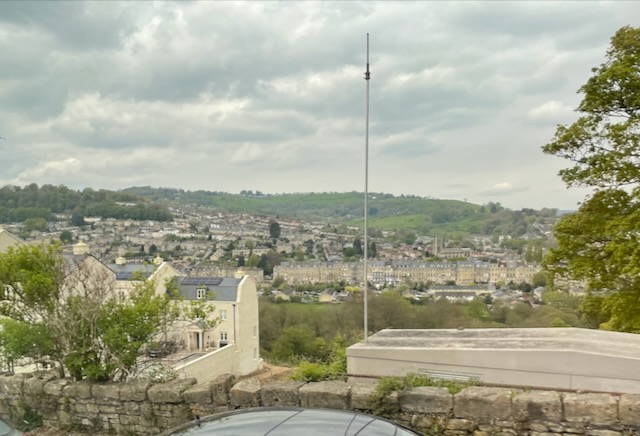
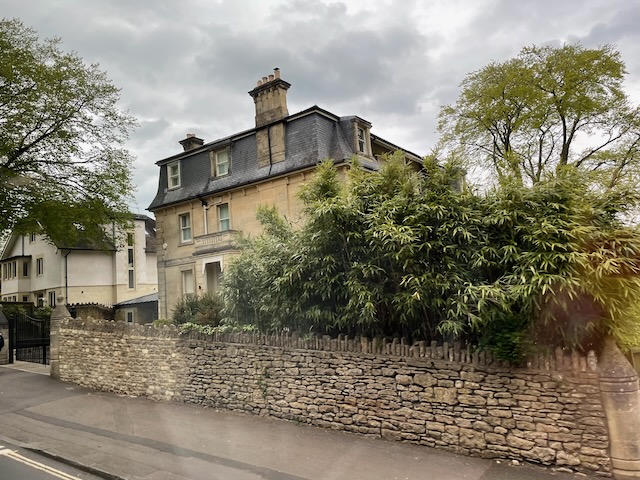
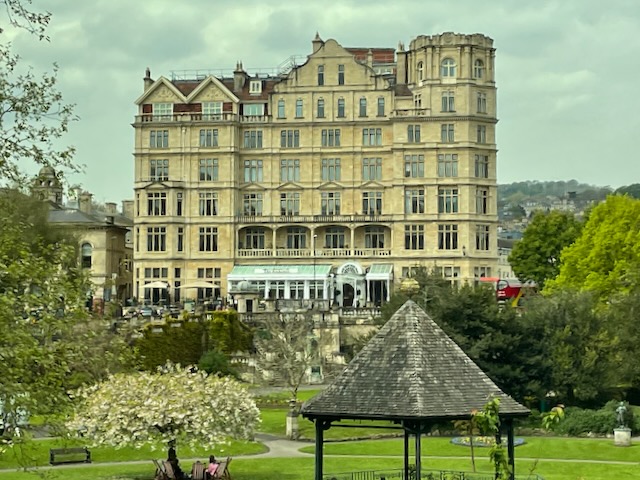
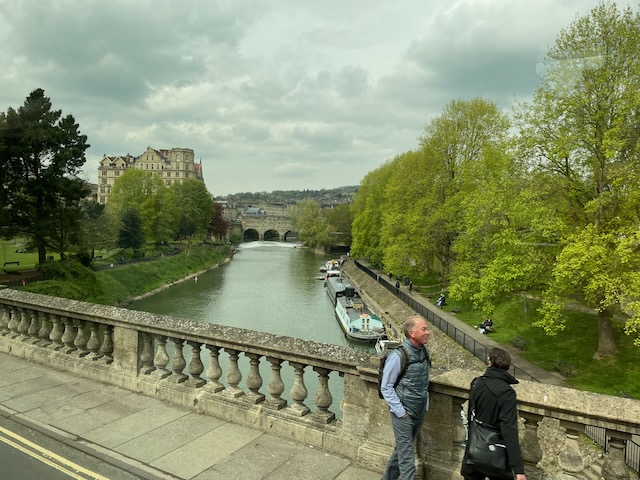
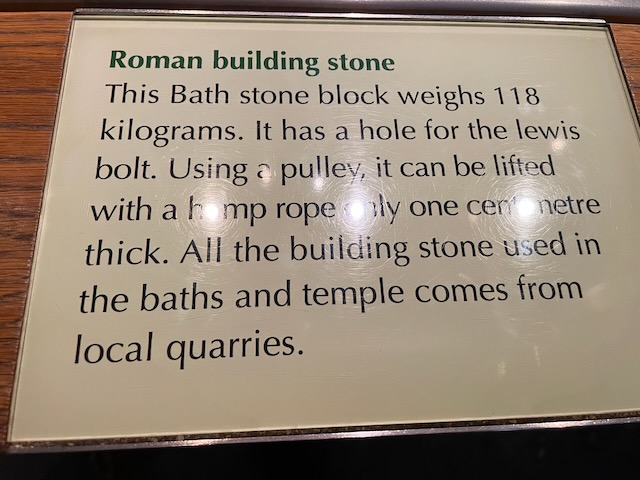
Our tour then moved on to the nearby city of Bath (33 miles from Stonehenge), whose buildings are almost all made from another local stone, this one with a lovely distinctive honey colour. (“Bath Stone is an oolitic limestone comprising granular fragments of calcium carbonate laid down during the Jurassic Period [195 to 135 million years ago] when the region that is now Bath was under a shallow sea”). Due to the hilly contours of the area and the proliferation of Georgian architecture, the town is picturesque from almost every vantage point.
The bus dropped us off in the main square of the city and a guide led us past Bath Abbey (1611; note the angels on the ladders at the front of the towers on each side of the entrance; oddly a couple of them are climbing down rather than up. I have found no explanation for the upside-down angels, nor for why angels might need ladders in the first place, but if you Google “Upside Down Angels Bath Abbey Ladders,” you’ll find some thoughts on the subject by other people) to the doors of the Roman Baths just down the street.
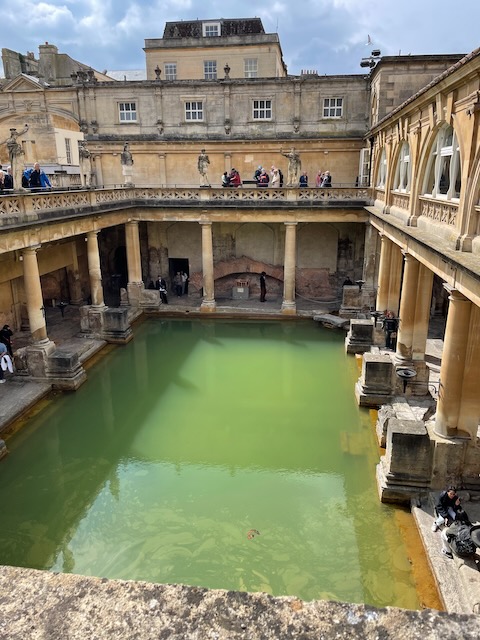
View of the baths from the outside, next to the Abbey
To be perfectly honest, I was mostly interested in seeing Bath because I had been so intrigued many decades ago when I read the “Prologue to The Wife of Bath’s Tale” in Geoffrey Chaucer’s Canterbury Tales in first-year English. The tale is distinctive not only because the narrator is a woman, but because her story speaks against “many centuries of an antifeminism that was particularly nurtured by the medieval church. In their eagerness to exalt the spiritual idea of chastity, certain theologians developed an idea of womankind that was nothing less than monstrous” (The Norton Anthology of English Literature, Vol. 1962). As a 16-year-old, this was one of my first brushes with feminist literature (even if it was written by a male who’d lived in the Middle Ages [1343-1400]).
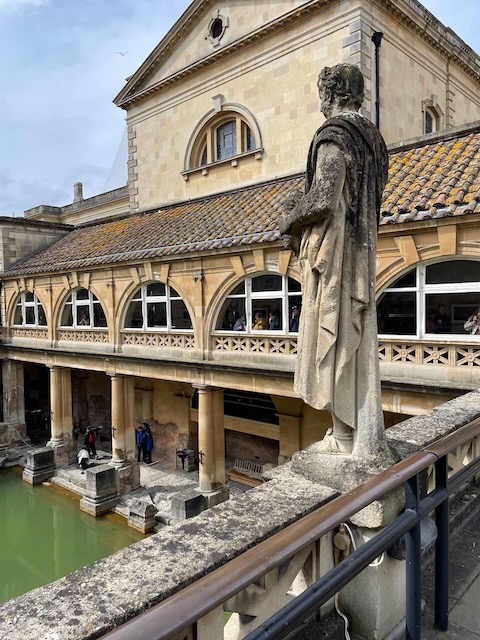
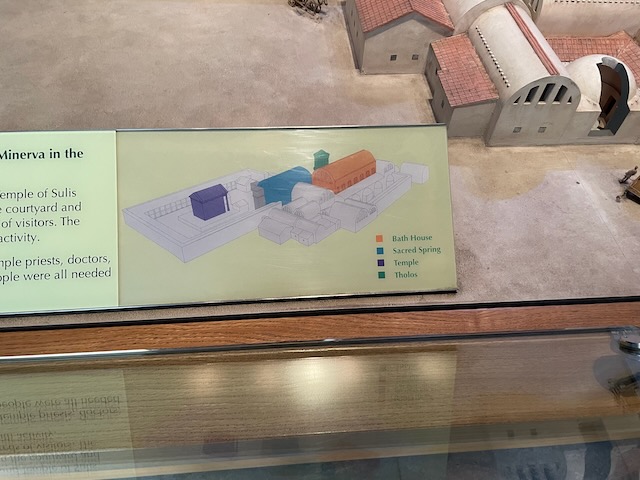
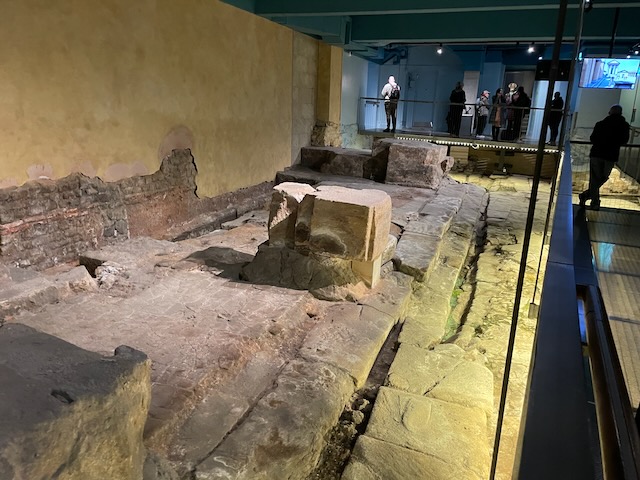
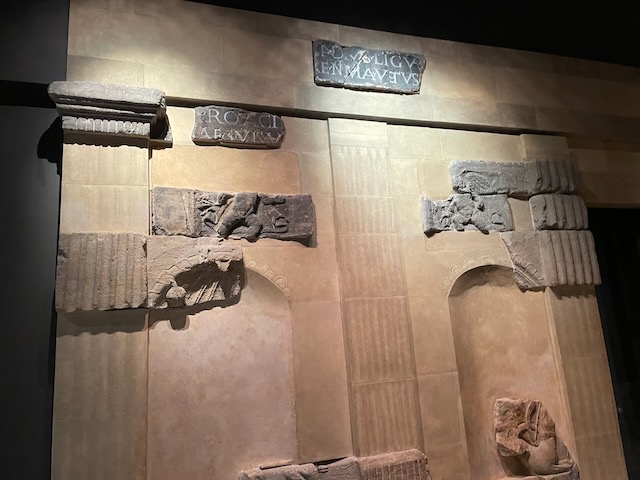
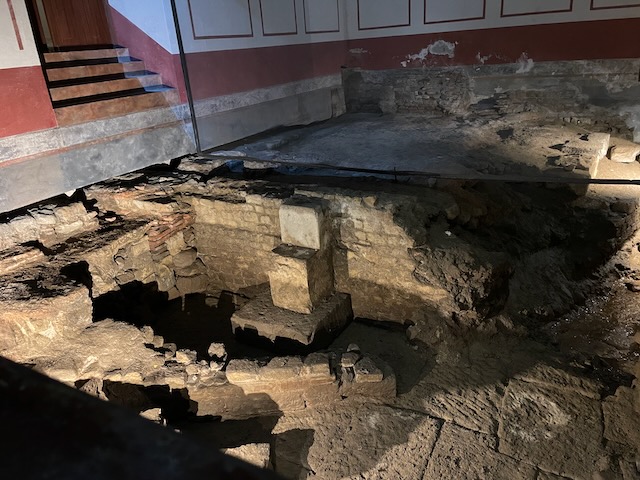
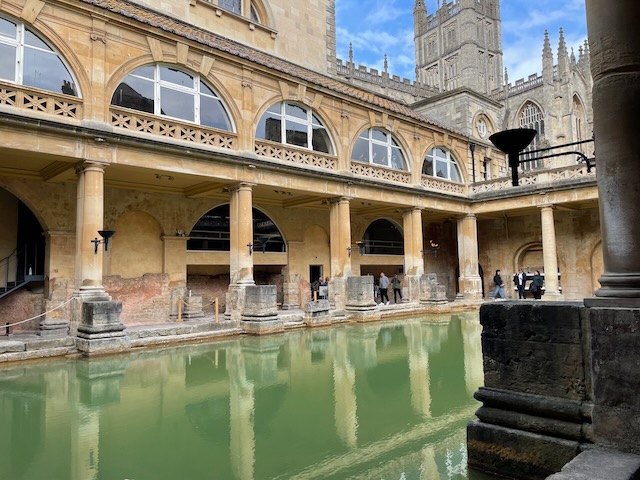
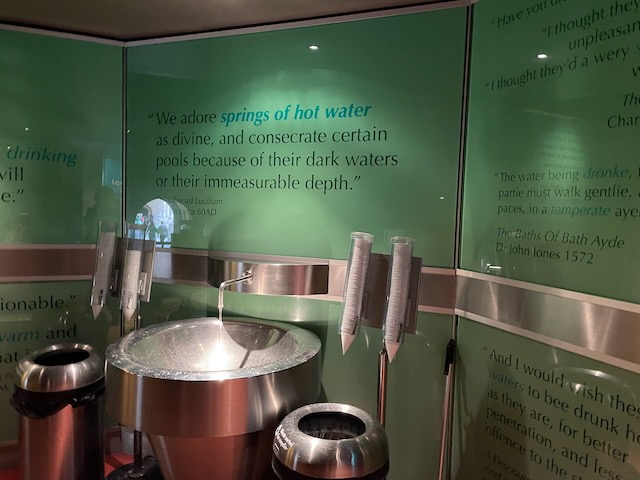
Somehow I’d missed realizing that the city had been named after the Roman baths that were built around the area’s natural springs during the Roman occupation in approximately 60 to 70 AD, and used until the Romans left Britain in about 500 AD. I almost didn’t bother to purchase advance tickets to the site, but I’m very glad I did. It is quite spectacular, mostly reconstructed in the 1800s to attract the interest of tourists. The lower level does preserve some of the features of the original Roman baths and, of course, the spring that motivated the Romans to build around it in the first place continues to burble up from about 10,000 feet below the surface. (“The hot mineral springs bubble up from the ground at temperatures well above 104 °F [40 °C], and the main one produces more than 300,000 gallons [1.3 million liters] a day” Britannica.) There is a very interesting piece about the Roman baths on Wikipedia.
The original baths would have been the tallest buildings most people in the area had ever seen
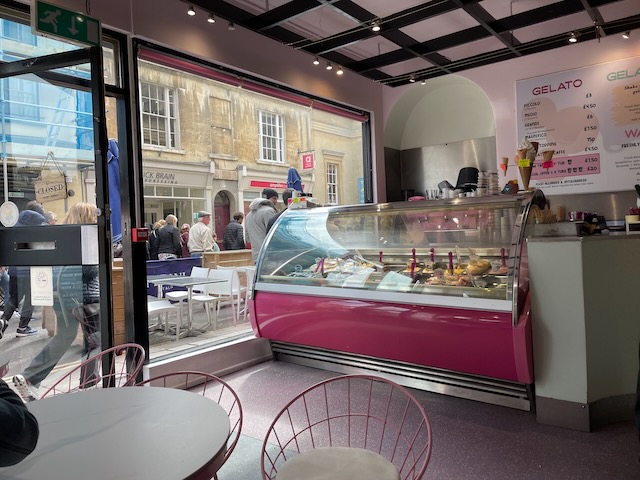
Bathing is not permitted at the Baths, but I took a sip of the water and was immediately cured of everything except for my sore feet and aching lower back. Afterwards, we had a decadent ice cream waffle for lunch, while watching a woman get her hair styled on the street outside in front of a hair salon with a rather disturbing name. As far as I know, she emerged with her tresses trimmed and her brain intact. (Poor Nick. There must be a lot of teasing.)
Here are three short videos I took on the lower level of the Roman baths:
A sign asks people not to put their hands (or other things) in the water, so don’t do what this guy did when you pop in there for a visit.
Did you know that England’s Thames is a “tidal river”? I did not, until I noticed that the water levels along the banks were much lower when we set out on our “sightseeing cruise” of London on the morning of April 25 than they were when we returned several hours later. So I started asking questions.
In summary, I learned that “Twice a day the Thames undergoes an incredible transformation – from a slow-moving river to a brimming marine environment as the North Sea floods inland. This remarkable event – governed by the moon – changes river height by up to 7m in just six hours. This 95-mile stretch from Teddington to Southend influenced by the ocean tides is the tidal Thames. As the sea water recedes it reveals a vast and beautiful riverbed that makes up London’s largest natural space.” – Thames21
Once I knew about the tides, all those scenes in movies and books where people (mostly murderous hooligans or poor innocents who are being chased by murderous hooligans, along with an occasional Royal Personage) descend ladders and stairs into the water or boats onto the Thames took on a whole new aspect.
Beachfront property – while the tide is out
When a major city has a river running through it, we have found guided boat trips to be a great way to orient ourselves and to see notable sights we’d never have time to cover any other way. Our voyage through London from near Westminster Pier to the Borough of Greenwich, about seven or eight miles upstream, took just under an hour. It was a chilly morning, but at least it wasn’t raining so we were able to sit on the upper deck outside.
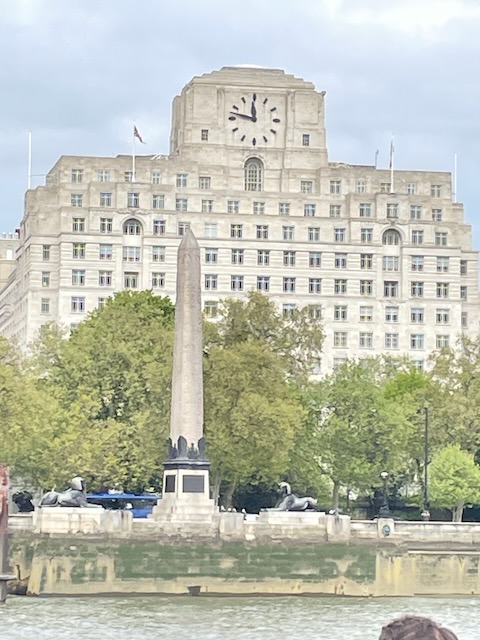
London Eye/Millenium Wheel Hungerford Rail BridgeCleopatra’s NeedleOne Blackfriars, aka The Vase or The Boomerang (l)HMS Wellington (museum)Mixed-eras skylineBlackfriars BridgeSt. Paul’s CathedralThe Globe TheatreVintner’s Hall: You can rent it for your next event!
Along with dozens of other people (including at least one “Influencer” who stood up in front of us to pose every time we passed something interesting. More on Influencers in a later post), we took in the sights along with a dry commentary by a young fellow who seemed to be steering our boat as well as serving as our tour guide. (He kept telling those in the centre aisle on top to please sit down because he couldn’t see where he was going.) He groused about the proliferation of “Uber” river taxis that kept zooming by us, and seemed unimpressed with the more expensive tourist options in the vicinity. He told us, for example, that it was easy to get a ticket on the Millennium Wheel: “There are never any lineups because it’s so expensive.” Pointing out the Savoy Hotel, he advised us that “A room is £500 a night, but you do get coffee and a croissant.”
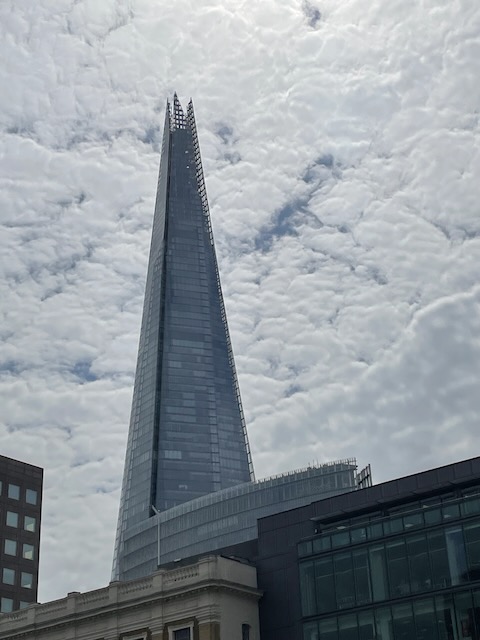
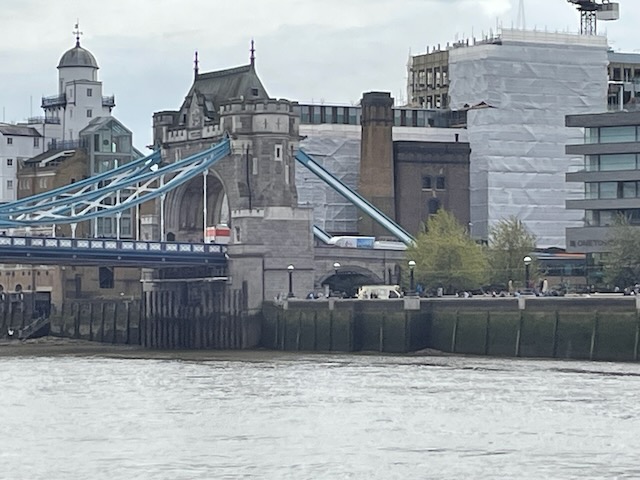
Our trip took us under the Charing Cross (Hungerford) Rail Bridge and past London’s Cleopatra’s Needle (a gift to the UK from Egypt in the early 1800s, the obelisk is 3500 years old! It’s one of a pair; my elder son and I once saw the other one, which is located near the Metropolitan Museum of Art in New York City). We saw the Waterloo Bridge, the rebuilding of which was allegedly completed in record time and within budget primarily by women during World War II, the Tower of London and the Tower Bridge, the National Theatre (“The ugliest building in London,” we were told), the Shard (“Where it’s £40 for a look outside”) and St. Paul’s Cathedral, to which architect Christopher Wren went to work by boat so often (almost daily for about 35 years) that one of the stairways up from the river is named after him.
The ShardHMS Belfast (also a museum)Tower Bridge (of course)Tower BridgeThe Tower of LondonThe bulge is on the Ofcom BldgChina WharfSo many interesting buildings
Greenwich
Greenwich is a lovely spot. After disembarking, we had a very tasty lunch then wandered past the University of Greenwich, the Royal Military College and the National Maritime Museum to an enormous park area where – at the top of a very long hill – the Royal Observatory is located.
National Maritime MuseumThe Queen’s House
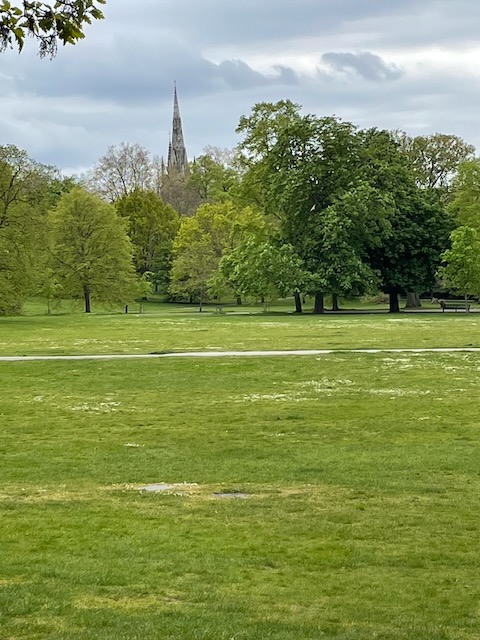
To get to the park where the observatory is located, we passed through the colonnaded walkway between the National Maritime Museum and the Queen’s House. The birdsong in the park on the way up was spectacular (according to my trusty Merlin app, among the birds we heard were a Eurasian Blue Tit, a Rose-Ringed Pheasant, and a Eurasian Wren), as was the flora. We even saw a fox.
Disappearing foxHawthorn in bloom
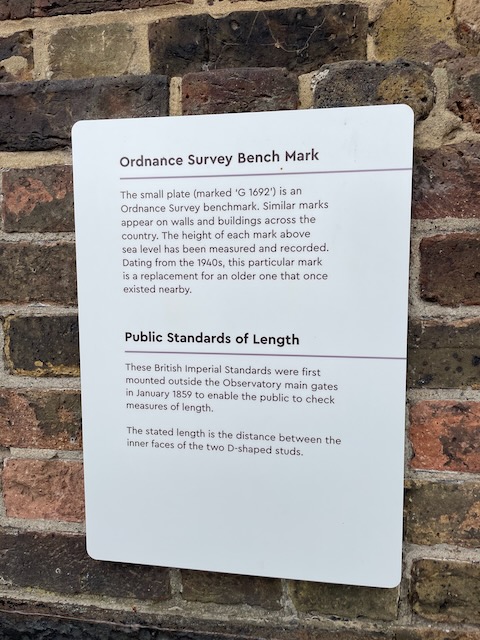
The Royal Observatory was designed by architects Christopher Wren and Robert Hooke, and it opened in 1676. Most notably, it is the “home” of Greenwich Mean Time, about which there is much of interest to note (Thanks, as always, to Wikipedia, to which I donate regularly and hope you do as well):
Greenwich Mean Time (GMT) is the local mean time at the Royal Observatory in Greenwich, London, counted from midnight. At different times in the past, it has been calculated in different ways, including being calculated from noon;[1] as a consequence, it cannot be used to specify a particular time unless a context is given. The term GMT is also used as one of the names for the time zone UTC+00:00 and,[2] in UK law, is the basis for civil time in the United Kingdom.[3][a]
Because of Earth’s uneven angular velocity in its elliptical orbit and its axial tilt, noon (12:00:00) GMT is rarely the exact moment the Sun crosses the Greenwich Meridian[b] and reaches its highest point in the sky there. This event may occur up to 16 minutes before or after noon GMT, a discrepancy described by the equation of time. Noon GMT is the annual average (the arithmetic mean) moment of this event, which accounts for the word “mean” in “Greenwich Mean Time”.[c]
On the Prime Meridian: Mary in the Eastern Hemisphere, Arnie in the Western one.
A prime meridian is an arbitrarily-chosen meridian in a geographic coordinate system at which longitude is defined to be 0°. Together, a prime meridian and its anti-meridian form a great circle. This great circle divides a spheroid, like Earth, into two hemispheres: the Eastern Hemisphere and the Western Hemisphere. For Earth’s prime meridian, various conventions have been used or advocated in different regions throughout history. Earth’s current international standard prime meridian is the IERS Reference Meridian. It is derived, but differs slightly, from the Greenwich Meridian, the previous standard.[2]
(Note: The IERS Reference Meridian is so close to the Greenwich Meridian that even though I’m not sure which one we were standing on, it is a difference that makes much more difference to an astronomer than a fiction writer.)
On our way back down, we did a tour of the Queen’s House, a former royal residence that now contains an art collection. We strolled past the Cutty Sark, which was one of the last and fastest clippers to sail the seas before the advent of steamships, but decided not to tour that: by then, we were more than ready to catch our return “cruise” back to central London.
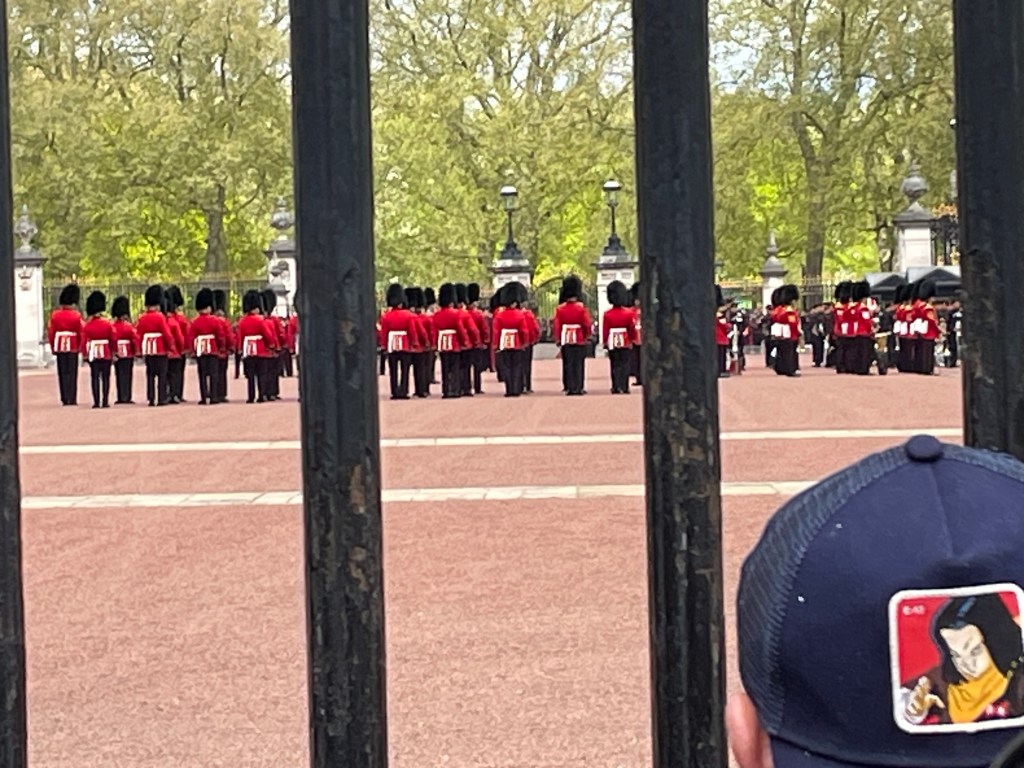
We decided to start this day with a stroll past Buckingham Palace. It seemed only proper to drop by the Royal Domicile since we were in London, whether or not the Monarch Himself was at home. (He wasn’t.) However, we did not realize until we got there that the Palace’s ceremonial Changing of the Guard takes place on Mondays, Wednesdays, Fridays and Sundays at 11 a.m. (I am not sure what happens to the guards on duty the other days of the week, but I presume they are changed in some other, quieter way.) Since we’d arrived at exactly 11 a.m. on a Wednesday, the entire area was jammed with people. We could get nowhere near the Royal Edifice until the event was over, which took about an hour. There were times when we common folk were packed together to an almost alarming degree, but I believe that all of us survived.
We’d have been more than happy to see the Palace without the Changing of the Guard, but it is quite a production and very colourful. And clearly, four times every week, people come from everywhere to see it. Once we’d managed to extricate ourselves, I decided I was glad that we had seen it too.
(Click on photos for bigger images.)
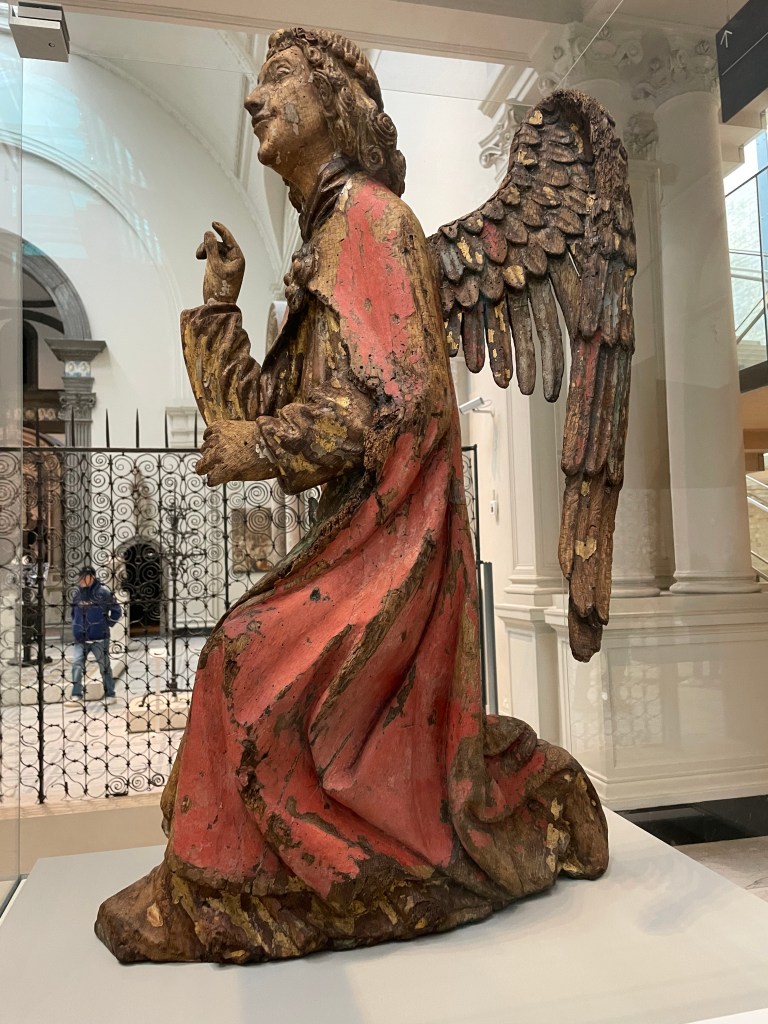
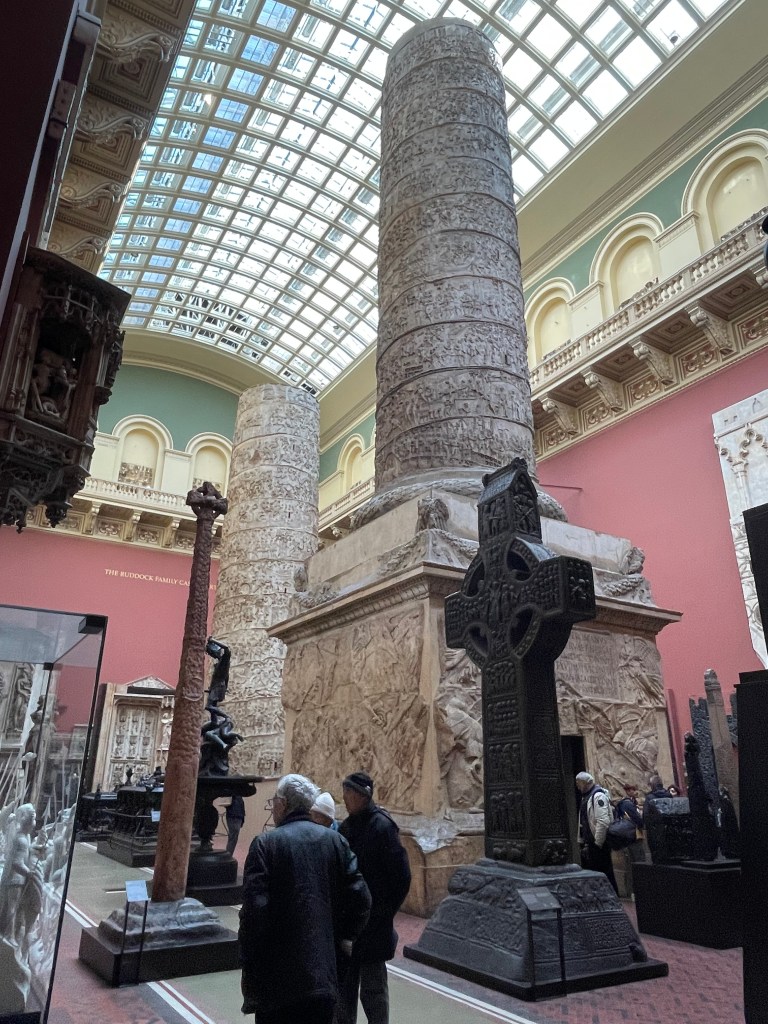
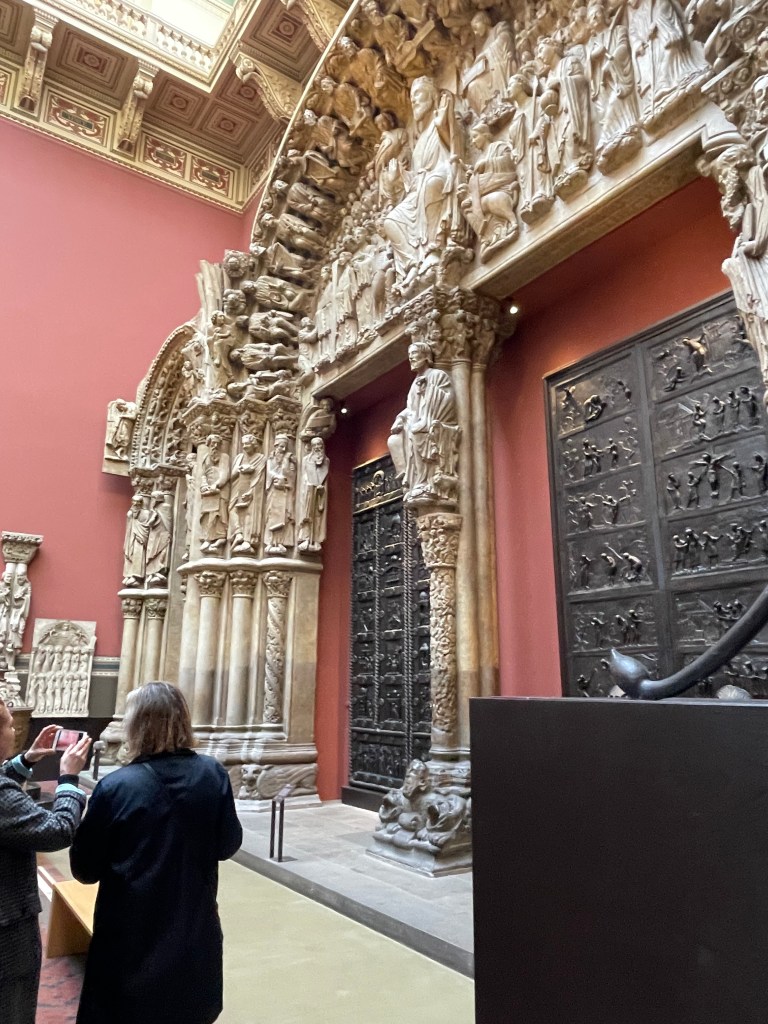
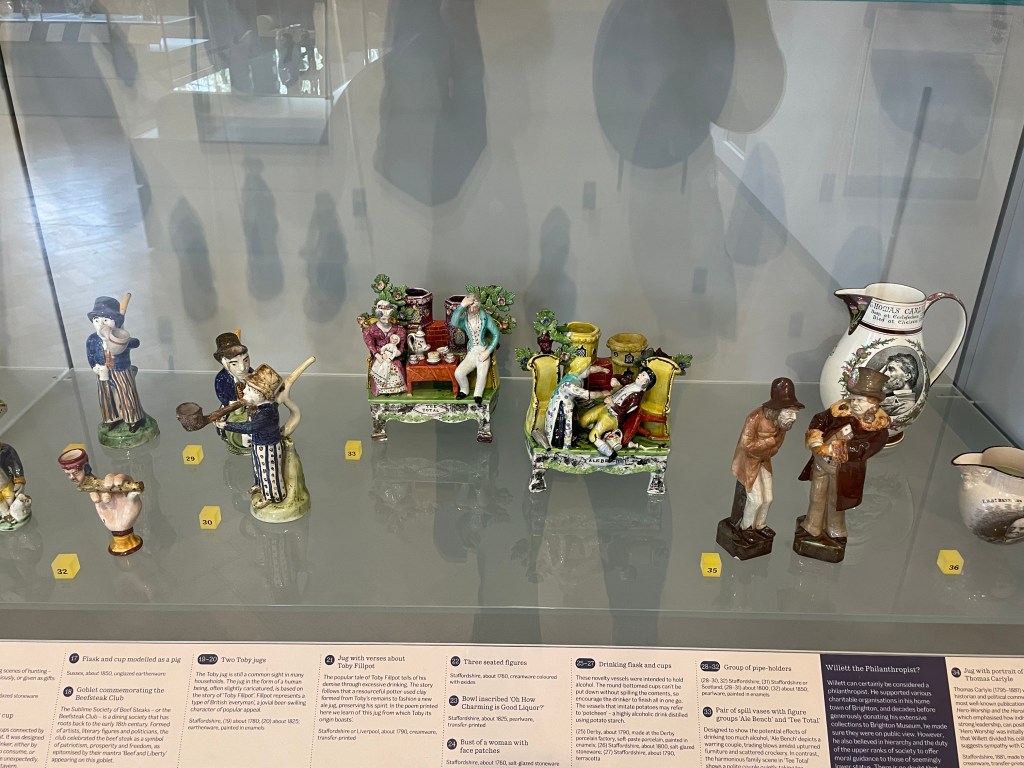
Our next stop was the Victoria and Albert Museum. I’d loved the V&A on my previous visit a couple of decades ago, and I’d seen a notice about a temporary ceramics exhibition that interested me. It was on the fourth level of the Museum, and on our way to and from it we had an opportunity to check out several other works that delighted and amazed us. Here are just a few of them.
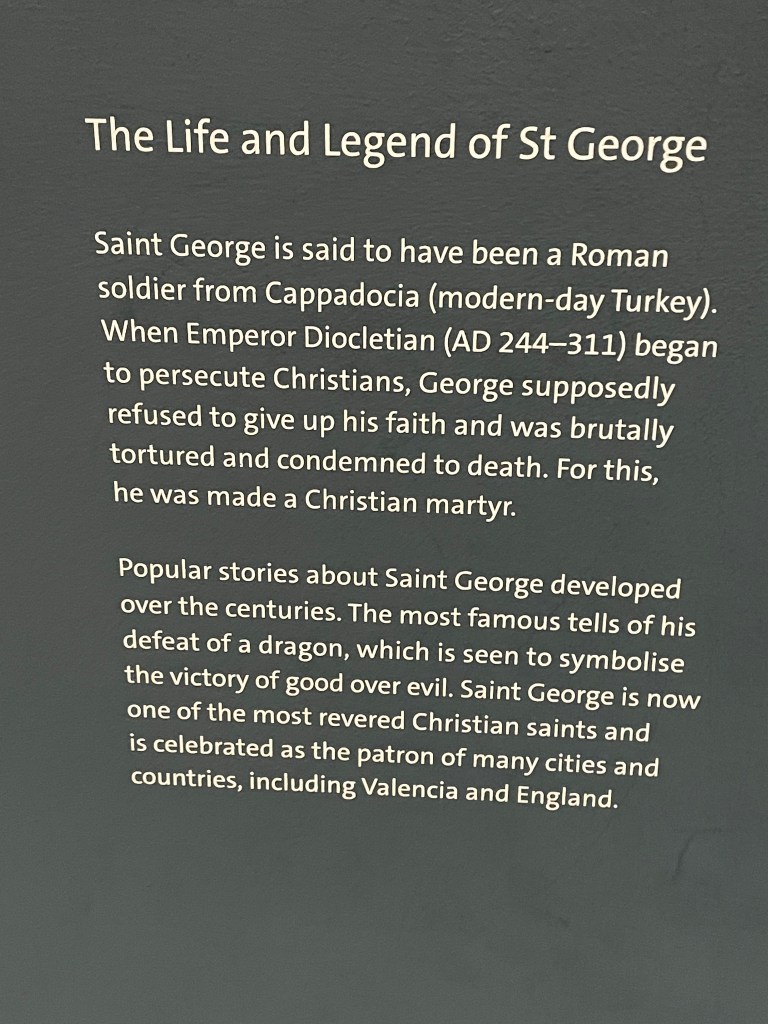
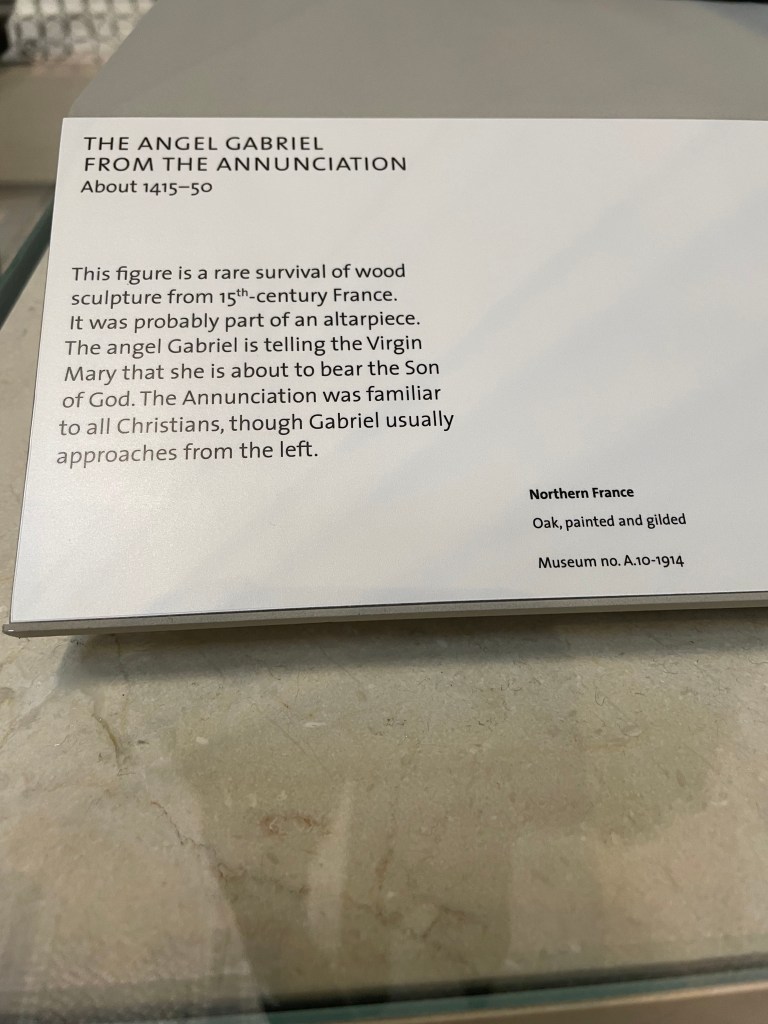
Check out this needlework!An Esther tapestry at the V&AAlterpiece of St. George (patron saint of England and several other places)I loved this. See next photo for descriptionReally big sculptures!Inside one of the casts
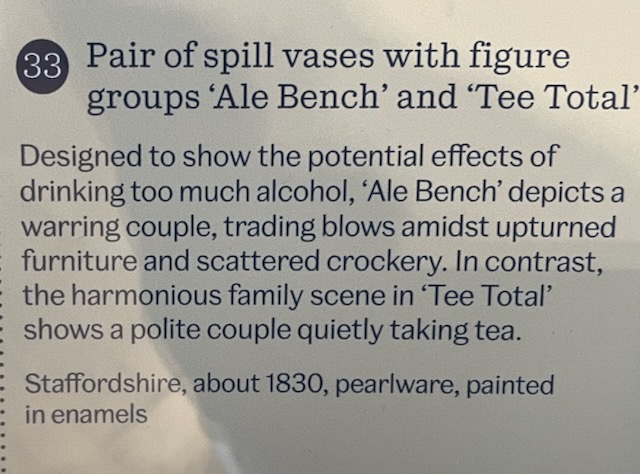
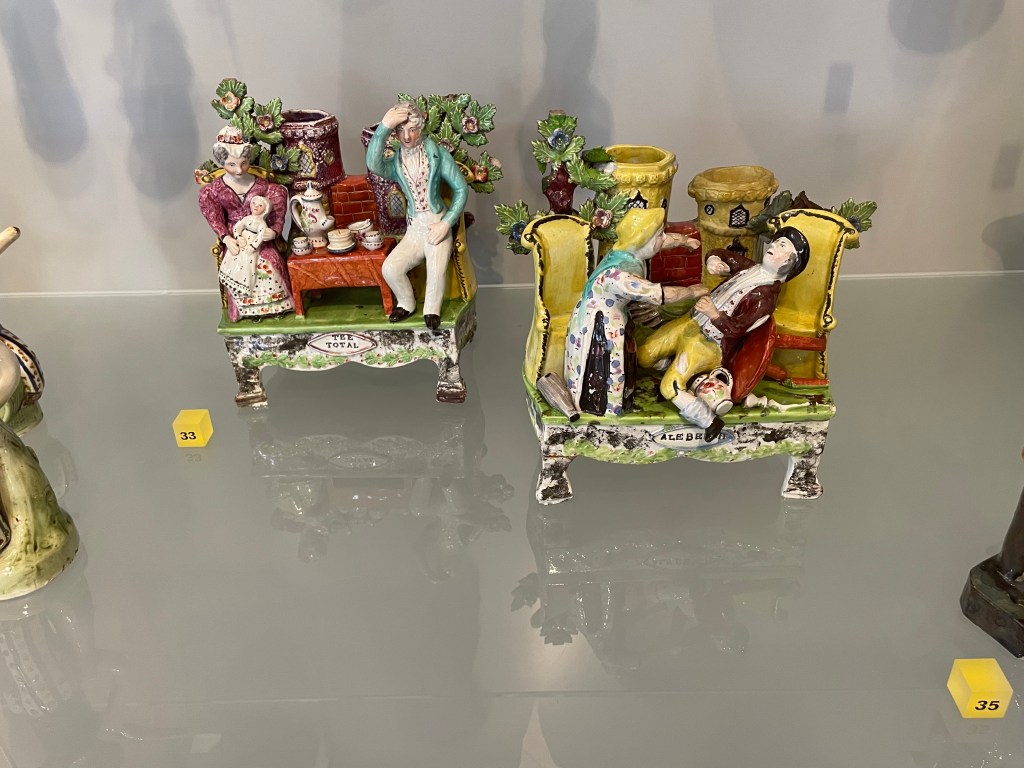
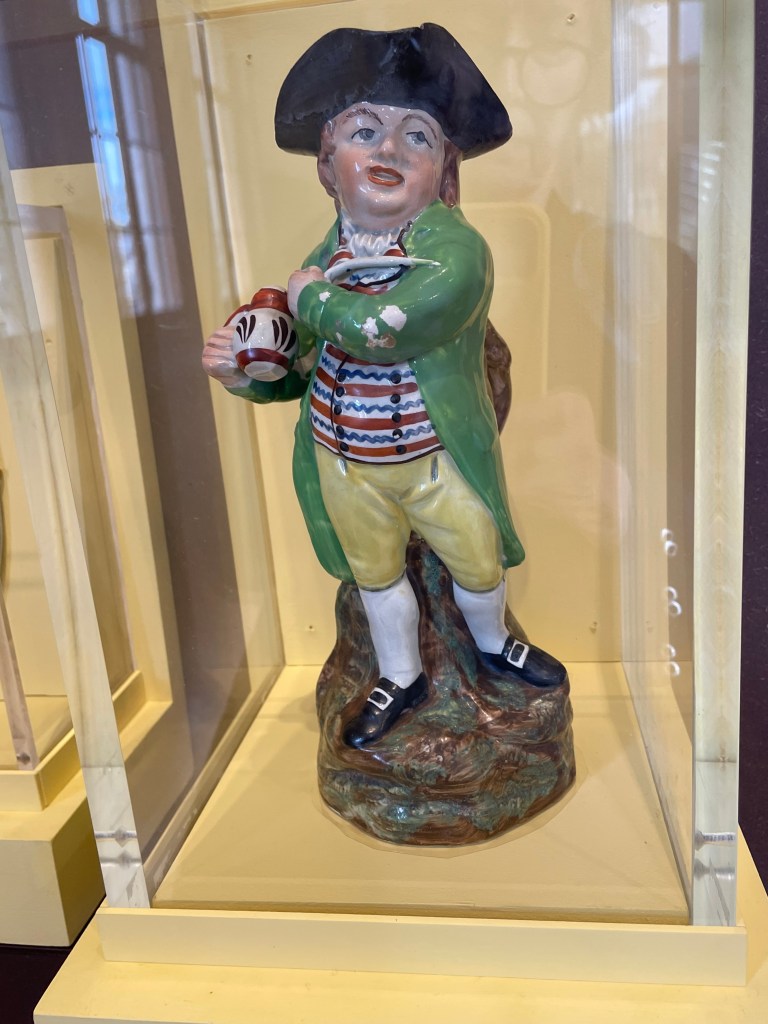
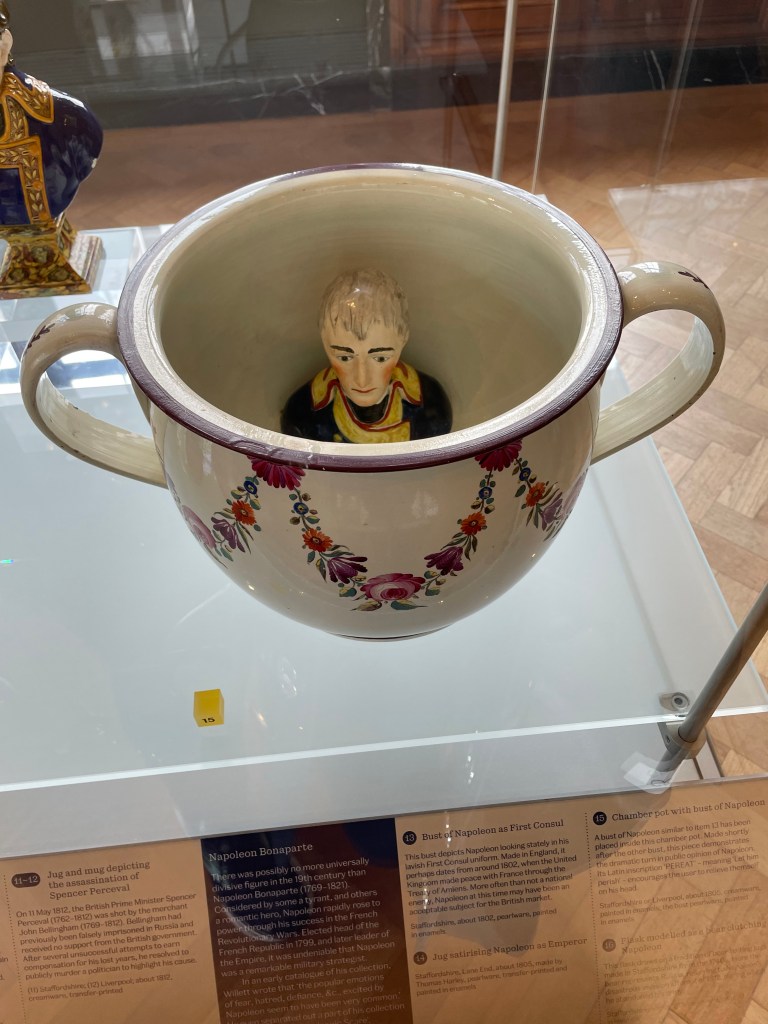
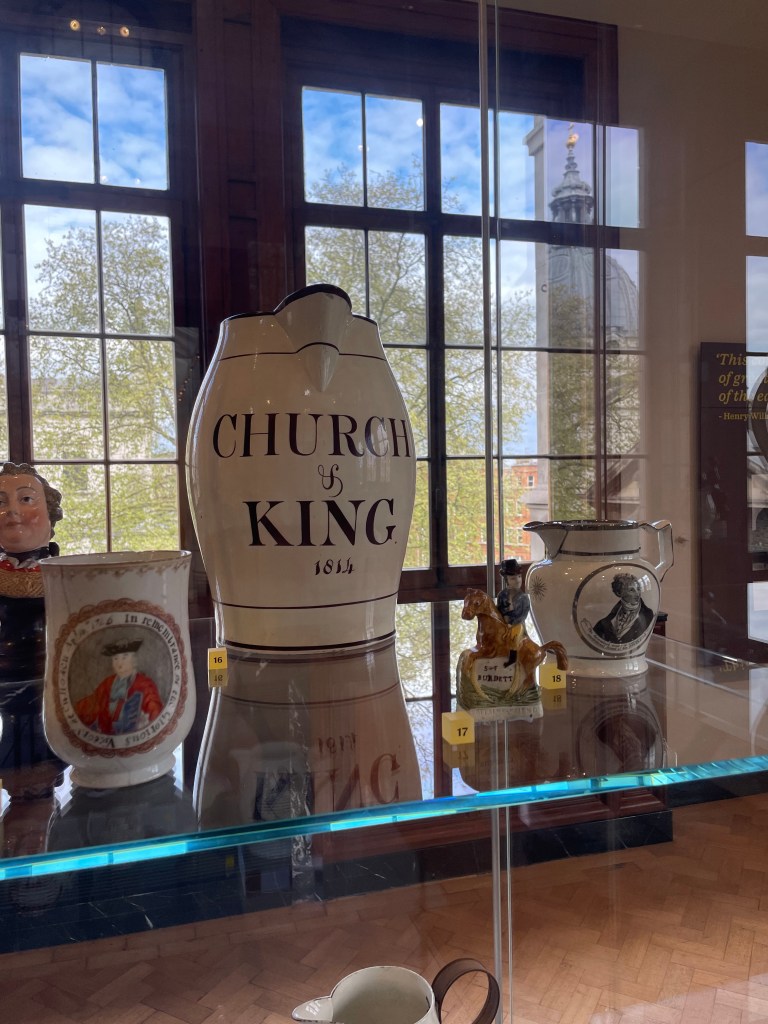
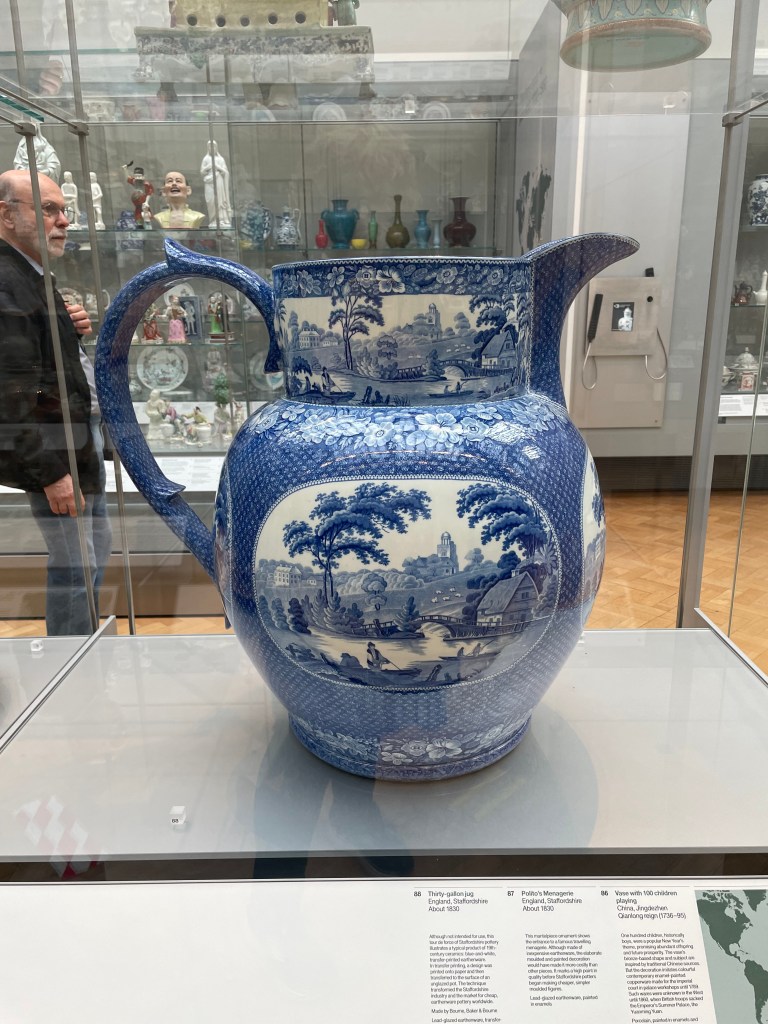
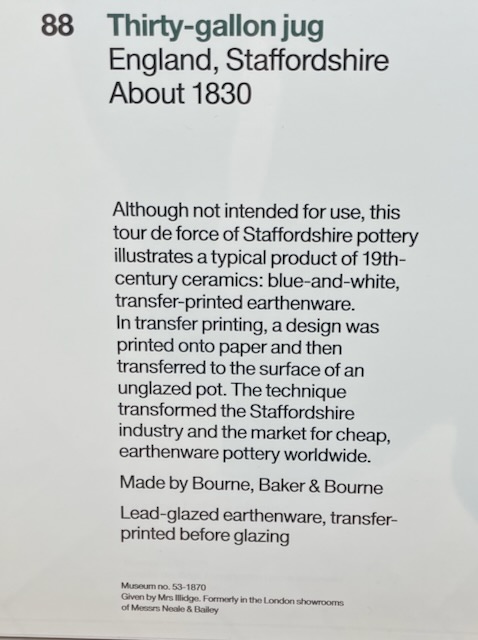
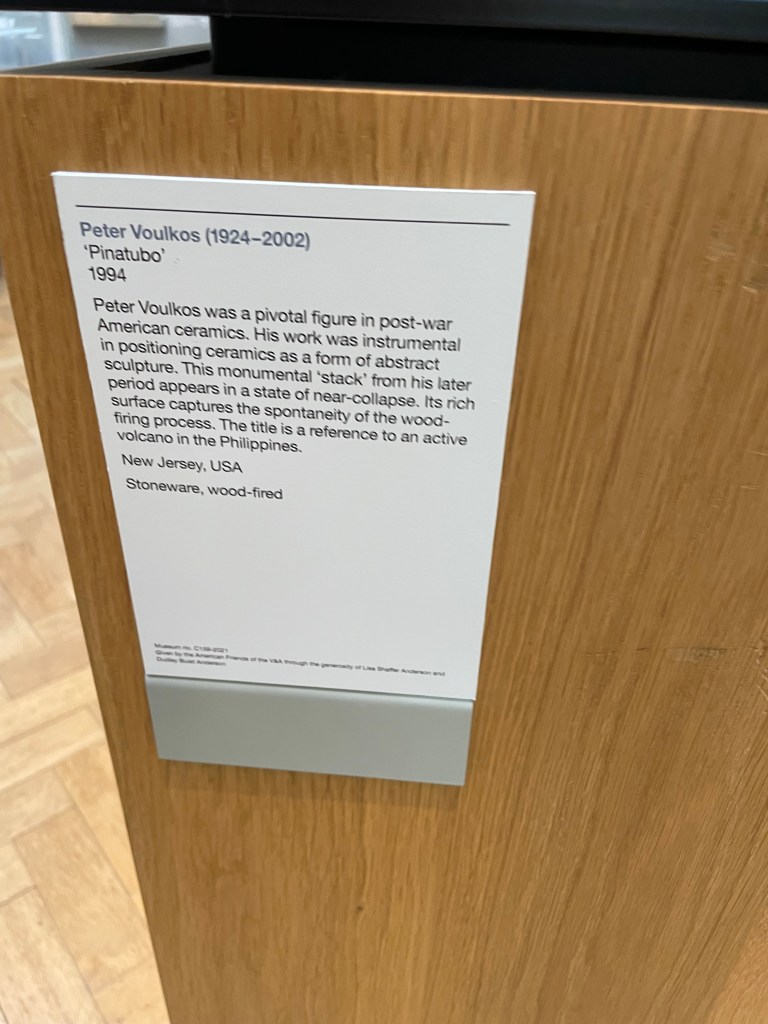
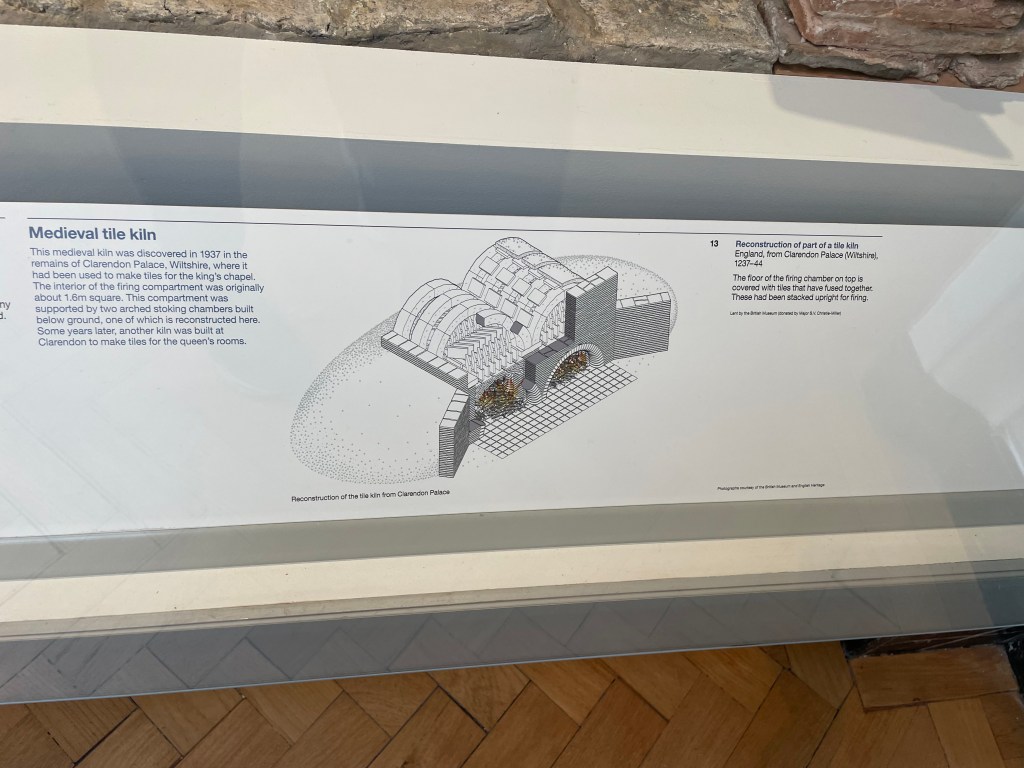
The ceramics show I wanted to see was entitled “Henry Willett’s Collection of Popular Pottery.” (How could a person resist that appealing title?) I am including the explanatory sign about the exhibition, which was as charming as it sounded. It included dozens of intriguing pieces that Willett had collected from “cottage homes” around England in the late 1800s.
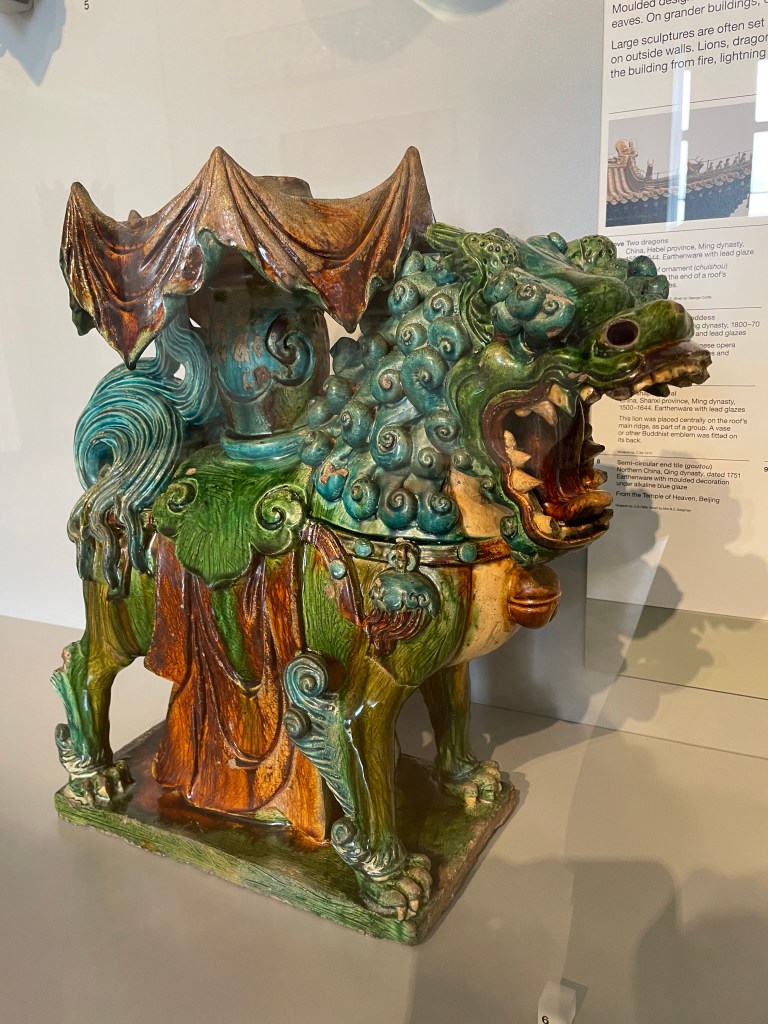
There are a whole lot of other interesting pieces in the Museum’s permanent ceramics collections. In fact, according to the V&A website, “The V&A’s Ceramics collections are unrivalled anywhere in the world. Encyclopaedic and global in scope, they encompass the history of fine ceramic production from about 2500 BC to the present day.” If only we’d had a week, just for this one museum… or even perhaps just for this one set of collections in this one museum.
The view from the top floor of the V&A was lovely, as was the architecture in the streets surrounding the museum.
Arnie on two phones in a phone booth
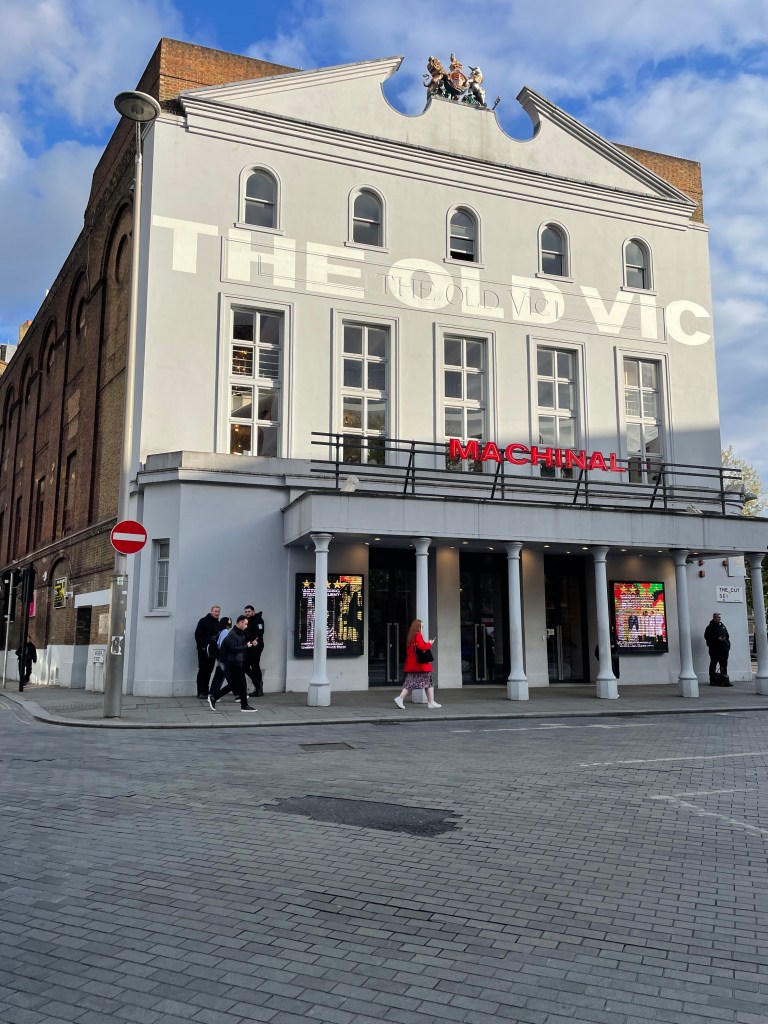
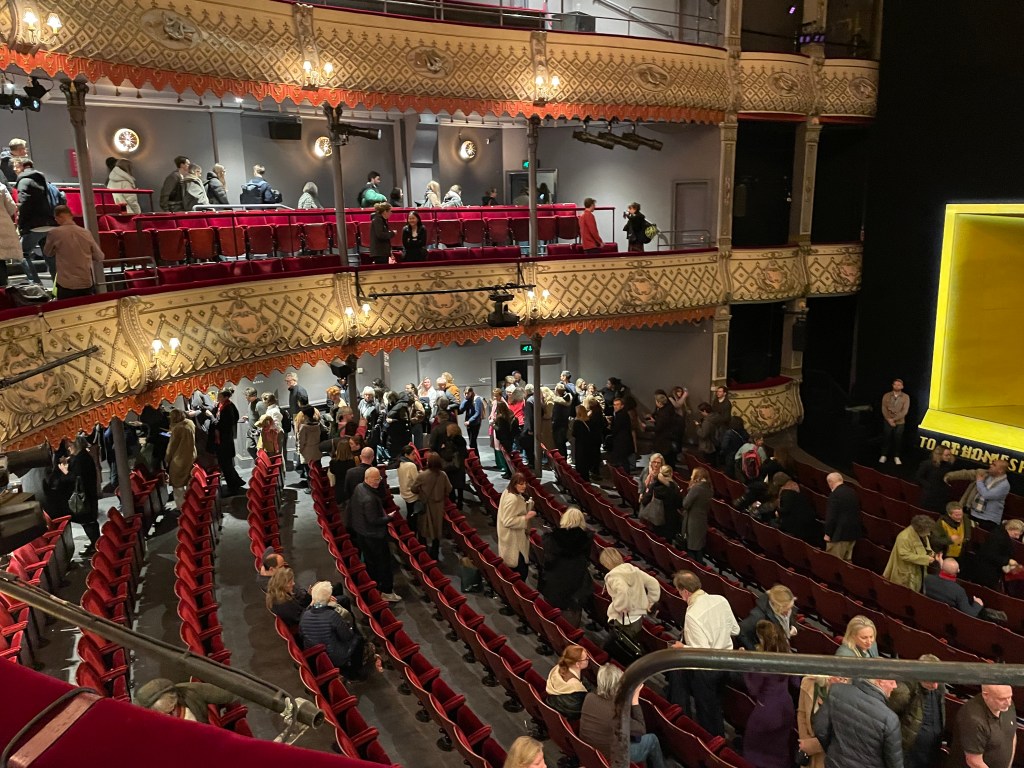
We made our way from the Victoria and Albert just in time to have a delicious sourdough-crust pizza at one of outlets in the excellent Franco Manca pizzeria chain, before taking in a really impressive play entitled Machinal at The Old Vic Theatre. It was a thrill to be in a theatre that I have read about so often in books, articles and reviews over the years. The quality of the production was a (not-unexpected) bonus: how could it be anything but excellent if it was at The Old Vic? (No need to answer this question if you attend the place regularly.) Machinal has a lyrical, devastating script, and the cast was outstanding. I was also taken with the totally offbeat stage design. If the play ever comes to Toronto, or appears in a broadcast somewhere accessible to me, I’m definitely going to see it again.
So that was quite a day. While we were gadding about (or in my case, limping about), according to my watch we added 18,250 steps to our walking total, and 11 flights of stairs.
On our first full day in London, we headed down to the City (did you know that the area of the actual City of London is only one square mile? The rest of the megalopolis is made up of 32 boroughs). The Underground stop where we resurfaced (not coincidentally named “Monument”) was located right next to the memorial to the Great Fire of London. Between September 2 and September 5, 1666, this blaze destroyed “13,200 houses, 87 parish churches, The Royal Exchange, Guildhall and St. Paul’s Cathedral” (London Fire Brigade). The conflagration may also have brought an end to the Great Plague, but that is just a theory; many think the plague was already drawing to a close when the fire broke out. Whatever the case, it is clear that for most Londoners, 1666 was not a good year.
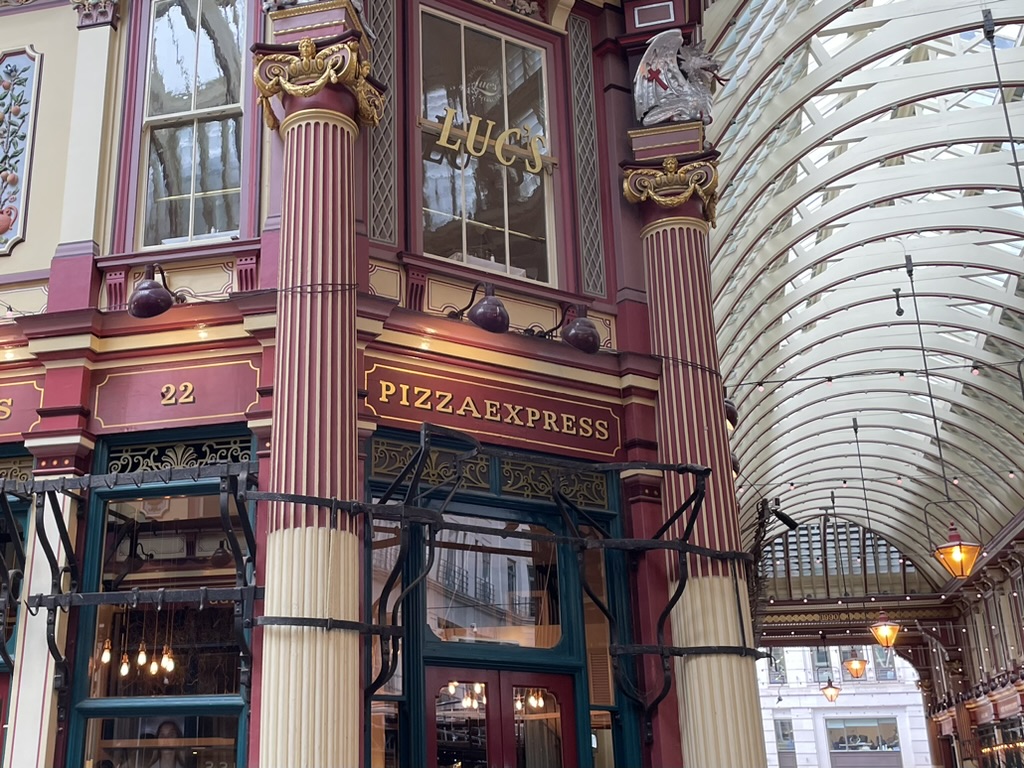
Our actual destination on that morning was the Leadenhall Market, which was used for the filming of the Diagon Alley scenes in the first Harry Potter movie. It is a fun market to walk around, and our visit was made even more interesting by the presence of two mounted police officers on beautiful horses, and a group of men in costume who were there to celebrate the Feast Day of St. George.
April 23, the presumed anniversary of St. George’s death, is celebrated not only in England but in several other countries and cities that have claimed St. George as their patron saint.
Door used as entrance to the Leaky Cauldron
After a second short trip on the Underground, we reached Westminster where we stopped briefly at the Church of St. Martin in the Fields before heading in to The National Gallery. There, we were particularly interested in a special exhibition entitled The Last Caravaggio, which included just two paintings, rare related documents, and explanatory text. Caravaggio’s last painting is “The Martyrdom of St. Ursula” and another of his later works, “Salome receives the Head of John the Baptist” was also on display. (This was of additional interest to us as we were going to see the Strauss opera Salome when we got to Paris). A lot of North Americans have become a bit obsessed with the works of Michelangelo Merisi da Caravaggio (1571-1610) after watching the outstanding recent Netflix series Ripley, and it seemed that patrons of the National Gallery were similarly intrigued: the line to get into the small exhibition extended down a corridor and then a long stairway to the lower floor of the gallery, and then along another hallway for a considerable distance. Everyone was very patient, and the line moved relatively quickly.
We took in paintings by a few other artists while we were at the National Gallery, then walked through Trafalgar Square and out onto Whitehall.
NCkaude Monet, Water-LiliesGustav Klimt, Portrait of Hermine Gallia Guess.Georges Seurat, Bathers at Asnières
There we ran into another, much larger group of St. George’s Day enthusiasts, already well into their cups at 4 p.m. or whatever it was and growing rowdier by the minute, surrounded by police officers on foot and horseback, and vans containing dozens more. We saw people being arrested and heard the whiz of beer bottles before they crashed into the pavement, so after taking a few photos we decided to move on. A woman I spoke to outside a restaurant confirmed my suspicion that the crowd of drinkers was mainly far-right protestors who are mad at the government, rather than average citizens celebrating the feast of England’s patron saint.
At the end of Whitehall we found Big Ben (aka “The Great Bell of the Great Clock of Westminster”), shiny and magnificent after its four years of being cleaned and repaired (2017 to 2021), and we caught our first sight of the famous “London Eye” or Millennium Wheel. If we’d felt the urge to go for a ride on it, which we didn’t, we’d have needed to invest at least £42 each, or about $70 Canadian. I’m sure it was worth that much if a person were so inclined, as the capsules look to be quite spacious, the wheel moves quite slowly, and the views at the top must be splendid.
[Note: In the past I have tried to write my travel blogs as I’ve been travelling. This has always been difficult because it takes time to write down what you want to say in the way you want to say it, and sometimes there just isn’t the time or energy to do that in addition to the enjoying the trip. I usually ended up finishing the series of posts after I got home to Canada. This time I decided to write the entire blog after the trip was over. Here is the first instalment of what will eventually be… quite a few. Facebook friends will have seen some of these photos and a few of my thoughts on our trip already, as I couldn’t completely resist the urge to share while we were away.]
We departed from Toronto for London, England at 8:30 p.m. on Sunday, April 21 and arrived without incident (!) at about 9 a.m. on Monday April 22. Of course in our heads, it was still late on the 21st so we took it fairly easy the first day, having a nap after we’d checked in, and then wandering about our new neighbourhood to get our bearings.
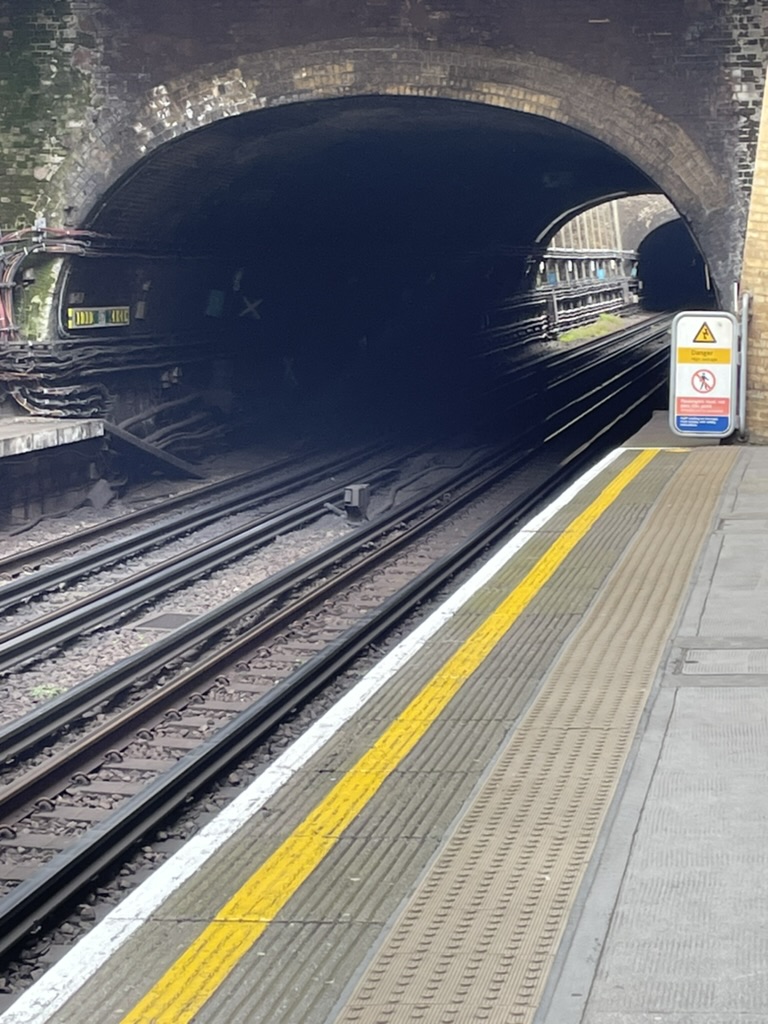
Our hotel was in one of dozens of boutique hotels and apart/hotels that have been made out of what appear to have previously been adjoining apartment buildings on a street called Sussex Gardens, about five blocks from Paddington Railway Station and the Paddington Underground Praed Street Station. I would stay in that area again anytime: there are many many excellent and reasonable restaurants with a wide range of ethnic (and veg-non-veg) options in the area, the people are friendly and helpful (used to dealing with tourists), there’s a laundromat, a grocer, and convenience stores nearby and the Underground links the neighbourhood to anywhere in London you want to go, promptly and efficiently.
The hotel room was reasonable because it was small, which might make it tricky if you had children with you, or had to spend any significant time in the room, but it was fine for a couple that was mainly using it to sleep and shower between adventures. The staff of the Orchard Hotel was friendly and helpful but the establishment offered the worst breakfast buffet we’ve encountered anywhere in the world: no fresh fruit or juice at all, and no fresh coffee (instead serving instant made in advance in large pots). No hot food either, just cheese and bread and sliced meats and boiled eggs. But considering the price of the hotel comparatively speaking, the fact that we ate such wonderful food the rest of the day, and our awareness (constantly sharpened by the sight of tents and destitute humans throughout the city) that lots of people don’t even have as much as we did for breakfast, we survived just fine.
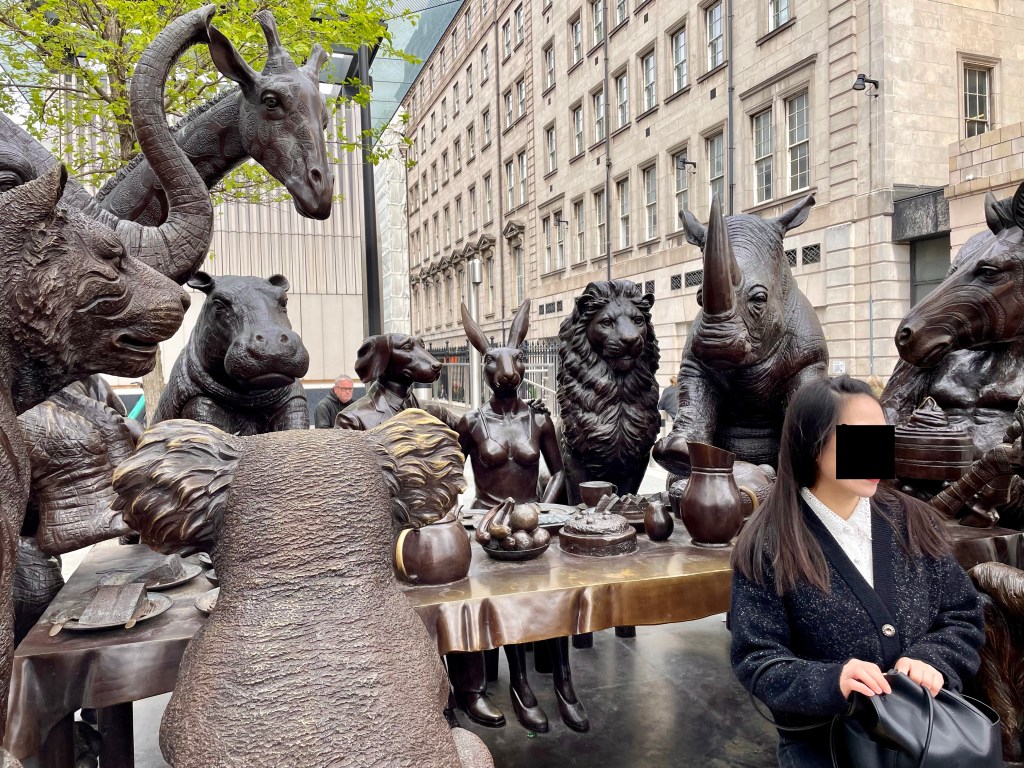
In Paddington, I was intrigued by the street art. In one (apparently temporary) installation that dominates the square outside the railway station, a very large group of twelve brass animals dine together – with a couple of seats left open in case you’d like to join them. According to Londonist, this is the work of Gilli and Marc and is entitled “Wild Table of Love.”
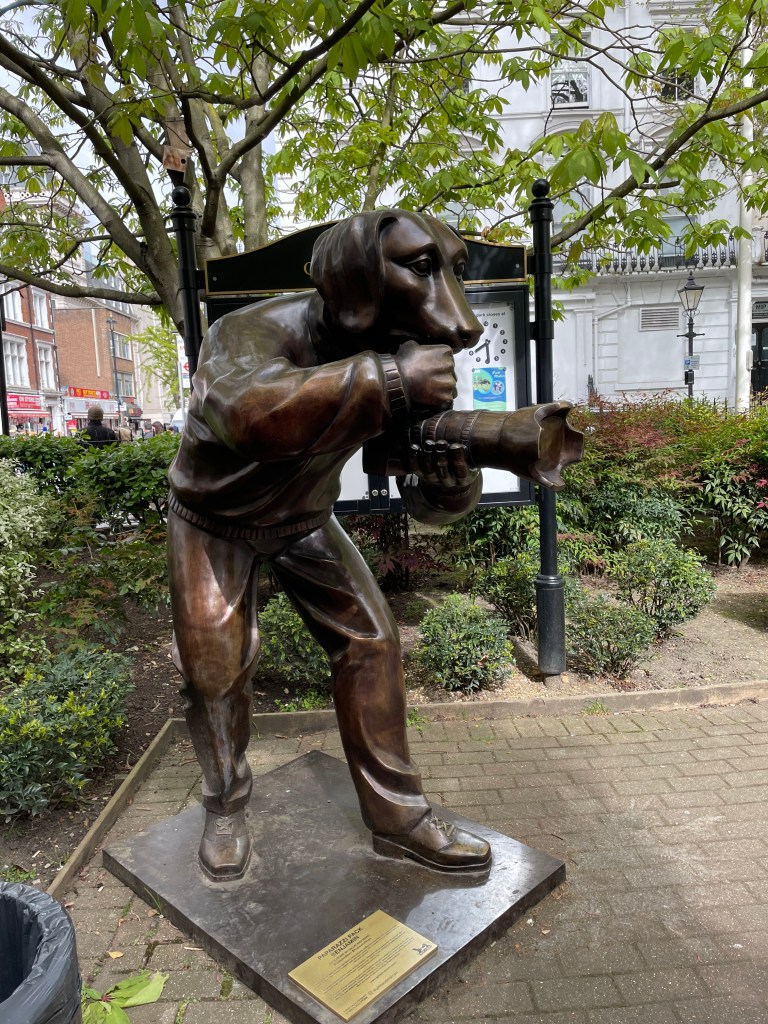
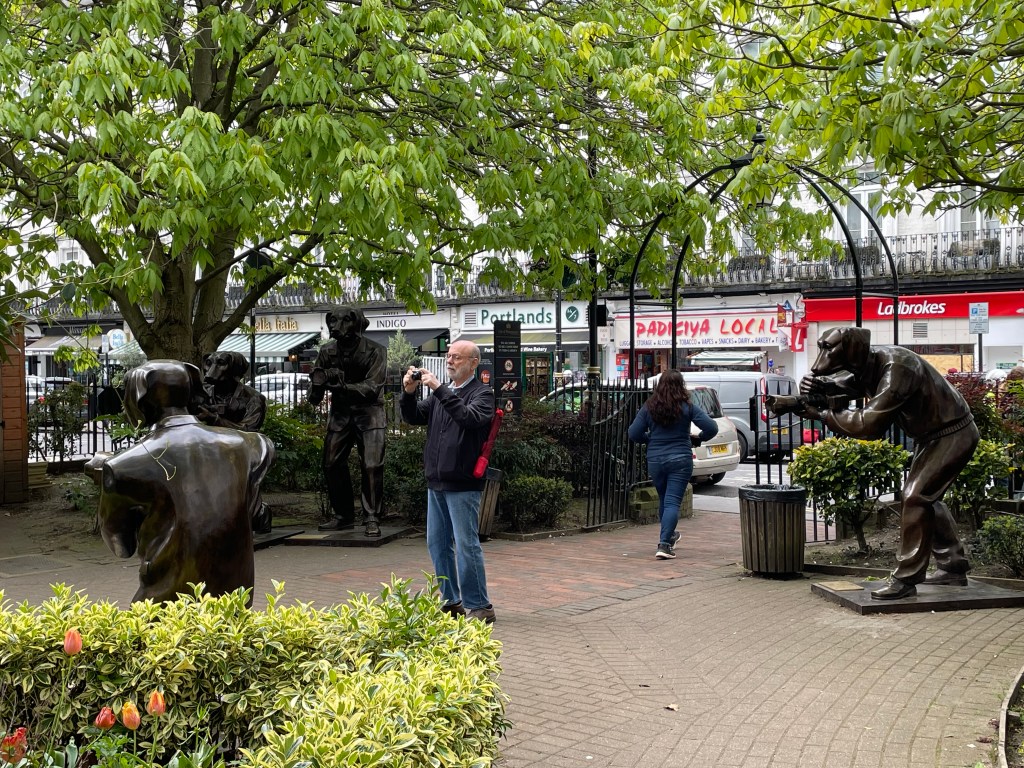
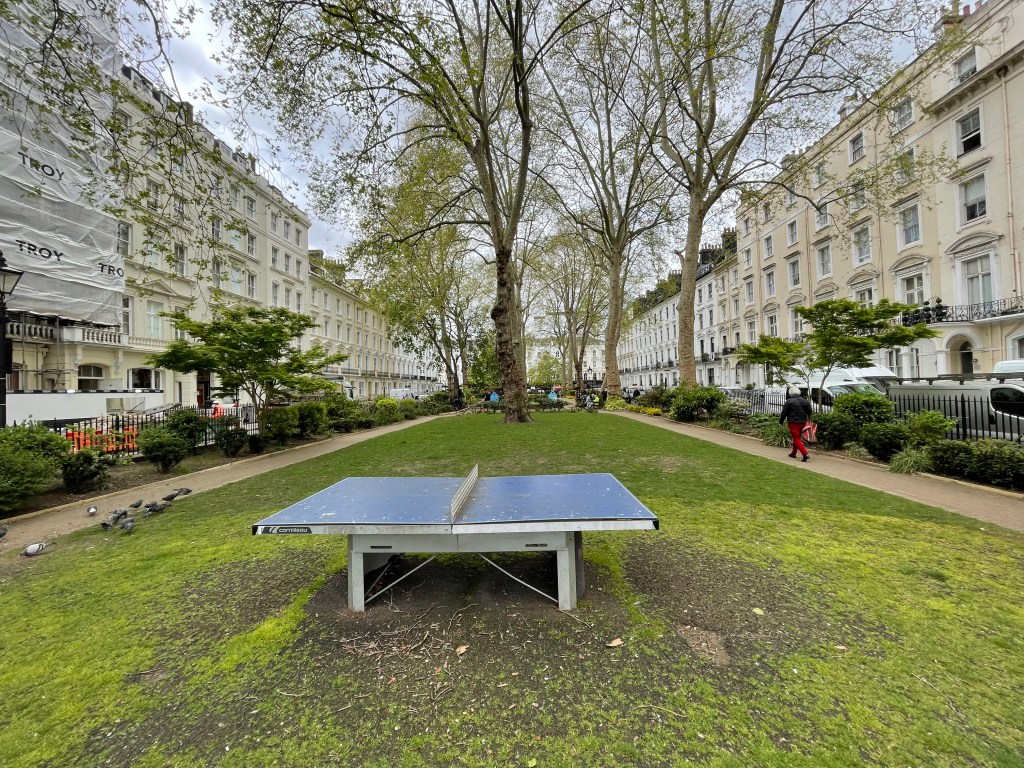
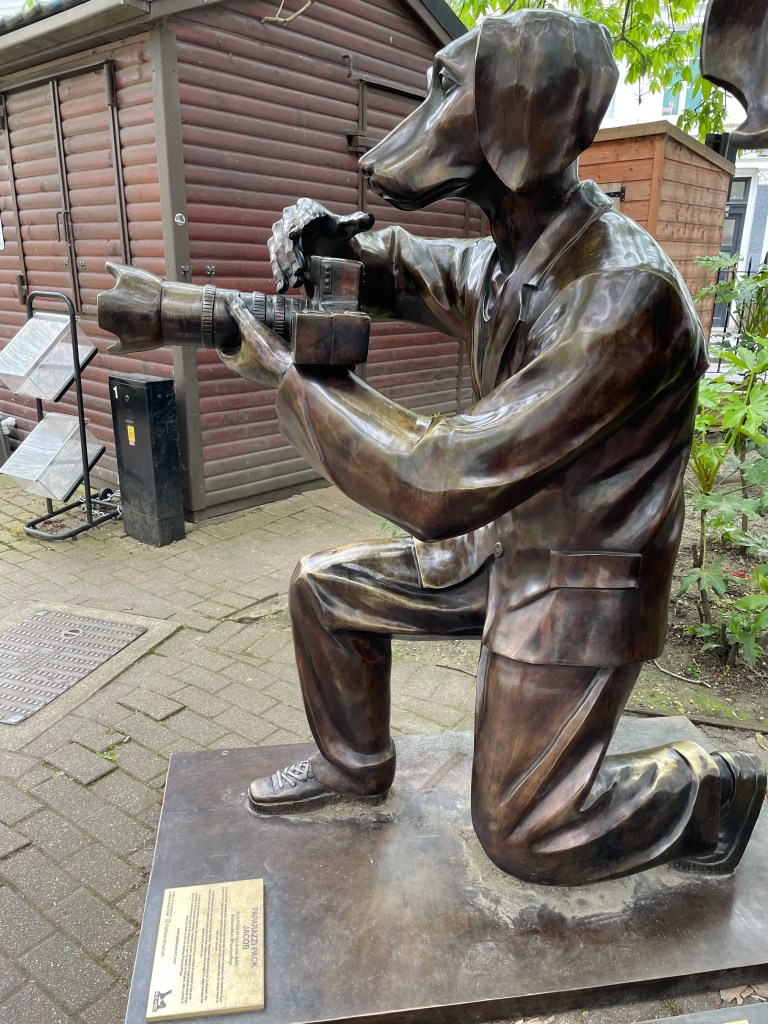
A bit closer to our hotel, in a long cozy park with a ping-pong table, we found another instalment by Gilli and Marc of brass animal sculptures – dogs this time – entitled Paparazzi Pack.
And then near the end of our stay in Paddington I noticed for the first time an animated (but accurate) clock that appears to have a person inside it, cleaning and repairing it and peering out at passersby. It was great fun to watch.
Having sussed out our immediate “home” surroundings for the next ten days and secured SIM cards for our phones (primarily so we could communicate with one another when we got separated, as we inevitably do), we had a solid sleep and were ready to really begin our adventure on Tuesday morning.
As I move closer to fulfilling my years-long resolution to finish reading the entire 1.3-million-word novel In Search of Lost Time (ISOLT) by Marcel Proust, I considered it a lovely coincidence that a couple of weeks ago, I came across an extended passage in the book that intersected with my own life at that very moment – and not in just one way, but in two.
Volume I, published in 1996, which I purchased many years ago.
For about fifteen years, I have been perusing the seven parts (contained in six volumes) that make up Proust’s monumental opus, at the rate of one thick tome every three or four years. Clearly I was not so gripped by his writing that I felt compelled to read the entire novel in one sitting, but neither was I ever reluctant to pick it up again. Last month, I decided that the weeks in advance of my first-ever trip to France – which will be occurring around the start of May – were the perfect time to start reading the one volume I still hadn’t read.
In Search of Lost Time proceeds at an extremely leisurely pace and, fortunately for people like me, the final volume comes with a synopsis of the volumes that came before, along with an index to real and fictional characters and places appearing in the book. Since I started ISOLT, I’ve come to think of reading it as a way of life, rather than an event: it is always there waiting for me when I want it. It has occurred to me that finishing it might not augur well for my own longevity – what reason will I have to go on? – but then I remembered that I can always start the book again. It is, after all, a story that was prompted by the main character’s recollection of his childhood, a recollection that was in turn prompted by the taste of a madeleine. Not to get too meta, but who is to say that some event or scent or view may not, at some point in the future, prompt me to start the entire book from the beginning?
I have been enchanted enough by In Search of Lost Time that the many sights I want to see when we go to France this year include several locations that have become familiar to me thanks to Proust. He gave a number of his locations fictional names but his book is so widely known and respected that one town, Illiers, even renamed itself “Illiers Combray” in recognition of its role as model for the fictional town of Combray, where Proust’s protagonist (M.) grew up. Other locations that provided settings for various events in Proust’s novel are easy enough to find: Balbec, the seaside resort in Normandy, where much of Volume II (which I read under the title Within a Budding Grove; titles of the different volumes change depending on the translator) is set is actually Cabourg.
In Paris, the setting for much of ISOLT, there will be many things to see that are non-Proust-related. But I’ll be getting in touch with him there as well. (I have been told that that I must see the Carnavalet Museum in that city where Proust’s bedroom has been recreated, including the bed in which he wrote much of the novel.) All in all, reading the concluding volume of the book before I went to France became imperative.
So imagine my pleasure to come upon a passage in Volume VI which seemed almost presciently relevant to my life. To start with, I was reading it in the days immediately prior to March 9, when we turned the clocks forward for daylight saving time this year. In those few days, Facebook was alive with opinions about the impending devastation the upcoming time change would wreak on mental and physical health and/or the joys of longer evenings (opinions varied depending on the constitution, the age, and the employment status of the person posting). But secondly, due to our forthcoming trip, as I read I was thinking about Paris more personally than usual – for example, wondering how far the Hotel de Paris Invalides, where we will stay for part of our visit, might be from certain locations Proust mentions.
Then I came upon this:
I had gone on walking as I turned over in my mind this recent meeting with St. Loup and had come a long way out of my way; I was almost at the Pont des Invalides. The lamps (there were very few of them, on account of the Gothas[1]) had already been lit, a little too early because “the clocks had been put forward” a little too early, when the night still came rather quickly, the time having been “changed” once and for all for the whole of the summer just as a central heating system is turned on or off once or for all on a fixed date; and above the city with its nocturnal illumination, in one whole quarter of the sky – the sky that knew nothing of summer time and winter time and did not deign to recognize that half past eight had become half past nine —in one whole quarter of the sky from which the blue had not vanished, there was still a little daylight. Over that whole portion of the city which is dominated by the towers of the Trocadéro, the sky looked like a vast sea the colour of turquoise, from which gradually there emerged, as it ebbed, a whole line of little black rocks, which might even have been nothing more than a row of fishermen’s nets and which were in fact small clouds – a sea at that moment the colour of turquoise, sweeping along with it, without their noticing, the whole human race in the wake of the vast revolution of the earth, that earth upon which they are mad enough to continue their own revolutions, their futile wars, like the war which at this very moment was staining France crimson with blood. But if one looked for long at the sky, this lazy, too beautiful sky which did not condescend to change its timetable and above the city, where the lamps had been lit, indolently prolonged its lingering day in these bluish tones, one was seized with giddiness: it was no longer a flat expanse of sea but a vertically stepped series of blue glaciers. And the towers of the Trocadéro which seemed so near to the turquoise steps must, one realized, be infinitely remote from them, like the twin towers of certain towns in Switzerland which at a distance one would suppose to be near neighbours of the upper mountain slopes.
Time Regained, In Search of Lost TimeVolume VI by Marcel Proust (Mayor, Kilmartin and Enright translation, 1981, 1992)
Volume VI, now underway
In Proust’s world, almost everything is a reminder of something else, and the evening sight described in this passage takes his mind back to a scene one hundred years before (which, of course, he could only imagine, as it happened before his birth), when in 1815 Bonaparte (hoping to build public support for his Charter) filled the Champs de Mars – the very boulevard down which Proust was by now walking, having left behind the Pont des Invalides – with an exotic parade of soldiers in dress uniforms from across Europe.
I have plotted out the Pont des Invalides on a map (a 20-minute walk from our hotel in Paris) and you can be sure that I will be standing “almost at” it and looking toward the Trocadéro one evening during our stay. And I have located the Champs de Mars nearby. Depending on our time and available modes of transportation, this may be the closest I will get to sharing the literal vision of the work that has created so many imagined pictures in my head over these past years. I will report to you on how that goes in a forthcoming series of travel blog posts.
With its lingering passages of description, philosophical ramblings, gossip, snapshots of France at the end of the 19th century, political discourse, conjectures about homosexuality, and artistic musings, Proust’s long novel is more like a stroll in the park with a voluble friend than any kind of tension- or action-driven novel most of us might choose to read to divert our attention today. It is strong on descriptions of everything – people and places in particular become etched in the mind, increasingly familiar as Proust’s world unfolds volume by volume, but his language is beautifully repetitive too, as fully-leaved trees might seem to be when you are driving down a country road. Just as you will note repetitions in phrasing between one sentence and the next in the passage I’ve included above, the events move, for the most part, at such a languid pace that one can lose one’s page location and spend an extensive period of time reading very similar passages until you locate the one you were actually reading last. Proust on an e-reader would be a nightmare, particularly if the bookmark function didn’t work.
That said, if you think that reading Proust’s novel would be too difficult for you, think again. It is very accessible, and very lovely. Granted, it is very long, but “long” does not mean insurmountable (i.e., does not equal “high,” as in the context of Everest, but continues on a stroll-able path at mostly the same altitude). You can read one volume or half of one and leave it at that, or you can read a volume every couple of years as I did. And you can borrow the first one from the library before adding the entire novel to your book collection: something you will definitely want to do, however, if you finish the whole thing. (Bragging rights are important for both Everest and Proust.) Proust is a pleasure that should intimidate no reader.
(Note: Today I learned that Proust’s full name was Marcel Valentin Louis Eugène Georges Proust. No wonder he felt comfortable with using so many words to tell his story.)
✻✻✻✻
I have been pleased with the response to my previous travel blogs (including ones to India, Cuba, Italy and Germany) and hope readers will find material of interest to them this time too, as Arnie and I explore England for ten days and then cross the channel into France. I have never been to France, but have been eager to visit the country since I started learning French – about sixty years ago (??? How did that happen???). I’ve been brushing up on my French with Duolingo and am amazed at how much I remember. Whether I’ll actually be able to speak the language when I reach the country of its origin remains to be seen. When I was in Italy I could remember no Italian, only French.
If you are interested in following along, please sign up (no charge) to get a notice each time I post a new instalment. We depart on April 21, and return on May 11. I’m looking forward to sharing our experiences with my readers.
P.S. I am cross-posting this and the upcoming travel articles on I Am All Write on WordPress and I Am All Write Too on Substack. This is the first step of a process on which I intend to embark upon as soon as I have finished writing my current novel, in which I will discontinue writing fiction for the most part and focus on my blogs – offering free posts at WordPress but monetizing those at Substack.
[1] German bombers, which mainly flew at night. Volume VI, “Time Regained,” takes place during World War I.











































































































 I'm All Write