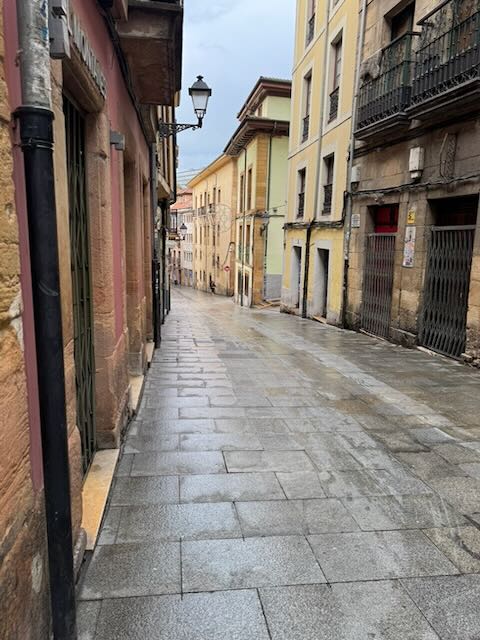
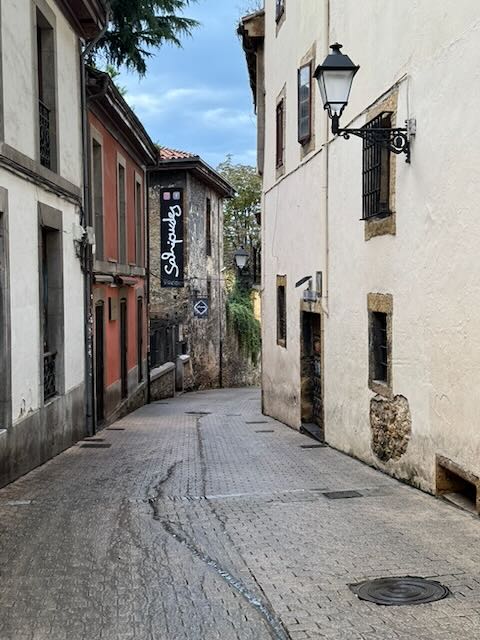
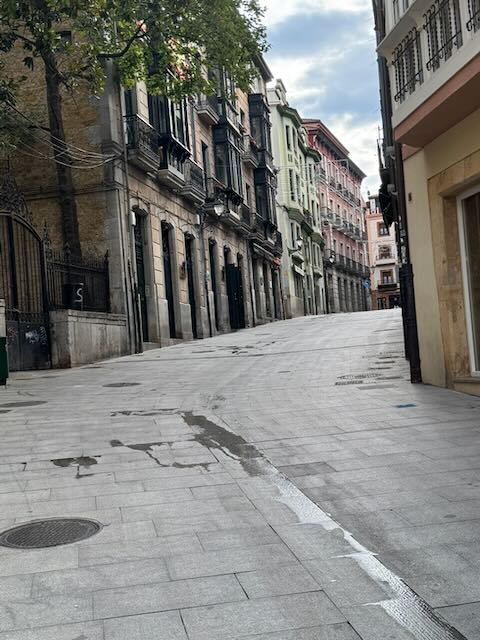
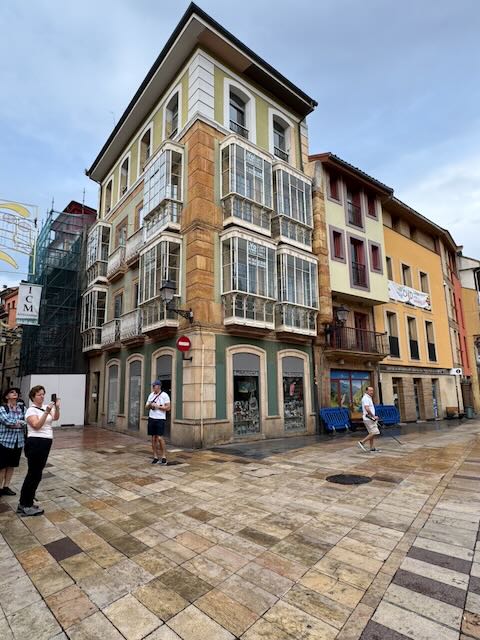
The City of Oviedo, the capital of the autonomous community of Asturias, is notable for several reasons: 1) it was established in the 8th Century, and offers distinctive opportunities to see Romanesque and later medieval architecture; 2) it is the site of more than one hundred open-air statues; 3) it is considered an important stop by pilgrims travelling to Santiago de Compostela (our next destination, too) ; and 4) it may be the cleanest city on the planet.
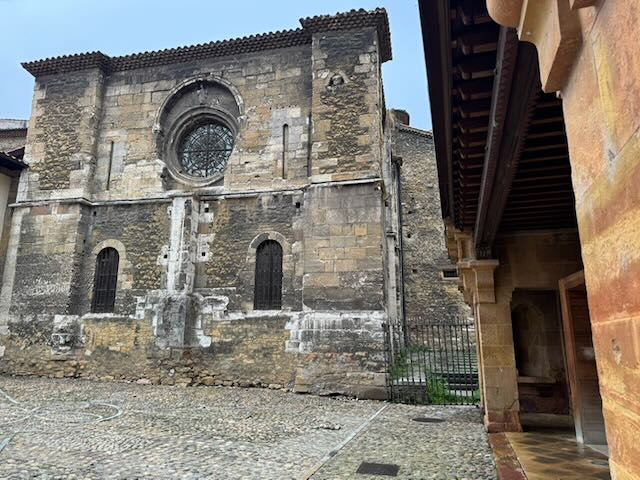
MurallaExtremely old section of the cathedral
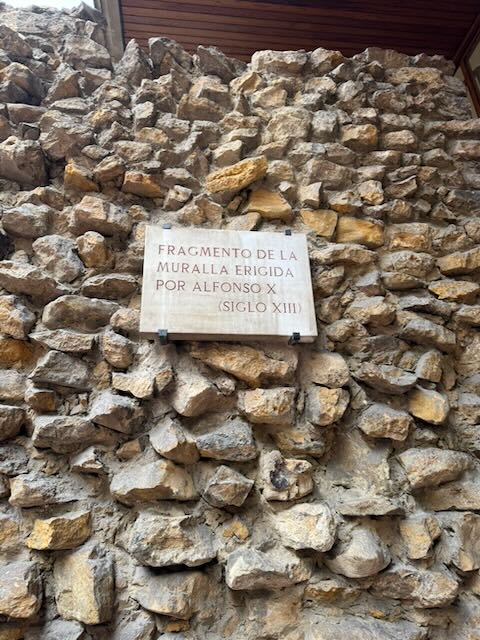
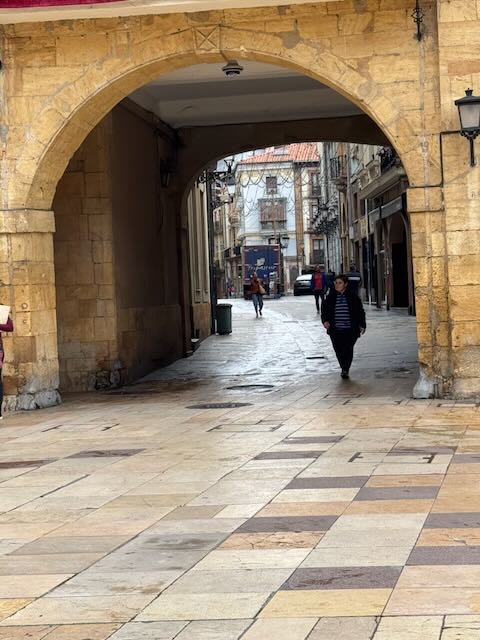
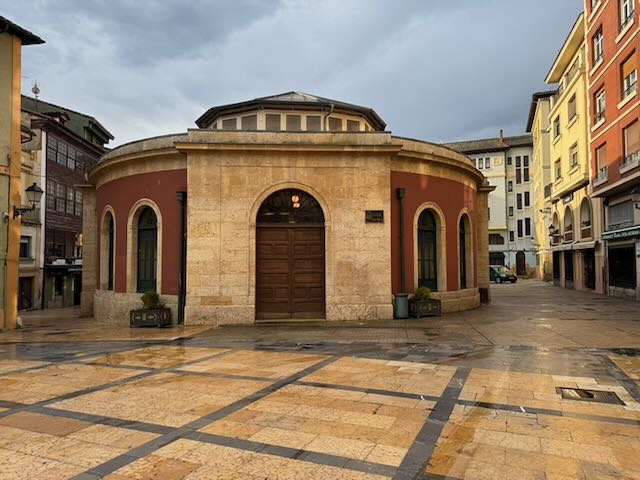
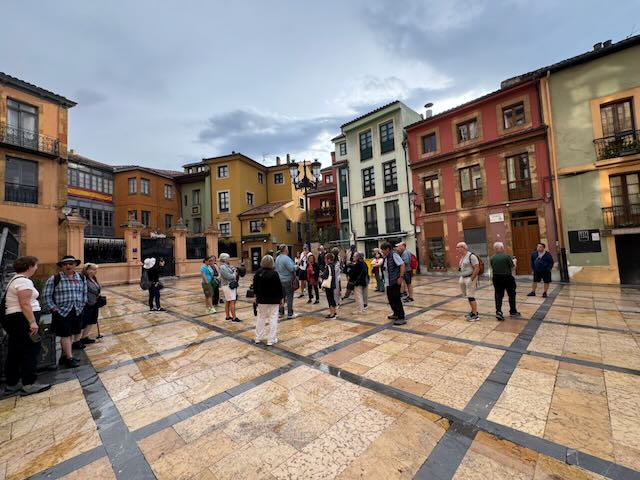
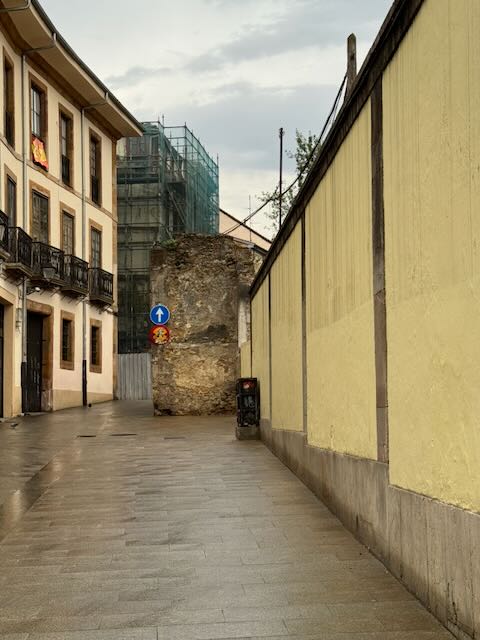
It was an intermittently rainy morning when we set out on our tour of Oviedo. Our local guide, a very interesting and enthusiasatic fellow, pointed out the Muralla Medieval de Oviedo, the largest remaining section of the city walls that were commissioned by Alfonso X in about 1260; they protected the city for centuries.
..
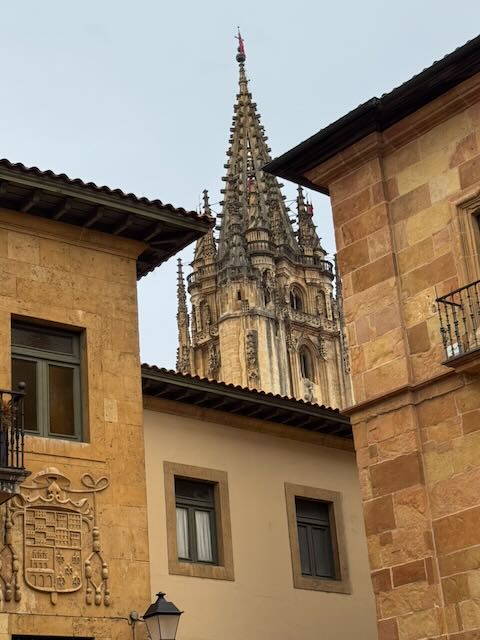
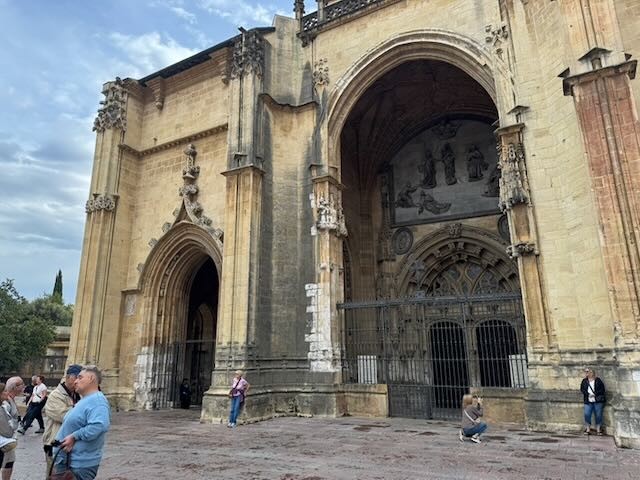
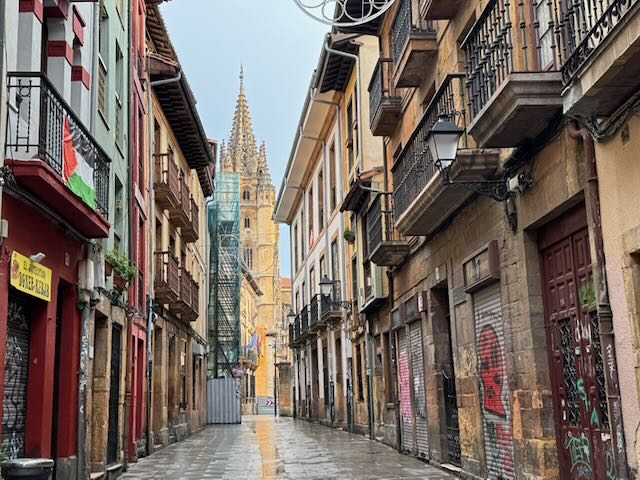
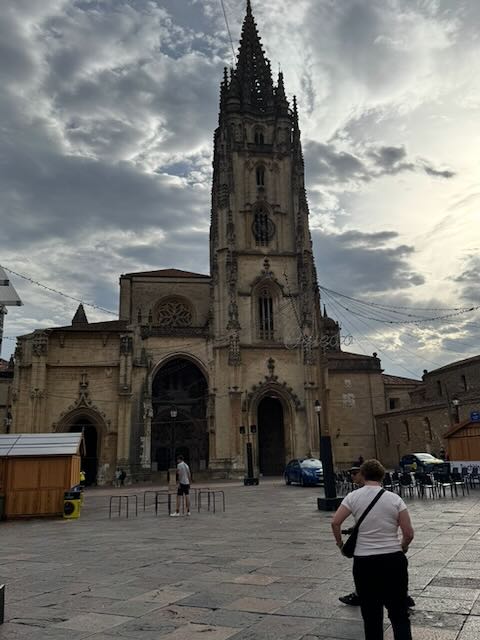
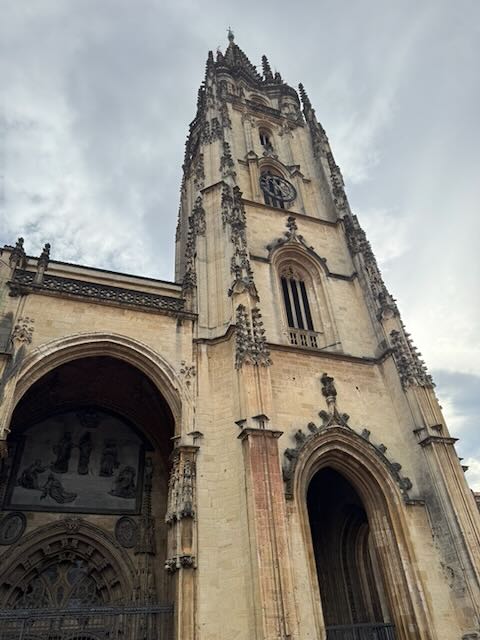
The Catedral de San Salvador (Basilica of the Holy Saviour) looms over everything in the centre of Oviedo. Within it is the Cámara Santa, a small chapel designated a UNESCO World Heritage Site, that was built in 840 CE by King Alfonso II of Asturias to house the “Shroud of Oviedo,” a bloodstained piece of cloth thought to have been wrapped around the head of Jesus Christ after he died.
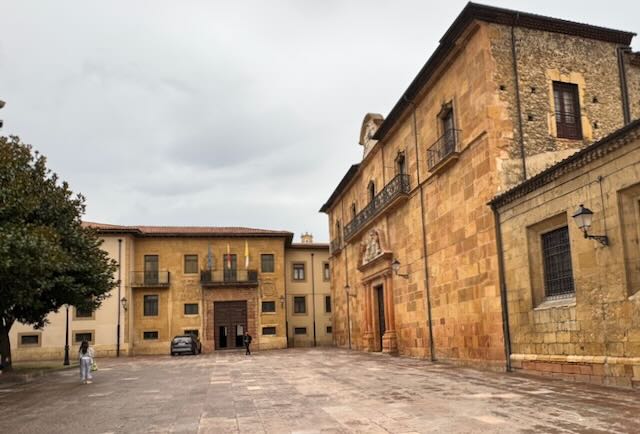
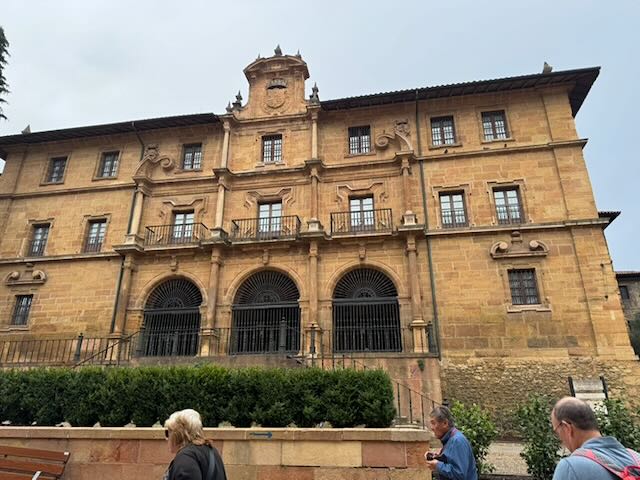
The Bishop’s Run Square (Corrada del Obispo) is a trapezoid-shaped plaza surrounded by some of the city’s most architecturally significant buildings, including the Episcopal Palace and the Gothic cloister of the cathedral (which is topped with a Baroque façade). The square’s name dates as far back as the 13th century, when it was a courtyard or “run” behind the bishop’s house. Over centuries, many buildings that frame it have been destroyed by fires, demolished, replaced and/or rebuilt – some of the renovations having taken place as recently as 1956.
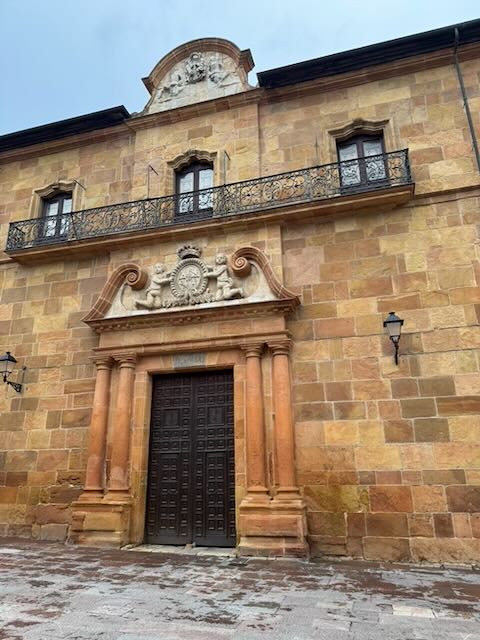
Bishop’s Run Square.The Alms Gate
“Visitors are immediately drawn to the Alms Gate, a magnificent Baroque portal leading into the cathedral cloister. Built between 1730 and 1733 by Francisco de la Riva Ladrón de Guevara, its Tuscan columns, medallions, and heraldic shields remain a highlight of the square’s regal character. Directly opposite is the House of the Dean Payarinos, constructed in 1900 in an eclectic, neoclassical style by Juan Miguel de la Guardia.” GPSMyCity For many decades, aid was handed out to the needy at the Alms Gate (Puerta de la Limosna).
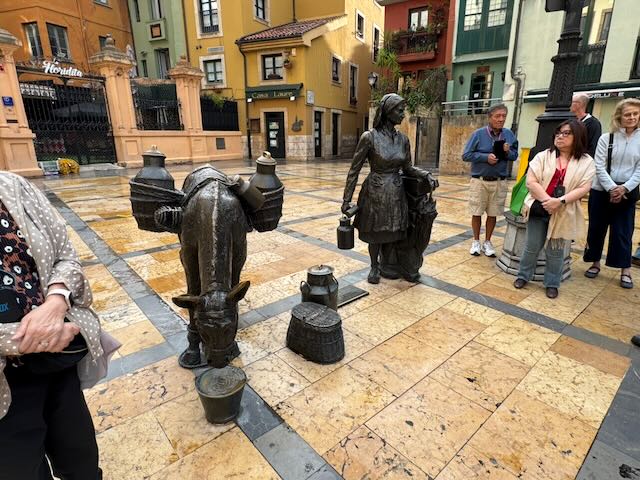
.Trascollores SquareEl Vendedor de PescadoLa Lechera
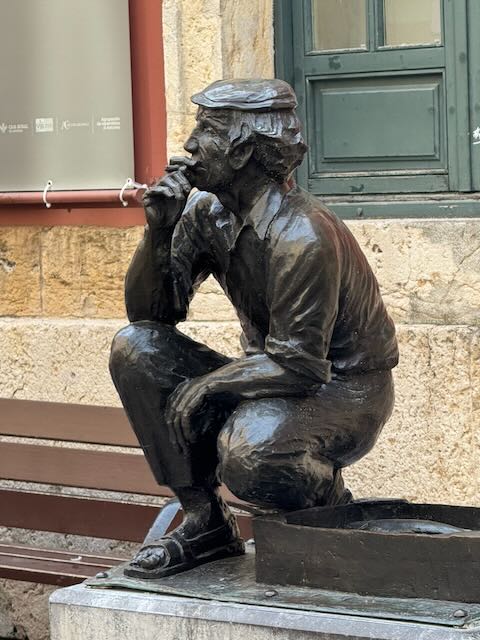
Trascollores Square is home to many of the city’s famous sculptures, including two notable bronze monuments, both created in 1996: “La Lechera” (The Milkmaid) by artist Manuel García Linares and “El Vendedor de Pescado” (Fish Seller) by José Antonio García Prieto, which pays tribute to the historical fishing trade in the square. There is also a life-sized bronze sculpture of actor, writer and director Woody Allen, who filmed part of Vicki Christina Barcelona in Oviedo.
CleanClean!Clean…So clean!Clean!
Oviedo is widely recognized as one of the cleanest cities in Spain and Europe, often winning awards for its sanitation efforts. Promotional materials tell us that the city’s reputation for cleanliness “is driven by a combination of intense municipal cleaning schedules, significant financial investment, and strong civic pride.” Indeed, the cleaning schedule means that the streets are cleaned and hosed down every day, and waste bins are often hidden to help convey the message that the people of the city make no garbage.
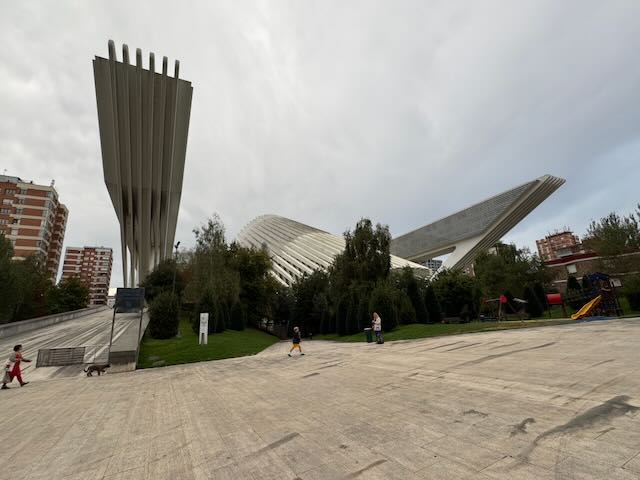
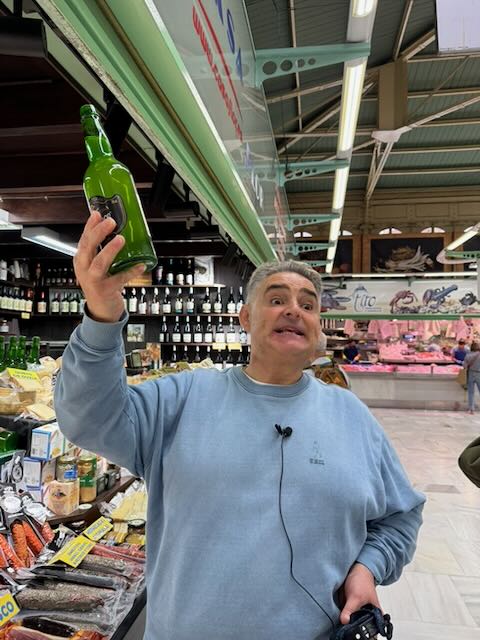
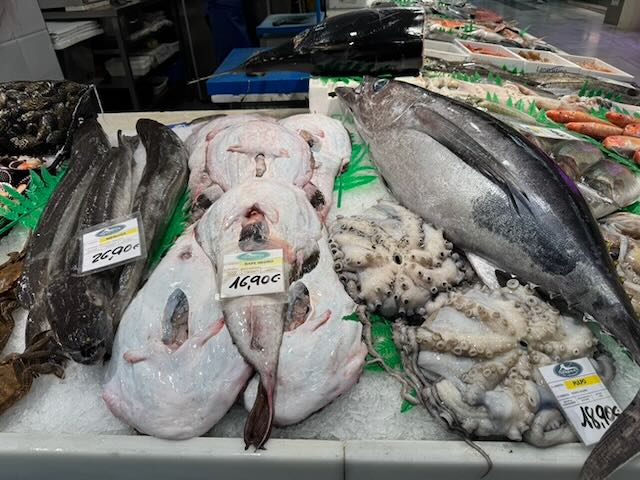
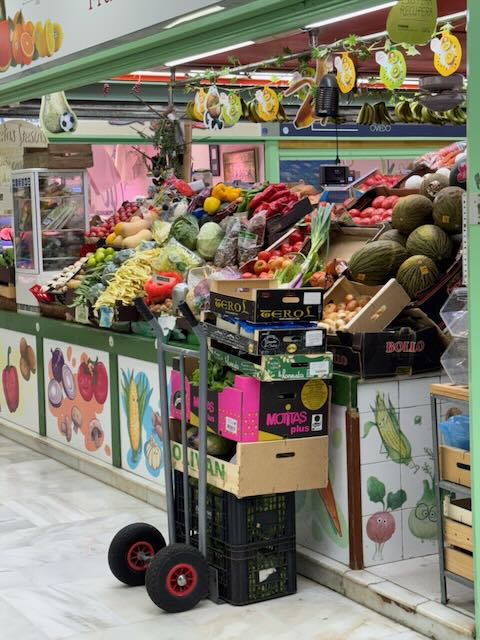
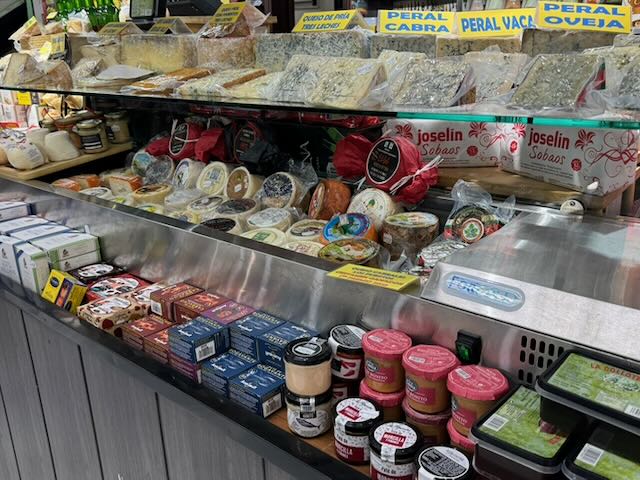
Oviedo may be known for its historic architecture, but we actually began our tour at a very modern building: the Palacio de Exposiciones y Congresos Ciudad de Oviedo (Oviedo Exhibition and Congress Centre), a distinctive facility designed by architect Santiago Calatrava, which opened in 2011. Our local tour guide also took us through the sumptuous city market.
Conference Centre.....
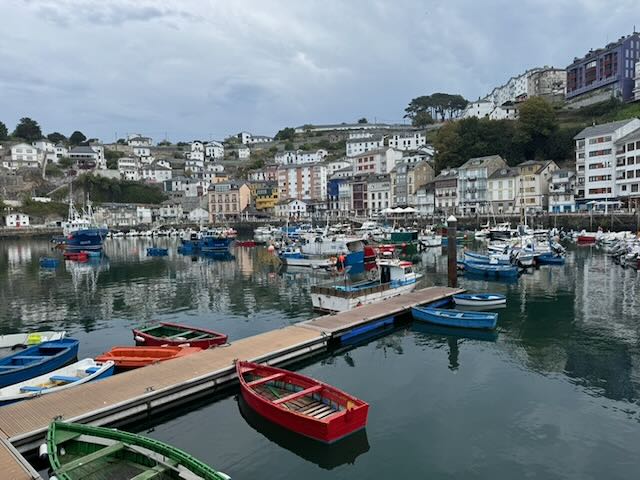
Luarca
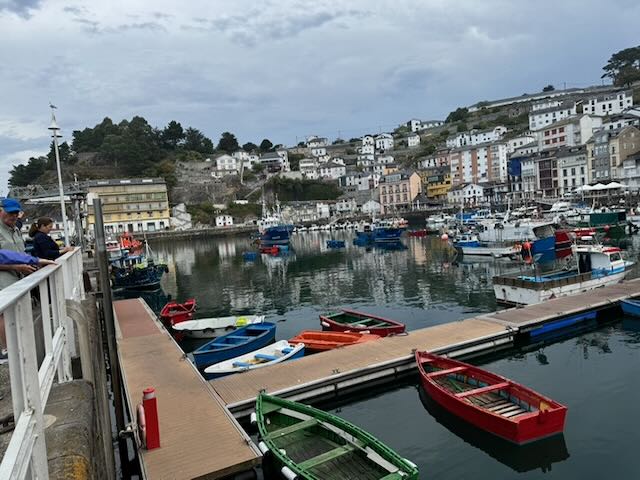
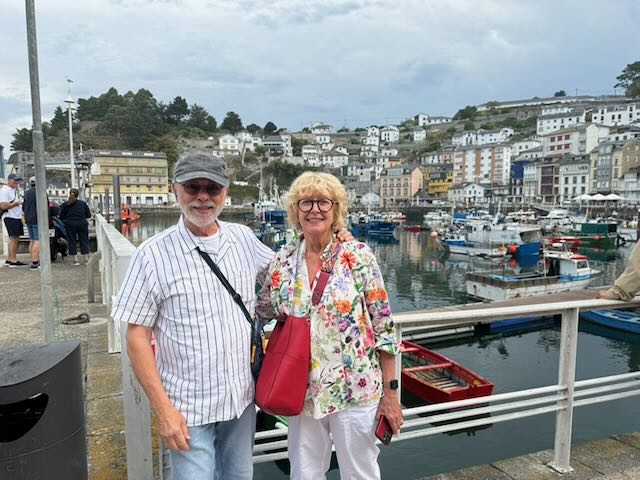
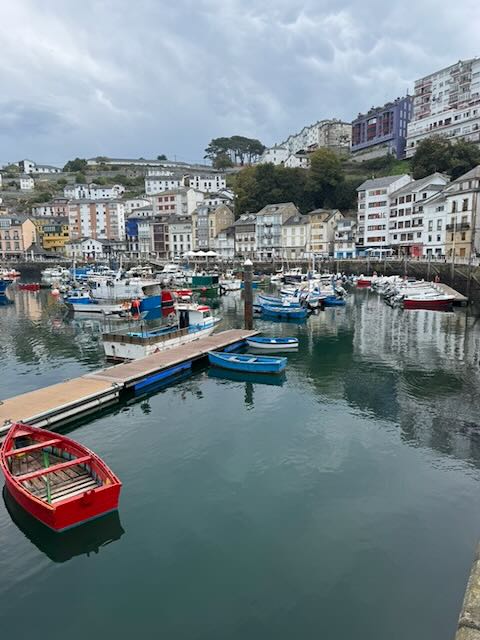
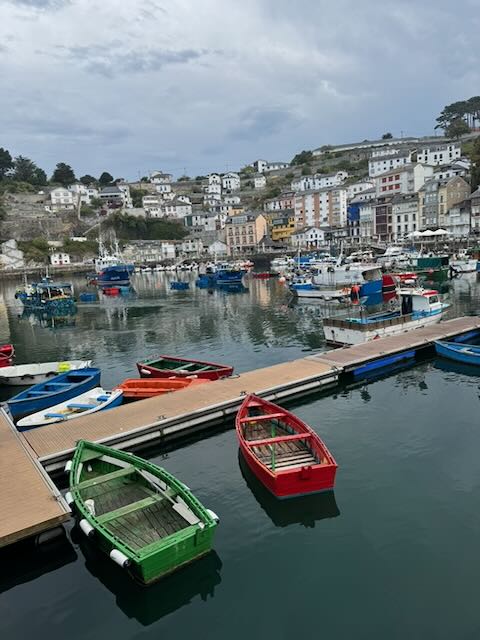
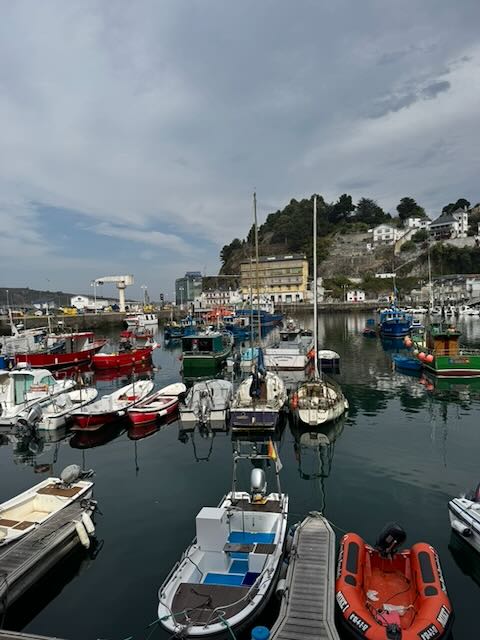
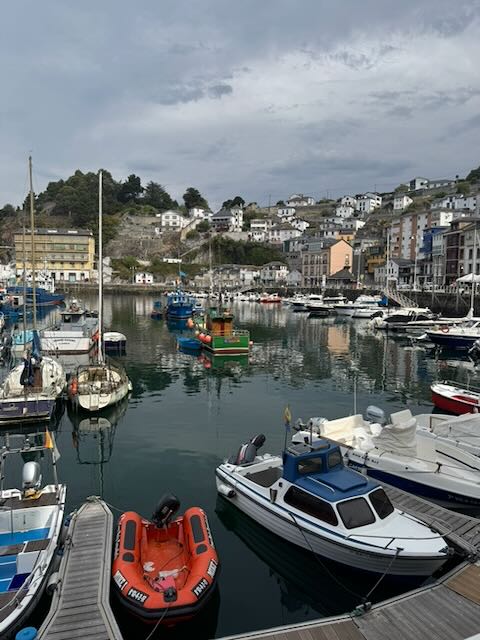
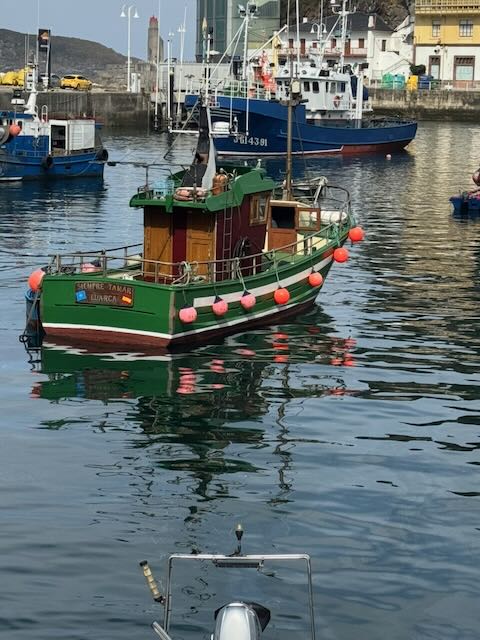
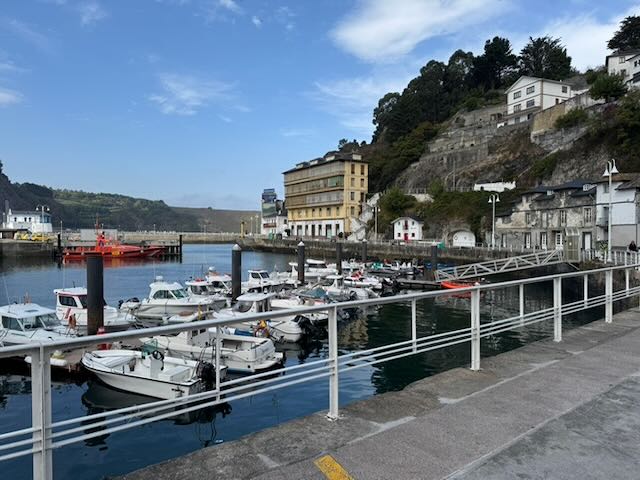
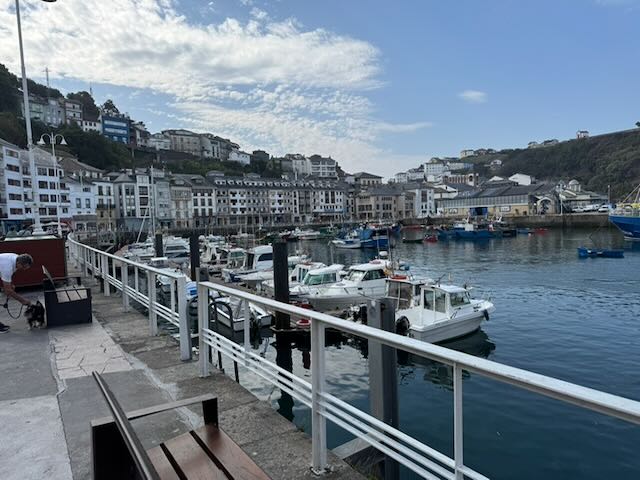
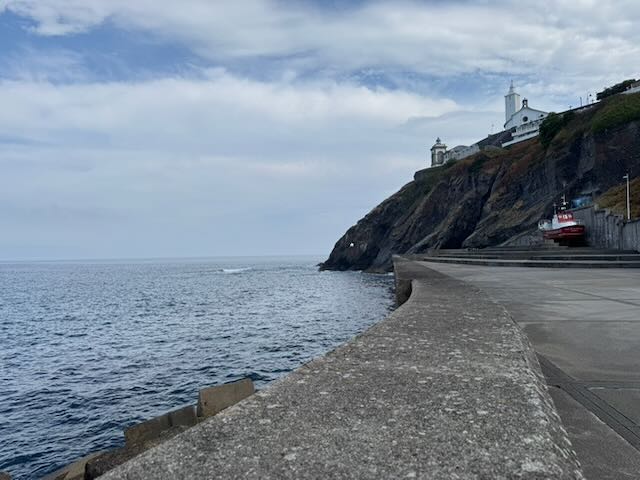
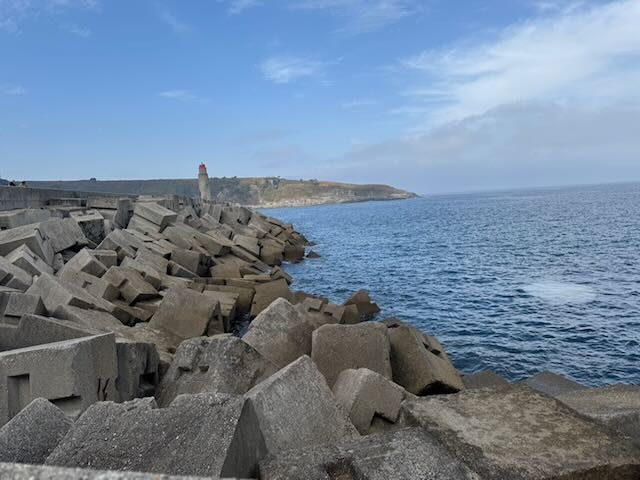
Luarca is a lovely fishing village about an hour west of Oviedo, the pleasures of which are best conveyed by photos rather than words. “Picturesque” does not even begin to describe it. We had lunch in one of the lovely restaurants along the harbourfront, then wandered around the harbour to the breakwater.
(A note to those who receive my posts by email: please visit the blog itself for better views of images.)
Picos de Europa
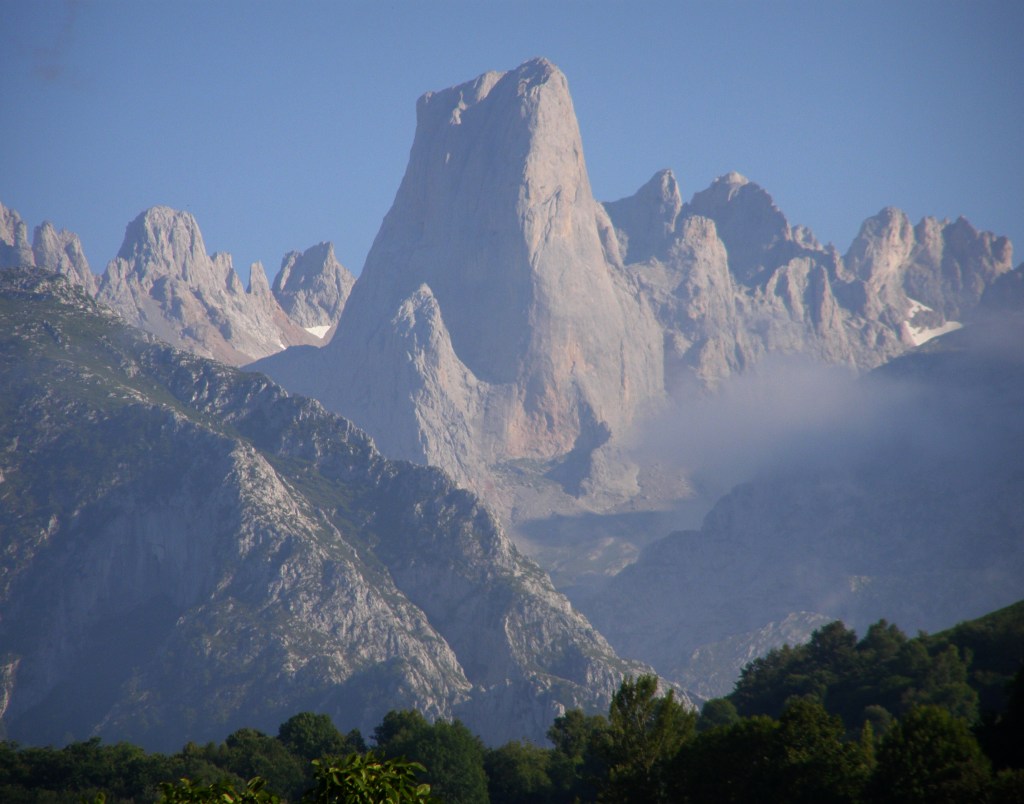
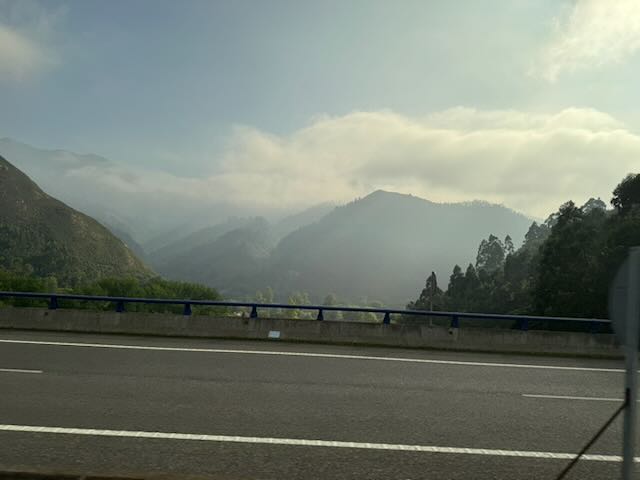
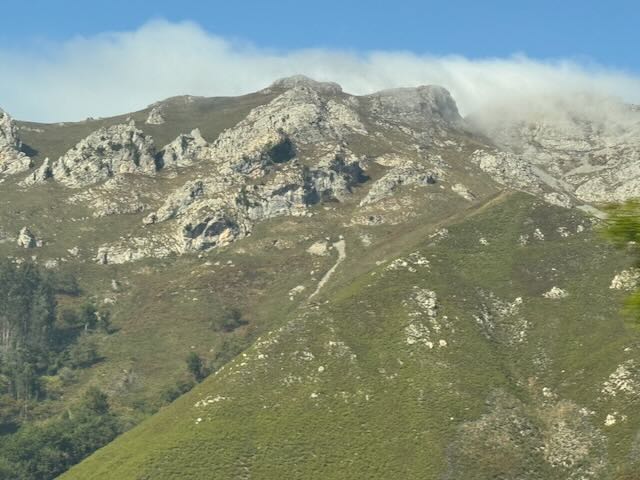
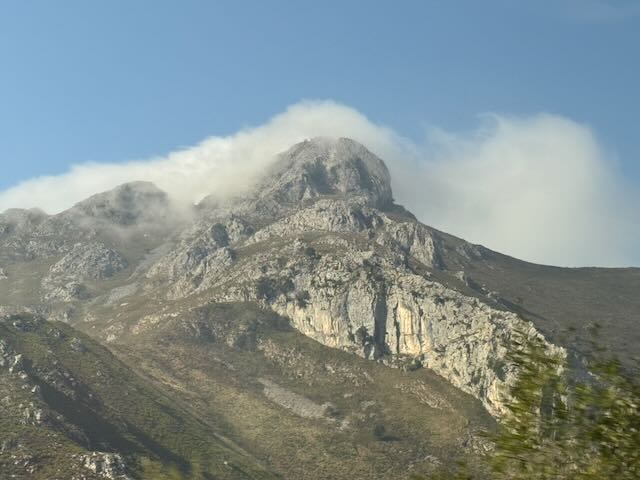
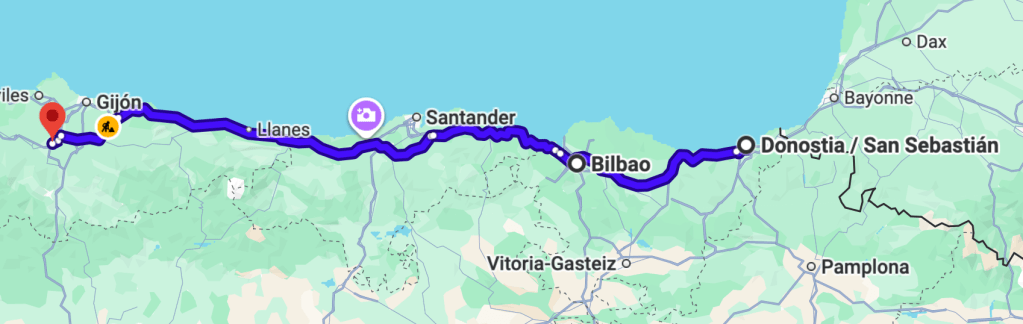
We left Bilbao at around noon on Thursday, September 18 (2025). Our destination for the day was the city of Oviedo, and the highway curved around the Bay of Biscay, which extends across the northern coast of Spain. Within an hour or so, the Picos de Europa came into view. This limestone mountain range is small by mountain-range standards – about 650 km2, and only about 40 km east to west and 12.5 km north to south. The Picos (Peaks) include three limestone massifs, the most rugged of which reaches an elevation of 2650 m. The Picos de Europa, which are mostly contained within a national park of the same name, attract thousands of hikers, kayakers and other outdoors enthusiasts every year.
Since the highway taken by our tour bus followed the coast of the Bay and the Picos are about 20 km south of the coast, we did not have a chance to see the breathtaking vistas of the range that are described in the travel guides – high meadows where cattle graze, lakes that sparkle, and rivers that plunge down rock faces etched with gorges as they fall toward the sea.
...Views from the highway of the northern elevations of the Picos de Europa
A Grotto with a History
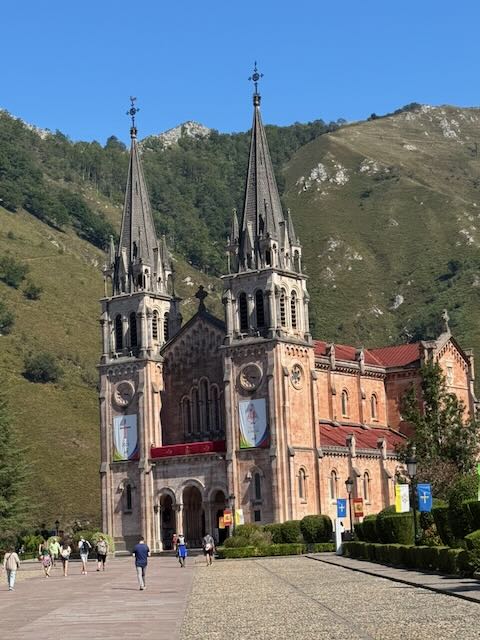
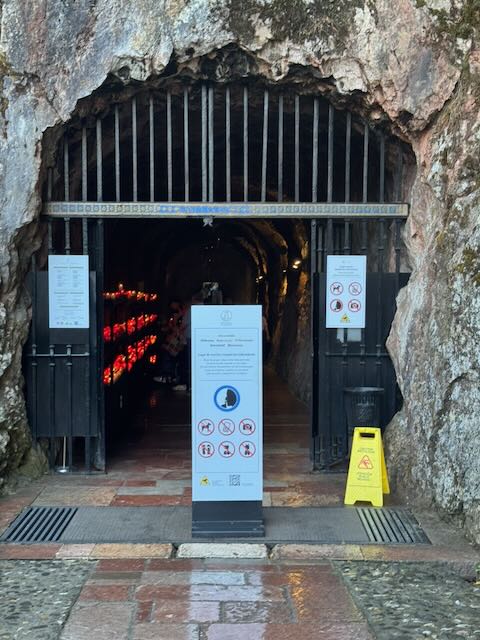
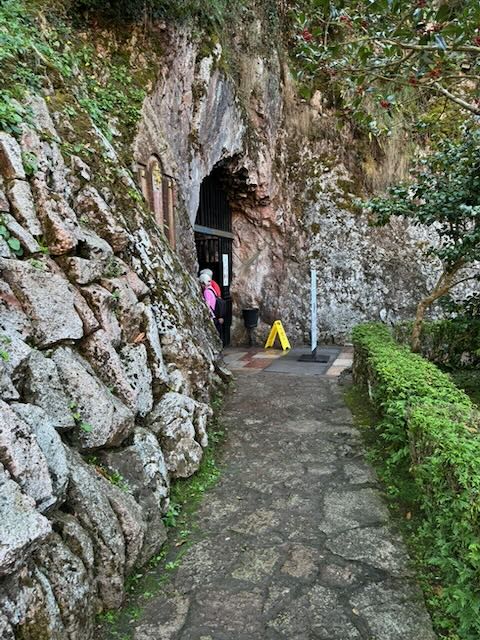
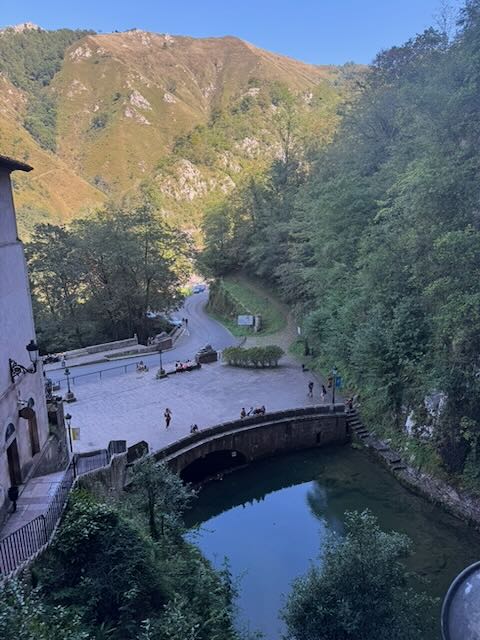
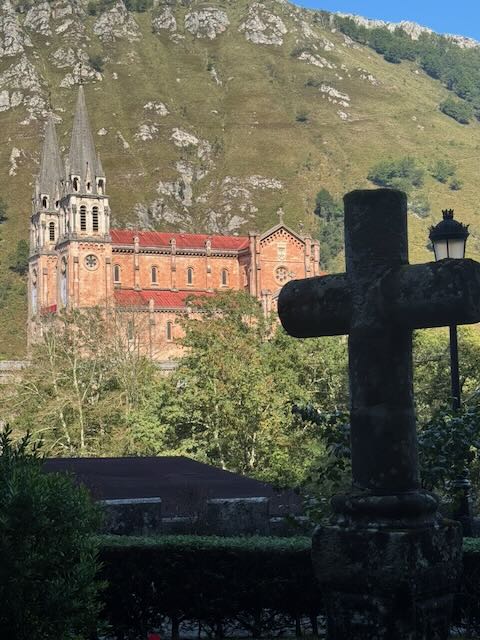
After driving past fishing villages and market towns along the coast, we reached the sanctuary of Our Lady of Covadonga, which features a beautiful cathedral and an intriguing network of caves. The “Lady” to whom the name of the site refers is the Virgin Mary, who is the patron saint of the autonomous region of Asturias where the sanctuary is located. The Virgin Mary and the Immaculate Conception are also the devotional focus of the “Marians” a fraternal order that was established in Poland in the 17th century, and now has communities around the world, including in Covadonga.
...
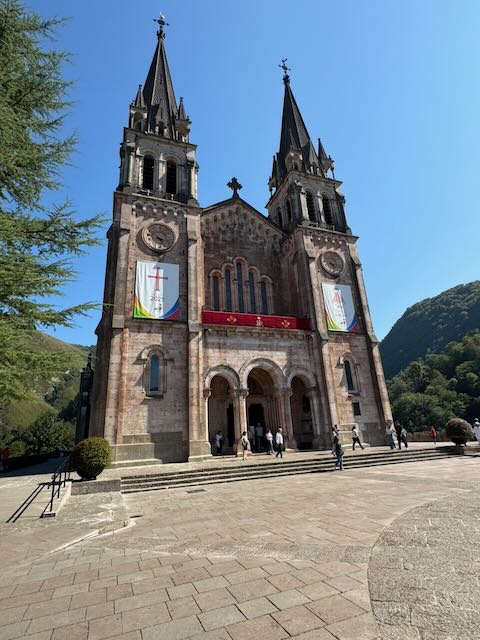
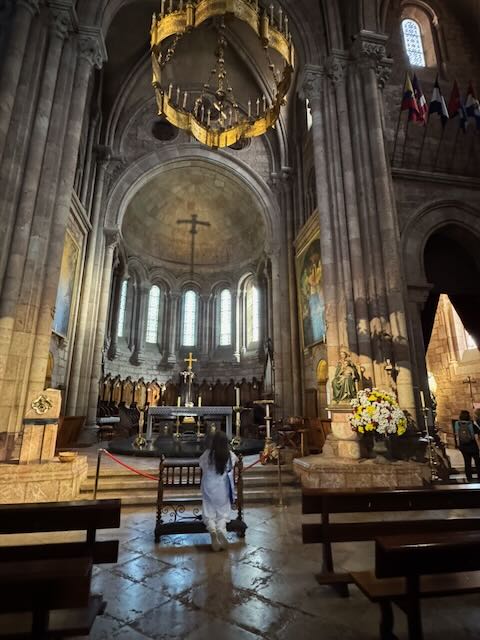
The Basílica de Santa María la Real de Covadonga was designed in the Neo-Romanesque style, and the exterior is pink limestone. It was completed and consecrated in 1901. It is lovely, and its elegance is amplified by its beautiful mountain setting.
According to legend, in 722 AD a Visigoth nobleman named Don Pelayo (Pelagio of Asturias) and a band of Christians set out to vanquish the Muslim overlords who ruled the area at the time. A massive Moorish force was sent to defeat them and the small group of rebels ended up in the caves at Covadonga. There, they found a statue of Mary that a hermit had hidden. Pelayo prayed to her, and as a result of her intercession, the arrows and stones the Moors were aiming at the small Christian group started to turn around and hit the attackers instead. As a result of this battle, Asturias became the only region of Spain that was able to remain independent of Islamic Rule.
...
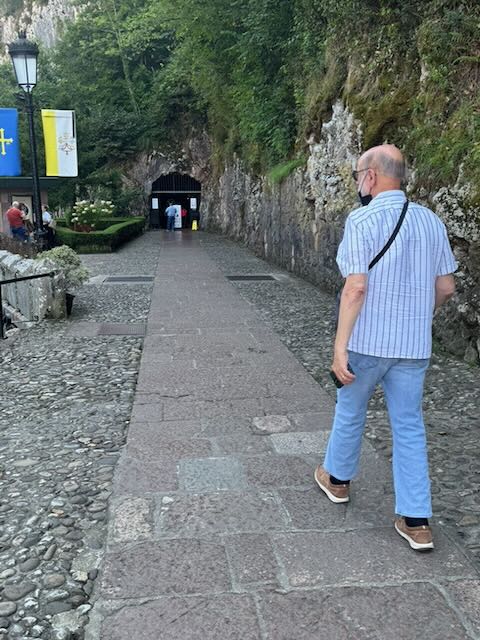
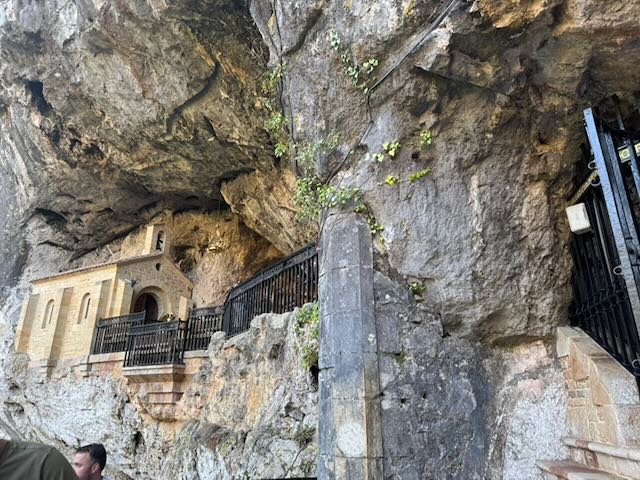
The Holy Cave is a grotto carved into the cliffside where the miracle-making statue of the Virgin Mary (which has a pet name of “La Santina”) is housed. Visitors are not permitted to take photos inside the grotto, but as you will guess from the photos I did take, it is a lovely, peaceful experience to walk past the hundreds of votive candles lining the walkway and deeper in the cool cave area that leads to the statue. Several sections are outfitted with pews and other kinds of seating to accommodate small services and individual meditations.
...A look back at the church from the grotto
A Cider Mill
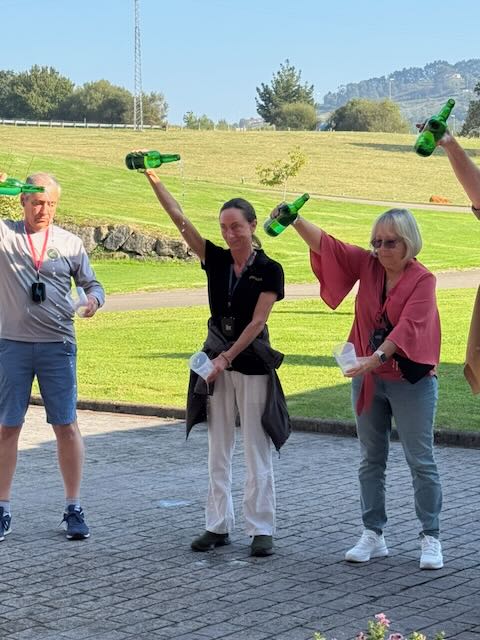
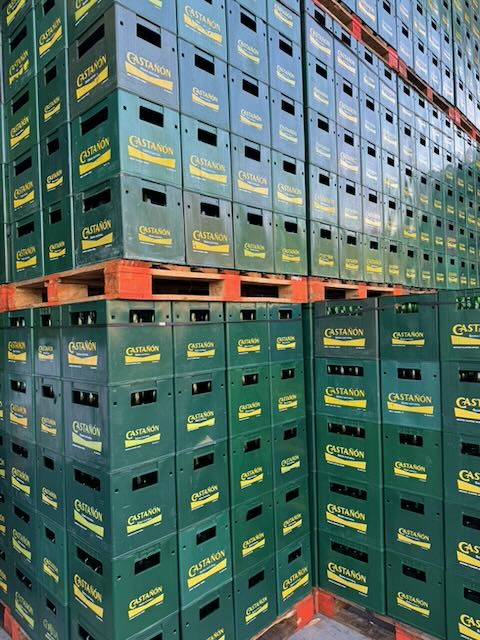
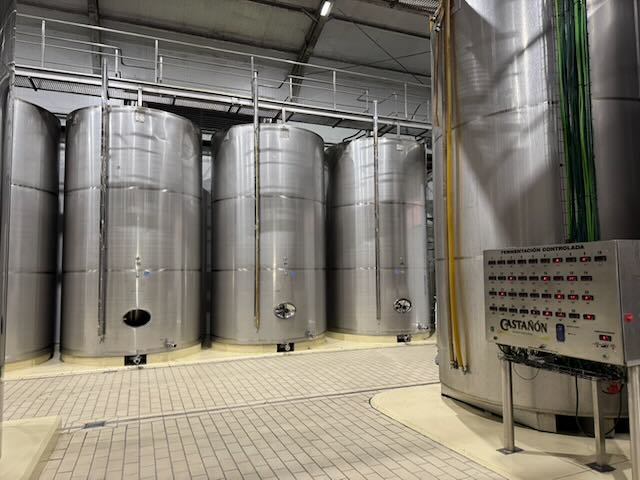
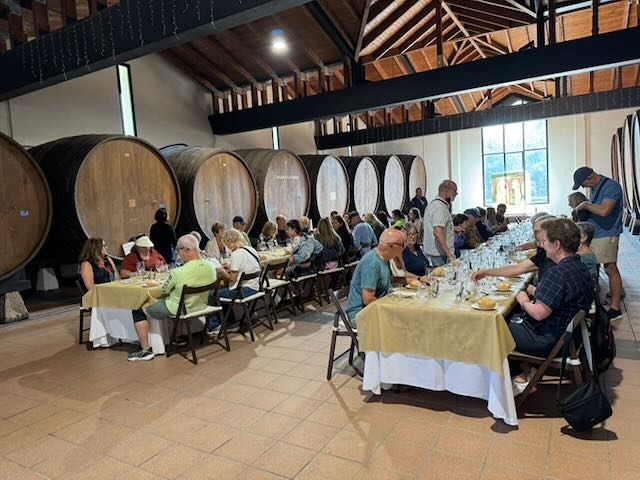
Our final stop of the day was at a cider mill owned for nine decades by the Castañón family. There, we were treated to a tour of the facility, a cider tasting, and a lovely regional-traditional meal including fava beans, chorizo and cheese.
...
The area’s Tourism information site humbly (?!) declares that “Asturian cider isn’t just any drink, it’s the lifeblood of a culture, the pulse of a land. Its low alcohol content and its totally natural fermentation make it a drink of conviviality, with a strong social and gastronomic spirit that has taken it to the top of the Asturianía. When it’s poured, we’re witnesses to a hypnotic choreography. And as the stream crashes against the glass, the cider comes alive, and there’s no turning back. We drink without hesitation… it’s light, effervescent, and fuels conversation, joy and laughter. From this point on, time’s marked by empty bottles.”
..
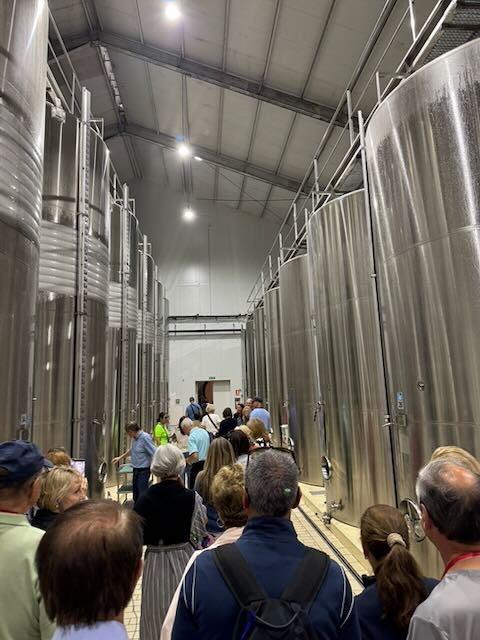
I was intrigued by what we learned and saw on our tour of the facility – from the correct way to pour cider (from a height), to the harvesting and fermentation process (which involves no added sugar) and the enormous vats of cider, from which the cider is bottled and shipped to markets all over the world. The Castoñons’ is one of the largest mills in the region.
After dinner, the bus at last took us to our hotel in Oviedo. It seemed a very long time since we had left San Sebastian headed for the Guggenheim in Bilbao, but it had only been twelve hours!
Travel date: Thursday, September 18, 2025 (Part 1)
After a laid-back couple of days enjoying extraordinarily beautiful seascapes, we were challenged with a jam-packed itinerary on September 18 that took us all the way from San Sebastián to Oviedo, also on the Bay of Biscay. We did so much on September 18 that I’ve divided the day into two posts.
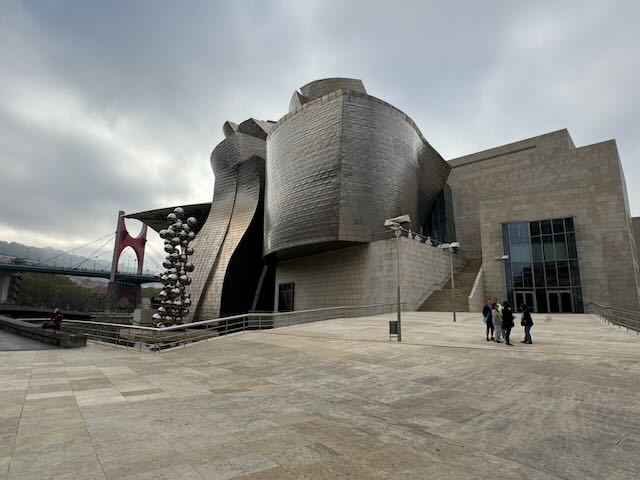
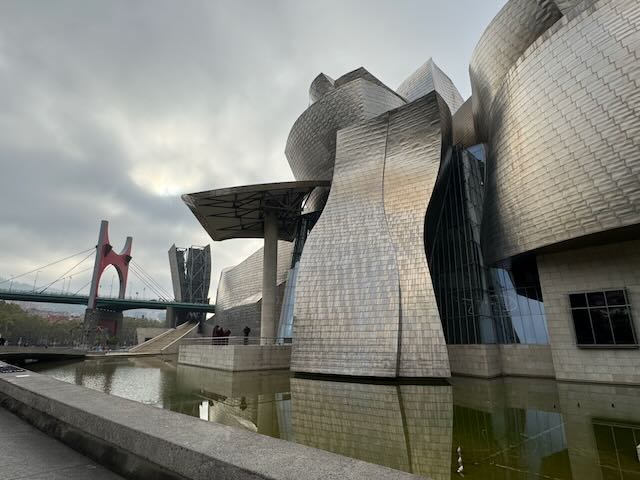
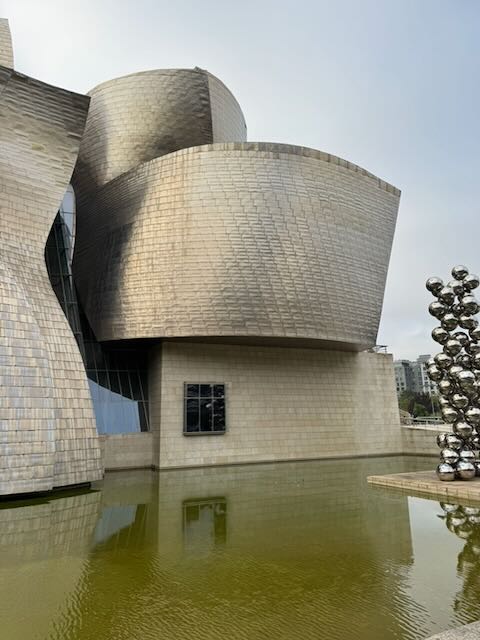
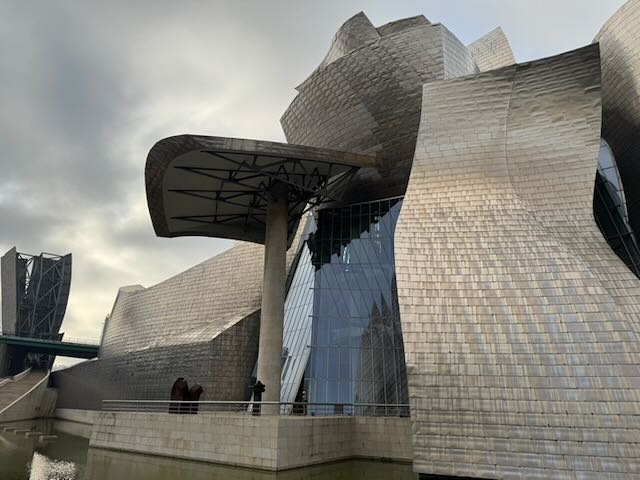
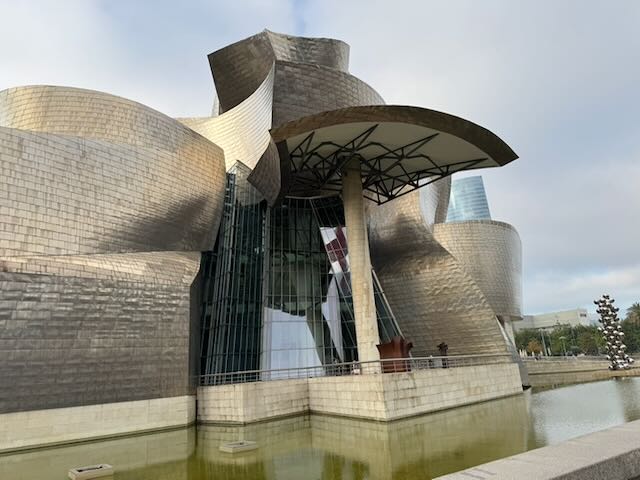
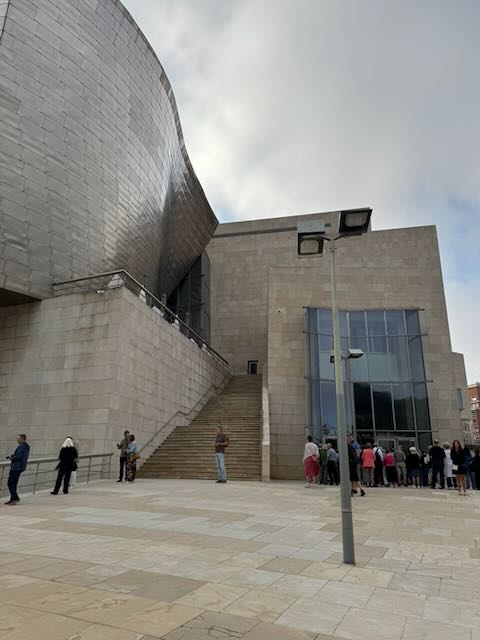
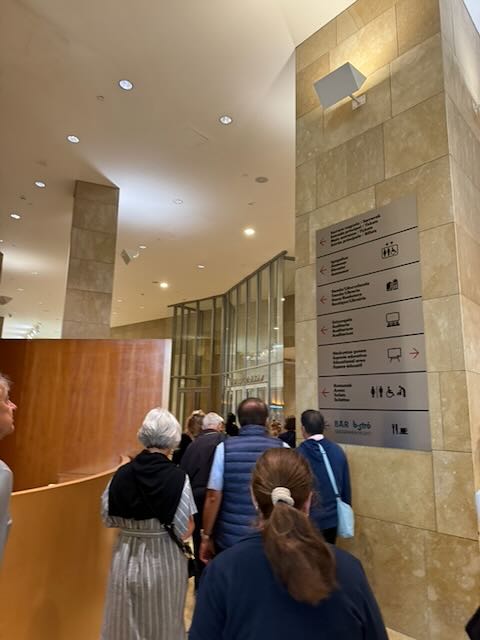
Our first stop was the Guggenheim Museum in Bilbao. Seeing Frank Gehry’s masterpiece has been on my “bucket list” since I first heard about it, decades ago, and is one of the reasons we went on a tour of Northern Spain rather than Southern Spain (or anywhere else) last year.
Bilbao, in the Basque autonomous region in the northeast of Spain, was once a thriving centre for the metallurgical and naval industries, but it fell into economic decline in the 1980s due to the petroleum crisis and the trade dynamics created by Spain’s having joined the European Union. Bilbao, Spain’s fifth-largest “municipal agglomeration,” is located on a tidal estuary formed where the Nervión and Ibaizabal rivers join – 16 km inland from the Bay of Biscay. Major flooding of the estuary in 1983, combined with social unrest and a dwindling population (from 433,000 in 1981 to 372,000 in 1991), led to the Basque Administration’s search for strategies to revitalize Bilbao. The members of the Administration conceived the idea of requesting assistance from the Solomon R. Guggenheim Foundation in New York City to build a contemporary art museum that they hoped would turn the fortunes of the city around, by attracting tourists and commerce.
......
Within six months of receiving approval for the museum’s construction, the Administration and the Guggenheim Foundation had selected Frank Gehry as lead architect for the project. Gehry (1929 to 2025), a Canadian by birth, was already well respected as an architect before he started work on the Bilbao project, and following that achievement he created several magnificent structures in other places (including the Dancing House in Prague, the Marqués de Riscal Hotel south of Bilbao, and the Walt Disney Concert Hall in Los Angeles). However, the museum in Bilbao is considered by many to be his master work.
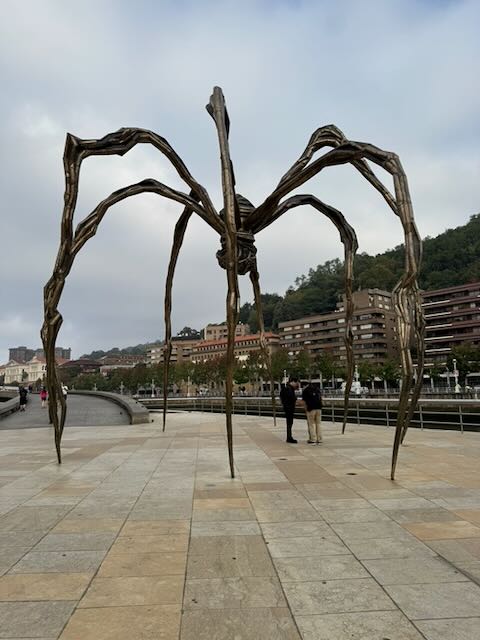
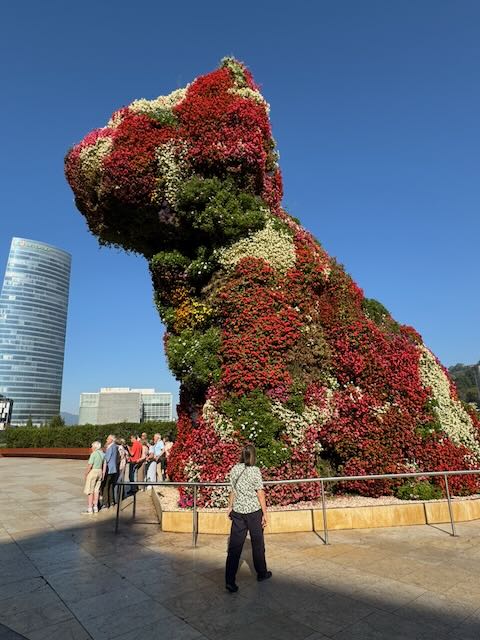
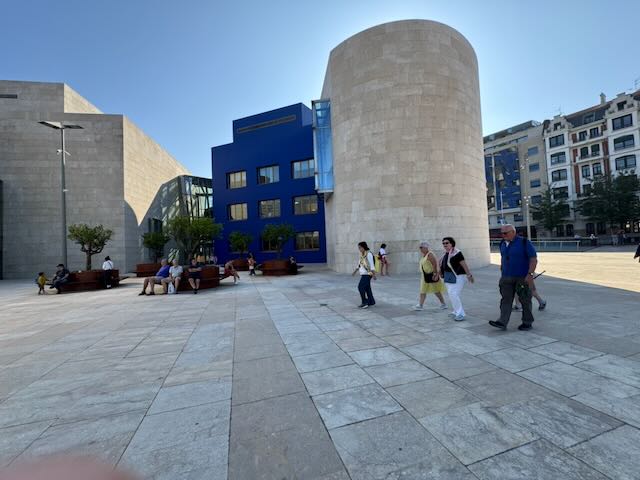
“Maman” by Louise Bourgeois“Puppy” by Jeff Koons, in Museum SquareThe blue building houses the museum’s officesThe bronze and steel sculpture by Louise Bourgeois named “Maman” appears in several locations around the world, including outside the National Gallery of Canada in Ottawa. It is 9 metres tall and symbolizes maternal strength and protection, featuring a cage-like belly filled with ten marble eggs
.
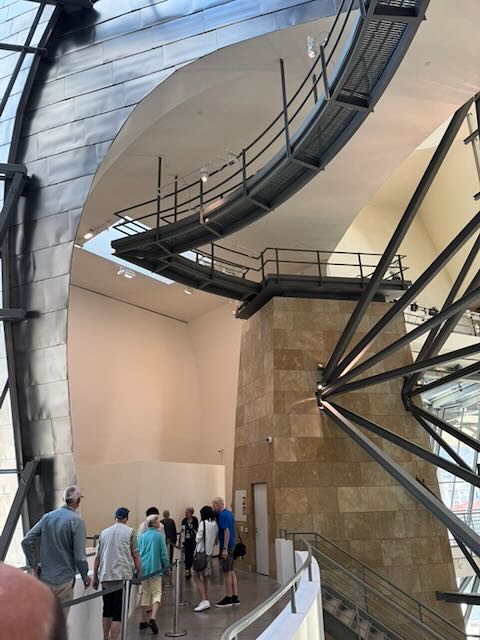
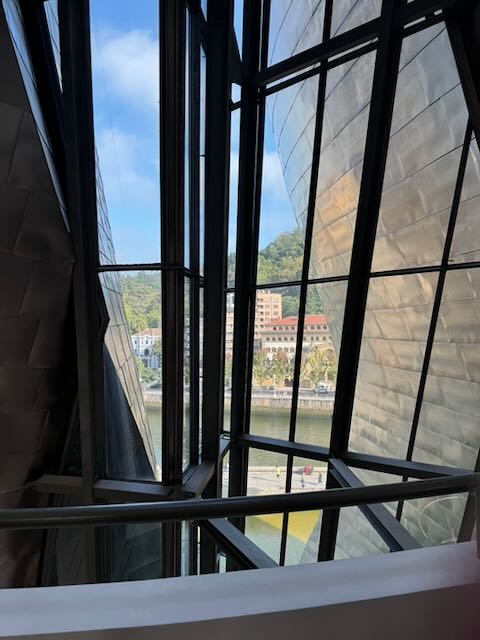
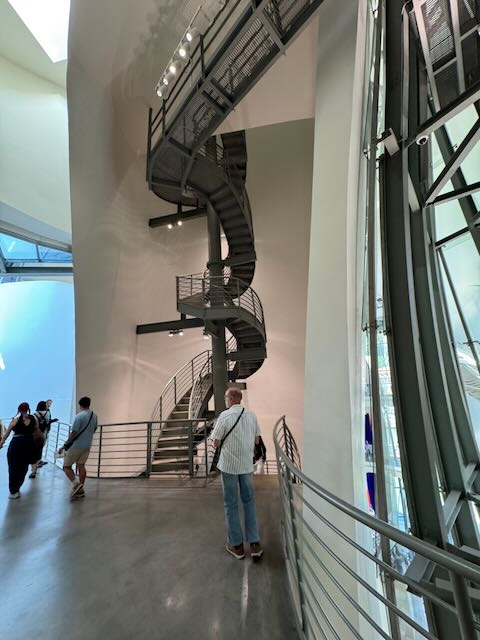
What is distinctive about the Bilbao Guggenheim is its very complex shape, which is as much a work of art as it is a functional building. Due to Bilbao’s location and its industrial history, Gehry formed the gallery from shapes that are reminiscent of sailing vessels and evoke the area’s history with the metallurgical industry. He used titanium to finish the exterior curved walls, and limestone for the vertical walls. He also made extensive use of glass and steel.
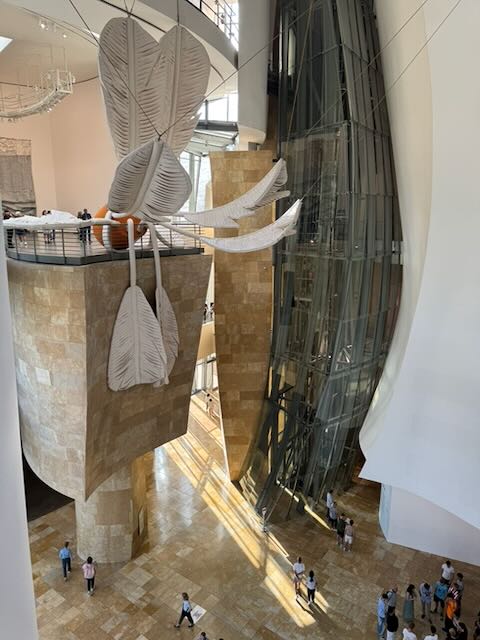
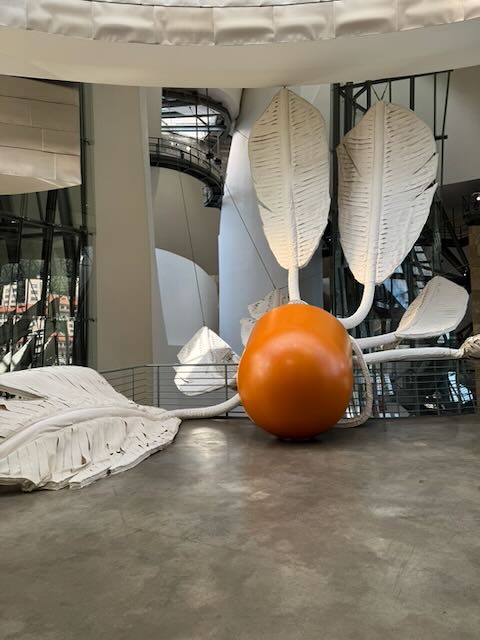
.The AtriumSecond floor.“Soft Shuttlecock” by Claes Oldenburg and Coosje van Bruggen“Soft Shuttlecock”
Gehry designed the many curves of the building using a computer program called CATIA, which until then had been used primarily in the aviation industry. The choice of titanium – non-corrosive and light-weight – for the “skin” allows the curvilinear aspects of the building to glow with light and glint like the scales of a fish, even on the gloomiest days. Overall, thirty-three thousand very thin titanium panels, each 80 x 115 cms, overlap like the shingles on a house.
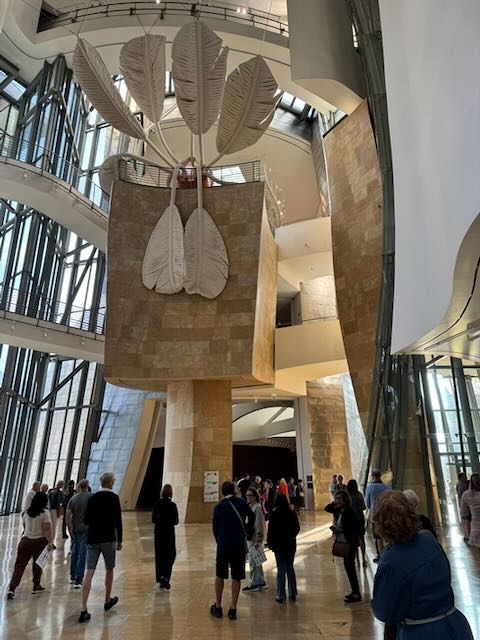
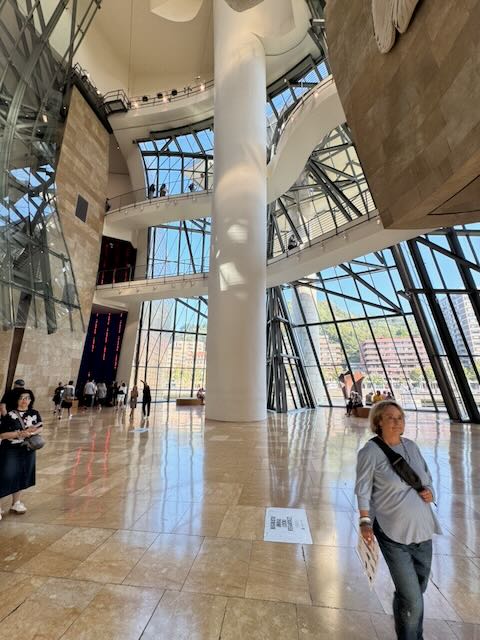
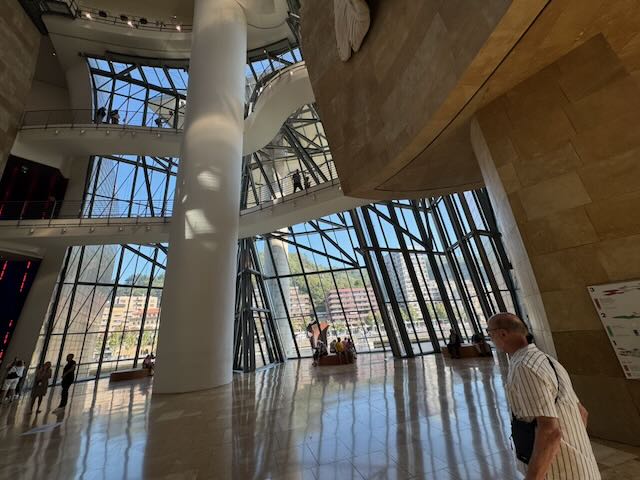
The interior of the museum is remarkable as well – due primarily to its wide open spaces. The walls themselves have been created to bear the weight of the building and its roof, which obviates the need for complex support systems. There are three floors in the museum and 20 galleries, including one of the largest exhibition spaces in the world – the ArcelorMittal Room, which is 2,768m2 and is designed for huge art installations. Some of the smaller galleries are conventional in design; others are irregular. The highest and most notable feature of the museum’s interior is the Atrium which, due to the ingenious use of glass and skylights, is filled with natural light.
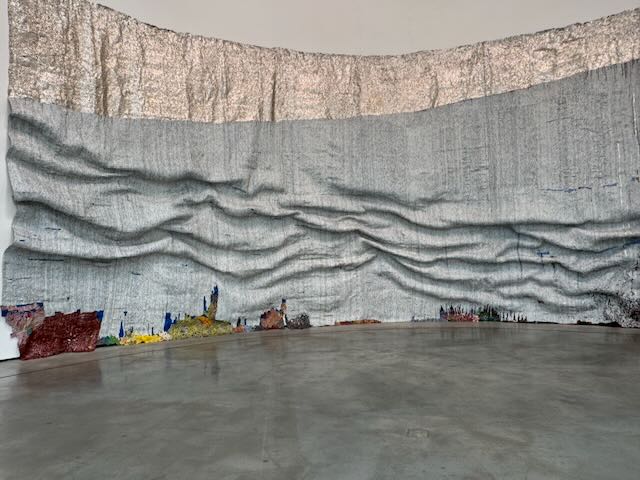
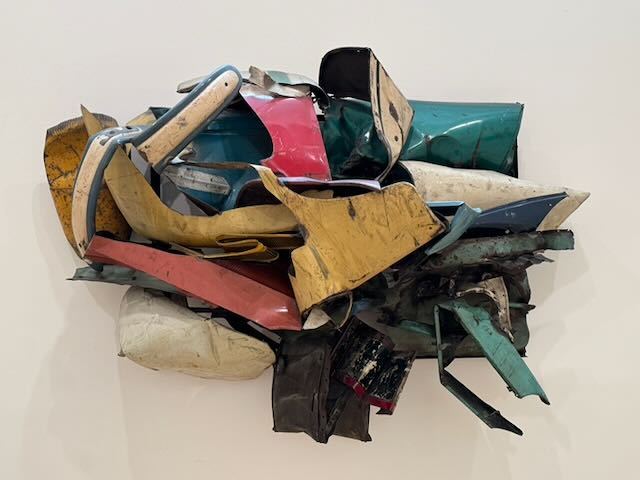
“Rising Sea,” El Anatsui“Dolores James,” John ChamberlainJean-Michel Basquiat,”Moses and the Egyptians”.AtriumSo much light!
The Guggenheim Bilbao took four years (1993 to 1997) to build, and the Basque Administration’s strategy actually worked: the museum transformed the city. The galleries offer visitors works by world-renowned contemporary artists (Jean-Michel Basquiat, Yves Klein, Jeff Koons, and Andy Warhol are among those in the permanent collection), and attracts more than a million tourists a year. Most visitors, if they are anything like me, come to see the museum itself perhaps even more than they do the art within. Today Bilbao is a major tourism and commercial centre, and Frank Gehry’s magnificent facility has attracted many other world-class architects to build other unique structures in or near the city.
We had only a couple of hours to tour the magnificent facility and while we did a quick overview of the inside galleries and some of the art, we spent most of our time outside, and in the Atrium, admiring Gehry’s astonishing work of architectural genius. I would have relished another few hours or even several days in Bilbao, but I’m delighted I got to see the facility at least once!
On our sixth day in Spain, we crossed from the Basque country in Spain to the Basque country in France for a quick look at the cities of Saint-Jean-de-Luz and Biarritz (also spelled Miarritze). Saint-Jean-de-Luz is only about forty kilometres along the Bay of Biscay from San Sebastian, and Biarritz about 20 km beyond that, so it was a perfect half-day excursion.
Biarritz
Phare de Biarritz....
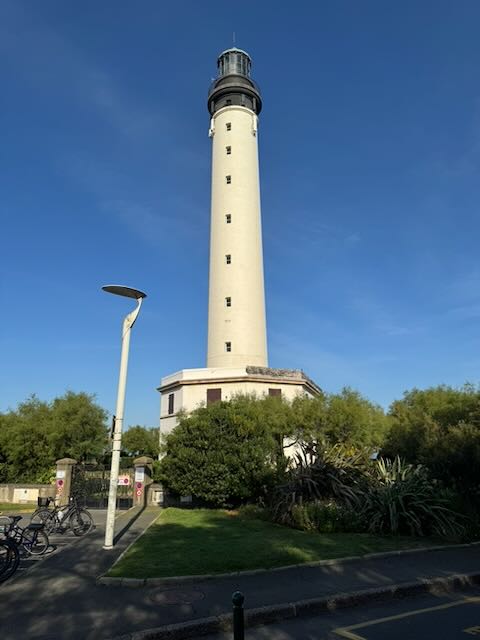
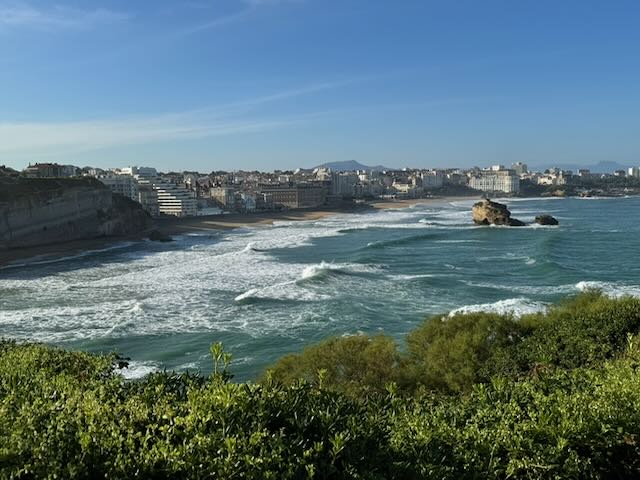
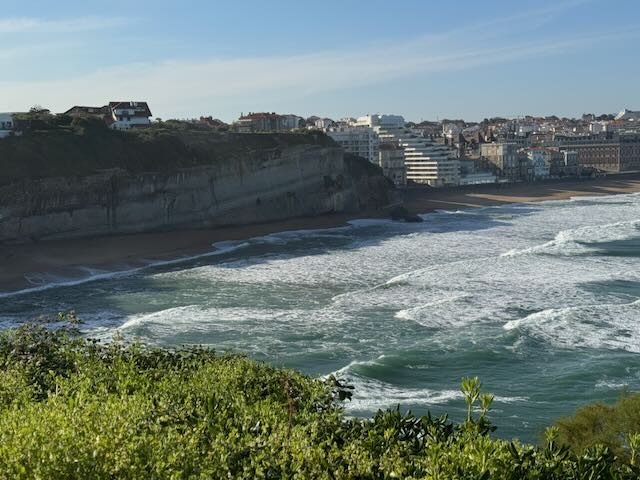
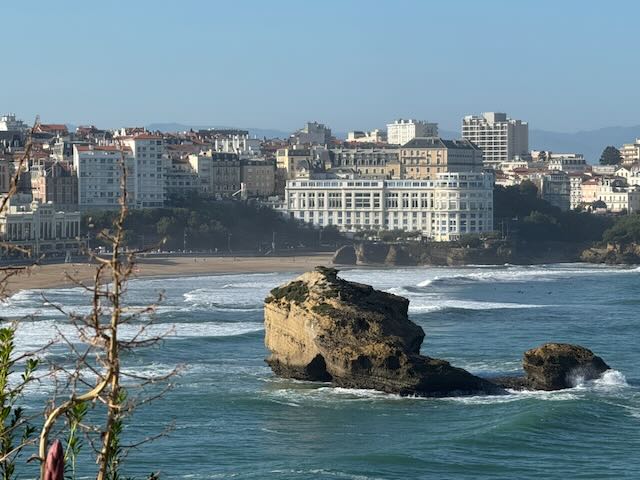
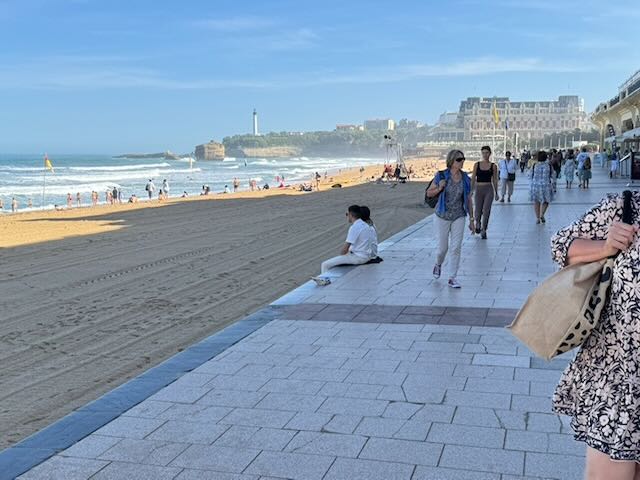
Our first stop was the farthest point of the day’s journey, the Phare de Biarritz (“phare” means “lighthouse”), from which we were able to look back at Biarritz before we visited it. Wikipedia describes the town as “a luxurious seaside tourist destination known for the Hôtel du Palais (originally built for the Empress Eugénie c. 1855), its seafront casinos, and its surfing culture.”
....
Empress Eugenie was the wife of Napoleon III. In 1893 the palace that had been built for her was converted into a hotel-casino complex, which was later rebuilt after a fire in 1903. There are nearly a dozen casinos in this region.
....Hotel du Palais in the upper right
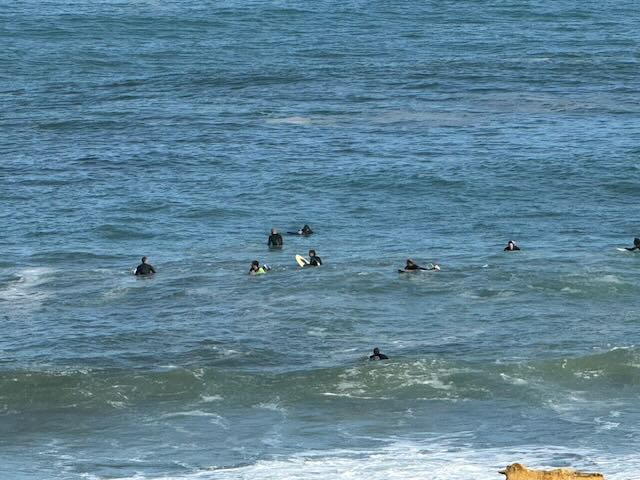
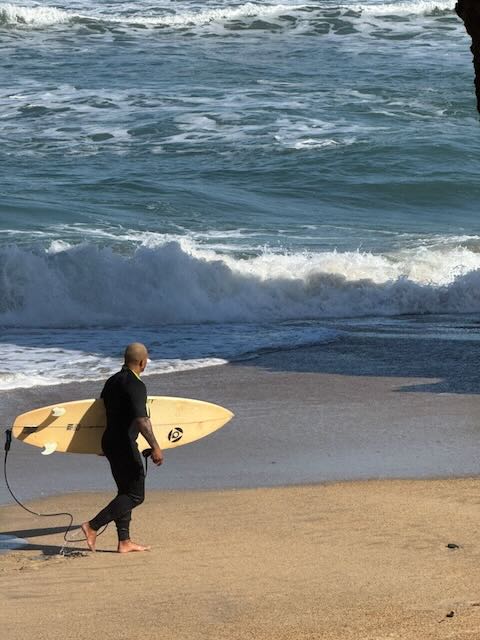
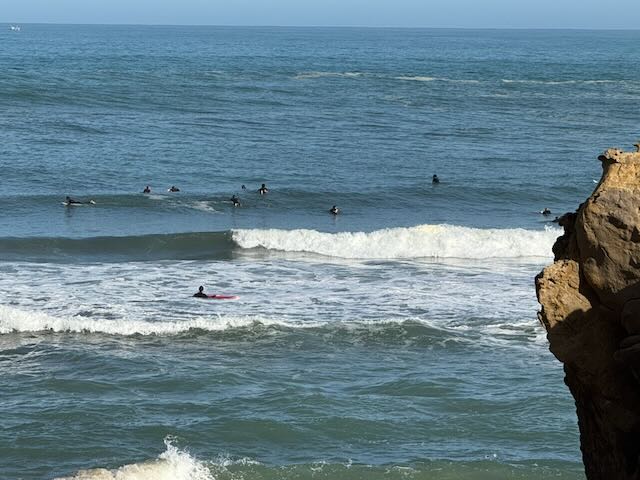
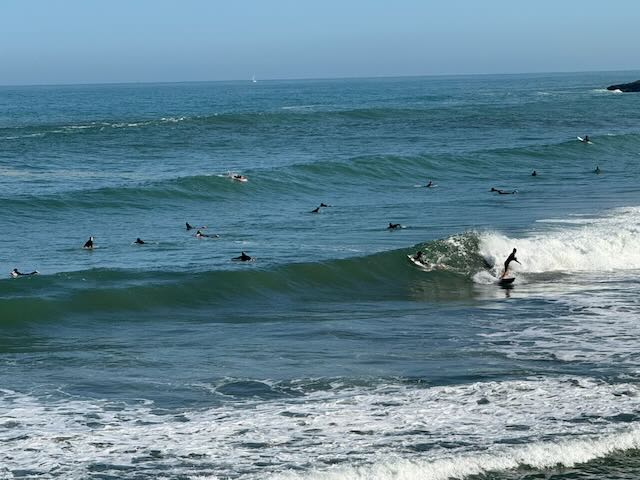
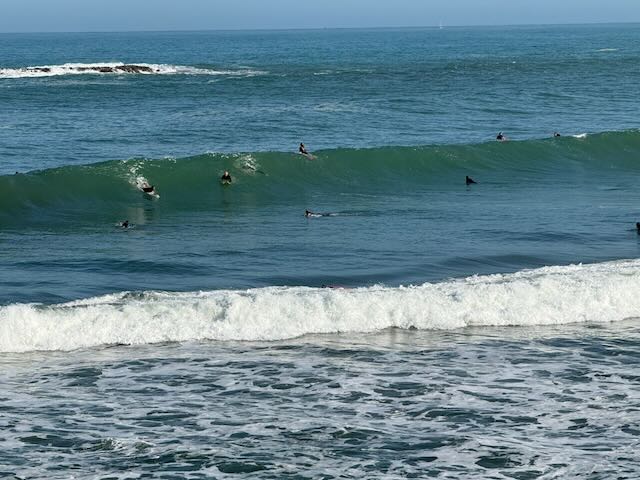
I personally could just sit on the beach in Biarritz all day and watch the surfers and the waves. (If you are reading this as an email, you will miss the video. It is here.)
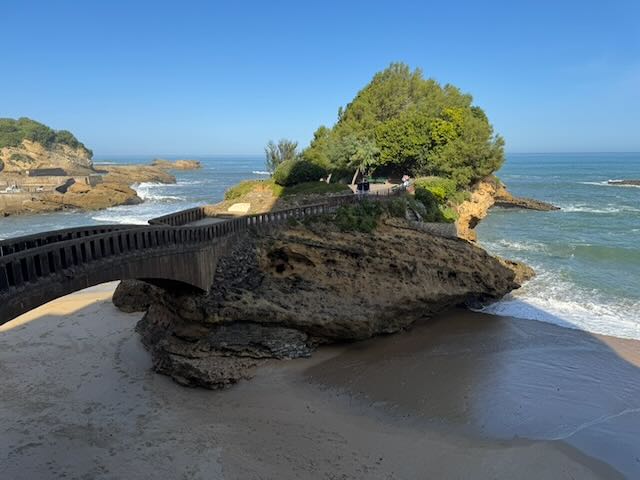
..,,,Rocher de la Vierge
A website promoting Biarritz says, “You may not know it, but Biarritz is the birthplace of surfing in France and even in Europe. The discipline, which arrived at the end of the 50s thanks to a filming on the Basque coast, aroused the curiosity of a few young locals who played the pioneers.”
Saint-Jean-de-Luz
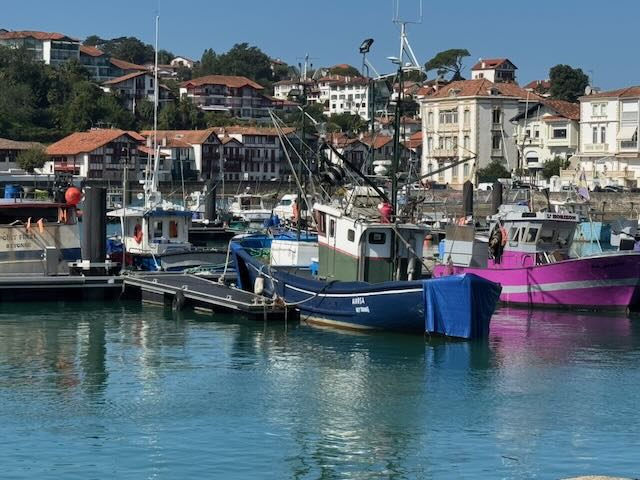
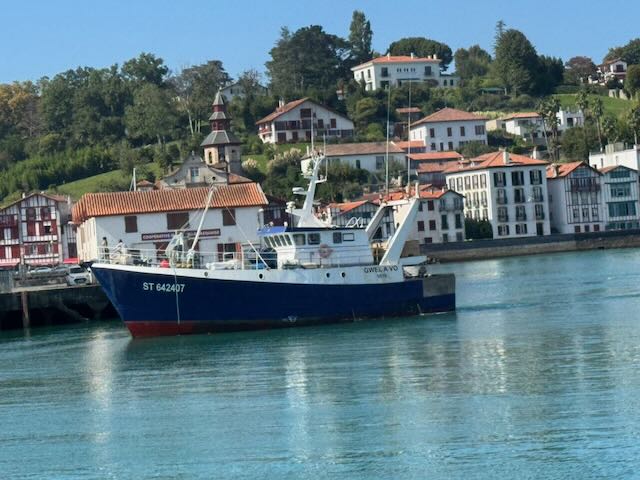
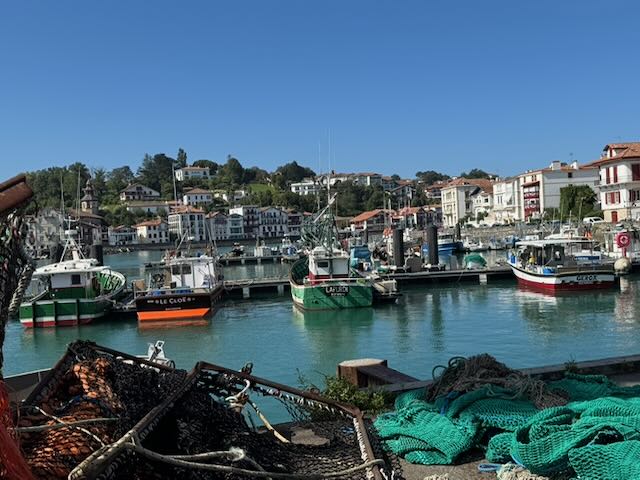
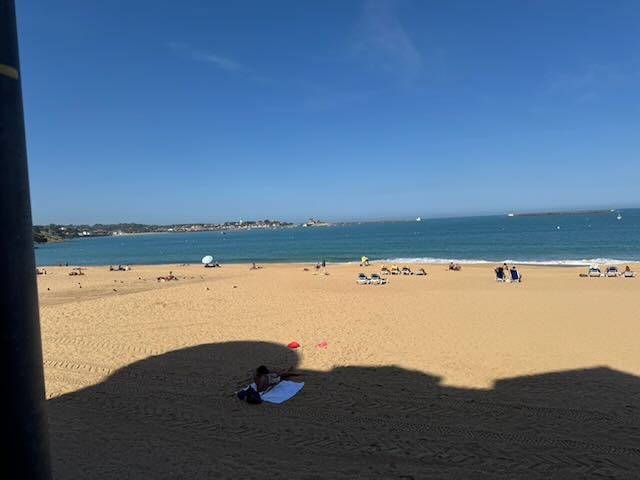
We had lunch in Saint-Jean-de-Luz, which was also lovely. It is a busy fishing town, and the harbour is particularly picturesque.
......
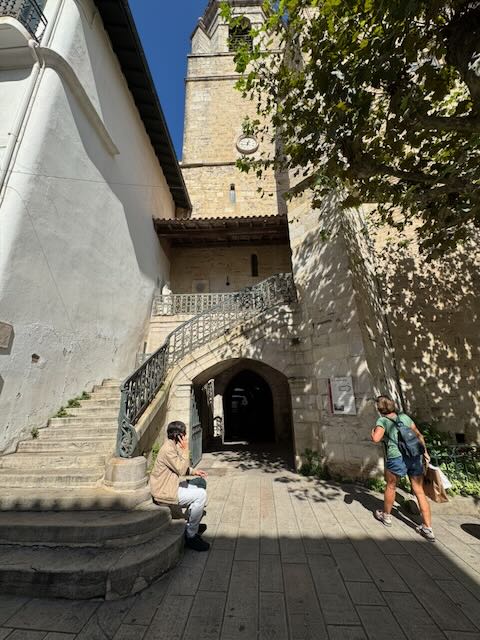
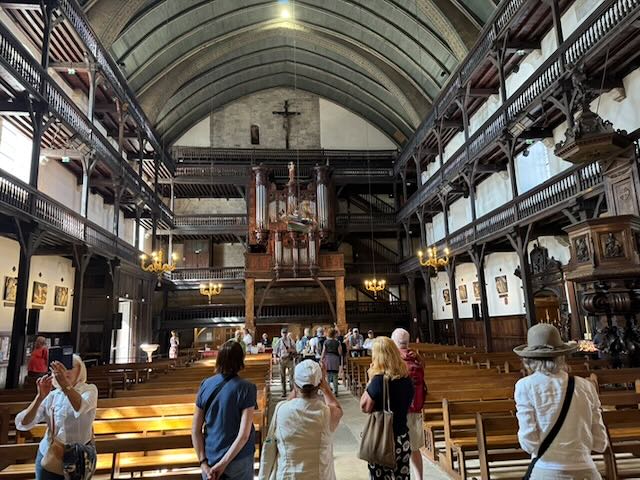
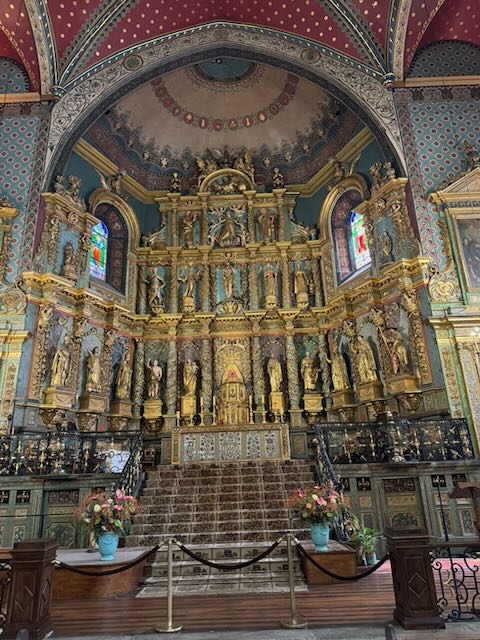
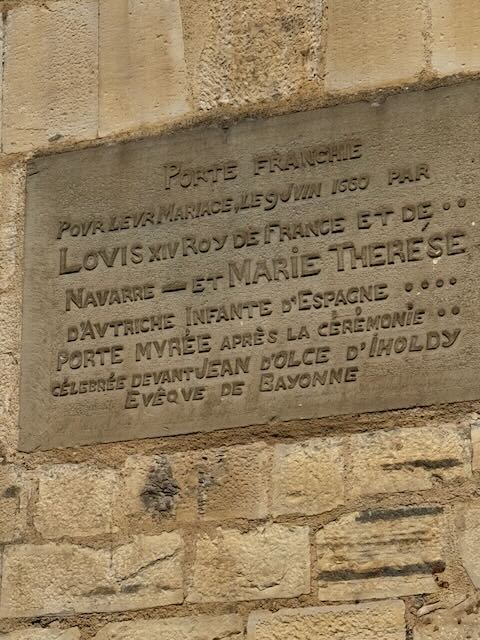
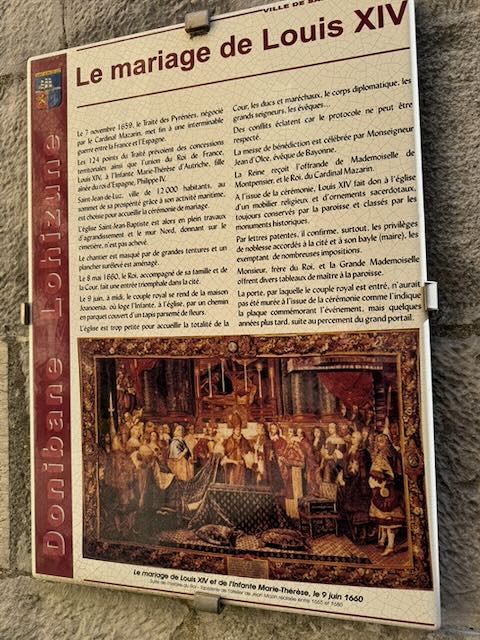
Saint-Jean-de-Luz is the location of the church where Louis XIV, the “Sun King,” married Spanish princess Maria Theresa (another Hapsburg. They really were everywhere) in 1660. This marriage marked the end of the Franco-Spanish War (1635–1659) – but of course one thing always leads to another, and French control of Spain ultimately led to the War of the Spanish Succession, which extended from 1701 to 1714).
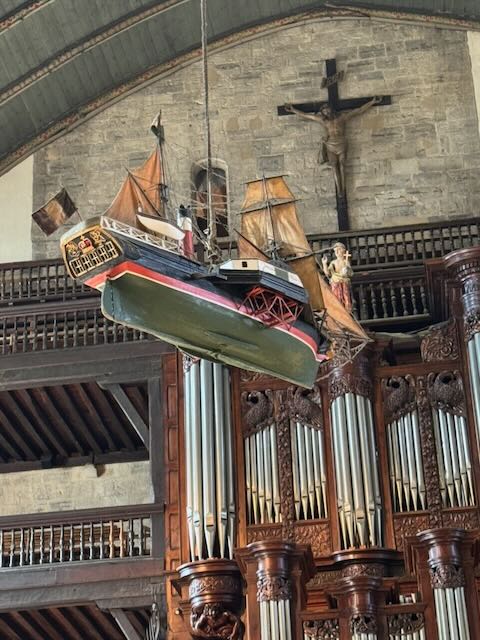
.The suspended ship is an ex-voto, a traditional offering made by sailors or their families to seek divine protection or give thanks for surviving a peril at seaChurch of Saint-Jean-Baptiste...
Louis XIV adopted the sun as his personal emblem, “symbolizing [according to the AI summary] his absolute power and centrality to France, much like the sun is the center of the universe, a concept reinforced by his self-styled image as the source of all light, life, and order in his kingdom, famously depicted as the Greek god Apollo.” Sounds familiar.
The next destination on our Northern Spain tour was San Sebastián (“Donostia” in Basque), where we would spend two nights. My mind was already immersed in the area because as the bus carried us from one city to another, I’d been reading Homeland by Fernando Aramburu, translated from the Spanish (in which language the novel is called Patria) by Alfred MacAdam. Set in an imaginary small Basque town in the hills near San Sebastián, Homeland’s other major setting – the city itself – provides a real-life anchor for the novel.
...On the road between Pamplona and San Sebastián
I liked Homeland very much (more on both it and the Basques below), but it did not prepare me for the beauty of the city.
Monte Igueldo
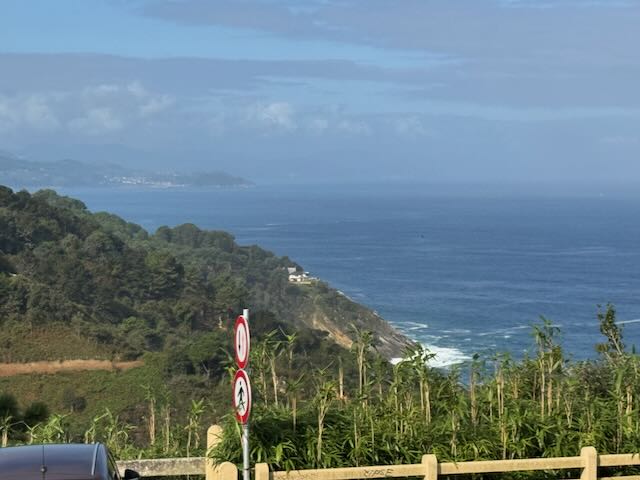
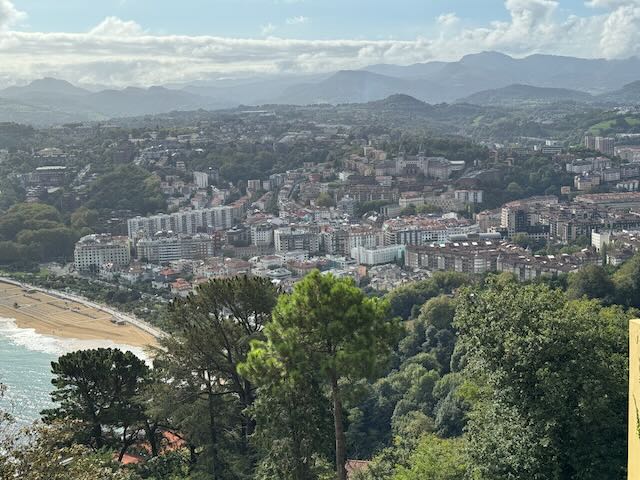
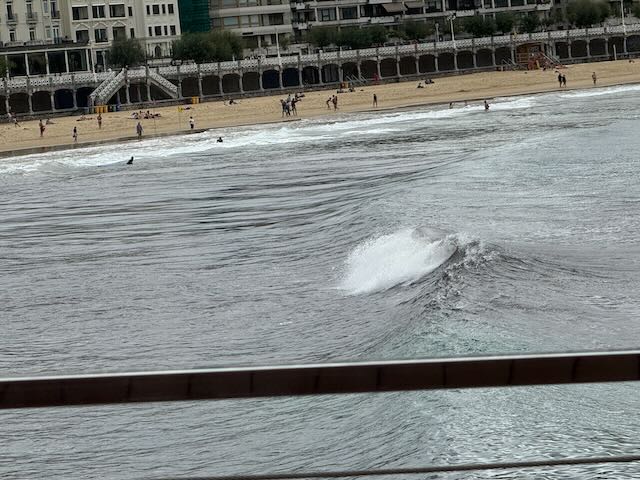
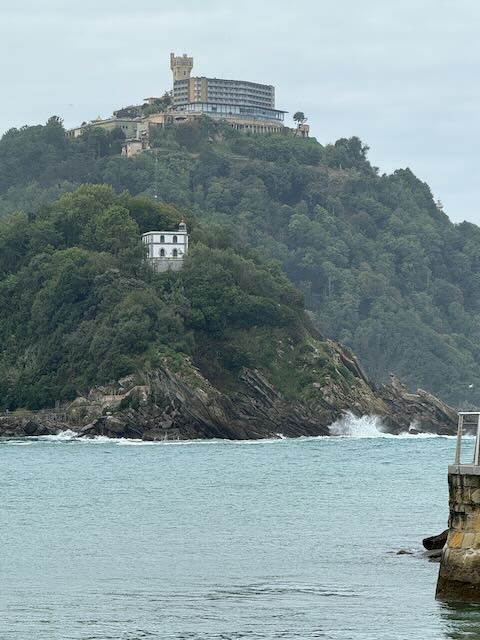
Our first stop was the Monte Igueldo Amusement Park, which overlooks San Sebastián from atop a high hill to the east of it. The park opened with a funicular and a ballroom in 1912, and it has been offering rides and other family-friendly activities ever since. We arrived before the park was open for the day, so it was wonderfully quiet. We were able to hear the breaking of the huge waves from the Bay of Biscay on the rocks below.
...San Sebastián from aboveSailboats in the harbourLooking north at the Bay of Biscay
The Bay of Biscay below Monte Igueldo
Panorama
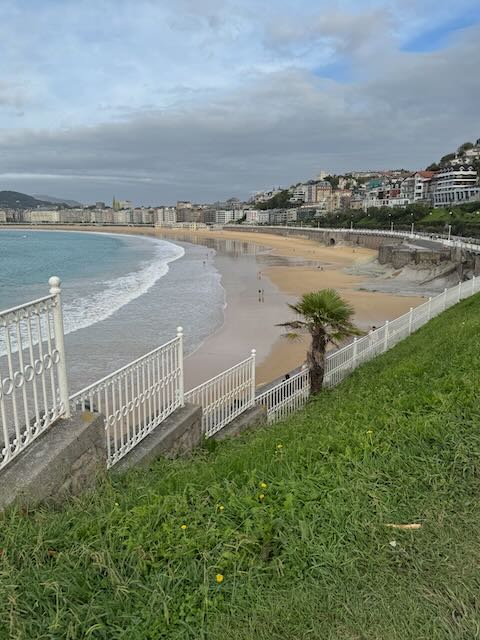
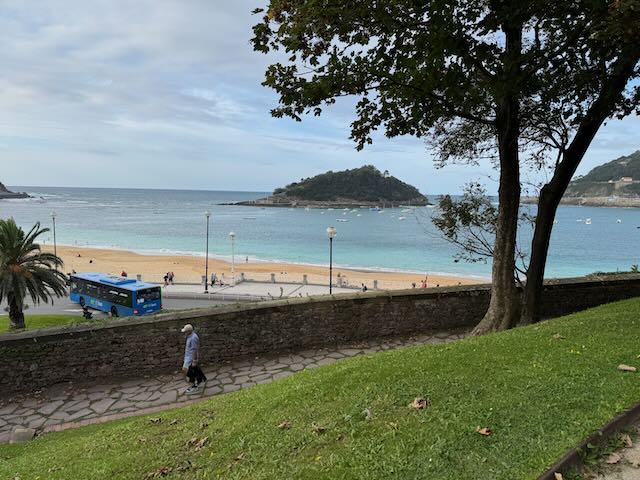
Thanks to Aramburu’s novel, I did immediately recognized the lovely curve of Playa de la Concha, the shell-shaped beach that is one of San Sebastián’s most celebrated features and, not far from shore, Santa Clara Island, which provides the city with shelter from ocean storms.
Santa Clara Island..
The city and the beach are as lovely close up as they are from far above.
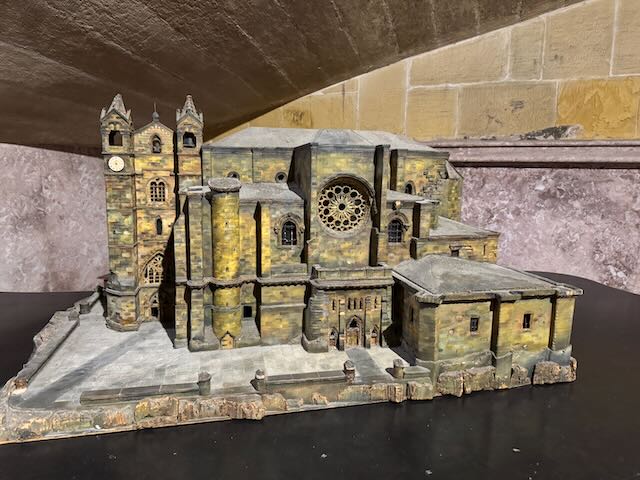
Maria Christina HotelIn Gipuzkoa PlazaBasilica de Santa Maria del CoroWater Fountain Model of the Church of San Vicente MártirInterior San VicentePlaza de la ConstitutiónThe plaza was historically used as a bullfighting ring, and the numbers indicate spectator boxes, not room numbers
Maria Christina and Mirador
One of the most cherished figures in San Sebastián history is Maria Christina Henriette Desideria Felicitas Raineria of Austria (her family called her Christa; 1858–1929). As the second wife of Alfonso XII (1857-1885), she became queen consort in 1879. She had two daughters almost immediately (1880 and 1882), but she was encouraged by her husband and his family to try again in the hope that she would produce a son. This she did, but the boy was not born until after his father died – at the age of only 28 – in 1885. Maria Christina was queen regent from the time of Alfonso’s death until her son (Alfonso XIII) came of age in 1902.
Maria Christina was a member of the Habsburg dynasty, the huge and ultimately massively inbred family that reigned in one way or another from the middle ages to the early modern era over more land than any other royal family in the world has ever done. (I am now reading a book about them. One thing always leads to another.) Their domain included massive territories in Europe (including the Holy Roman Empire and Spain) but also several countries in the New World. Maria Christina, who apparently – unlike many of her cousins – did not suffer from any of the disabilities that can arise from all that inbreeding, gave up her Habsburg rights upon her marriage to Alfonso, who was more interested in producing his own heir than in extending the Habsburg line.
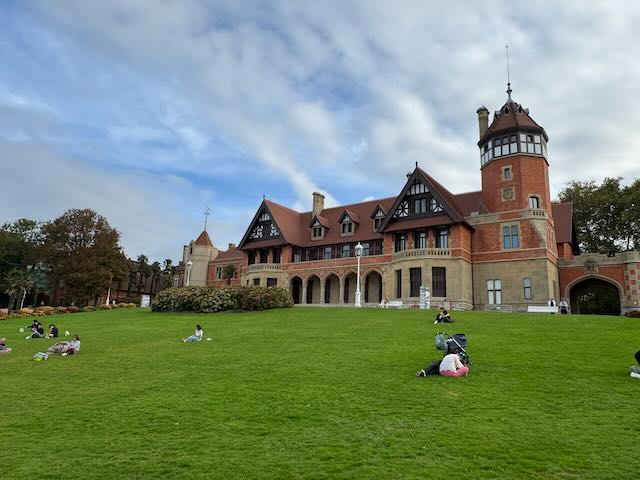
Like me, Maria Christina fell in love with San Sebastián the first time she saw it. She ultimately purchased seafront property and had a summer residence built there, named Miramar, to which she returned for 40 summers. Since the city fell in love with her, too, a hotel, a bridge, and a lot of other things are named after her. (That last part did not happen to me.)
MiramarView from MiramarSanta Clara Island as seen from Miramar.
One of the signs at Miramar says:
“[…]They enjoyed their stay in San Sebastian to such an extent, with sea air and country strolls, Jai Alai games and fireworks, and especially the tranquillity of a city with scarcely any protocol, that she expressed interest in returning the following year.” […] “Her affable nature earned her the affection of the city’s inhabitants and she even grew familiar with the Basque language. She was the best ambassador the city could have, and there was no cause in San Sebastián that she did not support in [the capital] Madrid.”
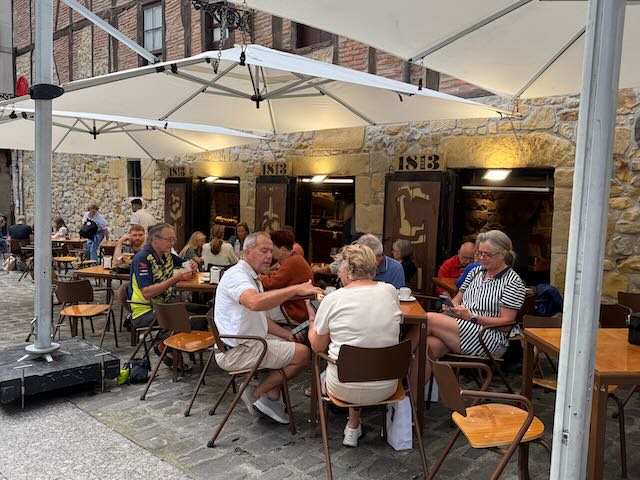
Seafood offerings in a market Pelota is a fast and dangerous game l with a ball that has been played in the Basque region since the 1300sLovely spot near the main square, where we had lunchWire ArtEach September, San Sebastián hosts an international film festival.
The Basques
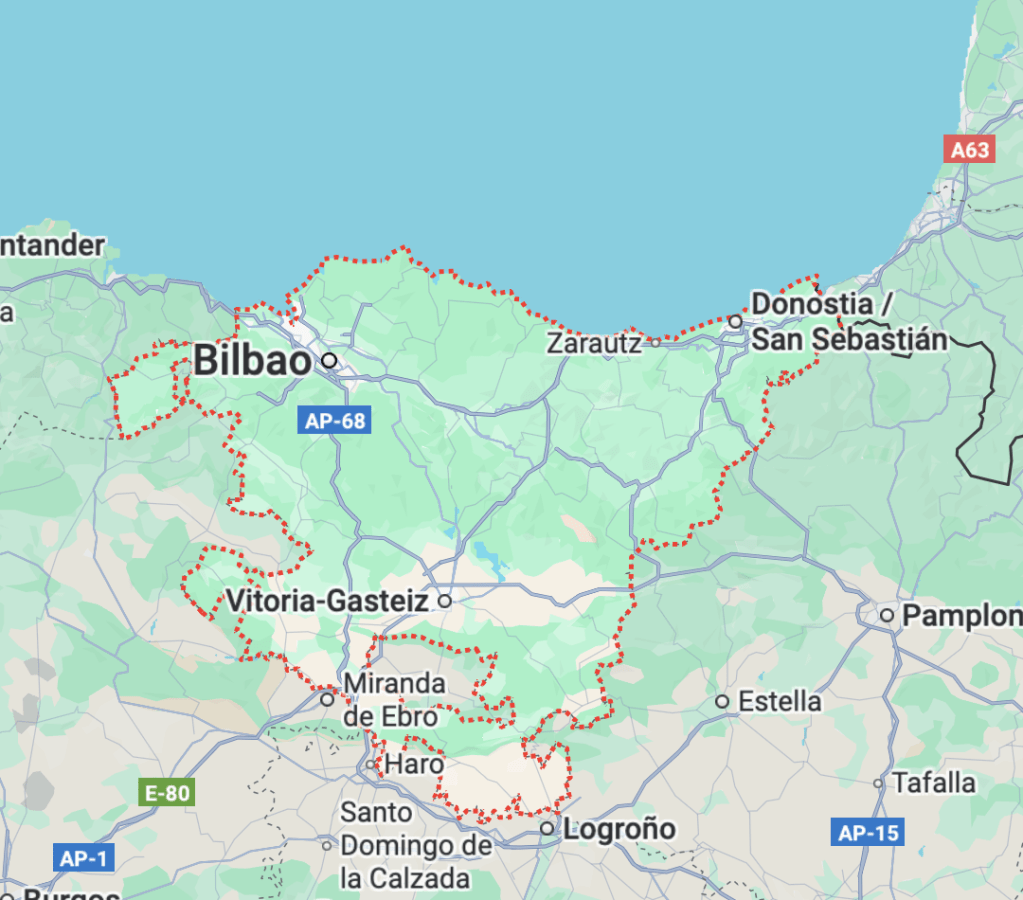
“Euskadi” is the official name for the Basque Autonomous Community in Spain, which includes the provinces of Álava, Biscay, and Gipuzko. San Sebastián is the capital of the province of Gipuzko. Approximately 500,000 people live in the metropolitan area of Donostia (San Sebastián), 180,000 in the city itself, and approximately half of these people identify as Basque.
For centuries, the Basques had a distinct culture in parts of Spain and France, with their own customs and language; in fact, the Basque language has no known connection with any other language in the world. The Basque region was independent until the 19th century but as the governments of France and Spain attempted to suppress and assimilate the group, Basque resistance grew. During the Franco regime, the situation intensified when the dictatorship focused efforts on complete elimination of the Basque language, culture and political activity. (“During the Spanish Civil War, Nazi German Luftwaffe carried out the bombing of Guernica (Gernika) on behalf of Franco’s forces in 1937 — a traumatic event that symbolized the brutal repression of Basque identity.” Wikipedia)
I had heard of the Basques on the news during the long period of conflict between the Basque National Independence Movement (Euskadi Ta Askatasuna, or ETA) and the governments of Spain and France. The period of active resistance lasted from 1959 through 2011, and resulted in the deaths of more than 800 people. (Visit Wikipedia for information.) The ETA was declared a terrorist organization for many years by several countries due to its armed guerrilla tactics. It was not until democracy had come to Spain that Basque Country was granted the status of “nationality,” in 1978. On 20 October 2011, ETA announced a “definitive cessation of its armed activity.”
Basque region of SpainBasque region of France
Basques (most of whom were not involved in actual revolutionary activities) continue to take deserved pride in their language, cuisine and culture, their heritage and history. The language is now taught in schools and it is estimated that nearly half of the residents of the Basque region speak it, often fluently.
Homeland: A Novel
The primary characters in Homeland are Bittori and Txato, a couple living in a small Basque town who are lifelong friends with another couple, Miren and Joxian. The bonds between the families are torn apart when Txato is murdered by the ETA, an organization that Miren and Joxian’s son Joxi Mare has recently joined. These four characters are all sympathetic and wonderfully delineated, as are Bittori and Txato’s adult children Xabier (a doctor in San Sebastian) and Nerea, a business woman who has lived for several years in London, and also Miren and Joxian’s younger son, Gorka. All of their lives and relationships have been badly damaged by the murder, and their situation and its implications demonstrate the kind of effect the conflict had on actual families who lived in the region during the uprising.
Now that I’ve read it, I have recommended Homelandto others several times, and for a variety of reasons. On one level it is a domestic drama set in a time of political conflict, and its specific insights into the uprising in the region at the time. Homeland was a best-selling novel in Spain and was made into a very popular tv series. The novel was described by the Dublin Literary Award, for which it was nominated in 2011, “A work of nearly unbearable suspense […] a searing examination of truth, reconciliation, and coming to terms with history.”
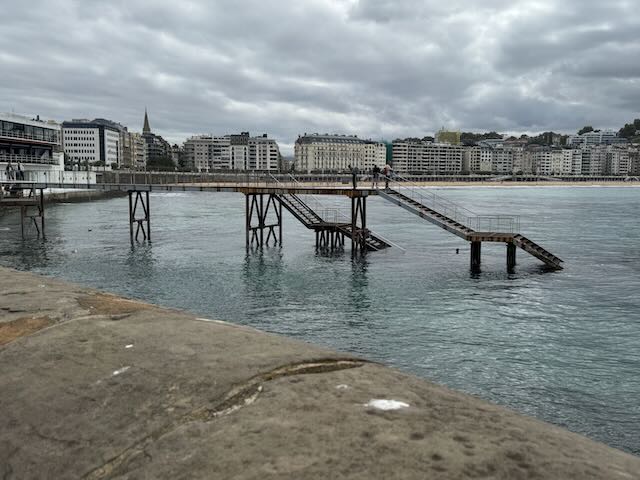
San Sebastián HarbourMullet, I think..There were surfers at La Concha beach.
Some of the destinations on our Trafalgar Tour of Northern Spain seemed more incidental than essential. This was probably true in part because I was not there as a pilgrim, seeking out specific sacred sites. Zaragoza, for example, was just over half way between Barcelona and Pamplona – our ultimate destination for the day – so it was a natural place to pause for lunch and a stretch. But unlike Pamplona itself – or San Sebastian, or Bilbao further down the road – I couldn’t imagine that too many people would put Zaragoza on a list entitled “Places I want to see in Spain.”
As it turned out, the lesser-known (to me) centres we visited on this tour offered a whole range of fascinating historical, cultural, geographical and even culinary marvels. From those experiences, plus information I’ve acquired about other parts of Spain before and since (e.g., the other day I read somewhere about the Aranjuez Palace near Madrid, which looks quite spectacular), I have come to understand that no matter where you go, you are probably going to find some really interesting stuff to look at. Rather than making me want to get back on the bus so we could move on to the next notable destination, such places just made me wish we had about a year to poke around to see the stuff in Spain that isn’t in the tourist books as well as the stuff that is.
The Bus Trip
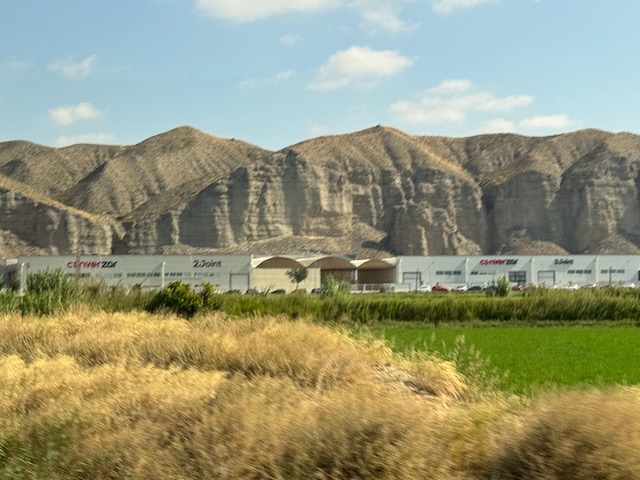
Zaragoza is about three hours from Barcelona, and about two hours from Pamplona. While recognizing that the very definition of “tour” involves the process of getting from one place to another, some people in our group did not enjoy the long travel days on our agenda. (Happily for one woman who was prone to travel sickness, these were relatively few in number.) I don’t mind spending most of a day on a bus or train: I fill such extended travel time quite contentedly by listening to a book while watching the countryside go by, and occasionally trying to photograph what I see (not always easy through a bus window. The reflection from the window itself often becomes an issue).
This is some of the countryside we saw as we drove from Barcelona to Pamplona.
Zaragoza
Zaragoza is the capital of the autonomous community of Aragon (Spain has 17 autonomous communities as well as two autonomous cities), and is also the capital of Zaragoza, one of three provinces in Aragon. As of 2024, the city’s population was about 680,00 people, which makes it the fourth most populous city in Spain. So while it may not be as famous as Barcelona or Madrid, it’s not exactly a whistle stop.
The city was founded more than 2000 years ago. Among its landmarks, it is known for: its Roman foundations; the Aljaferi Palace, a unique example of Islamic architecture that was built in the 11th century and is still in use as a government building; its Aragonese food and nightlife; and (especially) for the colossal Basilica del Pilar, a baroque cathedral with multiple domes and a shrine to the Virgin Mary. Thousands of pilgrims do make this a destination every year.
We did not see the Roman ruins or the palace, but during our visit we had time to wander some of the streets of Zaragoza, enjoy a delicious lunch at a kebab-felafel restaurant, and see the interior of the basilica.
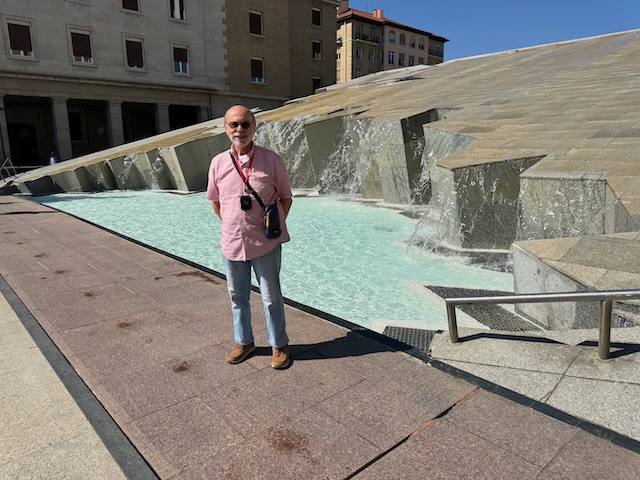
Basilica del Pilar..Down for cleaning. Not a job I’d want...Such clean streets!Fuente de la Hispanidad (Fountain of Hispanicity) in Zaragoza, and ArnieAtlas got nothin’ on me.
Pamplona
In each town or city we visited, a “local specialist” took over the microphone from our travel director, Celia, and in almost every case these people were excellent resources – interesting, patient, and deeply steeped in knowledge about their particular regions. This is one of the initiatives Trafalgar has instituted (as, I am sure, have most reputable tour companies) to funnel some of the money paid by travellers into local communities. Other such practices include patronizing local restaurants and businesses, and making time at most stops for groups to visit local shops.
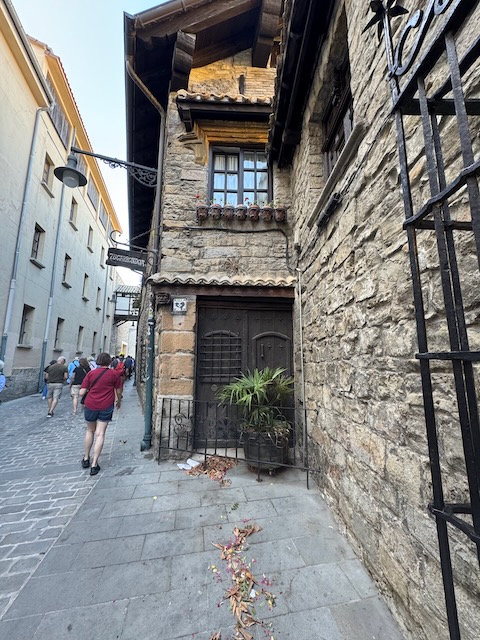
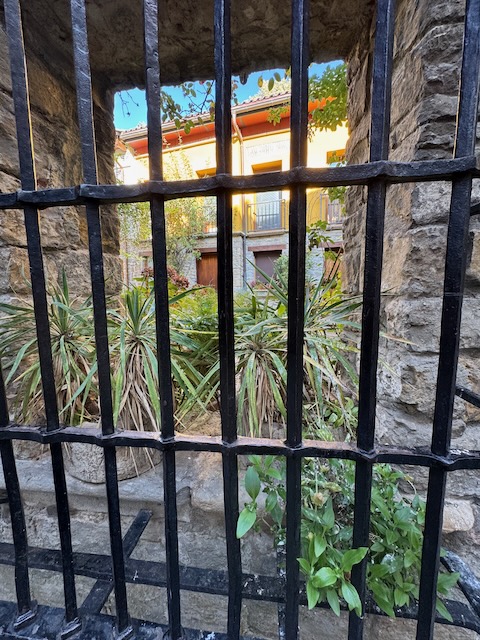
The Citadel, a renaissance military fort in PamplonaDrawbridge at the Citadel“Iruña” is the Basque word for “Pamplona”The house is behind a wallBut there’s a window to the garden.
The specialist who guided us around Pamplona told us that the city’s residents credit Ernest Hemingway with putting Pamplona on the map. Indeed, I expect that I first heard of Pamplona when I read The Sun Also Rises in university. (I’ve just finished listening to it again on Audible, read by William Hurt. Hurt has the dry, uninterested voice that is perfect for Hemingway’s prose. I’d forgotten most of the plot, and I’d also forgotten that Hemingway was a racist antisemite, among his other flaws. Which is too bad because his evocations of Pamplona, San Sebastian, Biarritz and other places we visited, not to mention his tormented characters, are masterfully done, but I doubt most self-respecting readers want to put up with his debased and ugly biases any more.) Everywhere you look in Pamplona, the memory of Hemingway is interwoven with the story of the city.
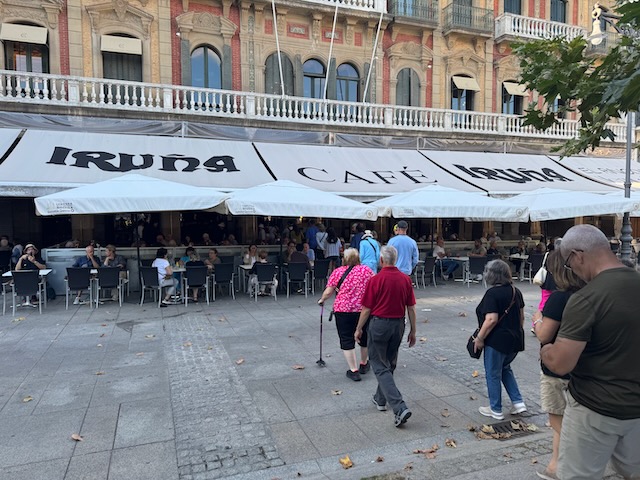
Hemingway statue near bull ringA street named after HemingwayIruna Cafe, which is one of the notable settings in The Sun Also RisesInterior of Cafe Iruna..
The Bulls
When his book was published to great acclaim in 1926, Hemingway brought the literary world’s attention not only to Pamplona, but also of course to its bullfights and to the annual encierro de toros (better known in English as “the running of the bulls”). Largely thanks to him, every year thousands upon thousands of tourists come to the city during the Feast of Saint Fermin (July 7 to 14) to watch the spectacle unfold – and often even to participate. The fiesta is an important contributor to Pamplona’s economy.
Each morning during the fiesta, at least six bulls and six steers are sent running along a short route through the streets of Pamplona to the bullfighting arena. There, the bulls are penned up until it is their turn to “participate” in the bullfighting event that takes place later in the day. Every year, thousands of tourists and locals try to outrun the bulls during the encierro. Since the bulls are running at 25 k per hour (about 15 mph), staying ahead of them is no mean feat, and those foolish enough to actually allow themselves to be chased typically run out of oomph and make their escape from the fenced-off running corridor after only a few metres.
Our group was invited to guess how many of the two to four thousand people who have attempted to run with the bulls each day since Hemingway made the activity famous in the 1920s have been killed. Guesses were mostly more than a hundred. Turns out the number is 12. Their names are carved on the base of the “Monumento al Encierro,” a statue by Rafael Huerta that depicts the annual event. Many more than 12 have, of course, been injured, many seriously.
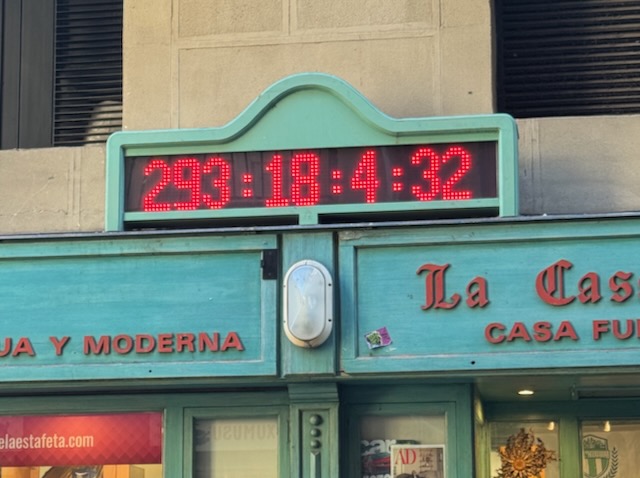
Monumento al EncierroThere are depictions everywhere in Pamplona of the events held during the Fiesta de San Fermin.The Bullfight RingIt wasn’t open when we were there. Fine with us.A flag protesting bullfightsAs soon as the Fiesta ends on July 14, Pamplona starts the countdown to the next one
El encierro de toros has been part of the local culture for hundreds of years, and evolved (as did the spectacle of bullfighting) from the annual herding of the bulls to market through the city’s streets. Our local specialist suggested that the custom came about when some bright bull breeder realized that it was cheaper and easier to get the beef to market on foot rather than by trying to transport the huge animals on wagons.
At the end of the encierro, the steers (who are used like pilot boats; they are veterans of previous corrida and know their way through the city to the bull ring) are sent back home, and the bulls are corralled in stalls in the bullfighting arena. Later in the day, they are confronted in a battle to the death by matadors and their attendant picadores, rejoneadores, and banderilleros, the latter three groups being lesser participants in the bullfight who help to wear the animal out in preparation for the kill.
Bullfighting occurs not only in Spain and Portugal (as it has in one form or another since prehistoric times), but also in Mexico and several South American countries. If you are interested in learning more about the actual bullfight, there are plenty of resources available, such as this write-up on Wikipedia, but I don’t want to read them or see any videos that may be available, so you are on your own. Thanks in part to the work of a number of animal welfare activist groups, bullfighting is now banned in several regions of Spain, Mexico and South America, and attendance at such events grows smaller every year so maybe one day they will be only another unwelcome historic memory.
Pamplona Cathedral.City Hall sporting the flags of Europe, Spain, the Autonomous Community of Navarre and the Ciity of Pamplona..Church of San Lorenzo, in which the San Fermin chapel is located.Pamplona’s main square, la Plaza de Castillo
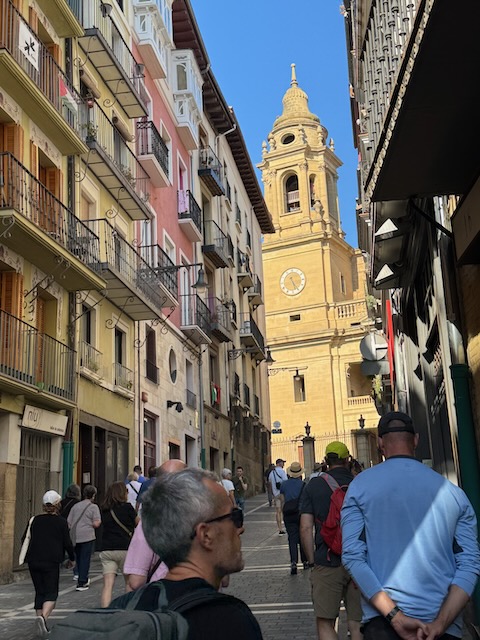
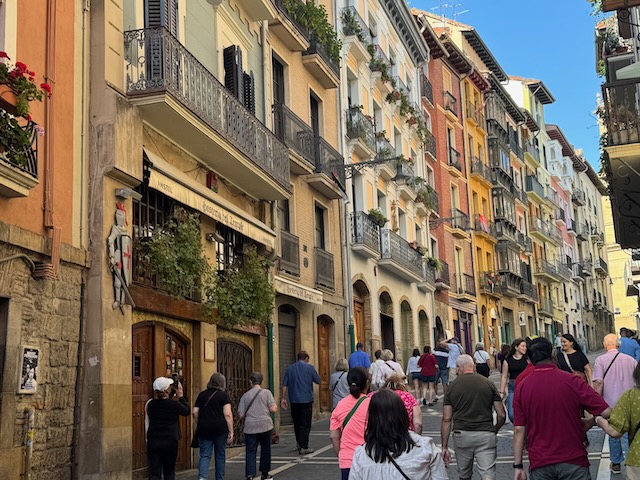
Pamplona is a lovely city (and again, so clean!). With our guide, we wandered the famous streets, and saw La Ciudadela (a Renaissance military fort built in the 16th and 17th centuries, which is now a park). Then we settled into the Iriba, the café and watering hole that features largely in Hemingway’s novel The Sun Also Rises. The cafe has been preserved very much the way Hemingway would have known it. There we were treated to a drink (appropriate since Hemingway was a notorious drunk. I had lemonade) and an assortment of tasty tapas.
Signs and Symbols
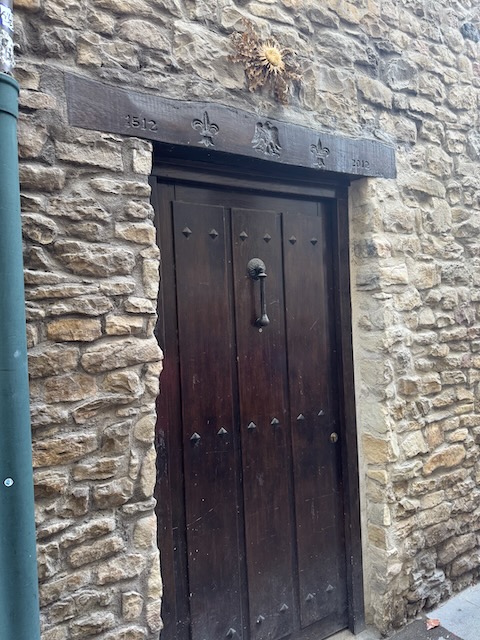
It is a custom in Pamplona to mount a dried flower over doors of homes and shops to keep evil away. The ornament looks like a sunflower, and indeed it is called an eguzkilore, which is the Basque word for “flower of the sun.” However, this traditional protective symbol is actually the dried bloom of the wild thistle Carlina acaulis or Carlina acanthifolia.
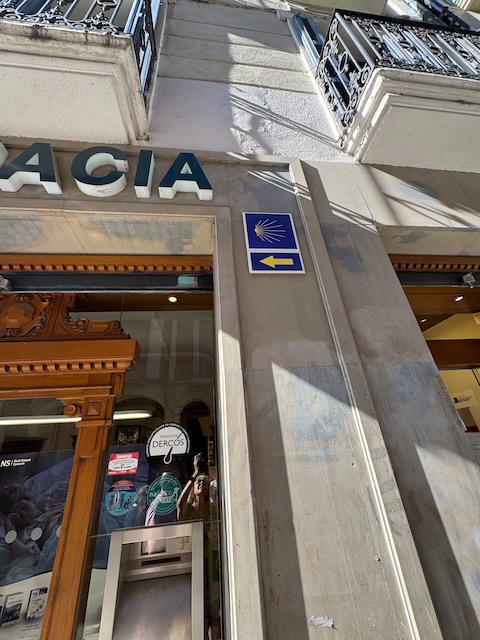
The scallop shell symbol that is seen all over Spain indicates that you are on one of the many roads (caminos) to Santiago de Compostela in northwest Spain, where it is believed that Saint James is buried. Santiago de Compostela is a sacred destination for thousands of pilgrims, most of whom travel to it on foot each year from all of the regions of Spain, Portugal, France and other countries. (More on that later.) As you can see from the blue and yellow sign, the hinge of the scallop shell, where the radiant lines meet, serves as a pointer in the direction of the holy site. One of our guides explained that the symbol not only offers directions, but reflects the way in which pilgrims from all around the world meet at the sacred destination.
Note the protective eguzkilore mounted above the doorThe scallop shell symbol on a wall.And one in the pavement..The large round plaque marks the spot where, it is traditionally believed, Saint Saturninas, Pamplona’s patron saint, retrieved the water that was used to baptize the first Christians of the city.
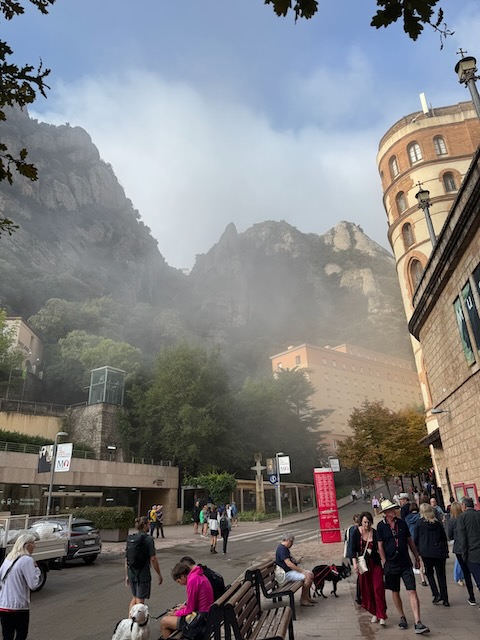
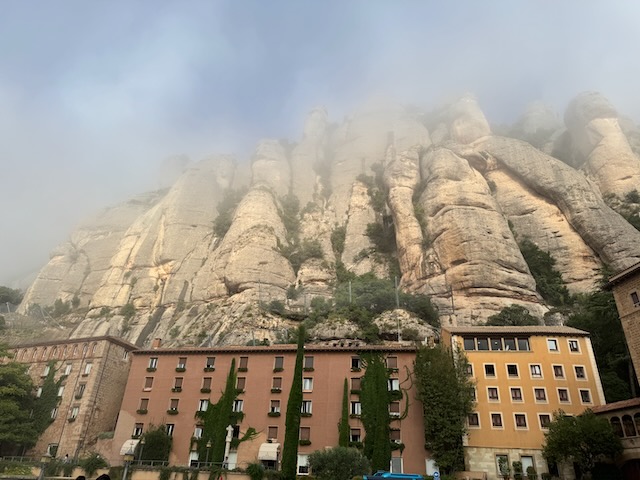
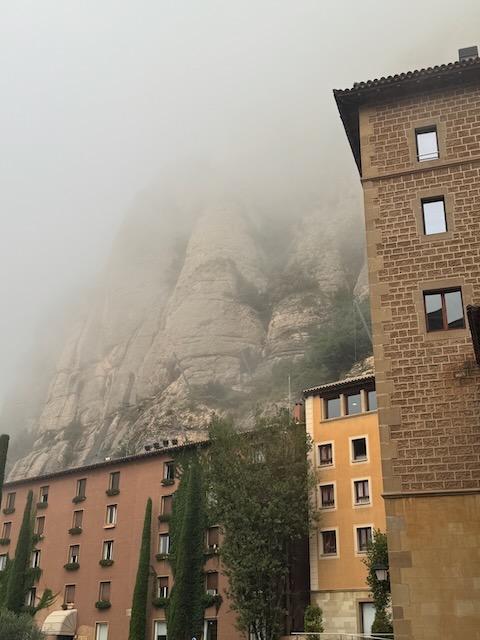
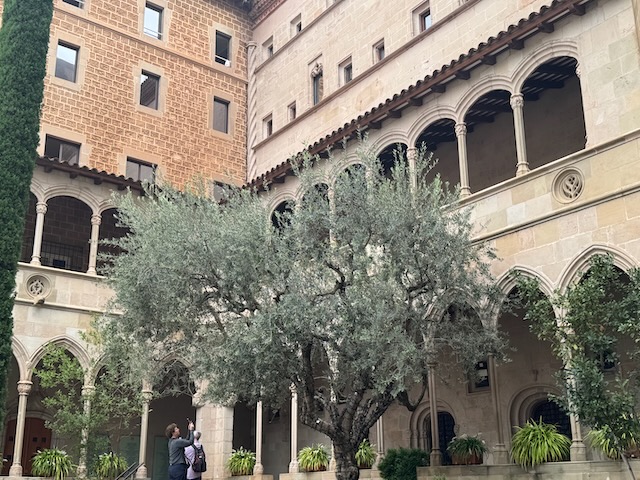
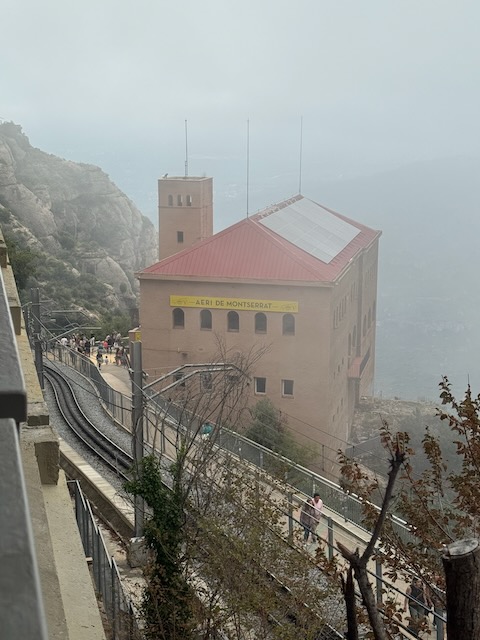
Traces of sunlight through mist and fog put the magical final touches to this excursion. At first we were disappointed to drive into low-hanging clouds as we ascended the mountains northwest of Barcelona toward the Benedictine abbey that was our destination. But in the end, instead of forming an opaque blanket, the clouds fell into shifting curtains of mist that revealed what was ahead of us, behind us, beside us for a few moments or minutes, then hid it away again. It was a haunting, almost otherworldly experience.
Montserrat
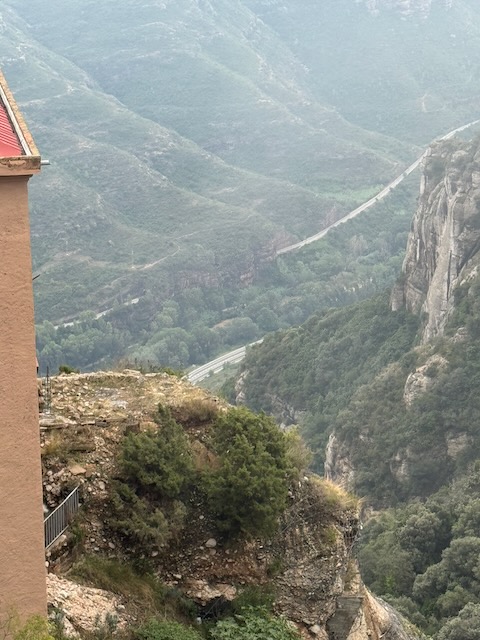
Montserrat (“serrated mountain”), the site of the Benedictine abbey Santa Maria de Montserrat, with its famous “Black Madonna” statue, is located in the Catalan Pre-Coastal Range about 45 km northwest of Barcelona. It is composed of a type of sedimentary rock called “pink conglomerate” that is formed from a mixture of hard and soft fragments including pebbles, gravel and sand, held together with a fine-grained binding compound. Over millennia, erosion – or, more specifically, the ability of this particular rock combination to partially resist it – has given Montserrat a stunningly distinctive appearance, more evocative of the limbs and digits of huge living creatures than of the jagged rock formations they actually are.
I couldn’t stop taking photos of these amazing land formations. They astonished me.
“Montserrat Mountain […] gives the appearance of being higher than it actually is, due to the fact that it rises straight up from the Llobregat River. There are no other mountains in its vicinity that come close to its height – making it look very distinctive in this part of Catalunya” (From the very useful Montserrat Tourist Guide).
The Funicular at Montserrat
The Benedictine Monastery
It is believed that it was during the ninth century that a group of solitary monks – of the variety that don’t talk to one another – started building the chapels that formed the foundations of the Santa Maria Abbey. Little of their work remains, although one of the original chapels – St. Iscle – can still be visited. (I just found this out today, so I didn’t get there in September. Adding it to my list of things to go back and see next time.)
Between the eleventh and thirteenth century, the monastery was officially established with the construction of a church in the Romanesque style, and pilgrims began to come to Montserrat. In 1492, one of the monks from the abbey went to the New World with Christopher Columbus, which is how one of the islands in the Lesser Antilles came to be named “Montserrat.”
The history of Montserrat Abbey is not entirely one of a peace cloaked (like the mist on its mountains) in silence and prayer. In 1811, Napoleon’s army destroyed the abbey; subsequently all of the monks but one left when the property was confiscated under new legislation. Reconstruction did not begin until 1858.
The monks were forced to leave again during the Spanish Civil War (1936 – 1939), and during this period 23 monks were killed. The Catalonia government protected the Abbey as much as it could during this period, and after the war, the monks returned and reconstruction continued. The church now standing on the site is Gothic in design.
The Black Madonna
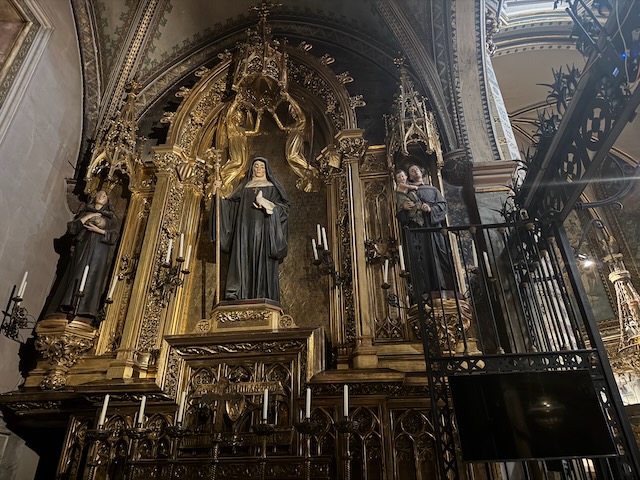
The Black Madonna, or “Black Virgin” as it is also known, has helped to make the Abbey at Montserrat famous.
The statue, which is carved from wood, is located high above the chancel of the abbey. We did not have time to go up to see it, but we caught a glimpse from the main floor. The online tourist guide tells us that the Madonna figure “sits behind a sheet of glass, but one of her hands that is holding a sphere (which symbolises the universe) is not behind the glass. It is tradition for you to kiss or touch the Virgin’s hand whilst opening out your other hand to Jesus.”
The Montserrat statue is only one of many Black Madonnas found around the world, but it is one of the most famous. Some believe that this sculpture was carved in Jerusalem when Christianity was new (possibly even by Saint Luke), was later given as a gift to monks in Barcelona, and then was hidden in a mountain during a century of Muslim rule. It was ultimately rediscovered only thanks to a miracle involving shepherds who saw light coming from a cave. The name “Black Madonna” comes from the colour of the wood, which was not dark when the statue was carved, but has darkened over time. (According to The Internet, historical analysis suggests that this Madonna sculpture is Romanesque, from the late 12th century.)
The Enthronement of the Image of the Mother of God was celebrated in 1947, and since then the Basilica’s restoration has been completed, a museum has been added, and the site has been visited by a Pope (John Paul II). Many people come to Montserrat each year for meditation and prayer, and a large hostel is located just below the abbey to accommodate these pilgrims.
Sculptors and Artists
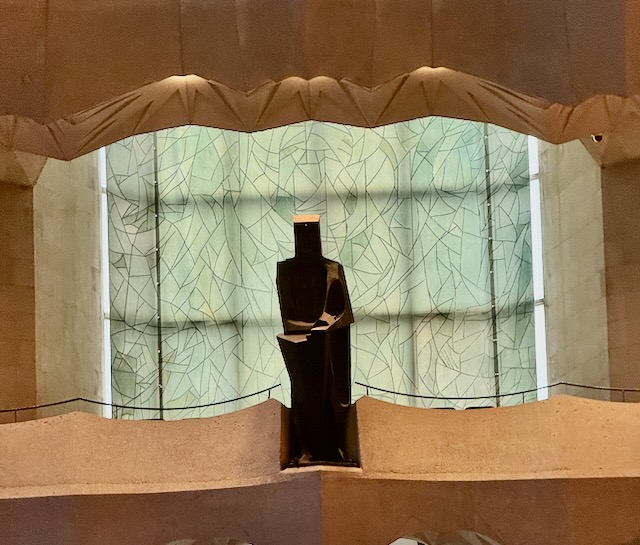
Saint George (Sant Jordi) by Josep Maria Subirachs. Altar del Santíssim, Subirachs, 1977
My interest in sculptors in general and those from the region we visited in particular was extended when I learned that contributions to the Basilica included the chapel of the Image of the Mother of God, which was completed in 1885 under the direction of Francesc de Paula del Villar i Lozano with the assistance of “a young Antoni Gaudí.” We also saw two pieces by my latest favourite Catalan sculptor, Josep Maria Subirachs.
Plaça de Catalunya Casa Milà, also known as La Pedrera, by Antoni Gaudi
After we had returned from Montserrat, we and our Trafalgar group headed out for a bus tour of Barcelona that included a walk around the Sagrada Familia. The day concluded with a lovely dinner at a Barcelona waterfront restaurant in which tapas figured largely. During our travels, I became a big fan of tapas, which are called by other names in other parts of Spain. More on that in another post.
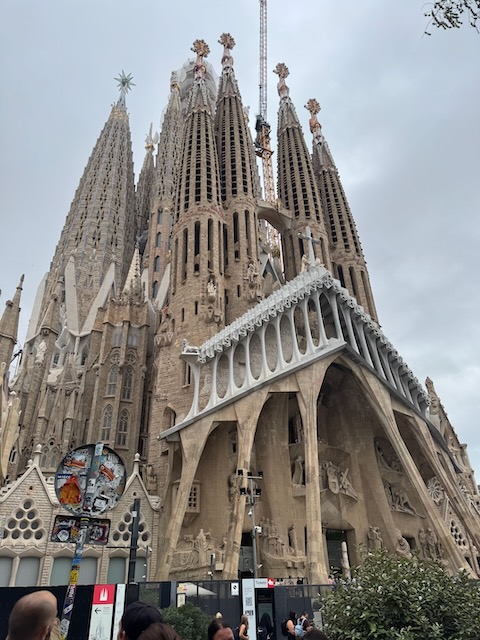
One of our most eagerly anticipated destinations in Spain was The Sagrada Familia, the basilica in Barcelona that was designed and partially built under the direction of the brilliant architect and artist Antoni Gaudi – whose truly distinctive work we had also seen the day before in Park Güell. Gaudi’s designs are also on display in several Barcelona residences, three of which are open for tours (next time!), and other buildings.
The itinerary for the group we were joining later on the 13th for our ten-day tour of Northern Spain would include only a walk-around of The Sagrada Familia, so we booked tickets for earlier in the day so we could take our time and see the interior as well.
Our first sight of The Sagrada Familia when we emerged from the nearest Metro station. In front of us is the Passion Facade, which faces west.
Gaudi began his work on The Sagrada Familia in 1884 and continued until his death in 1926. I was surprised to learn that he was not the first architect to have been selected to design and build the new church. He was appointed to the position only after Francisco de Paula del Villar y Lozano resigned after two years’ work, following a bureaucratic disagreement. Villar had planned a fairly standard neo-gothic church for the site, but Gaudi transformed the project into his magnum opus when he was awarded the position in 1883.
A deeply religious man, Gaudi was already an acclaimed Catalan architect when he took on this assignment. “Gaudí’s work was influenced by his passions in life: architecture, nature, and religion. He considered every detail of his creations and combined crafts such as ceramics, stained glass, wrought ironwork forging and carpentry. He introduced new techniques in the treatment of materials, such as trencadís which used waste ceramic pieces.” (Wikipedia)
Gaudi became so focused on the project that he moved from his house in Park Güell, where nuns had been looking after him, into the cathedral itself. As time went on he increasingly neglected his appearance, his diet, and his hygiene. On June 7, 1926, at the age of 74, Gaudi was walking down a Barcelona street on his way to confession at a nearby church when he was hit by a tram car. Due to his unkempt appearance and the fact that he was carrying no identification, passersby mistook him for a beggar and paid him little attention. Finally someone arranged for him to be transported to a nearby hospital, where he was admitted to the pauper’s ward. It was several days before his assistants at the basilica located and identified him. By then it was too late for him to receive the kind of treatment that might have helped him to survive his injuries, and he died soon after. He is buried in the crypt of his famous cathedral.
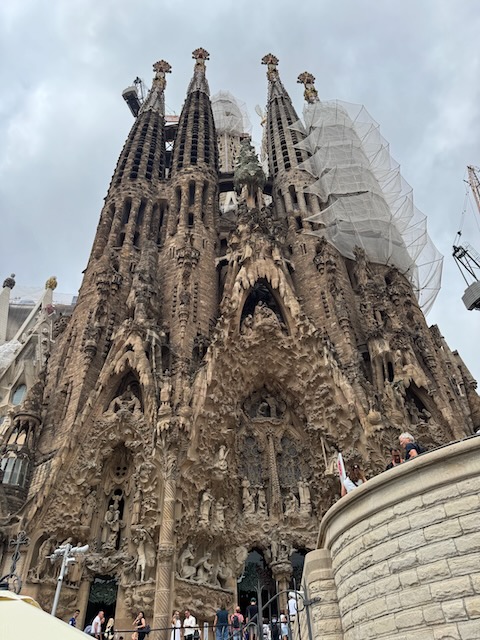
The Sagrada Familia was only about 25% complete when Gaudi died. Aside from a few years during the Spanish Civil War, work has continued ever since, but the cathedral is still not finished. While Gaudi was alive, most of the work on the “Nativity Façade” on the eastern side of the cathedral was completed, and his wishes for the entire project had been outlined. His creation reveals the unique inspiration he found in natural forms and shapes, in his religion, and in his Catalan heritage. His vision still guides the work, despite the contributions of other architects and artists who have created or supervised the realization of various components over the years.
The Cathedral
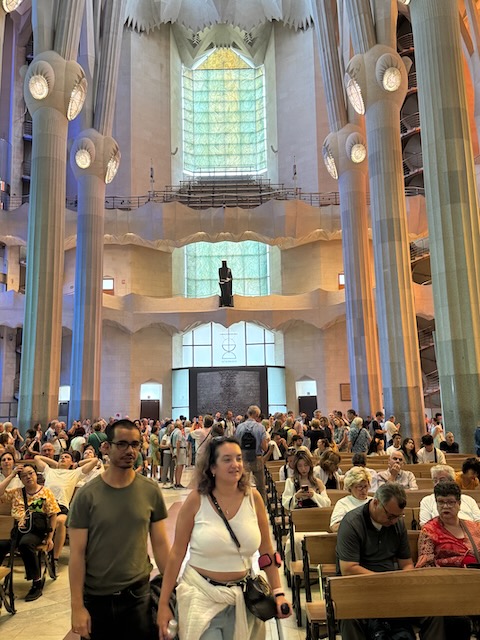
Like many Christian churches, the basic footprint of The Sagrada Familia is oblong, in the shape of a cross. The congregation sits in rows of pews and chairs down the middle of the nave, with the chancel, including the altar, near the top (north) end. A transept crosses the nave just below the chancel and on the east and western exteriors of the transept are doors, or portals. The main entrance, when it is finished, will face south.
Nave facing northNave facing southChancel/altarStained glass windows facing east (sunrise/birth)Stained glass windows facing west (sunset/death)Pillars
As well as supporting the enormous weight of the spires that rise from the cathedral, the columns suggest trees and are finished in various natural colours.
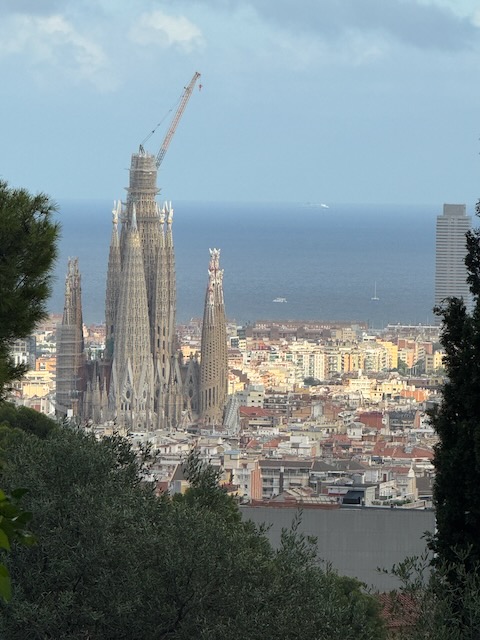
Gaudí’s original design for The Sagrada Familia “called for a total of eighteen spires, representing in ascending order of height the Twelve Apostles, the four Evangelists, the Virgin Mary and, tallest of all, Jesus Christ. Thirteen spires had been completed as of 2023, corresponding to four apostles at the Nativity façade, four apostles at the Passion façade, the four Evangelists, and the Virgin Mary” (Wikipedia). The Jesus Christ spire is due to be finished in 2026. At 172.5 metres with a cross on top, it will make The Sagrada Familia the tallest church in the world. A couple of the towers are open (for an additional fee) to those who wish to climb them (next time!), at which point (I have read) you are rewarded with great views of the city.
The official name of the magnificent structure is “Basílica i Temple Expiatori de la Sagrada Família.” “La Sagrada Familia” means “The Sacred Family.” A “basilica” is a special designation given to a church by the Pope, based on criteria that include its architecture, history and spiritual significance. The Sagrada Familia was consecrated on November 7, 2010 by Pope Benedict XVI, who also designated it a “minor basilica.”
The Nativity Facade
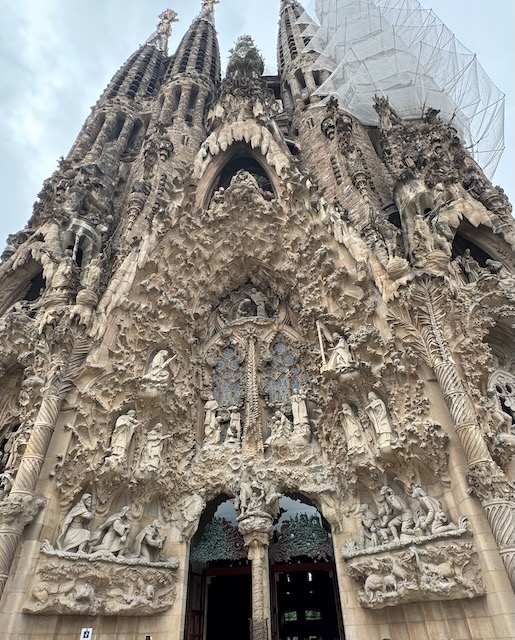
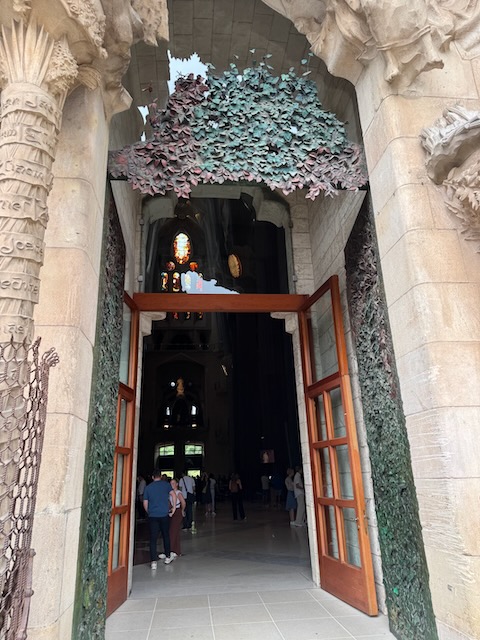
The Nativity Facade was completed first, in 1930. It features three portals (representing faith, hope and love), several towers (representing The Holy Trinity and four of the Apostles), and many decorative carvings and statues. It faces east, in honour of the birth of Jesus Christ, and includes many depictions of Biblical scenes describing Jesus’s early life.
You will notice the sculpture of a cypress tree above the middle portal. It is the symbol of the Tree of Life. A person could spend months tracking down the meanings associated with the adornments that appear everywhere on and in The Sagrada Familia.
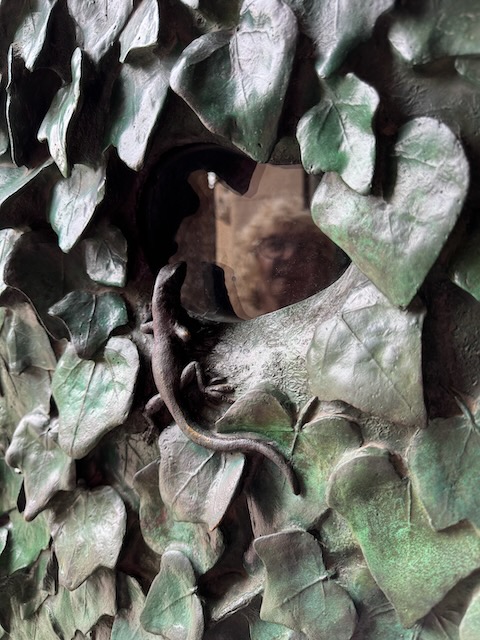
There are little mirrors in the leaves
The Passion Facade
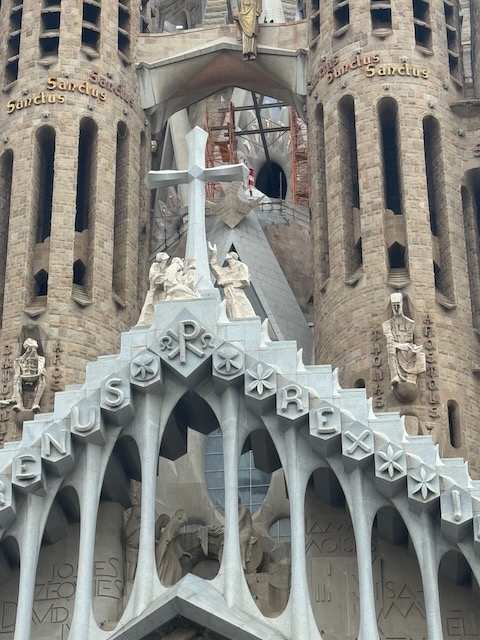
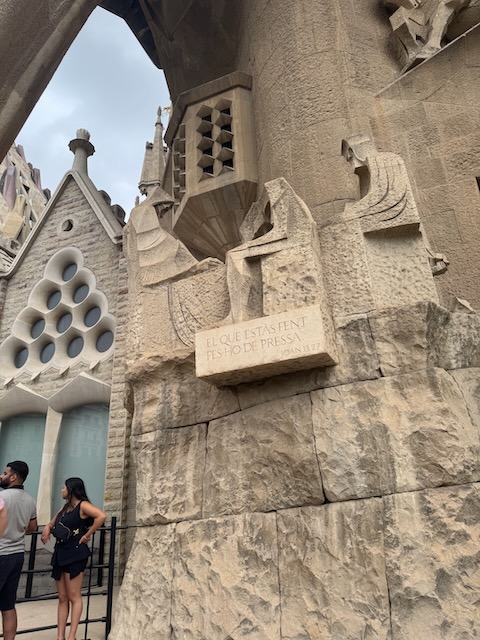
Several of Gaudi’s models for the cathedral were damaged and destroyed during the Spanish Civil War. Their restoration was overseen by Francesc de Paula Quintana, who had been one of Gaudi’s assistants. In 1954, Quintana initiated the construction of the Passion Facade, which Gaudi had instructed should be a stark, skeletal contrast to the rich and detailed Nativity Facade. The “look” is indeed different from the lavish detail that distinguishes The Nativity Facade: it is minimalist, abstract, spare and open. Themes of this facade (which faces west) include the Last Supper, the Way of the Cross, the Crucifixion, and other scenes from Jesus’s final days. Towers honour four more of the apostles.
The Glory Facade
While most of The Sagrada Familia is finally nearing completion, the Glory Facade, which faces south, in which the main entrance will be situated, is not finished. Its design represents the path to eternal glory, including Christ’s final judgement and ascension into heaven. Seven pillars represent the seven deadly sins and seven heavenly virtues.
Subirachs’s sculpture of Saint George
Josep Maria Subirachs (1927 to 2014) was commissioned to create the Glory Portal in 1987, and his distinctive style raised much controversy because his work (expressionist, abstract) is very different from that of Gaudi and the other designers involved with the project. (Note: I have no opinion on whether Subirachs’ designs are appropriate to The Sagrada Familia, but I did develop a great fondness for his work as we travelled through the region and saw several pieces he had done. Dark, haunting and evocative, his work is definitely nothing like Gaudi’s. Watch for his Crucifix in the next post.)
Plans for the construction of The Glory Facade are in conflict with the wishes of Barcelona residents who live nearby – approximately 3000 of whom will need to be relocated if the current plans are executed. With zoning issues as well as construction of the portal still ahead, a completion date in 2026 sounds somewhat optimistic.
The entry fees charged to the 4 to 5 million visitors who visit The Sagrada Familia each year are what pay for the construction. Due to the basilica’s popularity, it is wise to purchase tickets (online) several months in advance of a visit, as they are usually unavailable at the site. (One person told us that if you go to a Sunday morning service, there is no admission charge. But don’t quote me.)
After we returned to the hotel from The Sagrada Familia, we enjoyed a well-earned nap and then, at 5:30 p.m., we met with the others on our tour for the first time, in the hotel’s breakfast room. The group of about forty-five people included four or five other Canadians, a lot of Americans, two people from the UK and a family from the Philippines. Our tour guide’s name was Celia. Originally from Madrid she was extremely knowledgeable, well organized, attentive and personable. I can’t think of how she – or our driver Paolo – could have done anything better than exactly how they did it.
After some introductory remarks (such as a warning that we heard over and over again to keep an eye out for pickpockets in Barcelona), we were handed the headsets that we would use to hear our guides throughout the tour, and our luggage tags. (Our suitcases were collected from outside our room each travel day, loaded onto the bus, and delivered back to us after we arrived at our next destination. The system worked perfectly.)
Then we climbed onto our bus and were driven through Barcelona to a restaurant on a hill above the city. The restaurant where we ate is a community initiative sponsored by the Fundacion Mescladis, that works to train people in vulnerable situations (particularly immigrants) and to prepare them to enter the workforce. The staff was attentive and the food was delicious.
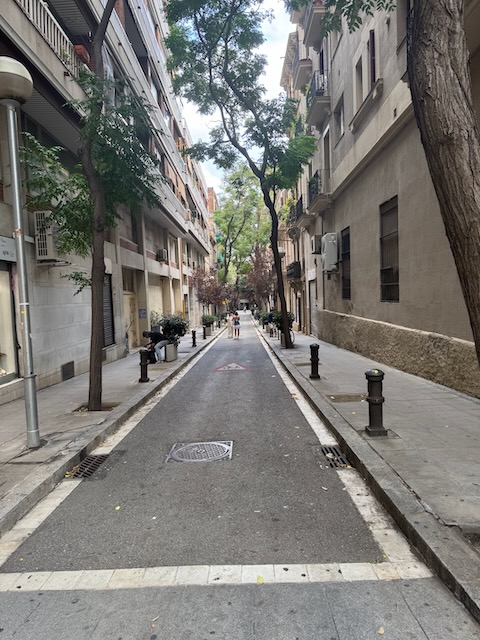
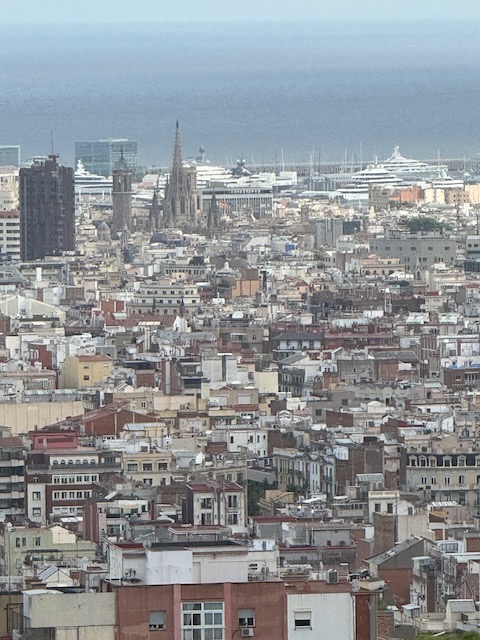
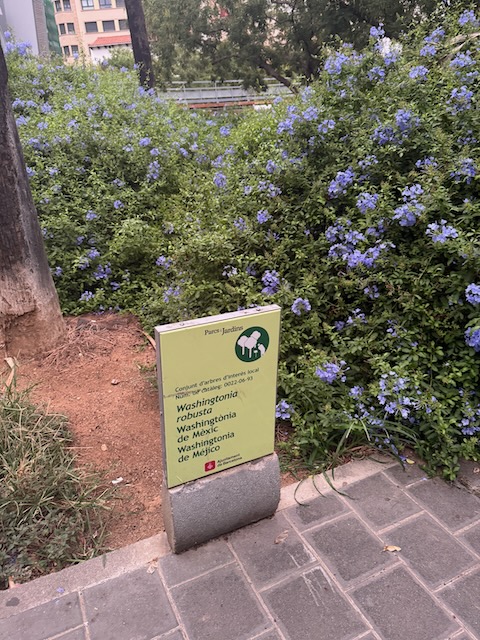
Our Trafalgar Tour busAnother clean and appealing Barcelona streetBottle trees (Brachychiton rupestris)
Last month we went to Spain. Now I’m going to tell you about our trip. It may take me a long time to do all the posts, because the longer I draw out this account, the more time I have to relive each stop we made along our way. Also, I want to get it right, because I have just realized that one or more of my grandkids might be reading these accounts someday, and I want them to know what I saw and what I thought. So I thank you in advance for your patience. (You can subscribe to this blog for free if you want to get an email when each new post appears, although I recommend you come back to the blog site to read it, as the photos show better here than they do in the emails.)
Spain has been on the list of countries I have wanted to visit for many years, probably since I started studying Spanish when I was in my first year of university. As my interest in art and architecture matured, I wanted to see Antoni Gaudi’s famous (so far uncompleted) cathedral, the Sagrada Familia, as well as the Guggenheim Museum at Bilbao and the Prado in Madrid. A number of years ago, I became fascinated by Northern Spain thanks to a book called Roads to Santiago by Ceec Nooteboom, and our trip took us to many of the places he’d written about. A friend who travelled widely and had lived in Europe for an extended period of time once told me that Barcelona was the most beautiful city she’d ever seen. I loved Don Quixote. I needed to see the plain where the rain stays mainly. In short, I had numerous reasons for wanting to visit Spain.
On no count was I disappointed. This was one of the best holidays ever – and all of our trips have been excellent so that’s really saying something. (Of course it helps to have a congenial travelling companion like Arnie, who seems to have grown used to my need to peer around every corner to make sure we’re not missing anything.)
This time, rather than travelling independently, we joined a tour. More on that later. But it was the right way to do Northern Spain as we saw places we would never have sought out on our own, and learned about the cultural (and historical, and culinary, and many other) aspects of different regions from people who actually live there.
We even went to France for half a day.
Barcelona
We arrived in Barcelona at about nine in the morning on Friday, September 12, after an uneventful direct flight from Toronto that had lasted approximately eight hours. In order to give ourselves an opportunity to explore a couple of places in Barcelona that the tour wouldn’t take us – specifically Park Güell and the interior of the aforementioned Sagrada Familia – we had booked an extra day and a half for ourselves before the group’s first meeting. Since I have a theory about jet lag that involves not sleeping on the plane, and then adhering to the local time for meals and naps and full-night sleeps (an approach that seems to work for me), after making our way by public transit and on foot to our hotel, we checked in, and then set out to have some lunch and then to find the famous Park Güell.
One of the first things we noticed about Barcelona was the number of motorcycles. According to surveys, Barcelona has the most motorcycles per inhabitant of any European city, with more than 500,000 motorbike registrations for a population of 1.7 million people.
We also noticed that Barcelona, or at least the parts of it we saw, was remarkably clean (much cleaner than Toronto, for example). This may be due in part to the fact that the standard of living in Barcelona is so high that most people can’t afford to live there: many of those who do own real estate are making a killing renting out space to tourists. So maybe they can afford to clean up after everybody else.
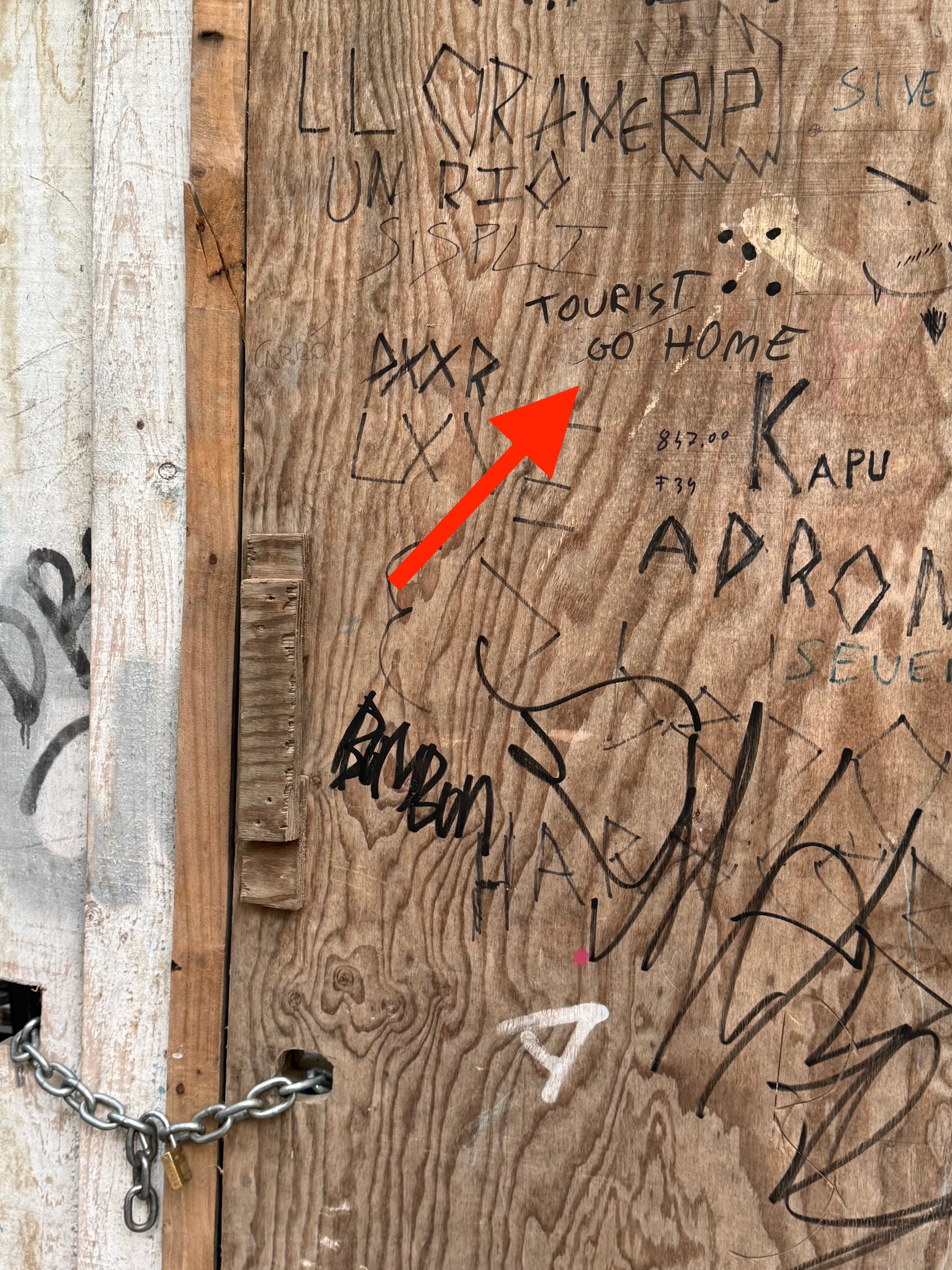
Overtourism is a major problem in Spain generally, and Barcelona in particular. Obviously, tourism is an important part of the economy, and they don’t want to get rid of it completely, but the effects are currently overwhelming. An article from EuroNews says that almost 66.8 million international tourists visited Spain in the first eight months of 2025 – 22.3 million of them during July and August, which is almost a million more than visited in those two months in 2024. As our tour guide confirmed later, not only has overtourism driven up prices and driven out locals, the hordes of visitors are undermining the culture and damaging the environment. Cruise ships are particularly resented as passengers typically eat and sleep on board, and don’t put any substantial amount of cash into the local economy. The graffiti we saw in English that told tourists to go away represents the tip of the iceberg when it comes to Spaniards’ unhappiness with the situation. Plans are underway to create legal and financial barriers that will at least reduce tourism in future.
I was glad we were visiting in September, when the crowds of tourists were still considerable but not as bad as they would have been in spring to late summer. Shopkeepers and people on the street whom we asked for directions were very helpful and kind, and we noted no (obvious) irritation or resentment anywhere. However, the number of times we remained lost after asking for directions did made us wonder if a few locals had deliberately sent us in the wrong direction. I actually wouldn’t have blamed them if they had. Aside from all the threats to Barcelona’s economic balance and way of life, it must get very tiresome to answer all those questions, mostly in English, asking for directions to tourist attractions, or wanting to know what the words on the menu mean.
Park Güell
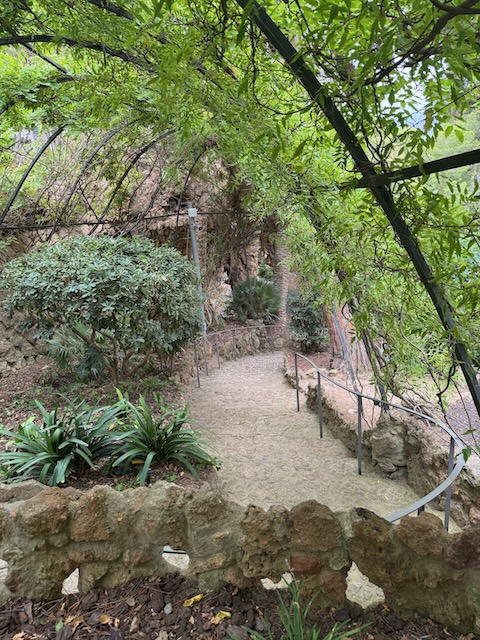
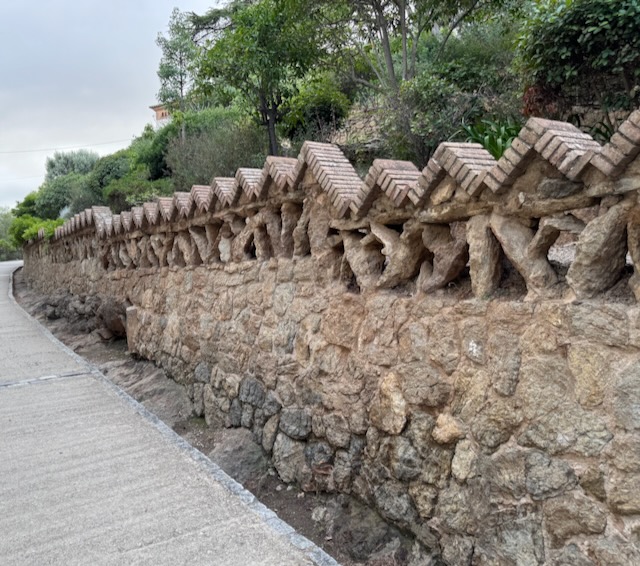
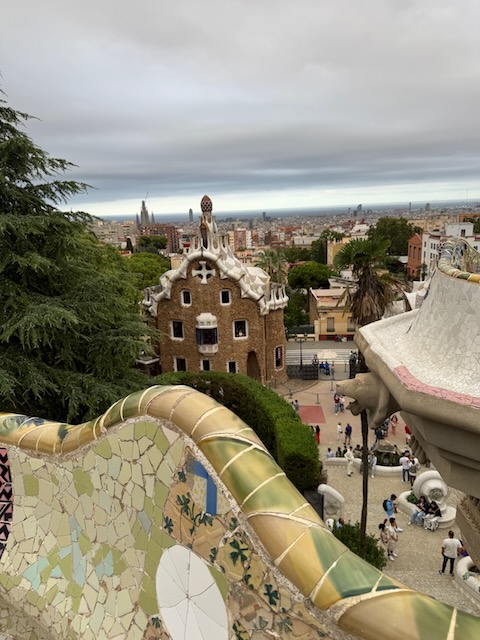
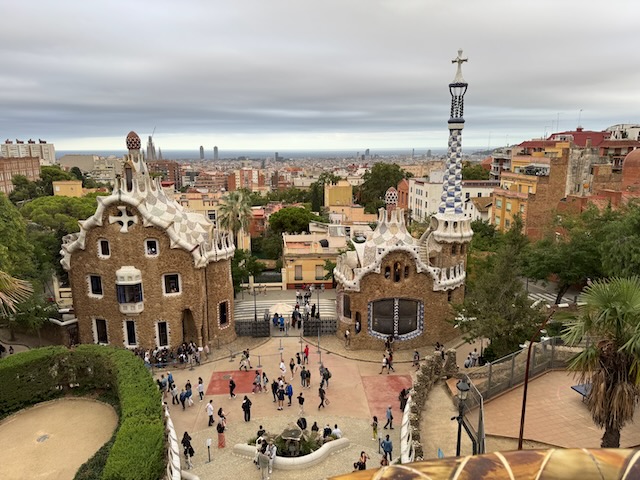
Park Gūell is a large property that overlooks the city of Barcelona. A wealthy industrialist and art patron named Eusebi Güell bought the land to build an exclusive housing development, and then hired the already highly regarded Catalan modernist Antoni Gaudi to design the parks and gardens, walkways and carriage paths that would form the backdrop for the luxury estate.
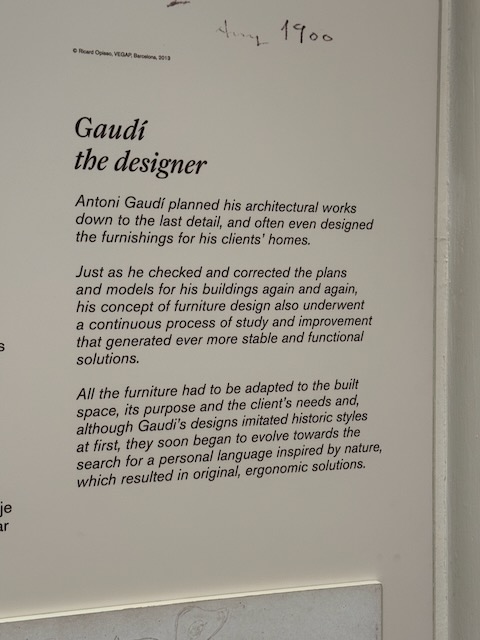
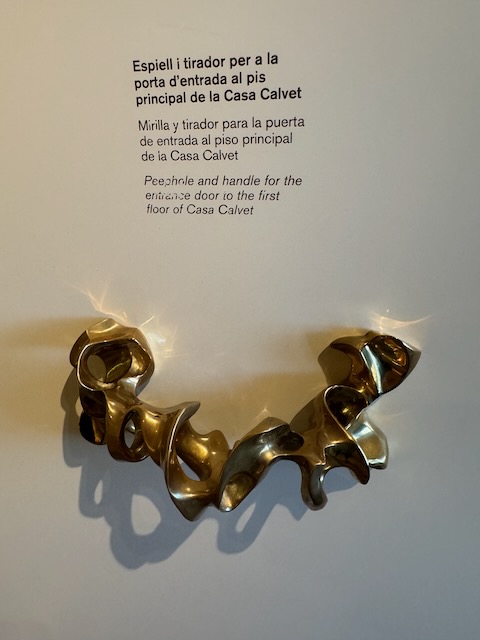
While he was doing his design work on the park, Gaudi lived in one of the two “model homes” in Güell’s development. This building is now a museum, where furniture, ornaments and other household and small industrial items designed by Gaudi are displayed. Gaudi had moved into the house with his father and his niece after his sister died, but then his father and then his niece also died. After that, he lived an ascetic life alone, his few domestic needs attended to by nuns, until much later when he moved into the Sagrada Familia itself to focus his attention on that project. As well as being deeply religious, Gaudi was a very disciplined artist. He got up early every day and worked until late into the night. Like so many people all around the world, I am a Gaudi nut, so I am very grateful that he accomplished so much in his lifetime that we and future generations can enjoy. His work – which includes several buildings in Barcelona in addition to the Sagrada Familia and Park Güell – is distinctive and remarkable.
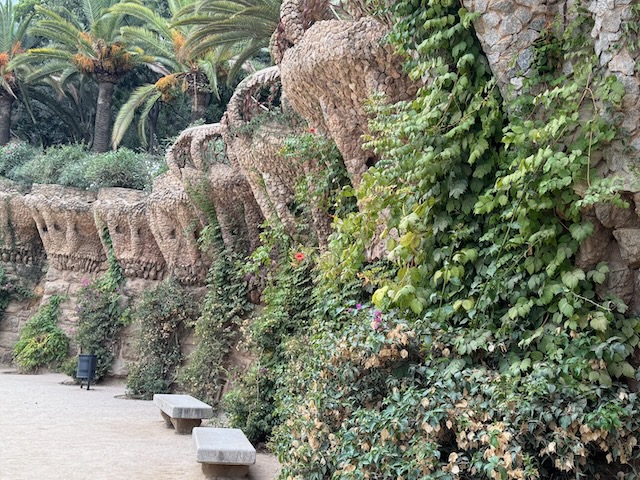
Park Güell was constructed between 1900 and 1914, and the stairways, viaducts, terraces, and gardens were designed to embody political and religious ideals and to reflect Gaudi’s interest in the geometric infrastructures of natural forms. His work has been described as being rooted in the Baroque, while also being much more expansive and open than the work of other artists from that era.
It is very difficult to do justice to the Park Güell with words, as is true of so much we saw in Spain, so there are going to be a lot of photo “galleries” in this series. As I mentioned above, if you’re reading this in an email message, you might want to click through to the actual blogsite in order to see the photos more completely.
The Serpentine Bench
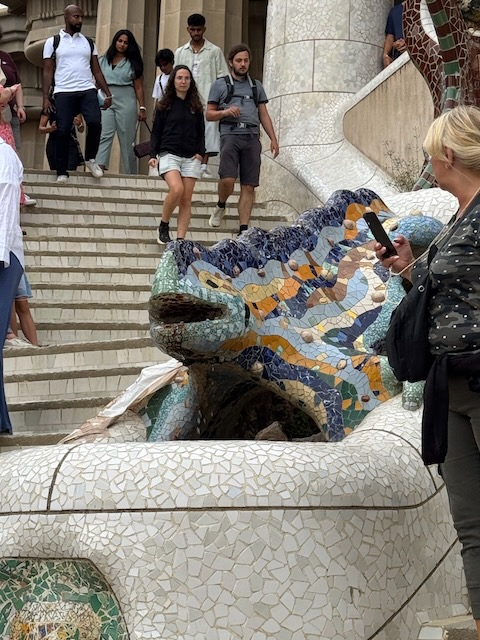
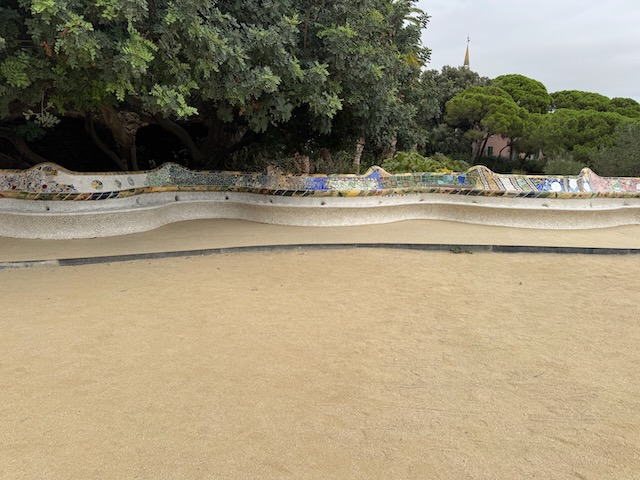
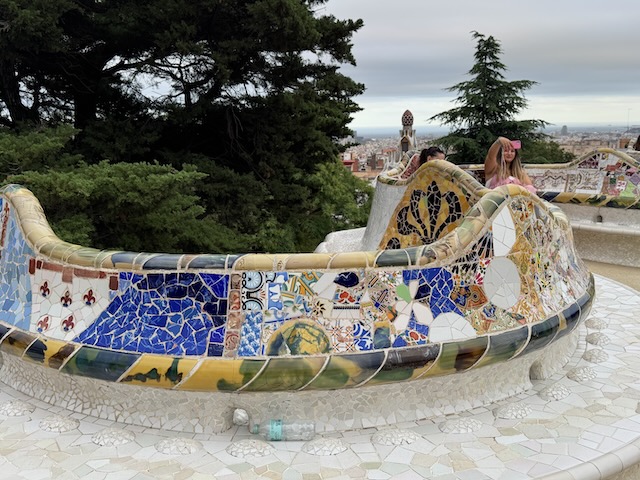
In addition to the walkways, pillars and viaducts, a focal point of Park Güell is a terrace at The Nature Square that is bordered by a long (110 metres) curving bench shaped like a serpent. Designed to be comfortable as well as visually appealing, the bench was designed by Josep Maria Jujol, who was mentored by Gaudi. Its mosaic decorations are distinctive, as is the entire installation.
As it turned out, only the two model houses in Park Güell were ever built. Ultimately declared a UNESCO site, the park became a public space that is one of Barcelona’s most photographed tourist destinations. (Book weeks ahead if you want to see it!) While there is a visitor charge for tourists (and an additional fee to see the Gaudi house), locals are able to enjoy the park at no cost, anytime they want.
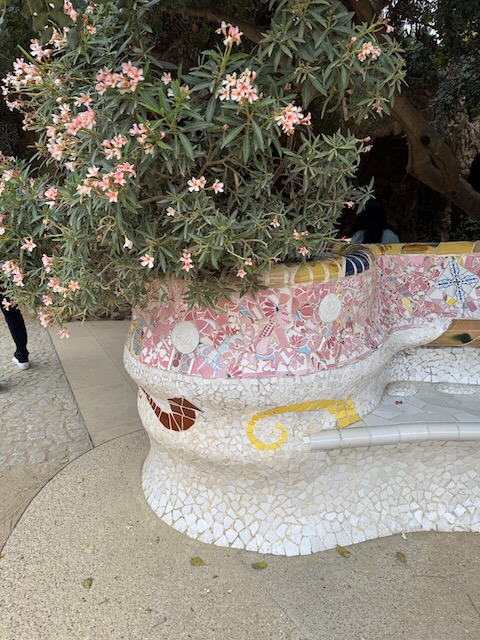
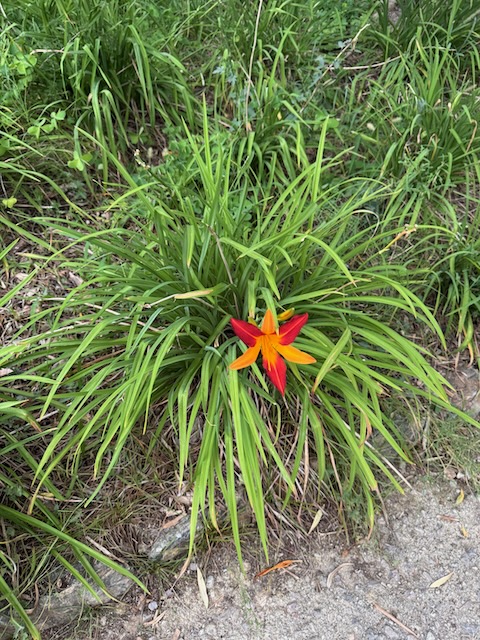
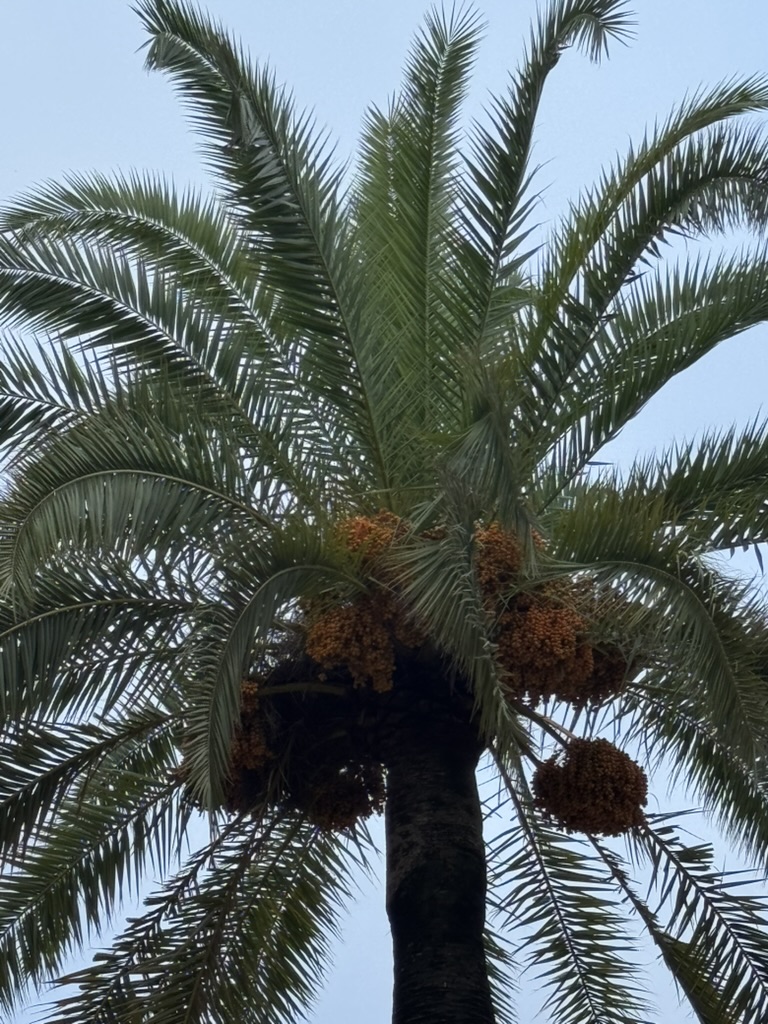
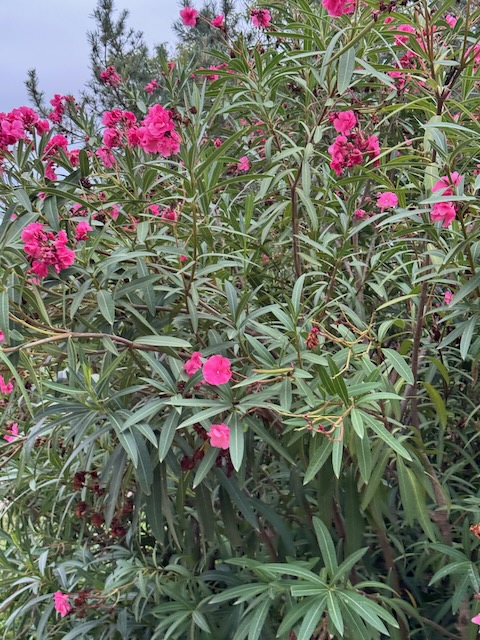
The Greenery
We were very very tired by the time we finally put our heads down on our pillows that night at our hotel in Barcelona. In addition to not having really slept since the morning of the day before in Toronto, we’d seen quite a bit of this beautiful Spanish city, travelled on the transit system, visited one of the city’s most famous destinations, seen plants and trees that were unfamiliar to these North Americans (see below), and sampled some Spanish food. We had wandered more airport concourses and city streets than we’d ever intended, hoped or wanted to wander in one day. As it turned out, aside from the lack of sleep, this would be a solid preparation for the physical demands of the following ten days.








































































 I'm All Write

_-_panoramio.jpg)
