Category Archives: Travelling

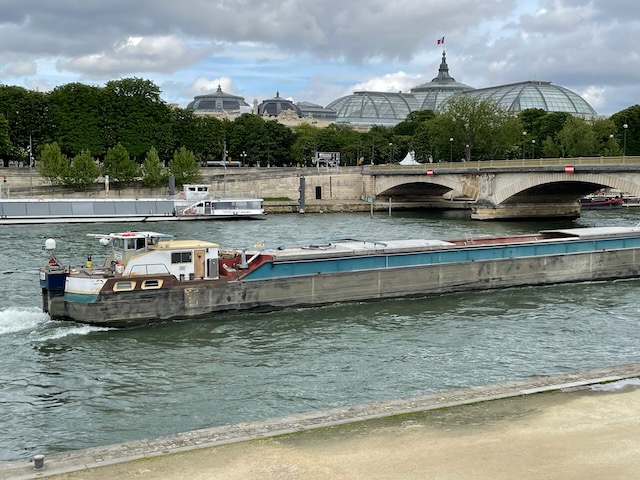
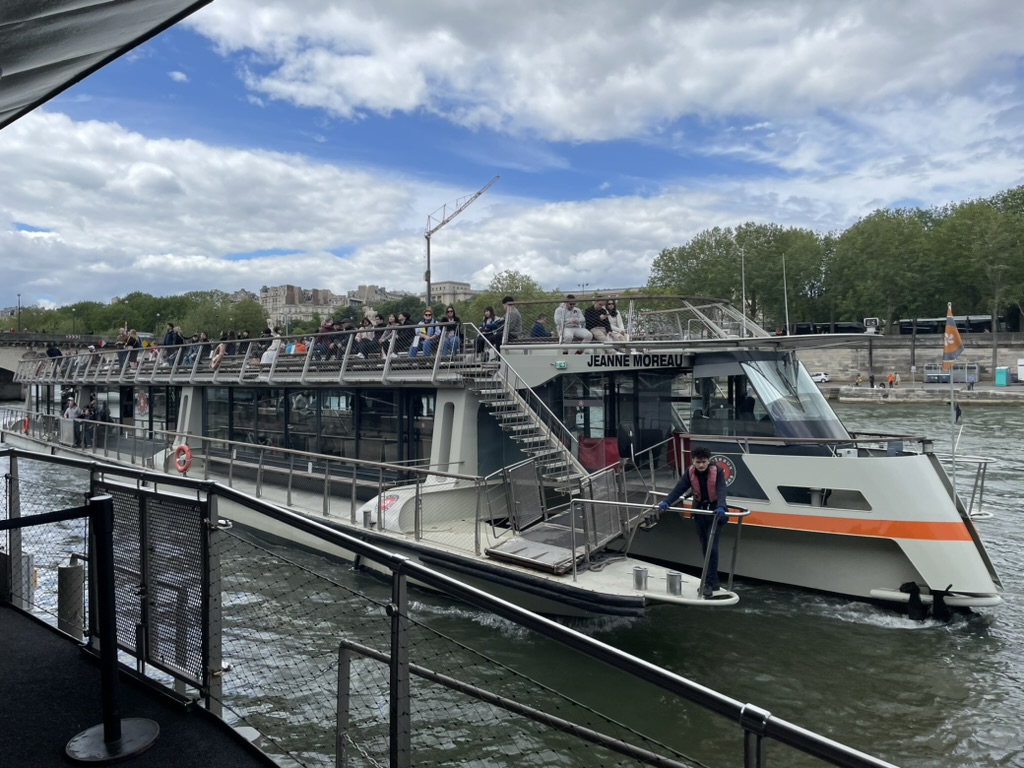
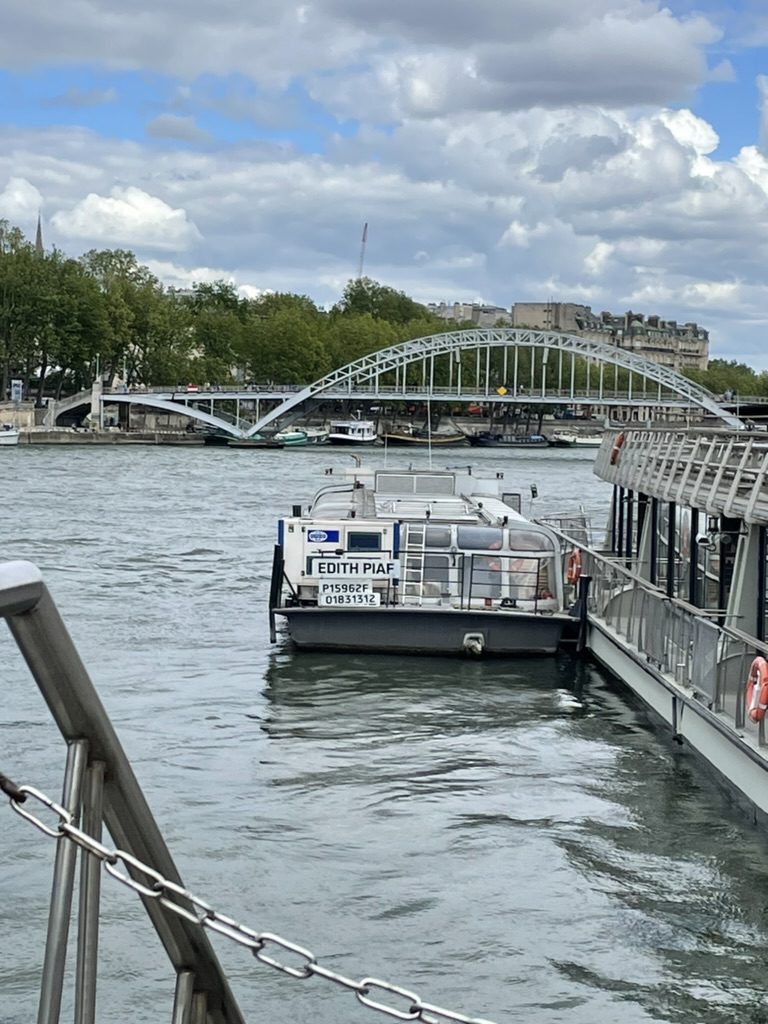
London, etc. and Paris, 15: A River Cruise and a Visit to the Arc de Triomphe, but no sign of Xi Jinping.

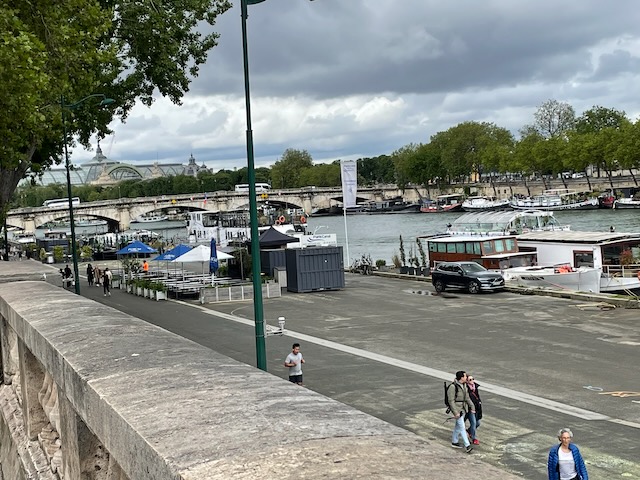
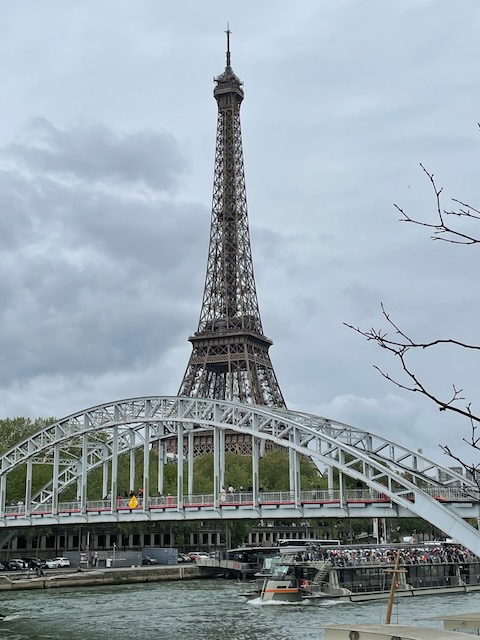
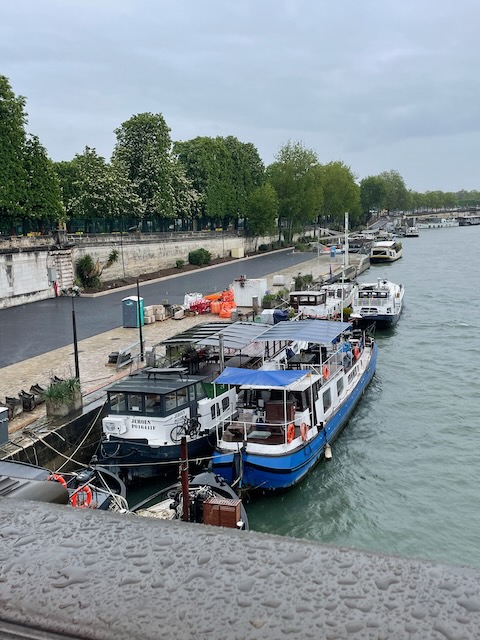
We descended the stairs at the end of the Rue de la Manutention (which sounds a little better in French than it does in English, but not much. The English translation of “Manutention” is “Handling”), and made our way to the footbridge across the Seine that would take us to our river tour.

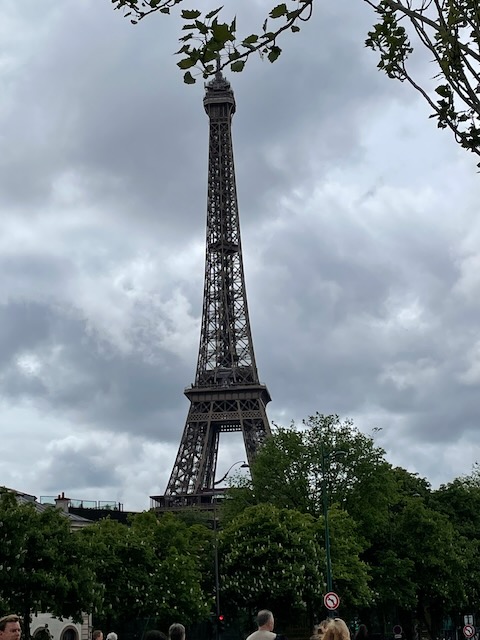
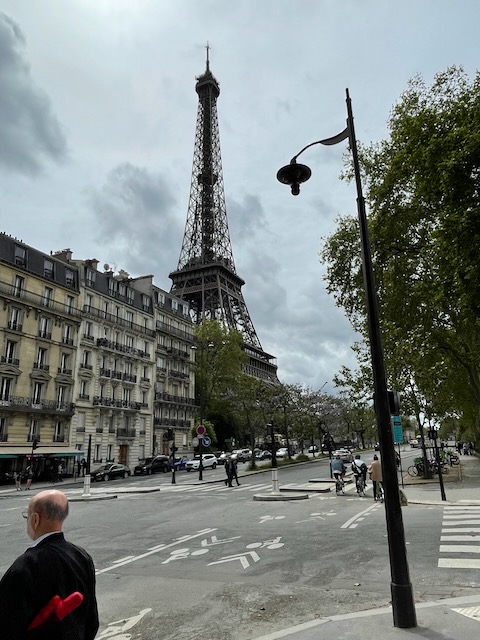
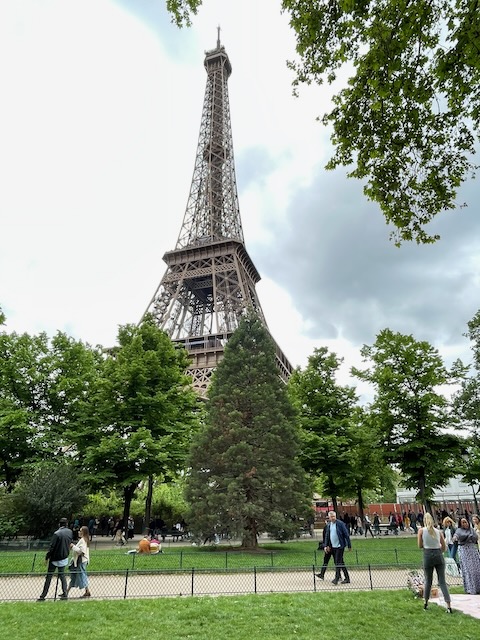
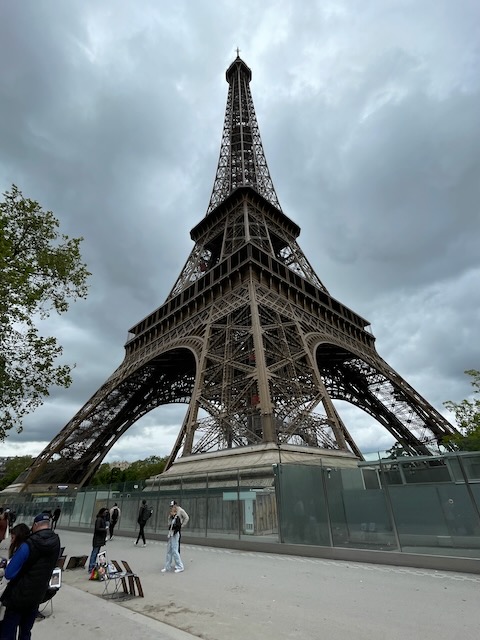
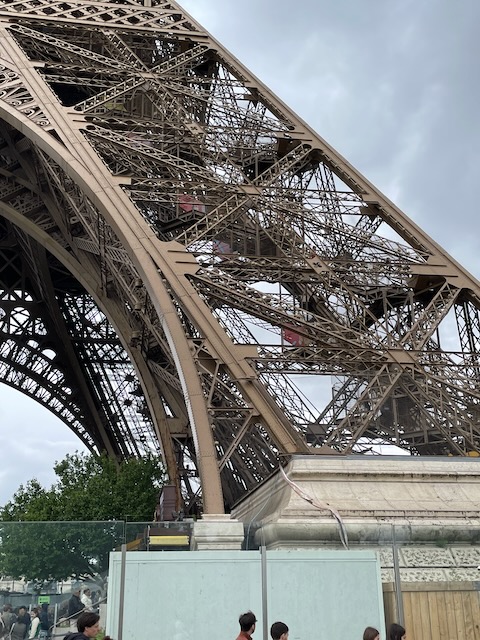
The river cruise in Paris starts just below the Eiffel Tower. I will spare you the ten or twenty photos I added that day to my already ridiculously large collection of Tower photos, but there are many pix of that landmark on my last post, if you have a hankering.

There is a very large island in the Seine east of the Musée D’Orsay called “Île de la Cité.” Just east of that is another, smaller island that fits nicely against the first (just as though it all used to be one big island!) called Île Saint-Louis. The cruise took us around that second island and then headed back toward its home dock.

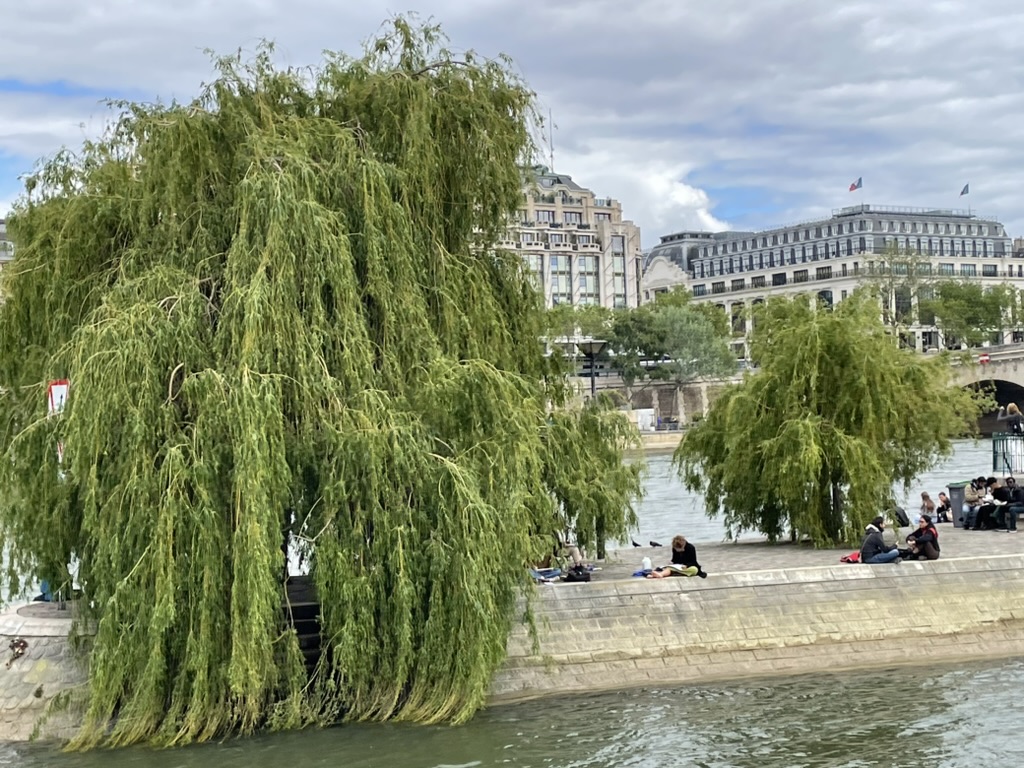
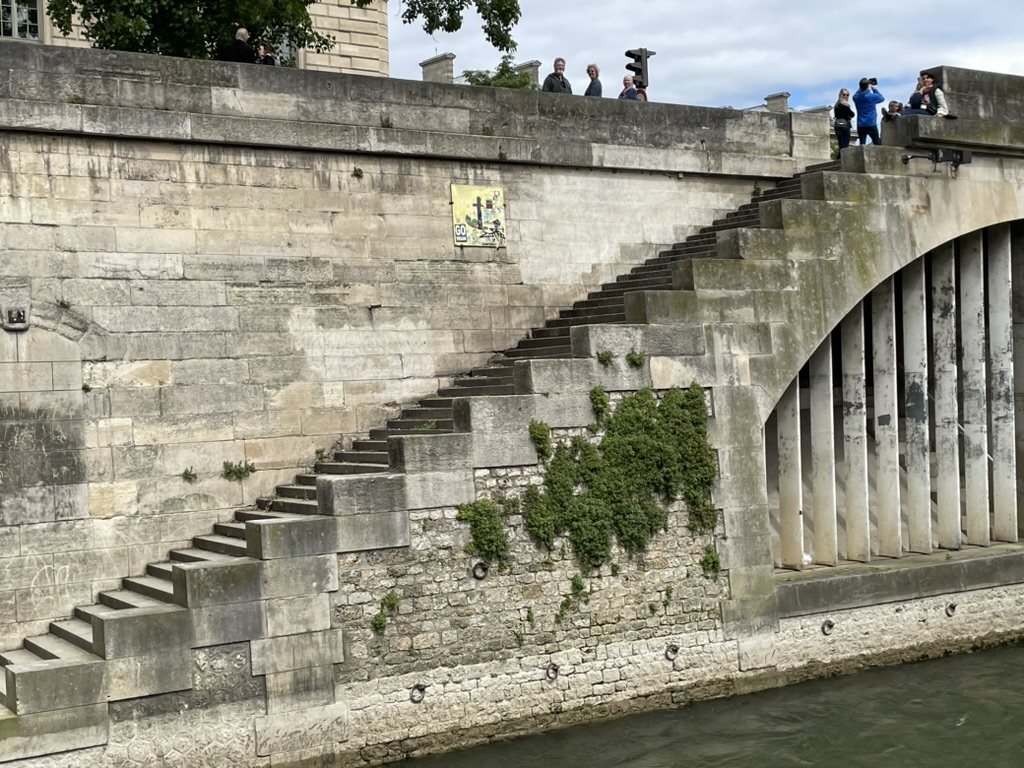
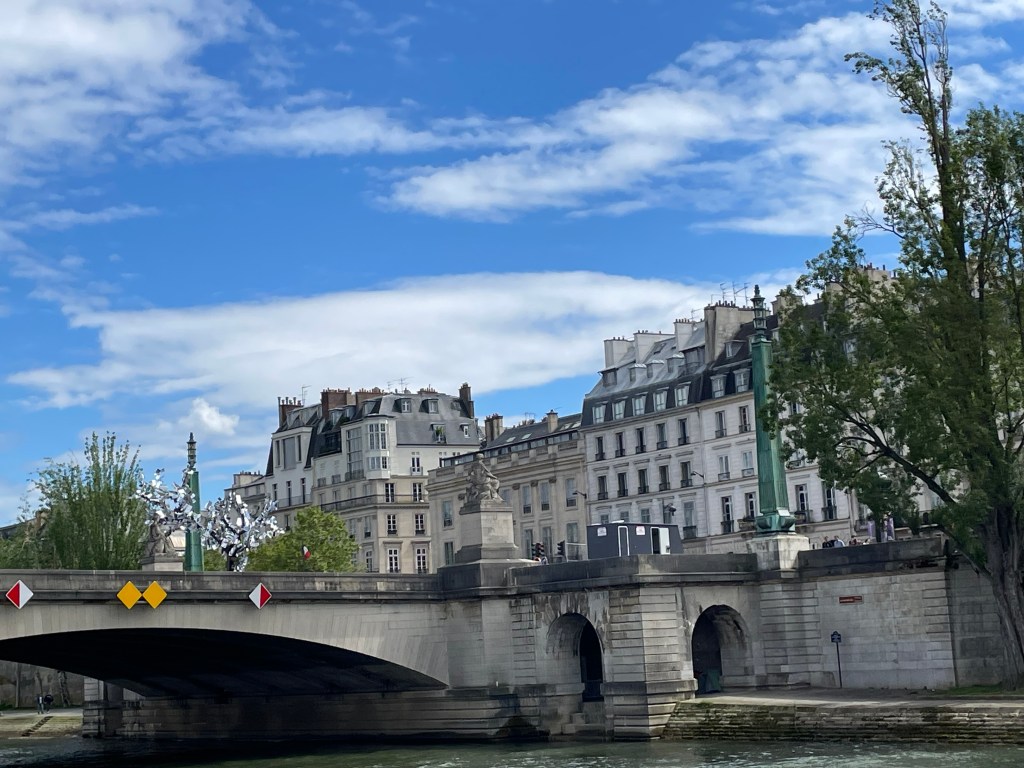
Here are some of the sights we saw on the trip.

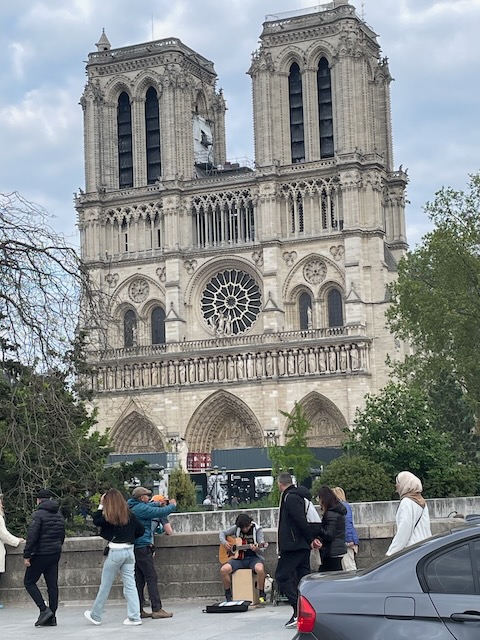
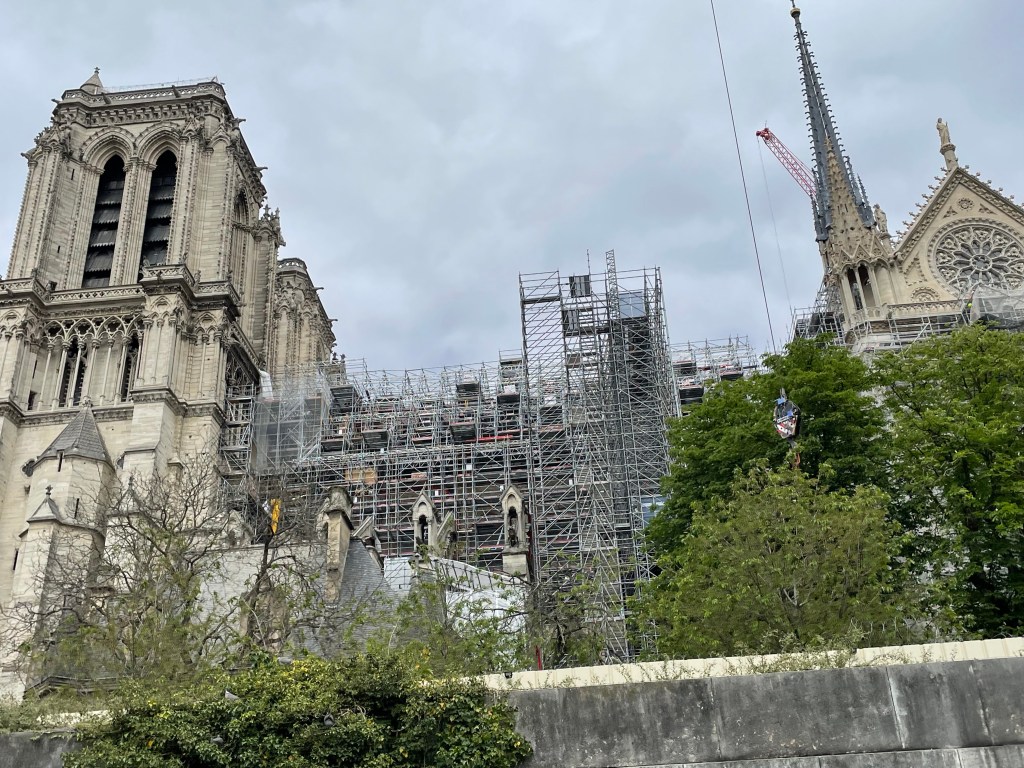
One of the highlights of the cruise was a close-up of Notre-Dame de Paris, which suffered a disastrous fire on April 15, 2019. The meticulous and very expensive reconstruction of the mediaeval Catholic cathedral, and particularly its spire, continues. It is expected to reopen in December of 2024.

There was a large group of high school students on board with us, and they insisted on making a howling noise whenever we went under one of Paris’s many bridges, thereby allowing us the opportunity (as it were) to hear not only them, but also their echoes.

Kids!

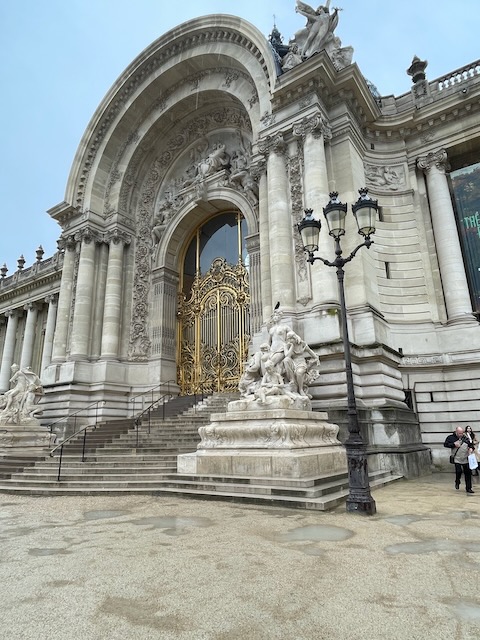
After the tour, we took the Métro to the Arc de Triomphe (1806) which is located at the west end of the Champs-Élysées. (Beyond that, the road is called l’Avenue de la Grande Armée.) We had seen the east end of the Avenue des Champs-Élysées earlier in the week, when we visited the Place de la Concorde.

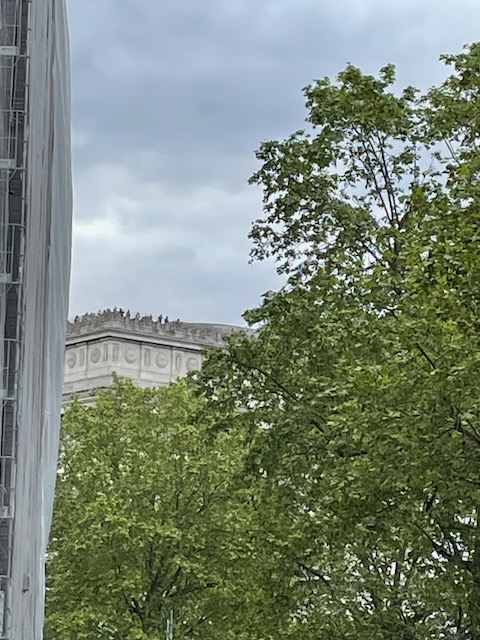
We declined to climb to the roof of the Arc de Triomphe and instead satisfied our curiosity from across the immense traffic circle that surrounds the monument.

“The Arc de Triomphe de l’Étoile, often called simply the Arc de Triomphe [… ] stand[s] […] at the centre of Place Charles de Gaulle, formerly named Place de l’Étoile—the étoile or “star” of the juncture formed by its twelve radiating avenues […]. The Arc de Triomphe honours those who fought and died for France in the French Revolutionary and Napoleonic Wars, with the names of all French victories and generals inscribed on its inner and outer surfaces. Beneath its vault lies the Tomb of the Unknown Soldier from World War I.” (Thanks as always to Wikipedia, which I support with a donation every month as I’m sure all regular users of that resource do. It’s always wise to double-check references on the site if you are citing the material in Important Documents, and some articles are biassed or incomplete, but in this age of disinformation the checks and balances on Wikipedia make it a very reliable source of background information on just about any topic you can think of. Plus, if you find a mistake, you can fix it yourself.)

I am a fan of the Tour de France, which always ends up circling the Arc de Triomphe during the final stage before heading to the finish line, so I took an extra pleasure in visualizing the peleton zooming around the monument. I would not personally want to cycle over all those cobbled streets, but then there is nothing in the Tour de France that tempts me to participate as anything but a spectator.

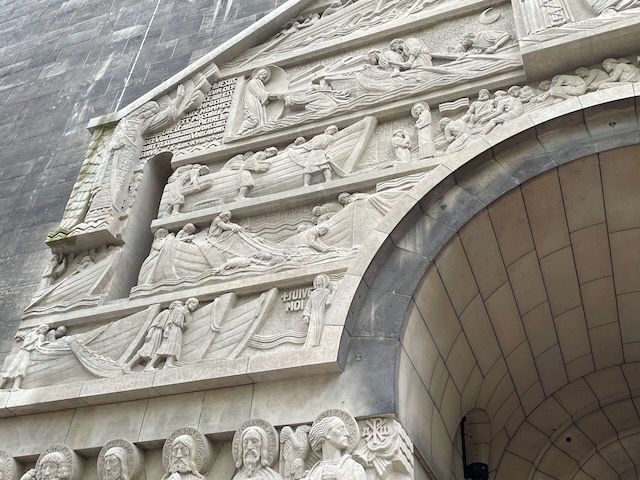
Later we walked past the magnificent Église Saint-Pierre de Chaillot, which opened in 1938 on a site the Roman Catholic Church has owned? occupied? since the 11th Century. “The church consists of three parts: a 65-metre high bell tower that dominates the whole and is located on Avenue Marceau, a low church, invisible because it was built like a crypt above which rises the main church with a central bell tower. The building is also characterised by its monumental façade on the avenue. […] It is constructed in the Romano-Byzantine style” (Wikipedia).

We didn’t go inside but the photos on the Wikipedia site suggest that the interior is as magnificent as the exterior.

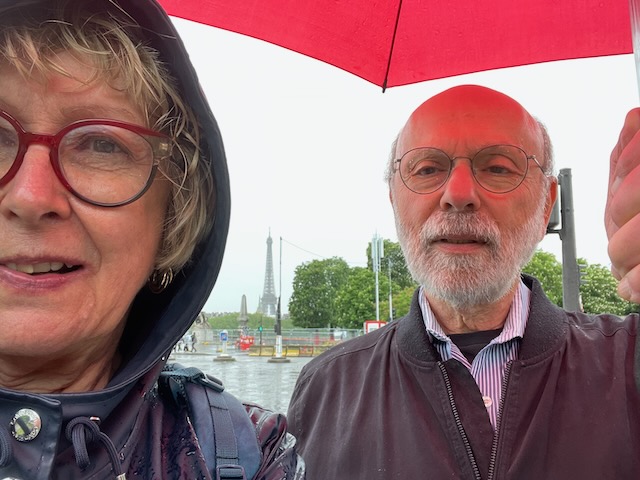
On our way back to the subway, we found ourselves on a section of roadways near the Pont d’Alma that had been entirely closed off to allow for the safe passage of President Xi Jinping, President of the People’s Republic of China, who we knew from the news was dining with President Macron that evening. We probably saw the vehicle that carried him past us, but since a lot of very official vehicles with dark windows went by, we weren’t sure which one it was. In the video and photo below you can see Xi supporters on the east side of the bridge awaiting his arrival. I don’t think they saw him, either. One of the people watching with us (of which there were very few. Most people just went on about their business) said that street closures like this for visiting dignitaries are common in Paris. In other words, as we waited for a glimpse of Xi, our status as tourists was probably obvious to all of the locals – and maybe even to the President of China.

We may not have seen the President, but we were rewarded for our wait with a rainbow.

London, etc. and Paris, 14: A Good Day for a Stroll with Close-ups of The Eiffel Tower and the Moulin Rouge

Paris is best seen on foot, and although we hadn’t exactly planned it, we were able to take advantage of our one Sunday in the city to walk and walk and walk.

Our original intention that day had been to visit the Musée D’Orsay, which offers free admission to everyone on Sundays. However, the Musée was “sold out” of free tickets so we weren’t able to visit. Turns out that even when tickets are free, you still need to book them in advance to secure an entry time – which we had not done because we didn’t know it was necessary. So NB: if you want a free ticket to the Musée D’Orsay, book it in advance online. (I’m sure this tip is applicable to other museums and galleries as well.)

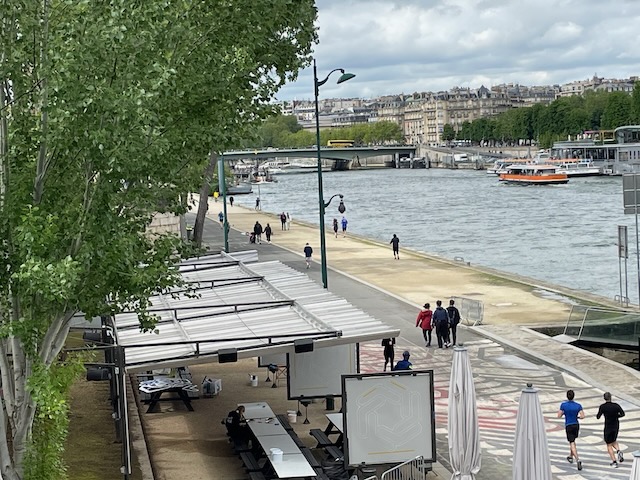
From the museum, we walked down to the Quai D’Orsay. From there, we made our way past several landmarks and bridges along the Left (south) Bank of the Seine to the Eiffel Tower, then crossed a bridge and walked back up the Right Bank. Later we made our way by subway to Place Pigalle, where we checked out the Moulin Rouge and marvelled at the dozens upon dozens of sex shops in the area. While I imagine there are some economic advantages to putting all of these outlets (for which the French term is “sex-shops”) in the same part of the city (reduced costs for advertising, shipping, signage, etc.) due to economy of scale or something, I can only thank the powers-that-be that Paris hasn’t used the same kind of organizational model for its patisseries.

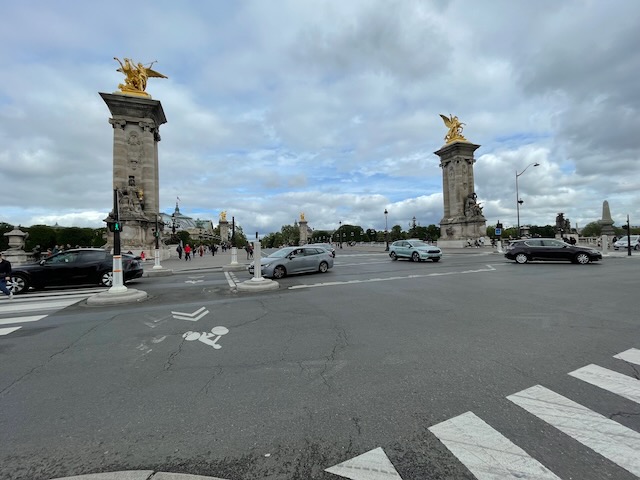
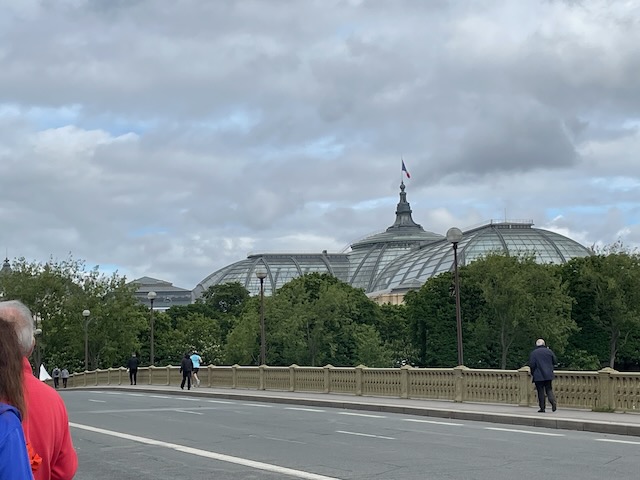
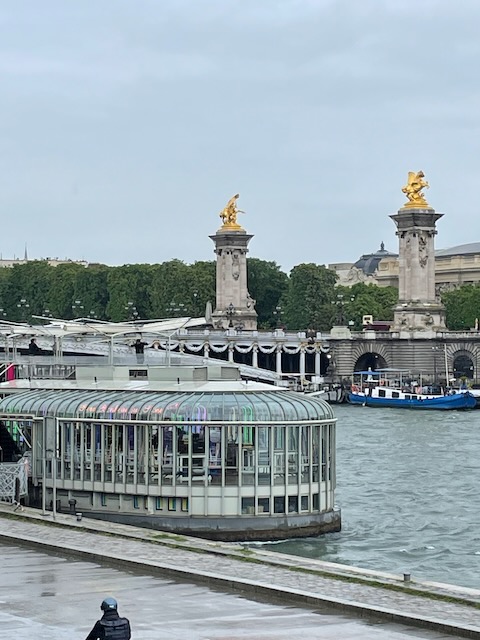
Our stroll down the Left Bank took us (for the second time) past the National Assembly and the Pont Alexandre III, and offered views across the river of Right Bank attractions, including the Grand Palais and some of the buildings that border the Tuilleries Garden.

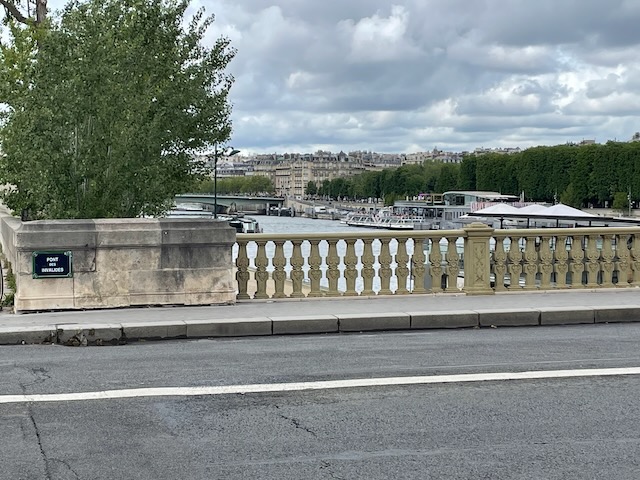
In the last volume of his novel, Marcel Proust mentions how, one evening during a blackout early in the first World War, soon after the clocks had been turned forward in the Spring, he stood not far from the Pont des Invalides on the Left Bank and looked across the Seine at the Trocadero. As I had hoped to do before I even went to France, I was able to replicate that experience (albeit in the daytime and not during a war). It was a small thing, but it pleased me.

The Trocadero, which we saw only from a distance, is a neighbourhood in the 16th arrondissement on the north (right) bank of the Seine, almost directly across from the Champs de Mars and Tour Eiffel. The Palais du Trocadéro was built on the Chaillot Hill for the World’s Fair in 1867. It was shaped like a huge concert hall, featured an enormous pipe organ (since moved to Lyon but still in use), and was named after a battle won by France in Spain. The building did not prove popular and it was partially demolished and then rebuilt in time for another World’s Fair, in 1937, at which time it was renamed Le Palais de Chaillot. The grounds include gardens, fountains and an underground aquarium, and I have added it to my “to do” list for next time.

“The Hôtel des Invalides, commonly called Les Invalides, is a complex of buildings in the 7th arrondissement of Paris, France, containing museums and monuments, all relating to the military history of France, as well as a hospital and an Old Soldiers’ retirement home, the building’s original purpose” (Wikipedia). On July 17, 1879, Parisian rioters ransacked the Hôtel for guns and ammunition before storming the Bastille.

From Wikipedia: “The Eiffel Tower is a wrought-iron lattice tower on the Champ de Mars in Paris, France. It is named after the engineer Gustave Eiffel, whose company designed and built the tower from 1887 to 1889. Locally nicknamed ‘La dame de fer‘ (French for ‘Iron Lady’), it was constructed as the centerpiece of the 1889 World’s Fair, and to crown the centennial anniversary of the French Revolution. Although initially criticised by some of France’s leading artists and intellectuals for its design, it has since become a global cultural icon of France and one of the most recognisable structures in the world.”

When you actually see the Eiffel Tower in real life, you cannot stop taking photos of it. Or at least, I couldn’t. I have about 200 photos of the Eiffel Tower.

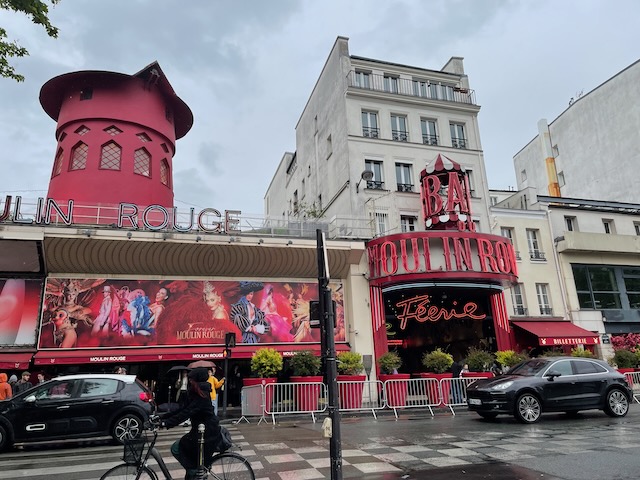
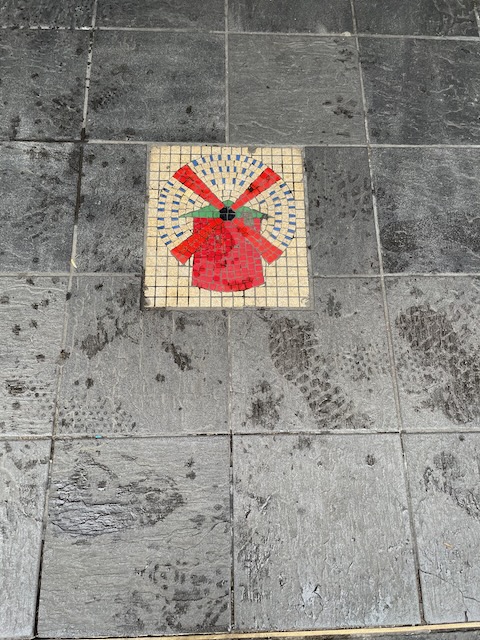
In the middle of a night shortly before we went to France, the famous windmill atop the famous Moulin Rouge fell off. It had not been reattached when we visited, so we had to make do with a Moulin Rouge cassé. Moulin Rouge is one of my favourite movies, so it was a real treat to visit the neighbourhood and the entryway to the facility, windmill or no windmill.

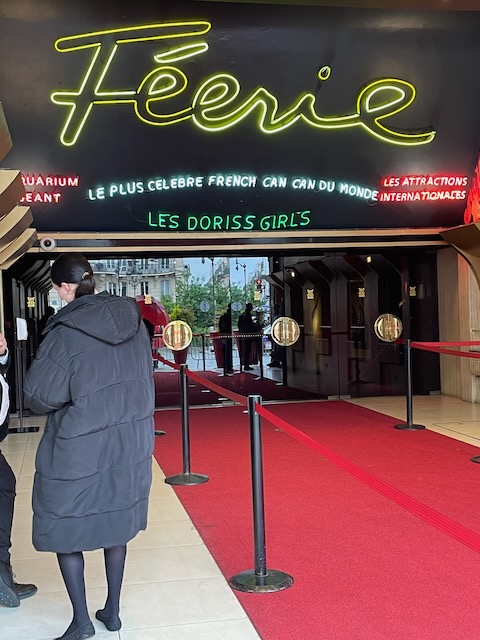
We did not attend any shows inside the Moulin Rouge but I got a few photos of what visitors might have expected to spend, and to see.

London, etc. and Paris, 12: Le Louvre, including a brief audience with Mona Lisa

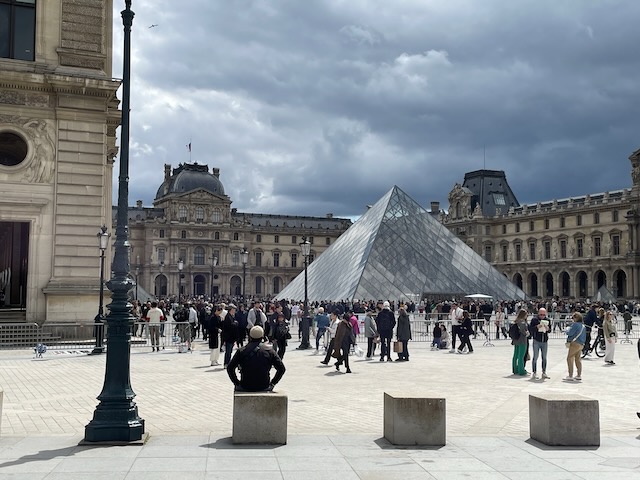
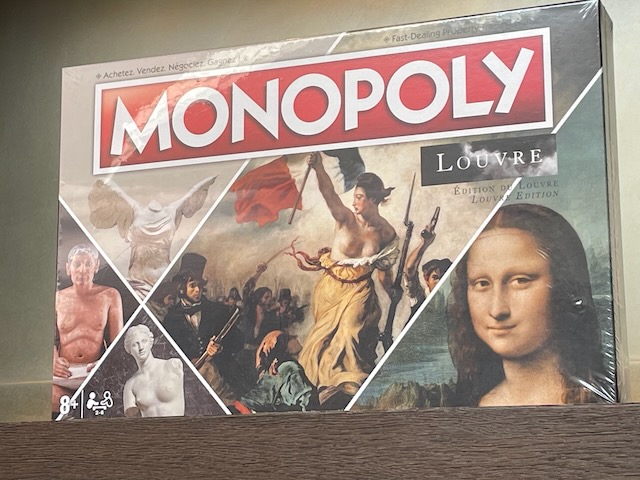
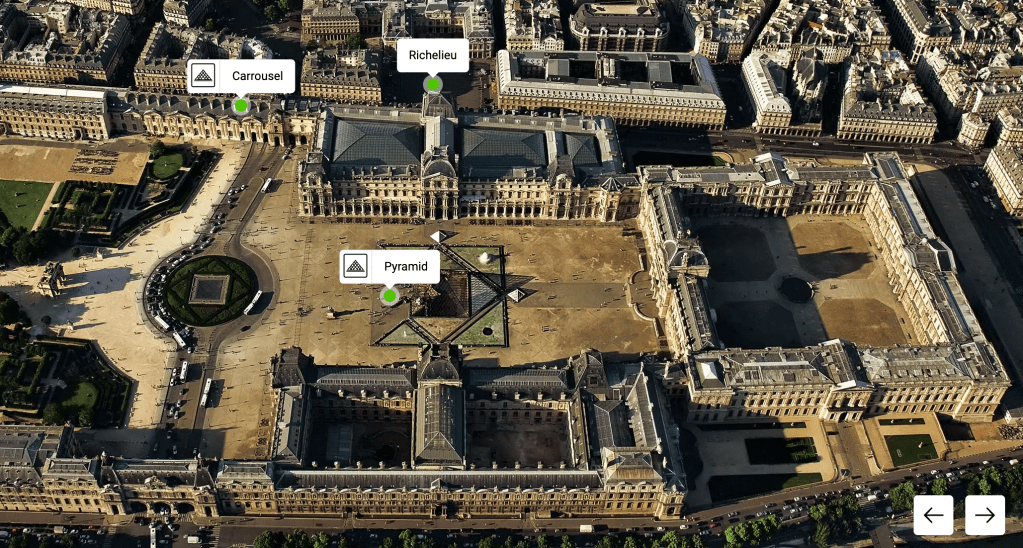
Since this post is mainly about a visit to an enormous museum (652,300 square feet, to be exact)1, there are quite a lot of photos in it. They depict only a few of the hundreds of paintings and sculptures I saw during our visit to Le Musée du Louvre in Paris that compelled me to take photos of them to ensure that I would never forget them. (Hah.) In the long run, of course, it was more time-consuming to figure out which photos to leave out of this blog post than it would have been to include them all, but I have done my best to cull and whittle; what is left is what you get.

.

In a shopping centre near Le Louvre we came across a public washroom that I thought must be an extension of the gallery itself. It turned out to have a more commercial intent: it was a promotional display by a paper company called Renova, which describes itself as selling “The Sexiest Paper on Earth” – a claim that is almost as engaging as the display itself.

Once we got to the actual art, I was immediately attracted by a painting of Joséphine, first wife of Napoleon I. It was completed just before the annulment of their marriage six years in, by which point she had failed to provide him with an heir. In contrast to the usual formal portrait of a member of nobility, she has chosen to be seated and to look away. Who can blame her?

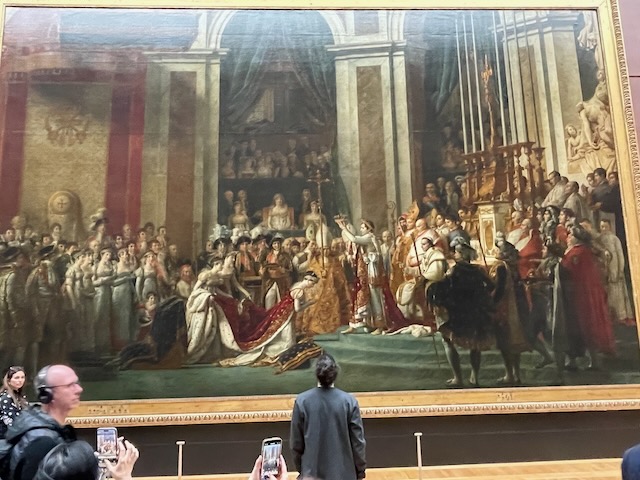
The last two photos in this set are of a painting of an event that took place in happier (?) days: The Consecration of the Emperor Napoleon and the Coronation of the Empress Joséphine in Notre-Dame Cathedral on 2 December, 1804. Since Napoleon essentially crowned himself, I saw this painting as a chilling but eminently plausible long-term strategy of a certain gilt-and-pomp-loving candidate in the 2024 U.S. presidential election.

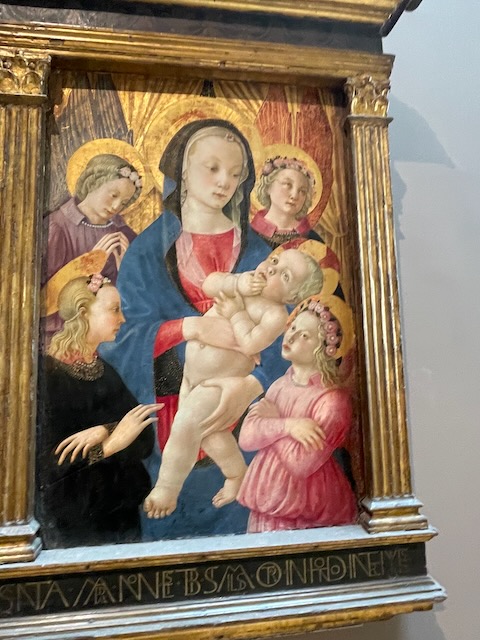
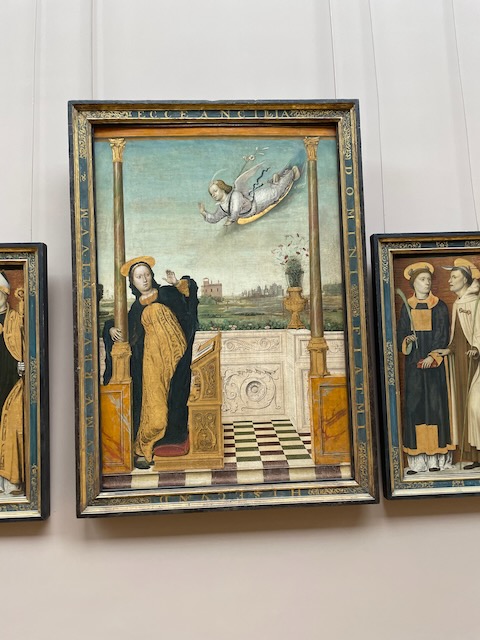
I am always impressed by the effect religious enlightenment and enthusiasm (or perhaps the fear of God) have had on the artistic initiatives of some of the world’s most noted visual artists and musicians. There were many outstanding examples of such works at the Louvre, although mythology was the source of inspiration for many artists too.

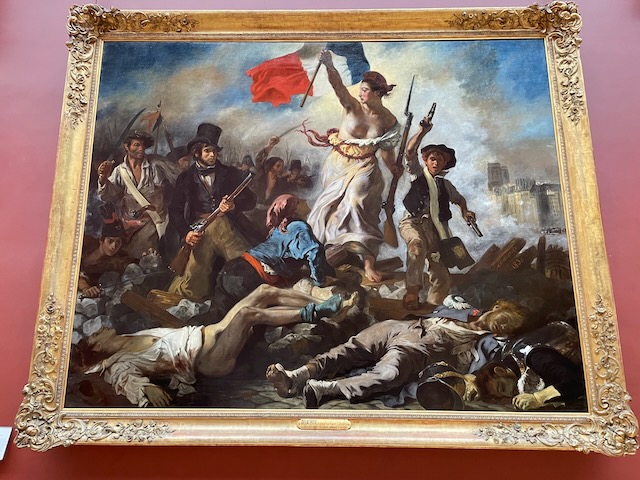
I liked the Delacroix paintings (below) very much, perhaps because of the immensity of their scale and subject matters.

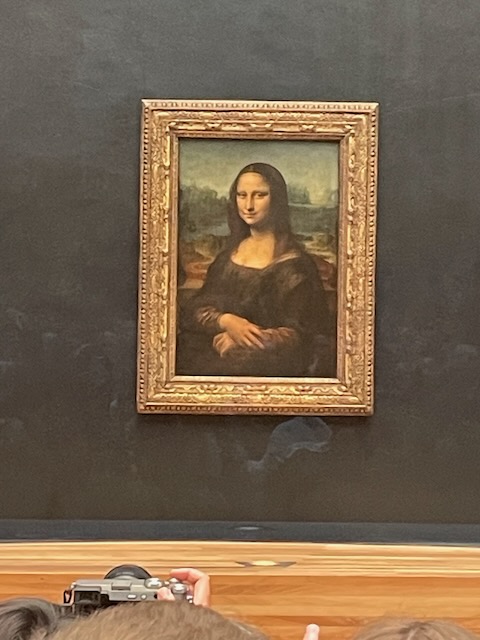
And at long last we got to see the Mona Lisa. The Louvre runs a very tight ship when it comes to what is likely the most famous work of art in its collection: After joining a carefully corralled group, we inched forward for about half an hour until we finally reached the wooden railing that separated us from the Da Vinci masterpiece. There, three uniformed staff members gave us maybe a minute to get our unobstructed photos before they hustled us out of the room.

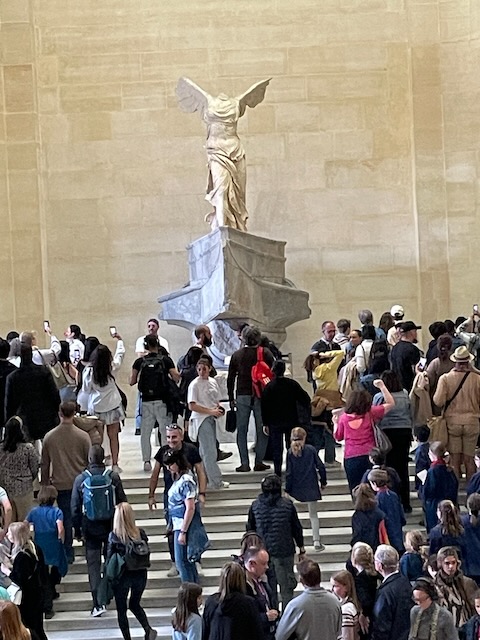
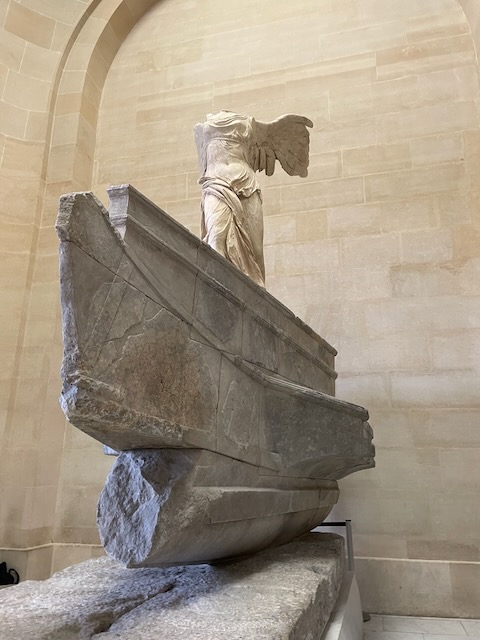
I think my favourite installation at The Louvre was the magnificent Winged Victory of Samothrace, which is “a votive monument originally found on the island of Samothrace, north of the Aegean Sea. It is a masterpiece of Greek sculpture from the Hellenistic era, dating from the beginning of the 2nd century BC” (Wikipedia). I could have gone back to the gallery again and again just to look at that sculpture.

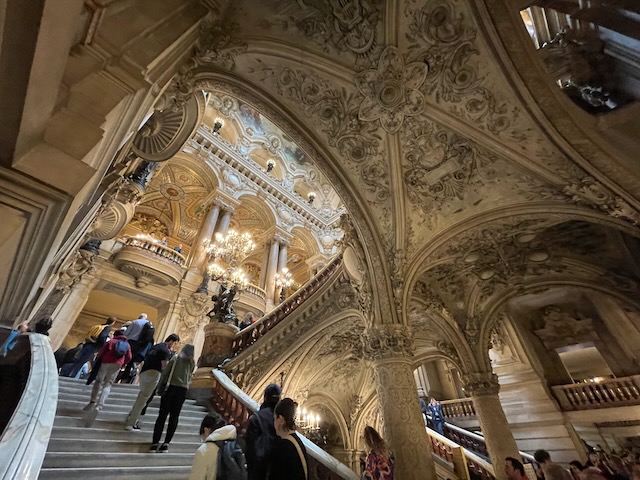
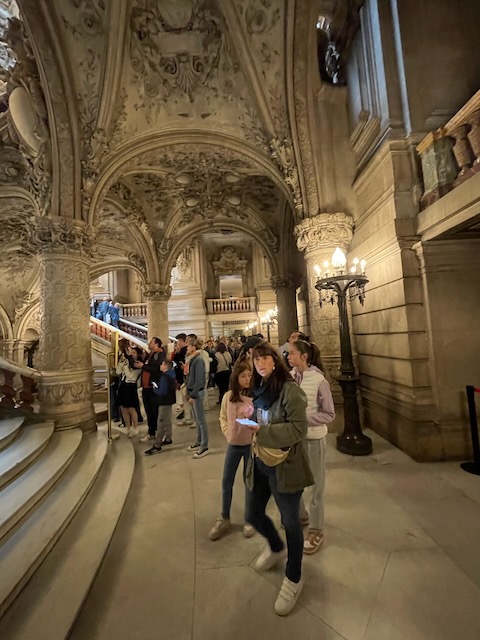
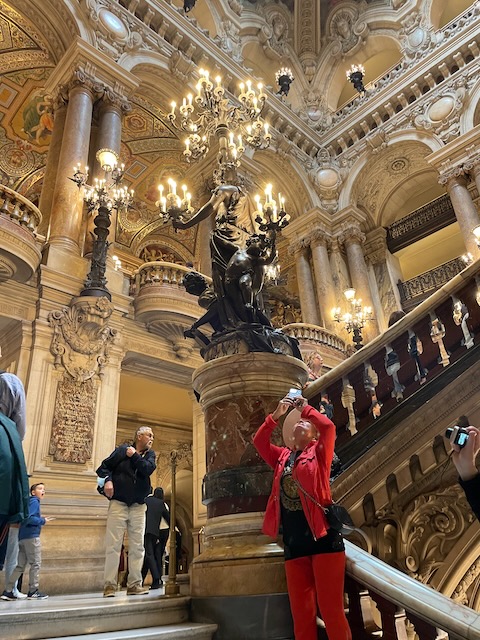
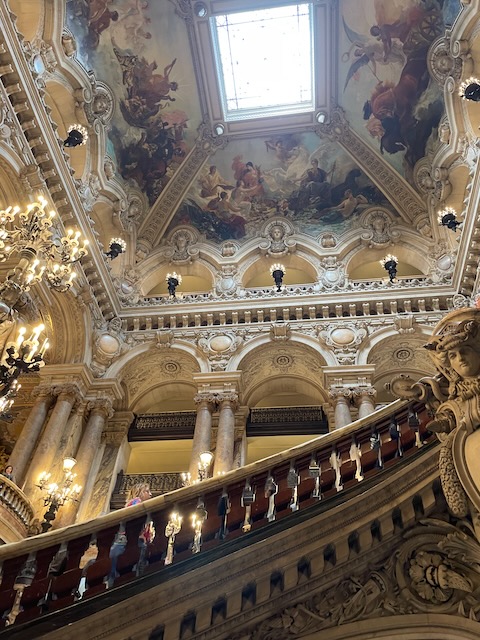
After departing the Louvre we decided to tour the Palais Garnier, one of the homes of the Paris Opera. We were unable to gain admission because it was almost closing time, which is probably just as well as we were fairly tired by then. Later in the week, we did see the building, a masterpiece of baroque architecture. As you will see in a later post, it was worth making a second attempt.

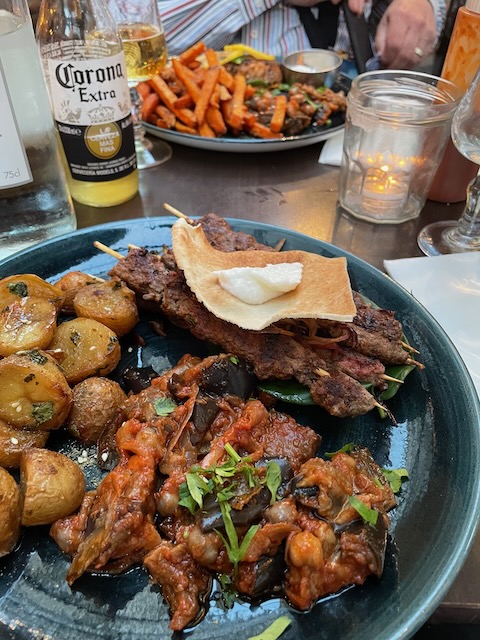
Near our hotel, a lovely plaza (Place Gustave Toudouze) offered four or five restaurants with different types of cuisine, including French, Italian and Indian. We enjoyed the food at the Lebanese restaurant Chez Sofia so much we went back again later in the week. (I even wrote a positive review online.)

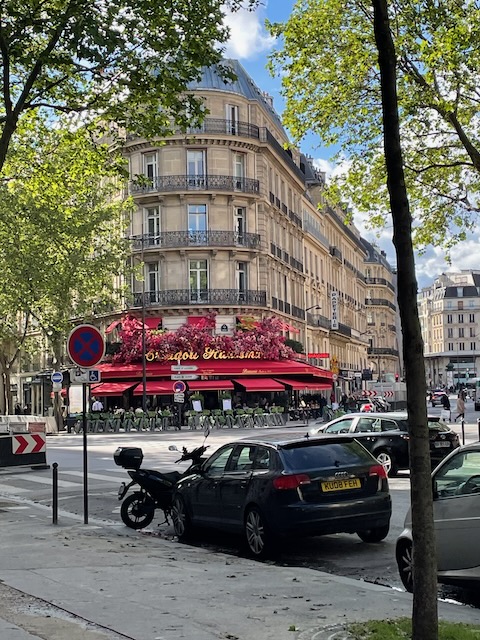
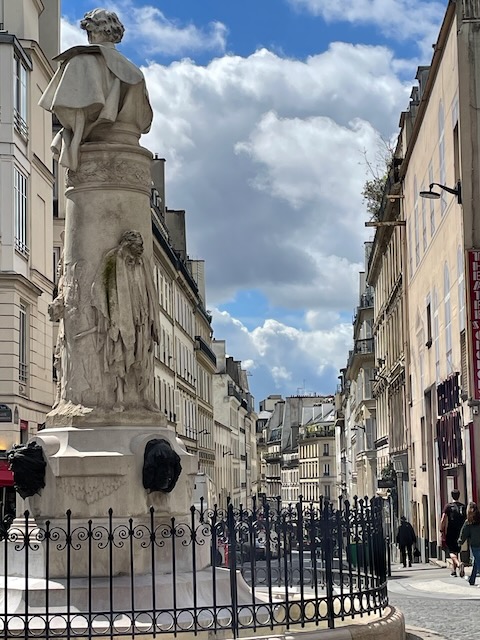
Here are a few other photos of the area near our hotel.

  1. This aerial photo of The Louvre, which I found on the museum’s website, gives a sense of how massive the complex really is ↩︎

London, etc. and Paris, 11: “I Love Paris… when It Drizzles.”

On Thursday morning, after settling in to our new, improved quarters and checking out the neighbourhood, we set out to discover Paris. (Arnie had been to France in the 1970s, but I had never been before.) It was still raining, but for the most part the rain was a fine drizzle so it didn’t interfere with our stroll.

After consuming a bowl of French onion soup at one of the many small cafés that edge the streets of Paris (because of course we did. Very tasty), we took the Métro to the south side of the Seine, emerging near the Quai D’Orsay, and began to walk west along the Left Bank/ Rive Gauche. First we passed the Assemblée Nationale, which is France’s lower House of Parliament, the upper being the Senate.

France, like most democracies, has three branches of government: legislative, executive, and judicial. The President (currently Emmanuel Macron), a position for which an election is held every five years, appoints the Prime Minister (normally the head of the party with the most seats); the Prime Minister and his or her deputies make up the Government. I understand that elected representatives whose politics are on the left sit on the left side of the PM in the Assemblée, and those whose politics are on the right sit on the right. Seems sensible.

(Please click on a photo for a better look. If you are reading this as an email, click “Read on Blog” (at the top of the email) to see larger versions of the photos.)

The French electoral system is somewhat confusing to an uneducated outsider (as are most countries’ electoral systems, come to think of it. Autocracies and dictatorships are easier to understand: rulers like Nicolás Maduro in Venezuela just retain control of everything, no matter what the voters decide they want). The French system of government is additionally confusing since France is a founding member of the European Union, so some of its legislative functions now fall under the purview of the European Commission.

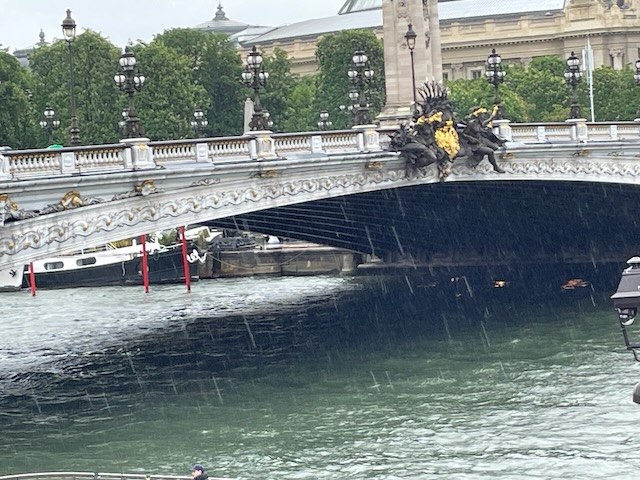
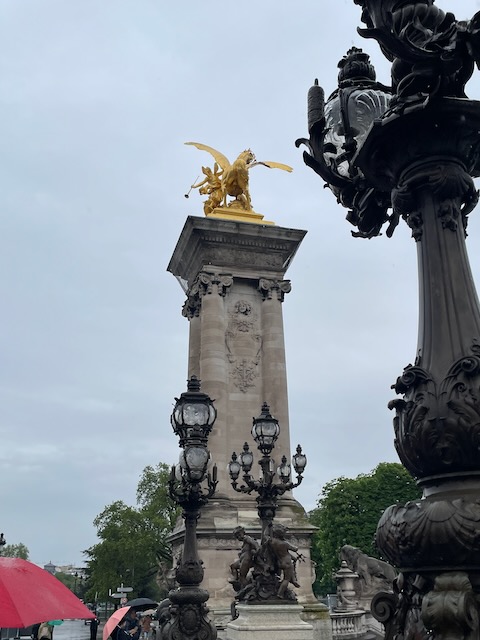
We continued along the Left Bank until we reached the Pont Alexandre III. From Wikipedia, I learned that “[This] Beaux-Arts style bridge, with its exuberant Art Nouveau lamps, cherubs, nymphs and winged horses at both ends, was built between 1896 and 1900. It is named after Tsar Alexander III of Russia, who had concluded the Franco-Russian Alliance in 1892. His son Nicholas II laid the foundation stone in October 1896. The style of the bridge reflects that of the Grand Palais, to which it leads on the right bank.” (Well said, Wikipedia.)

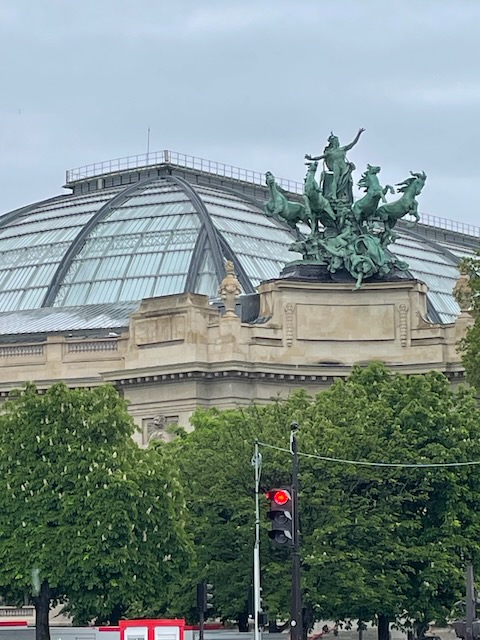
The Grand Palais was closed for renovations when we were there, but would reopen temporarily for the Olympics in August. (The fencing and taekwondo events were held there.) The full site will reopen to the public in 2025. The Grand Palais is an exhibition hall, museum and historic site dedicated to French art, and it sounds as though it is quite spectacular. We’ll have to go back to investigate it (and Notre-Dame Cathedral, of course, which was still closed for restoration following the terrible fire in 2019).

We kept catching sight of the Eiffel Tower and since I couldn’t get over the fact that we were actually IN Paris looking at THE ACTUAL Eiffel Tower (of which I have owned a small replica since my sons visited the city in about 1992), I kept taking photos of it. As a result, I now have about 200 photos of the Eiffel Tower. I will not post them all.

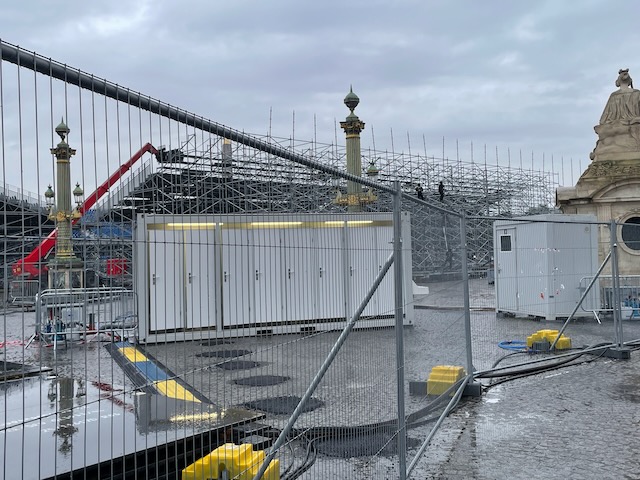
After walking in front of the Grand Palais we took a right turn and headed up the Champs-Elysées to the Place de la Concorde, the largest square in Paris, where there was a lot of activity going on to prepare for the upcoming Olympics. The Place Concorde was the site of the BMX freestyle, breaking, skateboarding and 3X3 basketball events and as the photos illustrate, a lot of temporary seating was being created when we were there.

As we walked, I spent a lot of time just marvelling to myself that I was actually on the Rive Gauche, walking by the Quay D’Orsay, crossing the Seine, catching glimpses of the Eiffel Tower, standing in the Place de la Concorde. It was both magically surreal and exactly as I had expected it would be: a perfect combination. It also made me think that if you read enough books and see enough films set in a certain location (or point in history, I suppose), it is almost as good as visiting it.

Almost, but not quite.

_________________

Addendum

Did you know that “I Love Paris” was written by Cole Porter and published in 1953? It’s been “covered” by just about everyone – notably Bing Crosby, Andy Williams, Ella Fitzgerald, Doris Day, Dean Martin, Frank Sinatra and Screamin’ Jay Hawkins. It’s a short song, but long enough to become an ear worm.

London, etc. and Paris, 10: Paris Greets Us with Thunderbolts, Hail and a Bus Station from Hell

It costs about £30 (C$50) and takes approximately 8.5 hours to get from London to Paris on a bus. (This includes the cost of the ferry the bus drives onto in order to cross the English Channel). It costs about £125 (C$221.25) to travel from London to Paris through the “Chunnel” on a train. It costs about £80 (C$140) to fly from London to Paris.

Partly because of the cost, partly because we had no deadlines, and partly because I wanted to see the English Channel as we crossed it, we took the bus.

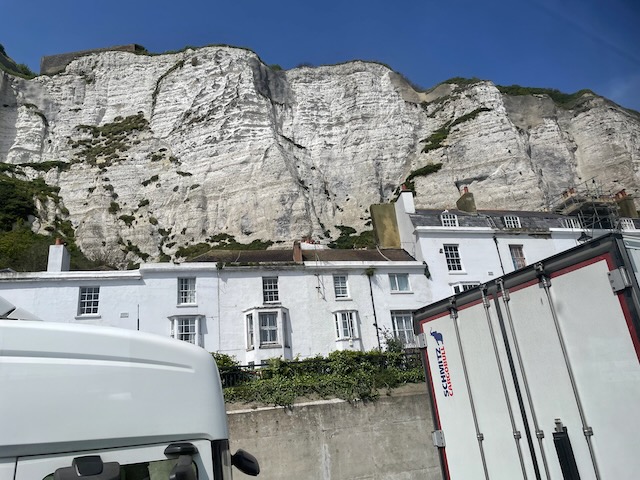
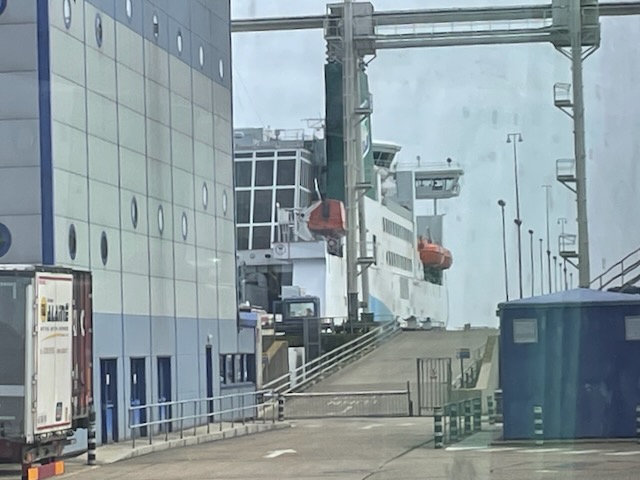
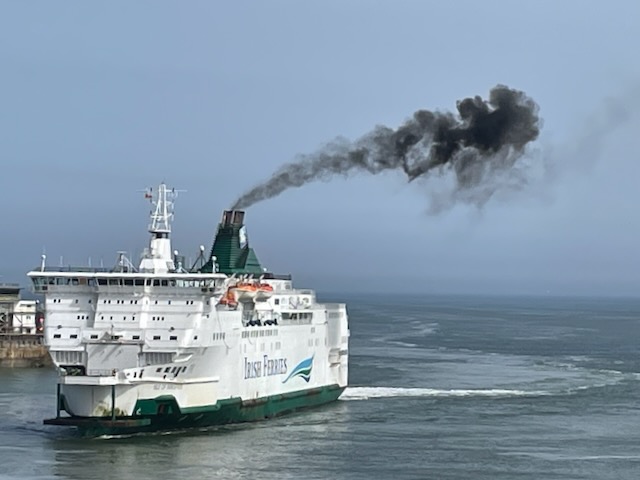
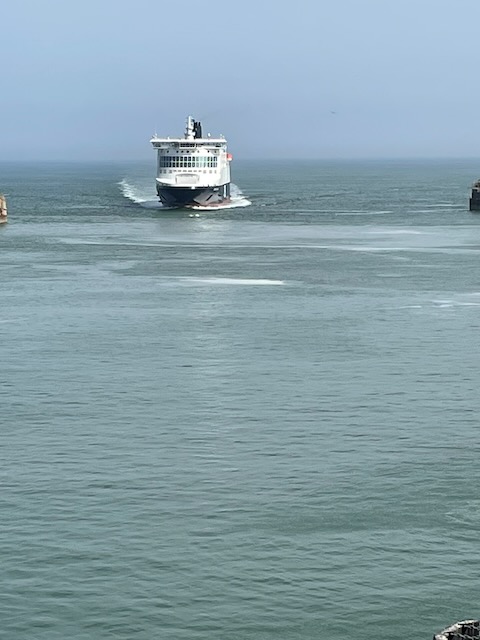
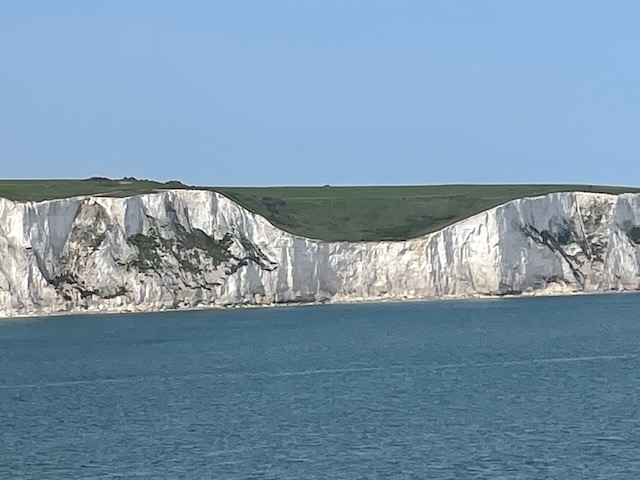
We had been warned that a rough crossing could be a nauseating experience or worse, but we were fortunate to make our trip to France on a wonderfully calm day. This was the second time we’d been to Dover, but we had much better views of its white cliffs this time, particularly after the ferry left the dock.

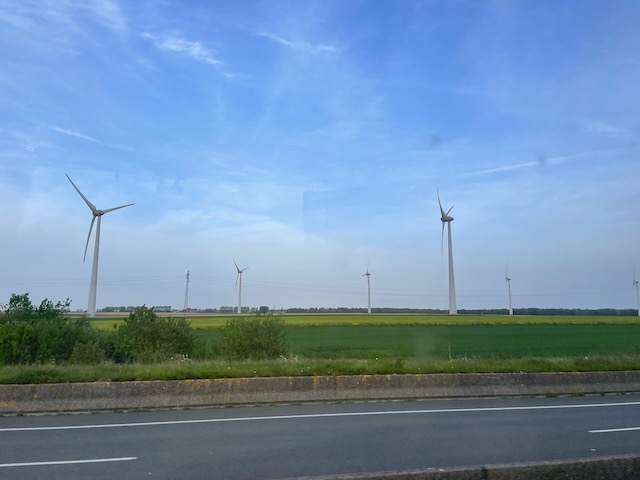
The actual crossing by ferry takes about 2.5 hours, and the trip was calm and picturesque. We arrived in Calais to find le temps there as pleasant as the weather had been in England. As we drove between Calais and Paris, I tried to get my brain around the fact that I was actually in France for the first time in my life. Since I was a young teenager, I’ve been studying French, reading books by French authors, watching French films, learning some French history, and envying absolutely everyone who got to be in France while I did not, so perhaps it is not difficult to understand why I found the experience almost unreal. As we travelled through the French countryside (where , by the way, I noticed happily – as I had in Germany a year or two before – that there are a lot of wind farms), I peered eagerly toward the horizon for my first sight of Paris.
But le temps had other ideas. The skies grew dark with clouds as the night fell, and as we reached Paris, a monstrous storm let loose. The torrent of hail and rain was intensified by near-constant flashes of lighting and crashing thunder. The bus, being largely a metal object, intensified the sound of the hailstones clattering down upon us, and I felt as though we were in a tin bucket – fortunately one with a lid on it, and windows.
I’m including a couple of the videos I took after the bus had pulled over to the side of the road, to wait for the worst to pass.
All hail breaks loose.

All of this meteorological excitement meant that we arrived at Paris’s Bercy Seine bus station a couple of hours later than scheduled, after ten at night. Delayed buses and storms be damned, all the service staff were heading home on time. Loiterers were being shooed out of the waiting room and asked to stand on the platforms until their connecting buses arrived. The lights in the office areas were extinguished, and doors and windows that might provide access to any useful information were securely locked.

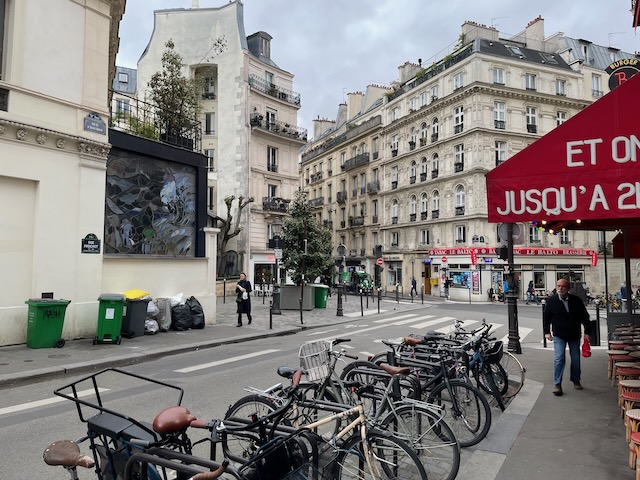
At first sight, the streets of Paris were not how I’d imagined them

Not being entirely fluent in French (not bad, but not fluent), we had some serious difficulty trying to figure out where to leave the building in order to find a ride to our hotel. We asked other travellers on the platform where the exit was, but those who did understand our questions and gesticulations all seemed to be waiting for connecting buses and didn’t know any more than we did about the layout of the station.

Several days later, when I finally had some time to try to figure out where we had gone wrong with la Gare Bercy Seine, I discovered that our challenges were not entirely due to our inadequacies in French (although our fellow-sufferer was also from Toronto, so maybe it’s a Canadian thing to expect that there be signage). On Trip Advisor I came across a review by “Oyster Boys” entitled “Flixbus Station at Bercy Seine in Paris is the Bermuda Triangle!!!!” Turns out its authors had had the same experience as we did, only in reverse: they’d been trying to leave Paris to go to Brussels when they’d encountered the mysteries of the Gare from Hell. “Finding the Flixbus station is like looking for the North Korean nuclear missile site,” they wrote. “You can’t find it. It’s almost as if they don’t want you to find it. It’s hidden underground inside a park….yes a park full of trees and some kind of playground full of graffitis…. It’s like walking into the abyss of the underworld. There’s no sign that says it’s a bus station. You just have to walk to a park with no sign to lead you to the entrance. I could see people circling around the park looking for the station.”

The only exit we could find opened into the aforementioned park. As we peered through the ongoing downpour we noticed that past the park, a couple of city blocks away, there was a street with cars on it. Although the worst of the storm had passed, we knew we were about to get very wet, but we had little choice. So off we went toward the street where we could call an Uber, dragging our suitcases through the park’s puddles as we walked.

After being tricked once by a non-Uber driver who convinced us he was an Uber driver, and then shouting at him until he returned us to the original meeting spot and let us out of his vehicle, and after finally connecting with our actual Uber driver (yes. I know. Check the license plate. We won’t forget again), we were dropped off after midnight at our small hotel – on one of those wonderful Paris streets I’d come so far to see. It was no longer raining, and the reflections of the street lights glinted on the wet stones and pavement.

However, the day was not quite over. We had to wake someone up inside the hotel in order to be let in and register. Our third-floor room, it turned out, was only a few feet larger than the double bed, but we were exhausted: we’d figure out how to manage the unpacking of the suitcases in the morning. I plugged my power bar into the wall so I could recharge my phone and my watch, and promptly plunged the entire hotel into darkness.

After Arnie went down to confess my sin, and received a small lecture from the night manager, we heard a caretaker (or most likely the manager himself) open a door just outside our room, and fiddle around with things a bit. Suddenly the lights came on. We turned them out and went to sleep.

The next morning we got up and looked around, now even more fully aware of how much time we might need to spend just to figure out how to sort our stuff so that we could get at it when we needed it, and still have enough floor space to get from the bed to the bathroom and to the doorway to the hall. But after a superb petit déjeuner in the downstairs breakfast room (it included fruit, eggs, sausages, bacon, croissants, real coffee, pain chocolat and more, and was included in the price of our room), we went to the desk to ask about something else, and the person who was then on duty said, “Hey. You guys are here for an extended stay. Wouldn’t you like a larger room?”

The next thing we knew we were in a main-floor “suite,” at no additional cost (a very small suite, but it had a very large bathroom and a hallway and a window to the patio outside and lots of room for suitcases).

And so, as it turned out, May 1 was the only truly difficult day on our entire trip. We had other moments of frustration (getting lost in the subway system, for example, which happened several times in Paris, as it had in London), but despite their reputation, every Parisian we encountered was helpful and friendly (aside from one or two who worked in booths at the Métro, see above), and no day that followed was anything like the day we went from London, England to Paris, France.

And even that one day had caused us only a few hours of grief. After that, we were in Perfect Paris, which was all that I had ever dreamed it would be, and more.

London, etc. and Paris, 9: The Globe Theatre and the Tate Modern. Our last day in London

I can’t think of a better way to have spent our last day in London than with two long-time friends.

We began our day by making the familiar trek from our hotel to Paddington Station, and I found I was feeling nostalgic in advance for the neighbourhood where we’d felt so at home (and eaten so well) for the past ten days. We emerged from the underground at Mansion House station, walked past St. Paul’s Cathedral and then across the Millennium Footbridge to the south side of the Thames. There, at the entrance to Shakespeare’s Globe Theatre, we met Nancy Mattson – whom I’ve known since both of us lived in Edmonton, many decades ago – and her British-born husband Michael Bartholemew-Biggs. We were amazed to learn that they had never done the Globe tour before, although they had seen many plays at the theatre. We were all in for a treat.

The original Globe Theatre was built in what is now the Borough of Southwark by Shakespeare’s theatre troupe in 1599, but the building was destroyed by fire in 1613. A second Globe opened a year later on the same site, but it closed along with all the other theatres in London in 1642 when, at the start of the first English Civil War, “lascivious Mirth and Levity” and other unhealthy states of mind that might be incurred if one attended a play were officially deemed incongruous with the spirit of the times.

Shakespeare’s Globe,” the newest incarnation of Shakespeare’s theatre, opened in 1997. It is located 500 feet away from the original, but the design is very much the same. Our well spoken young guide related intriguing structural details about the original theatre, how both players and patrons were accommodated there, and how the theatre’s attributes (and drawbacks, such as the lack of a roof over those standing in front of the stage) had been reproduced in the current building. We wore headsets and our guide spoke quietly into the microphone so we wouldn’t disturb a rehearsal for Much Ado about Nothing that was taking place on the colourfully decorated stage. It was an excellent and interesting tour.

After checking out some displays in the lobby, and giving the gift shop a quick look (Note the umbrella: so charming, but how would you manage it on the Tube, especially if it got wet?), we walked over to Tas Pide, a middle-eastern/Turkish restaurant that Nancy and Michael knew. The food was outstanding.

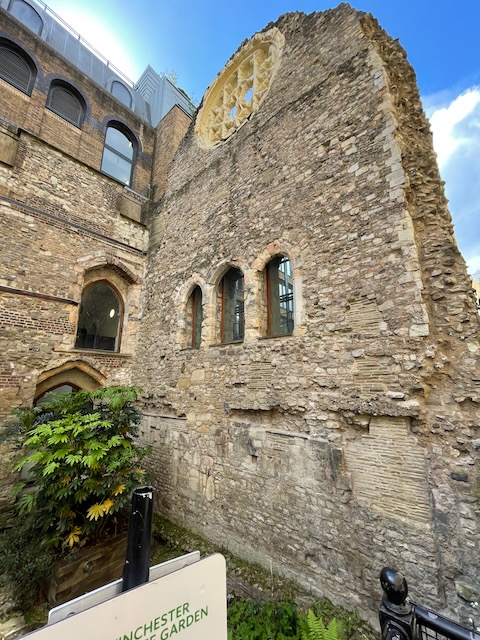
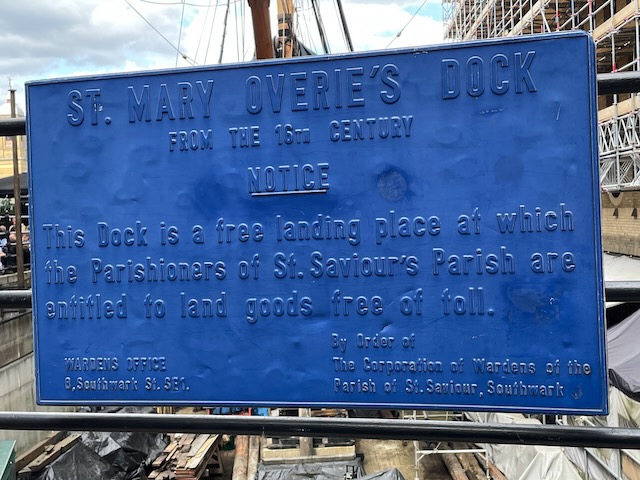
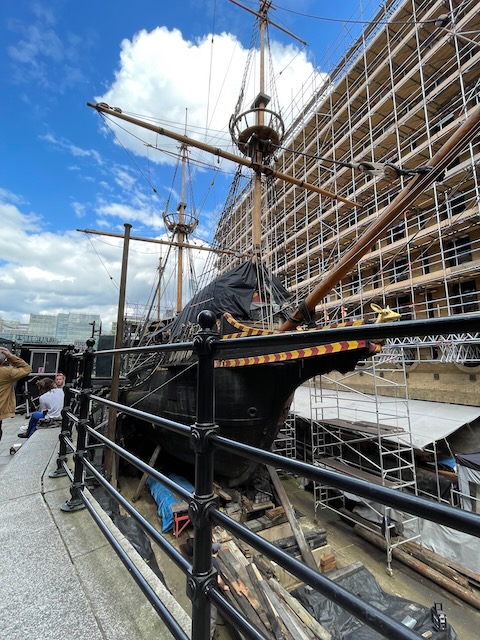
Our route from the Globe to Tas Pide and then back to the Tate Modern – our final destination for the day – took us past a number of interesting sights along the waterfront in Southwark, including: the original site of Globe playhouse; a museum in honour of The Clink; the remains of 12th-century era Winchester Palace, which includes the rose window from its Great Hall – one of the remaining pieces of the original structure that was mostly destroyed by fire in 1814 – and its lovely medieval-themed garden; a replica of the Golden Hynde; St. Mary’s Overie’s Dock; and Dirty Lane. The British have a definite talent for giving names to things.

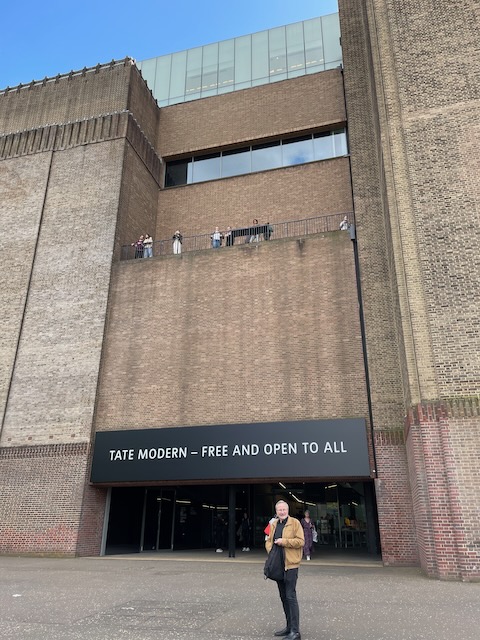
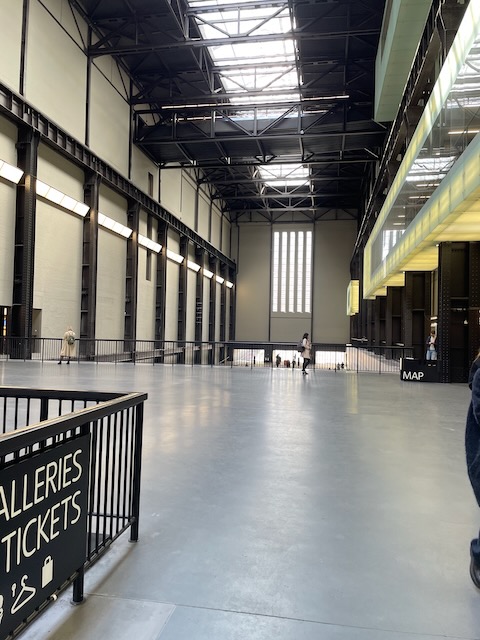
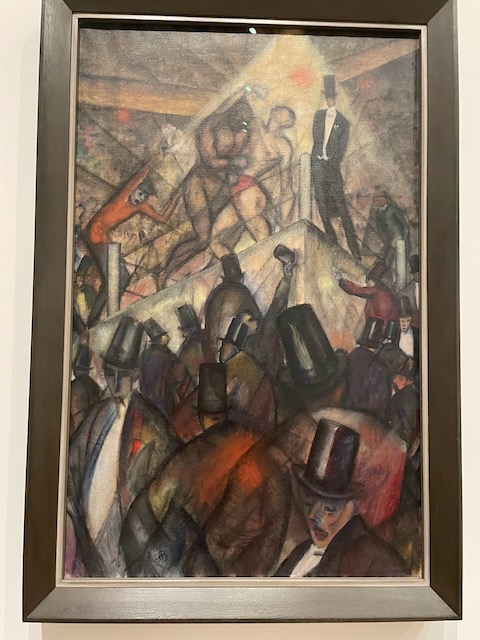
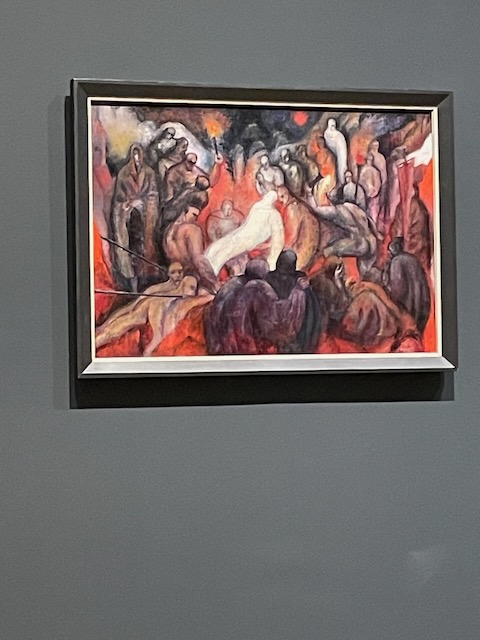
We saw a fabulous exhibition at the Tate Modern: The Expressionists: Kandinsky, Münter and the Blue Rider. The Blue Rider [Der Blaue Reiter] was a group of avant-garde artists in Munich at the start of the 20th century. Gabriele Münter and Wassily Kandinsky were two of its founding members. The Expressionists intended through art to portray emotions and responses to real and spiritual experiences, as opposed to creating realistic depictions of objects and scenes. Their works often featured distorted forms and bold colours.

The show was huge. Before long, my feet were causing me serious grief so I wasn’t able to enjoy the pieces near the end as much as I had the ones at the beginning. (Nor, as you will note, was I too particular about how I was holding my phone as I snapped photos of the works of art.) If we’d been in London longer, I’d have gone back a second time so I could have absorbed more than I did. I’d had no idea how much I liked Expressionist art!

Most of the artworks in this show were created in the first decade of the 20th century.

Nancy Mattson and Michael Bartholomew-Biggs are both poets, and in my next post I’ll be taking a side trip from this travelogue to profile their most recent books. Each poet has a distinctive voice, but both works are accessible, intelligent and eloquent. Stay tuned.

London, etc. and Paris, 8: Leeds Castle, Canterbury Cathedral and the White Cliffs of Dover. Plus “The One and Only Dog Collar Museum.”

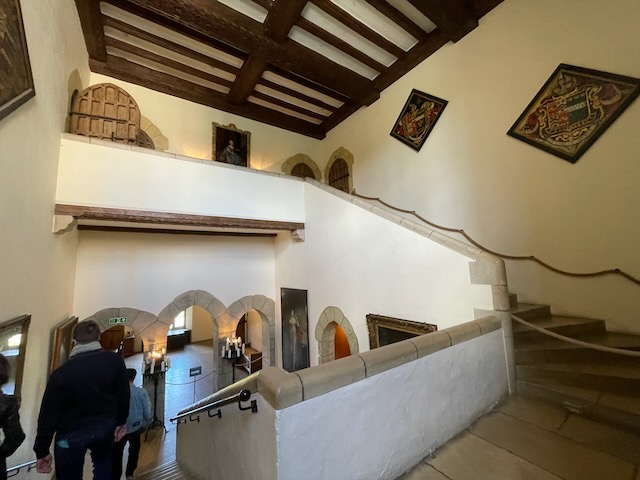
Our second bus tour took us southwest from London to the English Channel at Dover, via Leeds Castle and Canterbury. Leeds Castle is only the second “castle” (as opposed to palaces) I’ve ever visited, the first being Randolph Hearst’s estate at San Simeon, which I toured when I was about twenty. Hearst didn’t have a moat. Leeds has a moat.

[Click on a photo to view the gallery. If you’re reading this in an email, click the link at the top of the email to view it in a browser (or reader) for better views of the images.]

“Listed in the Domesday book of 1086, Leeds Castle has been a Norman stronghold, a royal residence for six of England’s medieval queens, a palace belonging to Henry VIII and a country retreat for influential 20th-century figures”(on-site signage).

Leeds is a comfortable size for a castle. With the support of a staff of dozens, I think I could quite happily live there. In fact, this castle was in use less than a hundred years ago, when its final owner, Lady Olive Baillie, entertained famous people from all over the world. “Alongside a close circle of friends, Lady Baillie [who purchased the castle in 1923] enjoyed Leeds Castle as her luxurious country house and a weekend retreat before setting up a trust to care for it after her death in 1974” (on-site signage). Thanks to the decor from Lady Baillie’s era (along with some piped in ragtime music), this medieval palace has a Roaring Twenties feel to it.

One of the appealing features of Leeds Castle is the decision by the curation team to embroider some of the historical information onto pillows and to stencil it onto walls.

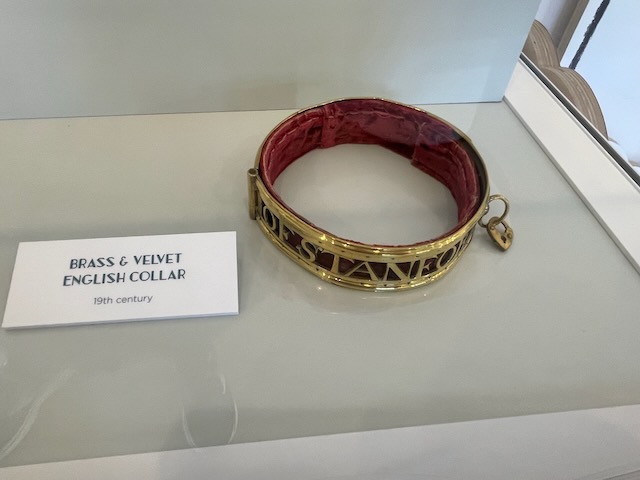
After touring the castle, I wandered past contented waterbirds up to the stable-courtyard area (which now features accommodation (people can stay at the castle overnight), some shops, and food vendors), and checked out what is reportedly the world’s only Dog Collar Museum. (You’re welcome.)

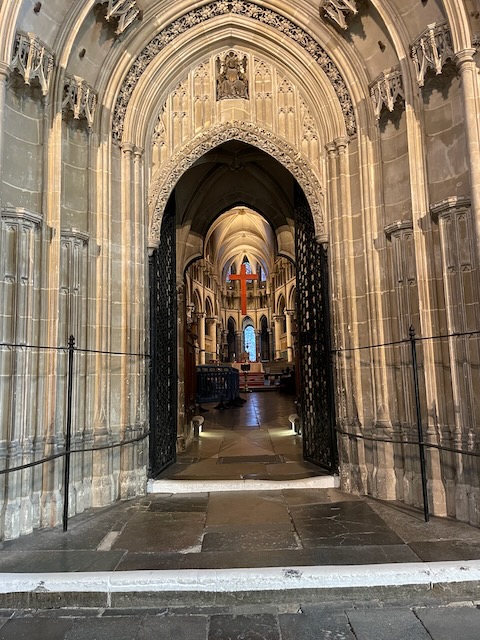
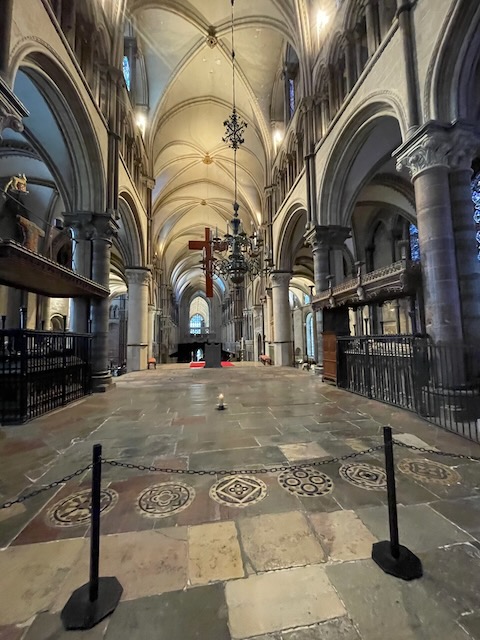
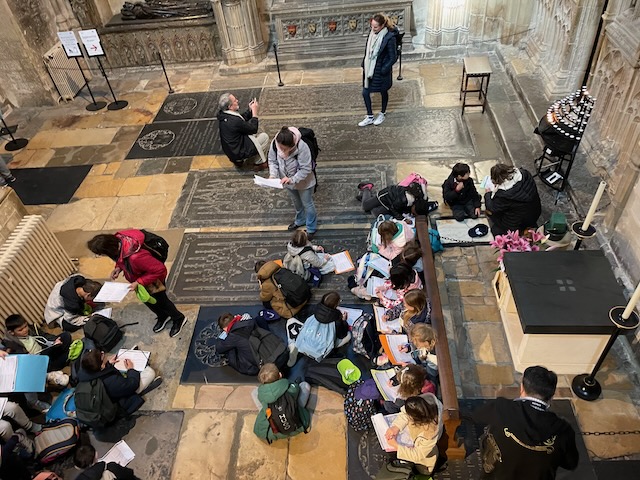
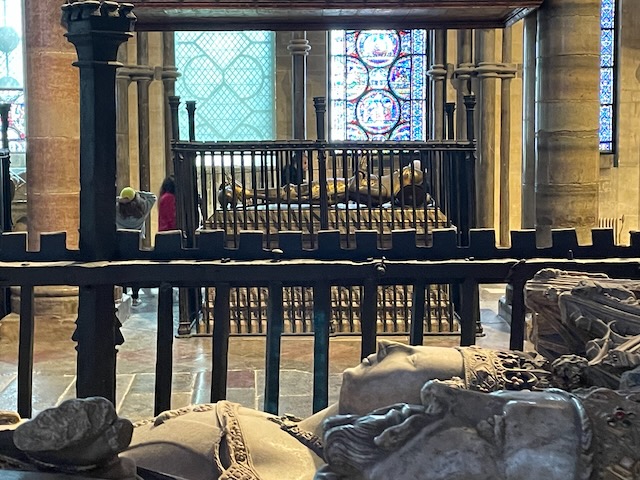
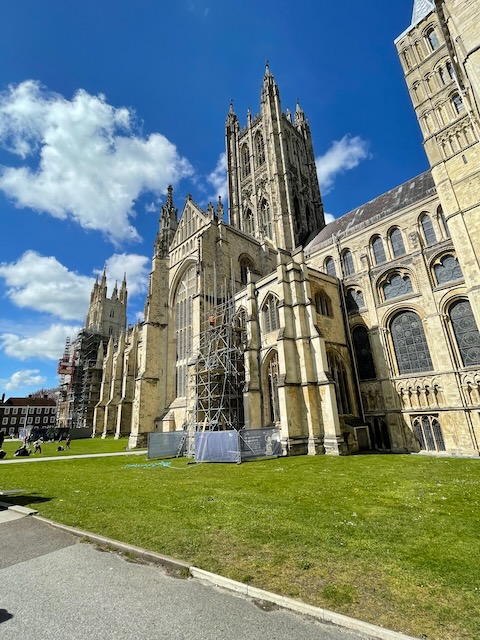
Our next stop was Canterbury Cathedral, a UNESCO World Heritage Site, seat of the Archbishop of Canterbury, an important pilgrimage destination, the location of the tombs of many royals and saints, and the site of the murder of Thomas Becket in 1170.

Canterbury Cathedral features Gothic and Romanesque architecture that dates from CE 597, when it was founded by St. Augustine. It has been modified several times over the centuries.

Thomas Becket, who was Archbishop of Canterbury when he died and Lord Chancellor before that, had a falling out with King Henry II over their differing views on the the powers of the Church vs. the Crown, and was murdered in the Cathedral by supporters of the King in 1170. (It seemed appropriate to purchase a copy of Murder in the Cathedral, the play by T.S. Eliott [1935], in the gift shop. So I did). Becket was canonized by Pope Alexander III and is considered a saint by both Roman Catholics and Anglicans. But neither his death nor his sainthood spared him from ongoing conflict with British royalty. Henry VIII (who had his own ideas on the role of the Church in England and how much control over it the Pope should have, particularly when it came to annulments of the marriages of kings) destroyed Becket’s shrine in 1538. It was recently digitally reconstructed using computer generated imaging.

The Canterbury Tales by Geoffrey Chaucer (written between 1387 and 1400) imagines stories told as a way to pass the time by 24 pilgrims on their way from London to the Cathedral. “The Wife of Bath’s Tale,” mentioned in the post about our trip to Bath, is one of these.

The small glimpses of the City of Canterbury we caught en route to the Cathedral gave us the impression of a charming, friendly city. We particularly enjoyed the square outside the Cathedral, where we had a very satisfying meal of fish and chips.

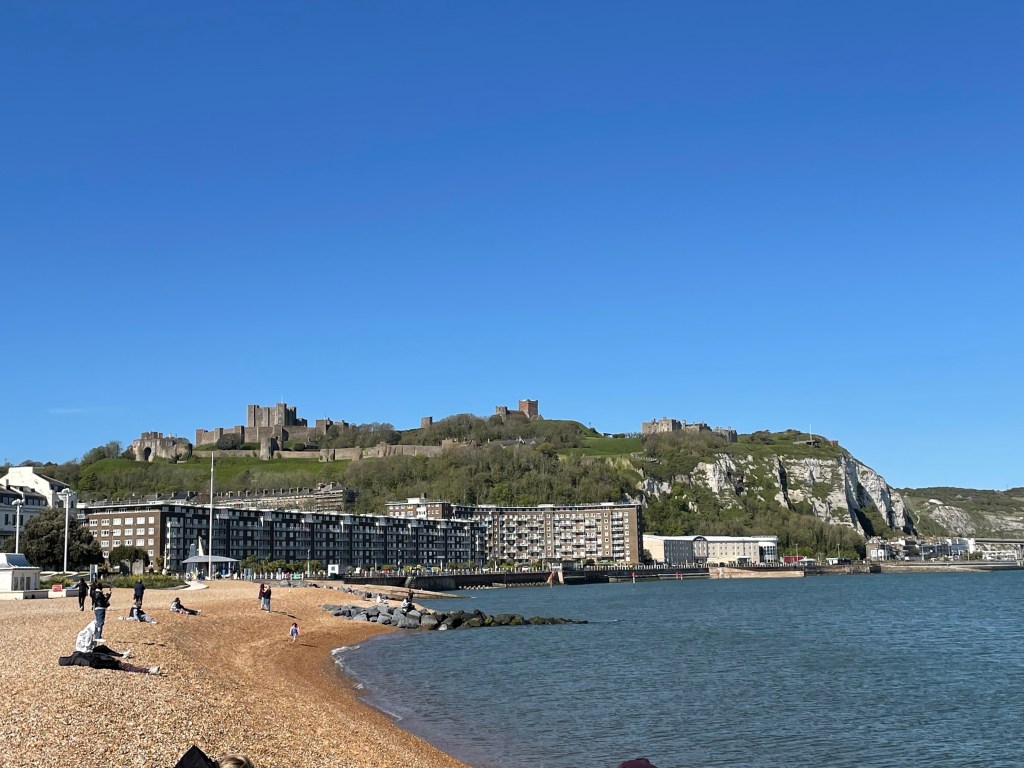
Our bus tour finally took us to Dover for a look at the famous white cliffs. As it turned out we got a better view of them two days later when we took a bus and ferry to France, but we enjoyed the opportunity to wander along the (very stony) beach and to breathe the sea air before we returned to London.

London, etc. and Paris, 7: Sir John Soane’s Museum and a Musical Matinee

[Note to readers: If you receive these blog posts by email and some of the photos look stretched or squished, I apologize. I recommend you click the link in the upper right hand corner of the email, where it says “Read on Blog or Reader” to read the post online. I think the problem has to do with the aspect ratio of the photographs, but I can’t figure out how to fix it. Please drop me a note if this doesn’t work.]

After a week of industrious touristing, we took it a bit easier on April 28th. I wanted Arnie to see Sir John Soane’s Museum, to which my friend Rhona McAdam had introduced me on my previous trip to London 25 years ago. The museum is close to Covent Garden and Drury Lane, which are part of London’s “West End Theatreland” so we decided to take in a matinee as well as the museum, have dinner and call that a day. (Drury Lane was, of course, also the home address of the famed Muffin Man. Do you know him?)

Sir John Soane (1753-1837) was a highly respected architect whose neo-classical designs included a number of buildings for the Bank of England as well as private commissions. He ultimately taught architecture at the Royal Academy.

Despite the best efforts of two recalcitrant offspring, Soane had a fascinating and productive life (you can get an overview of it on Wikipedia), and he travelled widely. Although the buildings he designed are mostly gone now, he continues to be well known primarily because he turned his house and office in Lincoln’s Inn Fields (really two adjoining houses, to which a third was later added) into a museum, and filled it literally to the rafters with an intriguing and massively diverse collection of antiquities from all over the world, including bronzes, urns, sculptures, tiles, stained glass, busts and even the Sarcophagus of Seti. (Apparently Soane threw quite a party after the sarcophagus was safely delivered.) In addition to all that, he collected paintings – you can see Hogarths, J.M.W. Turners and Canalettos among others at the Soane – and over his life he also acquired nearly 8000 books including illuminated manuscripts, and architectural drawings from around the world.

Having purchased our matinee tickets in advance at the Gillian Lynne Theatre box office, we waited in the rain for half an hour to get into the Soane, then saw as many artifacts as we could before heading off to see the musical Standing at the Sky’s Edge.

Standing at the Sky’s Edge had rave reviews when it was at the National Theatre in London, before it moved to the West End. It also won several awards. It is deeply grounded in the experience of Great Britain in the past seventy years (including Thatcher’s devastations, Brexit, etc.). The profusion of English accents meant that we missed a bunch of lines because our ears didn’t tune into the vernacular/accents quickly enough. But we really enjoyed the production.

“Hailed as ‘the greatest new British musical’ (Daily Express), Standing at the Sky’s Edge is a kaleidoscopic portrait of life on an ever-changing estate, charting the highs and lows and loves and losses of three generations over six tumultuous decades.” – National Theatre

London, etc. and Paris, 6: Photography at the V&A, and Hundreds of Welsh Voices at Royal Albert Hall

Travel Date: Saturday, April 27, 2024

Prince Albert was the Prince Consort from 1857 until his death four years later. He had married his first cousin, Queen Victoria of England, in 1840, three years after her ascent to the throne. Born in Coborg, Germany, Albert died when he was only 42, but he made an impressive number and range of contributions to the arts and sciences in England during his tenure there. Following his death, his widow and her subjects continued to honour his memory by naming things after him, and since Victoria reigned for 63 years, seven months and two days (a record until Elizabeth II’s nearly 72 years), it is no surprise that everywhere you turn in London, you are running into a bridge or a building or a street or a hotel named after Victoria or Albert, or – as in the case of the Victoria and Albert Museum – both. In fact, the neighbourhood in which the V&A is located is known as “Albertopolis” because of the number of edifices and institutions in the area that are associated with him one way or another (including Royal Albert Hall, which we’d be visiting later this same day.)

We’d been intrigued by the signs promoting a photography exhibition when we’d visited the V&A’s South Kensington location earlier in the week, but the gallery had closed before we’d had a chance to explore it. So on Saturday, we decided to go back just to look at the Photography Centre, a series of seven galleries on the third level of the museum. The Centre includes about 800,000 photographs dating back as far as 1820. One of the large display rooms is sponsored by Sir Elton John and his husband David Furnish. (A show featuring photographs from their collection, Fragile Beauty , which opened after we had left, is on display until early 2025.)

An interesting multi-shelf display at the entrance to the Centre features hundreds of different kinds of cameras, and it is tempting to try to find a camera you once owned somewhere in that display. (My first was a Brownie box camera with a viewfinder on top. I found cameras like it in the display, but I didn’t find it.)

(Please click on an image to see them in gallery format)

The Photography Centre explores the whole field of photography from a range of viewpoints, from the technical (types of cameras, processes and techniques including black and white, printmaking, vintage 3D, etc.) through the historical, artistic, political, and beyond. Fascinating stuff.

I was particularly interested in the photos of the coal miners, as my father’s forebears also worked in the coal mines. The V&A photos were taken in Durham, England and my father’s family was from Abertillery in Wales, but I’m sure that they had lots in common when they emerged from below the ground at the end of a shift.

My father died when I was two, and one of the few physical connections I had with him as I grew up was a record from 1963 called Five Thousand Voices: A Nation Sings, recorded on May 3, 1963. That record is worn out now, although I still have it, but imagine my delight when I learned that a concert of “Massed Male Choirs” from Wales would take place at the Royal Albert Hall while we were there.

We walked through more of “Albertopolis” on our way to the concert, checking out the lovely neighbourhood where Royal Albert Hall is located and then the Albert Memorial, which stands a few hundred feet in front of the Hall in Hyde Park, not far from Buckingham Palace.

After an outstanding dinner at Verdi, which is located in Royal Albert Hall, we made our way to our (swivel) seats, and were properly overwhelmed. Almost like Stonehenge, I feel like I’ve been aware of Royal Albert Hall for my entire life, particularly because it is such a plum for artists to add the venue to their resumes. (In regard to The Beatles’ line, “Now they know how many holes it takes to fill the Albert Hall,” I just found this: “Papers newly discovered deep under the Royal Albert Hall have revealed that the iconic London venue wrote to the Beatles in 1967 to object ‘in the strongest conceivable terms’ to being named in the Fab Four’s song A Day in the Life.”)

The album of Welsh hymn singing that I own is called “Five Thousand Voices,” and the concert we attended on April 27, “A Festival of Male Welsh Voices” indicates that “more than 500 choristers” were on stage. However, several additional groups joined the event now and then, including a number of female voices, and since the entire audience (except for Arnie and me) seemed to be from Wales and to know the songs, I expect we heard 5000 voices that night too.

It was splendid.

After the concert, we took some time to enjoy the collage/mural by Sir Peter Blake entitled “Appearing at the Royal Albert Hall” which is in the lobby of the building. Unveiled in 2014, it features more than 400 of the singers, dancers and other performers (not to mention scientists, a prime minister, a sumo wrestler and Muhammed Ali) who have appeared at the Hall since it opened in 1871. You can see an interactive version here.

And here are three videos from the concert. Enjoy!

London, etc. and Paris, 5: Because until now the world did not have enough photos of Stonehenge (or of the Roman Baths)

On the first Friday of our trip, we made our way from Paddington to the Victoria Coach Station to join a day tour that would take us to Stonehenge and the City of Bath. The Victoria Coach Station is not, as one might have expected, attached to the Victoria Underground Station, or even to the Victoria Train Station (the latter two being adjacent and loosely connected) but is instead several blocks away. As it turned out, this was useful information for us to have as we would need to make two more trips to that same station before the conclusion of our time in England.

Boarding began at 8 a.m. for the 8:30 tour, and due to the unanticipated quarter-hour walk from the Victoria Underground to the correct gate at the Victoria Coach Station, we were hard pressed to get in a quick breakfast before we boarded. All of the departure-gate doors in the station are locked five minutes before departure in order to prevent people from being driven over by departing buses, which means that if you don’t board early, you are SOL. Also, you are not allowed to take hot food or drink on board with you. On our second tour from VCS the following week, the guide told us that the only downside of her job was the sad spectacle of late-arriving customers banging on the glass doors as they helplessly watched their tour buses driving away without them.

Soon after we pulled away from the station, I saw through the bus window an intriguing little building, decorated with shells, in a park. I learned through an online search that this is one of two huts built during a post-WWII redesign of Grosvenor Gardens (which is the name of the park) by architect Jean Moreux. The shells are from England and France, to symbolize English-French unity. The huts, which are still used to store equipment, are built in the French fabrique style.

Two hours later, after travelling a little south but mostly west, we arrived at Stonehenge. Believed to have been constructed and in use from about 3700 to 1600 BC., the prehistoric structure is so famous that it must be recognizable to just about everyone on the planet. I’m sure I first saw photos of it when I was still in elementary school. Indeed, I think that much of the dramatic impact of catching a first sight of it (which is dramatic and worth the visit even if you’ve seen too many images of it already) arises from the site’s familiarity.

(Please click on photos to see bigger versions of them in a gallery format.)

Our visit took place on a cool and windy day but the sun was out and we took our time strolling around the site, trying to imagine how people several thousand years ago could possibly have gathered these immense stones together in one place – some from as far away as southern Wales – standing most of them on their ends and then hoisting the lintel stones into their horizontal positions. The upright stones, most of them “sarcen,” or silicified sandstone blocks, are estimated to weigh about 25 tons each. That’s the other part of the impact of visiting this place: the entire project seems impossible, but there it is, right before your eyes.

“Stonehenge is one of the most impressive prehistoric megalithic monuments in the world on account of the sheer size of its megaliths, the sophistication of its concentric plan and architectural design, the shaping of the stones – uniquely using both Wiltshire Sarsen sandstone and Pembroke Bluestone – and the precision with which it was built.” (UNESCO)

On Facebook, a number of people expressed regret that I did not get to see the site when it was still accessible to visitors. (“Back in the 70s, we could sit on the rocks!” they told me.) But once I realized what I was looking at, I was kind of glad that direct access is restricted. This marvel needs to be left alone so that future generations can see it too. Humans are always tempted to take away a souvenir or leave a mark, and in fact some of the graffiti on the stones already is hundreds of years old.

We learned that until the early 1900s, stones were still being removed from the site to be used as building materials elsewhere – another great reason for uncontrolled public access to be discontinued. It is still possible to walk into the site twice a year – during the spring and fall equinoxes – but it is necessary to sign up for these carefully controlled visits well in advance. In the meantime, the masses of tourists do not diminish the experience: even when hundreds of us were walking around Stonehenge, the site felt vast and unoccupied. It was easy to imagine how overwhelming the place must be when the visitors have left and only the stones (and the birds) remain. (I know, I know. Who would it overwhelm if there was no one there? But you know what I mean.)

Our tour then moved on to the nearby city of Bath (33 miles from Stonehenge), whose buildings are almost all made from another local stone, this one with a lovely distinctive honey colour. (“Bath Stone is an oolitic limestone comprising granular fragments of calcium carbonate laid down during the Jurassic Period [195 to 135 million years ago] when the region that is now Bath was under a shallow sea”). Due to the hilly contours of the area and the proliferation of Georgian architecture, the town is picturesque from almost every vantage point.

The bus dropped us off in the main square of the city and a guide led us past Bath Abbey (1611; note the angels on the ladders at the front of the towers on each side of the entrance; oddly a couple of them are climbing down rather than up. I have found no explanation for the upside-down angels, nor for why angels might need ladders in the first place, but if you Google “Upside Down Angels Bath Abbey Ladders,” you’ll find some thoughts on the subject by other people) to the doors of the Roman Baths just down the street.

To be perfectly honest, I was mostly interested in seeing Bath because I had been so intrigued many decades ago when I read the “Prologue to The Wife of Bath’s Tale” in Geoffrey Chaucer’s Canterbury Tales in first-year English. The tale is distinctive not only because the narrator is a woman, but because her story speaks against “many centuries of an antifeminism that was particularly nurtured by the medieval church. In their eagerness to exalt the spiritual idea of chastity, certain theologians developed an idea of womankind that was nothing less than monstrous” (The Norton Anthology of English Literature, Vol. 1962). As a 16-year-old, this was one of my first brushes with feminist literature (even if it was written by a male who’d lived in the Middle Ages [1343-1400]).

Somehow I’d missed realizing that the city had been named after the Roman baths that were built around the area’s natural springs during the Roman occupation in approximately 60 to 70 AD, and used until the Romans left Britain in about 500 AD. I almost didn’t bother to purchase advance tickets to the site, but I’m very glad I did. It is quite spectacular, mostly reconstructed in the 1800s to attract the interest of tourists. The lower level does preserve some of the features of the original Roman baths and, of course, the spring that motivated the Romans to build around it in the first place continues to burble up from about 10,000 feet below the surface. (“The hot mineral springs bubble up from the ground at temperatures well above 104 °F [40 °C], and the main one produces more than 300,000 gallons [1.3 million liters] a day” Britannica.) There is a very interesting piece about the Roman baths on Wikipedia.

Bathing is not permitted at the Baths, but I took a sip of the water and was immediately cured of everything except for my sore feet and aching lower back. Afterwards, we had a decadent ice cream waffle for lunch, while watching a woman get her hair styled on the street outside in front of a hair salon with a rather disturbing name. As far as I know, she emerged with her tresses trimmed and her brain intact. (Poor Nick. There must be a lot of teasing.)

Here are three short videos I took on the lower level of the Roman baths:

A sign asks people not to put their hands (or other things) in the water, so don’t do what this guy did when you pop in there for a visit.
Overflow
Burbles from the deep