
Travel Date: Thursday, May 9, 2024
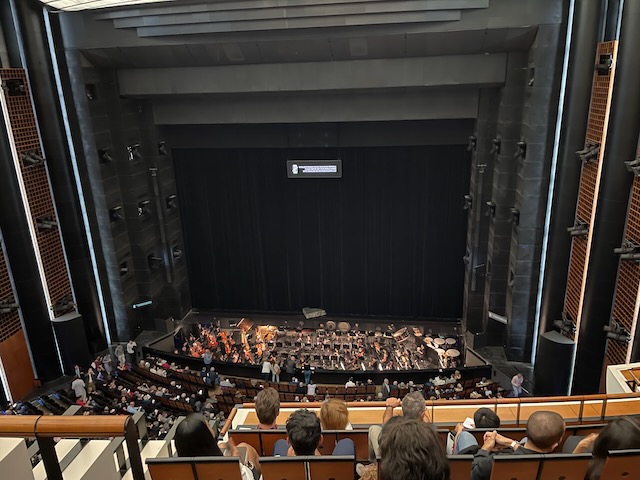
On our second-last full day in Paris, we turned our focus to two of the most important sites for opera in the city – opera having become one of my favourite pastimes in the past few decades. First we toured the lavishly beautiful Palais Garnier, then later in the day we made our way to the more restrained but no less magnificent Opera Bastille. There we attended an extraordinary production of Salomé by Richard Strauss, starring Norway’s Lise Davidsen, one of the most in-demand sopranos in the world.
[Reminder: If you receive this post as an email, you might want to click on the “Read on Blog or Reader” link at the top of the page so you can see larger versions of the photos. Once you get to the webpage, click on a photo and it will expand.]
Palais Garnier: “No Space Undecorated”
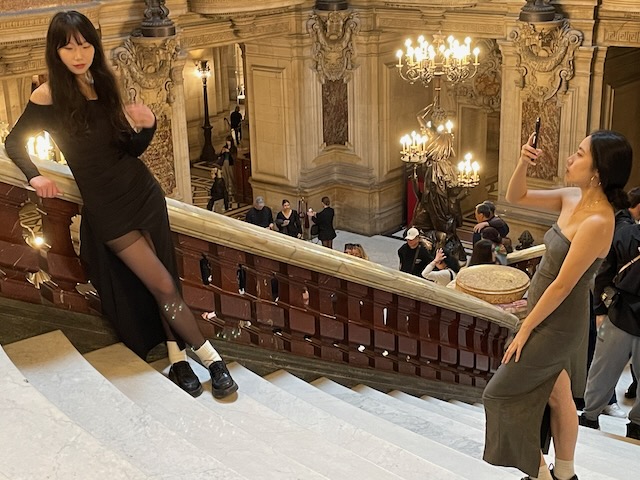
The magnificently designed and lavishly decorated Palais Garnier was built at the direction of Napoleon III. Construction began in 1861 and took more than a decade to complete. Named after Charles Garnier, its architect, the theatre was built in what is known as the Napoleonic III or Second Empire style. And as the “influencers” posing everywhere in the Palais when we were there had clearly discovered, there are more varied photo backdrops for lovely young women outside the performance auditorium than there is inside it. In fact, much of the facility was intended to be decorative rather than functional.

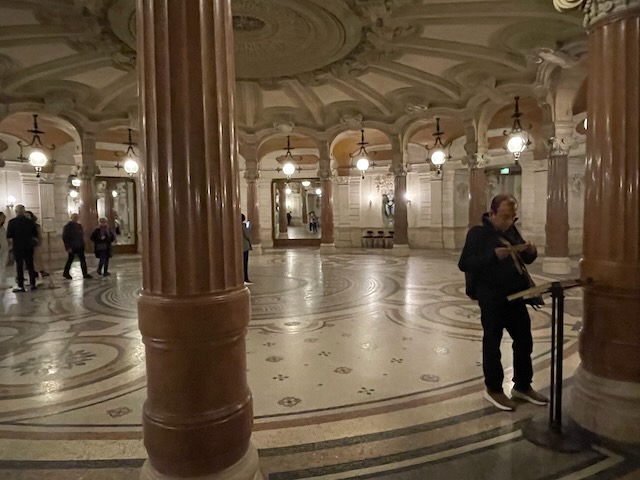

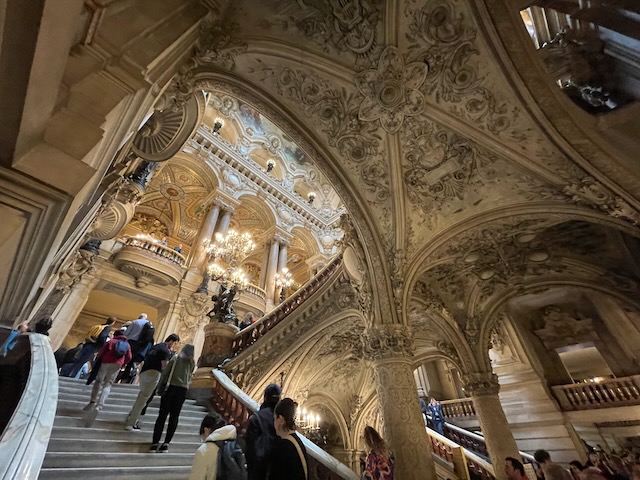
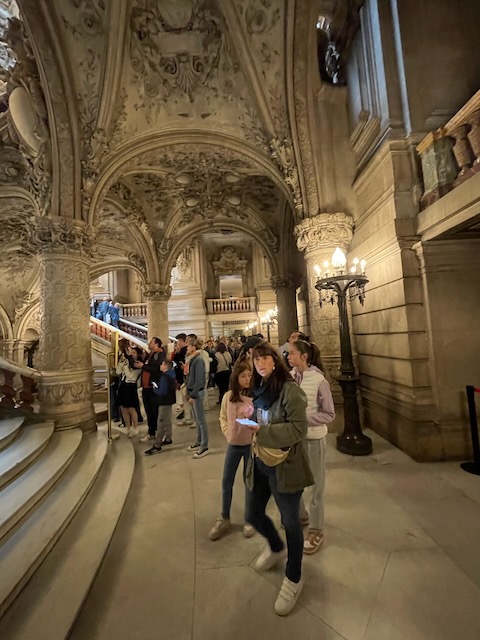
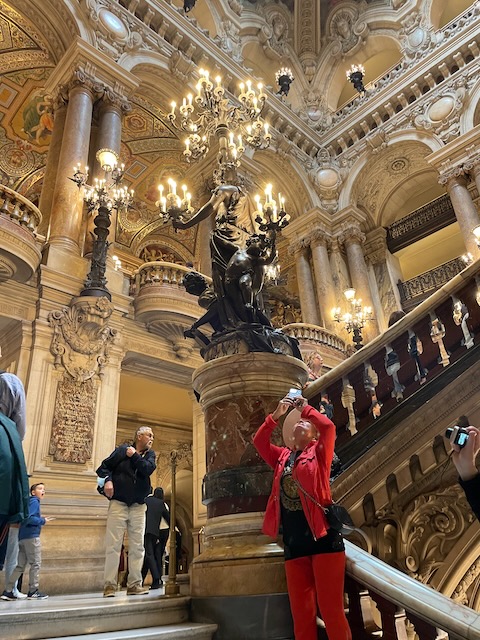
“The basic principle of Napoleon III interior decoration was [to] leave no space undecorated. Another principle was polychromy, an abundance of color obtained by using colored marble, malachite, onyx, porphyry, mosaics, and silver or gold plated bronze. Wood panelling was often encrusted with rare and exotic woods, or darkened to resemble ebony. [….] Drawing liberally from the Gothic style, Renaissance style, and the styles dominant during the reigns of Louis XV and Louis XVI [including Baroque], the combination was derided by Émile Zola as ‘the opulent bastard child of all the styles'” (Wikipedia).
“Opulent” is right.
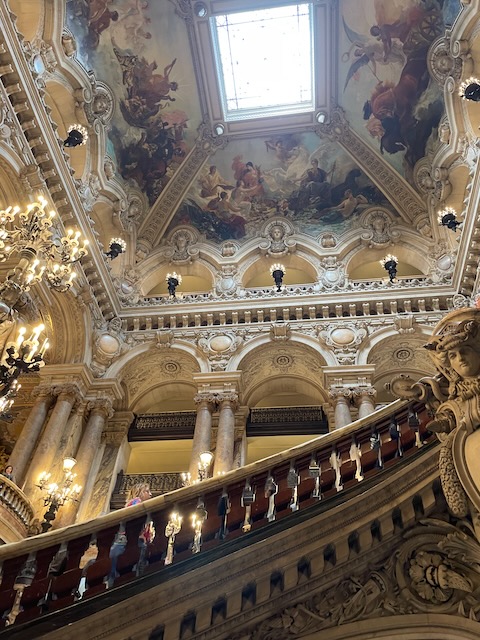


“The ceiling of the Opéra Garnier was completely renovated and re-imagined in 1964 at the urging of Minister of Culture André Malraux. The talented Marc Chagall was entrusted with painting 2,400 square feet of frescoes. The opera’s new ceiling was widely decried and contested when it was unveiled to the public on September 23, 1964, and the work at this iconic Paris opera house continues to elicit curiosity and stir passions.” (The Ceiling of the Opera Garnier)


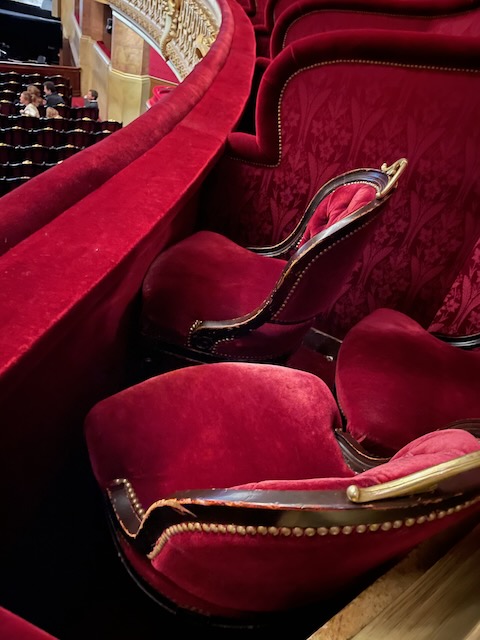

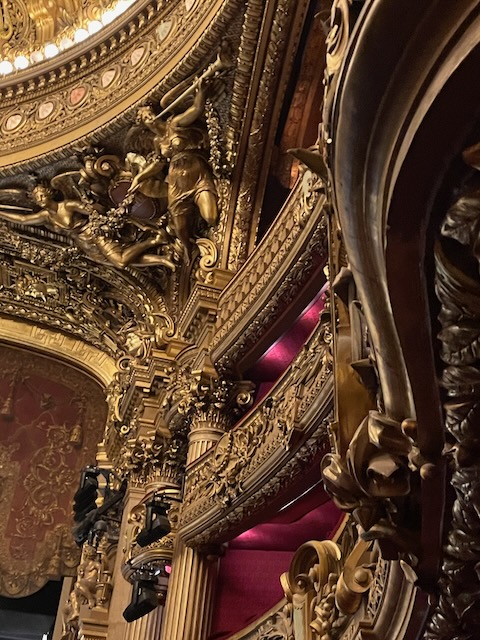


The Palais Garnier, which seats nearly 2,000 people, was for many years the sole home of the Paris Opera, which has itself has been around in one form or another since it was established by King Louis XIV in about 1670. The impetus for establishing the company was a desire to catch up to or even surpass the Italians in the field – although the Italians, having invented opera during the Renaissance, did have a good head start. Still, today French opera is well established, and works by composers such as Bizet, Massenet, Gounod and many other traditional and more modern French composers are enjoyed by audiences around the world.



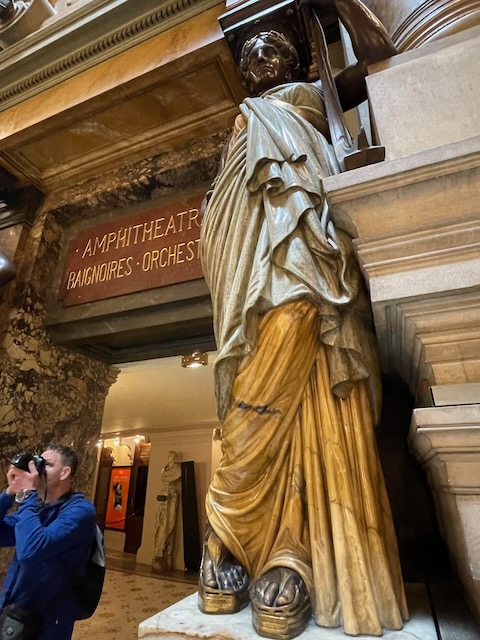
The Paris Ballet is also part of the Paris Opera organization. Although most of productions by the Paris opera and ballet companies are now staged at the “new” Opera Bastille, nearly 400 performances still attract sold-out audiences to the stage of the Palace Garnier every year. Tickets for the opportunity to tour the building (without seeing the current stage production) also regularly sell out, which is why we didn’t get into the facility until our third attempt.
Opera Bastille
Before we left Canada, we happened to see a very interesting documentary on TVO called Building Bastille (available to watch for free on YouTube). This fascinating program documents how an almost unknown Canadian architect named Carlos Ott won the competition to create a modern opera house where the infamous Bastille Prison had once stood.


The Bastille Opera was an initiative of the then-president of France, François Mitterand. Construction began in 1984, and Mitterand wanted the project completed in time to mark the 200th anniversary of the storming of the Bastille, which had occurred early in the French Revolution in 1789. No expense was to be spared – he wanted the building to be both culturally and architecturally cutting-edge. Jacques Chirac, who had been mayor of Paris and was elected president of France in 1986, tried to halt the project several times due his to concerns about rising costs, and part of Ott’s challenge was to keep the construction moving until it was completed. With Mitterand’s help, he succeeded, and secured his name as a world-class architect with this amazing facility.
“[The Opera Bastille] was a conscious, egalitarian, departure from the Palais Garnier, which has several dozen types of seats and does not offer stage visibility from all of them. Every seat at the Opéra Bastille offers an unrestricted view of the stage, is the very same type of seat with the same level of comfort, and there are no boxes. Subtitles are visible from every seat except for those at the very back of the arena and of the first balcony” (Wikipedia).
The Bastille Opera house was just one piece of a massive monument-building initiative undertaken by Mitterand in the 1980s. Entitled the Grands Projets, the undertaking was intended to revitalize the architecture of the city and to reflect France’s commitment to, and achievements in, the arts. In addition to the Opera Bastille, the Grand Projets included the Musée d’Orsay, the pyramid at the Louvre, la Grand Arche de Défense and several other major buildings. When all of it was complete – many years after originally scheduled – the cost of these projects was estimated to have reached 15.7 billion francs.
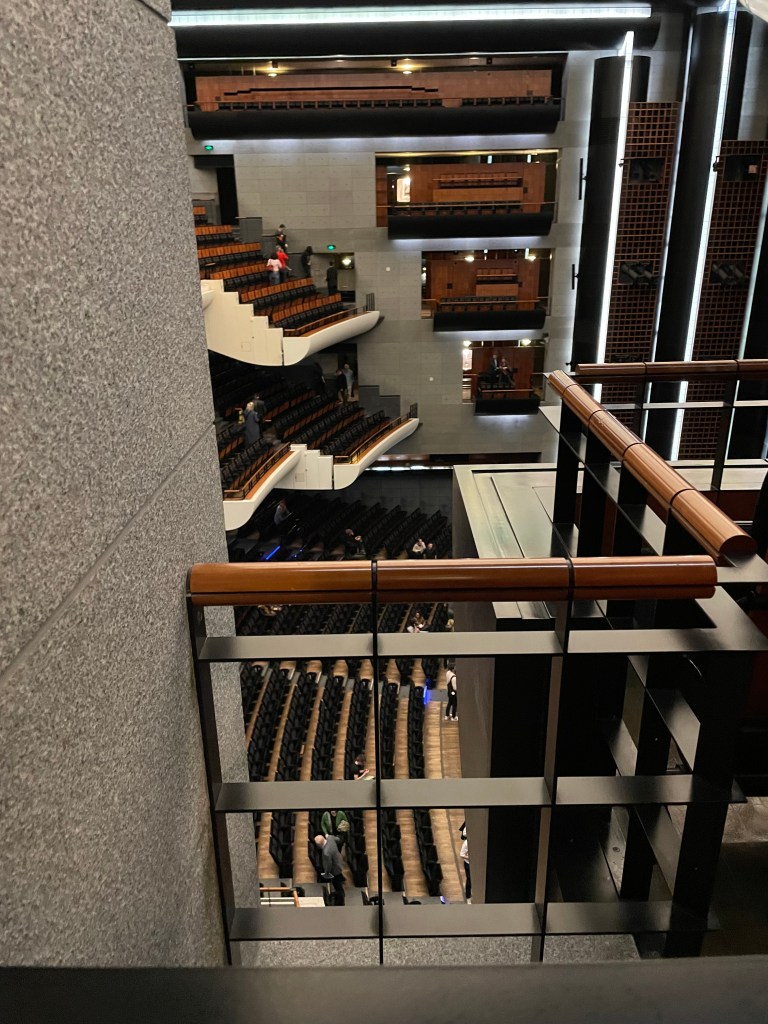

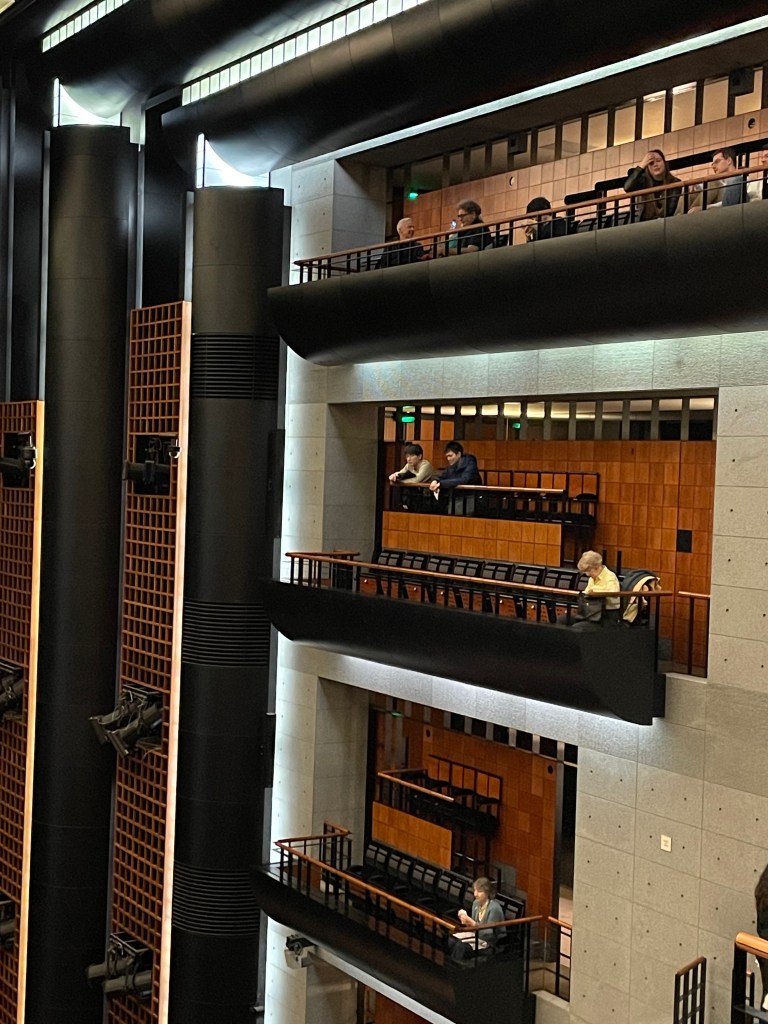
The facility seats 2,703 people. In addition to the main theatre, it includes a concert hall and a studio theatre.
“The backstage [of the Opera Bastille] occupies an enormous area (5,000 m2), six times larger than the stage […]. A system of rails and a rotating dock make it possible to roll entire sets on and off on giant motorised platforms in a few minutes and to store these platforms on the available backstage spots; quick changes of set enable the artists to rehearse a work in the afternoon and to perform another one in the evening within the same space, something impossible at the Palais Garnier. The use of such platforms also makes it considerably easier to use three-dimensional sets rather than traditional flat images. Under the stage is a giant elevator, which is used to lower unused set platforms to an underground storehouse as large as the backstage itself” (Wikipedia).
Another elevator system lifts and lowers the entire orchestra pit, as required by different productions.
Here is a video showing the interior of the Opera Bastille’s main theatre.
Salomé
Critics have called the Bastille “cold” and “impersonal” due to its minimalist design and the extensive use of concrete walls, and black, cream and grey decore. To my mind, the spareness also works to its advantage, as it surely offers less distraction from actual productions than would the ornately and colourful Opera Garnier.
Ott’s building certainly seemed a perfect setting for the production of Salomé we saw on May 9. Lise Davidsen was outstanding as the stepdaughter and niece of King Herod, a man who has lustful eyes for her. She falls in love with prophet Jochanaan (John the Baptist), whom Herod has imprisoned mainly because he’s afraid of the power he wields with his spirituality. Jochanaan resists Salome’s overtures, and ultimately she gives Herod everything he wants from her (as depicted in the agonizing and powerful Dance of the Seven Veils) in exchange for Jochanaan’s head.
The opera was dramatic, haunting, and fantastic.
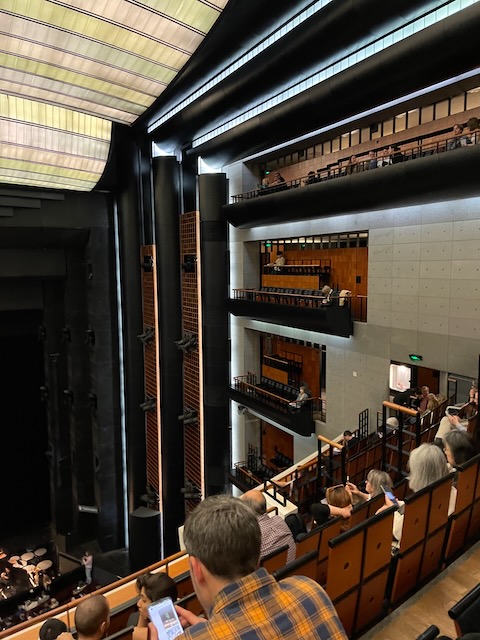


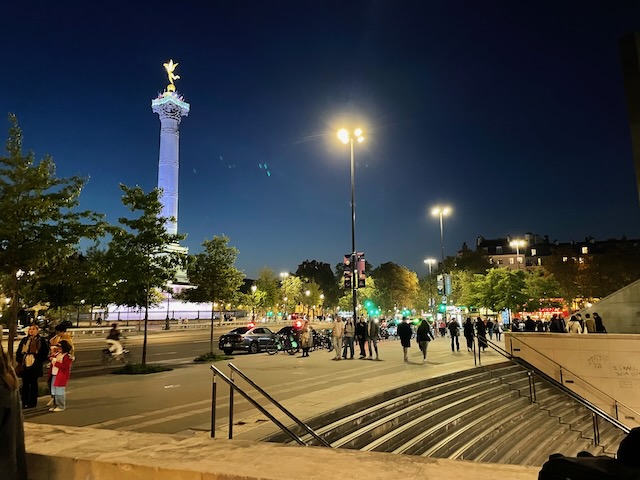
After the opera, we emerged into a warm, perfect Paris evening.


.

































































 I'm All Write


