Travel date: Saturday, September 13, 2025
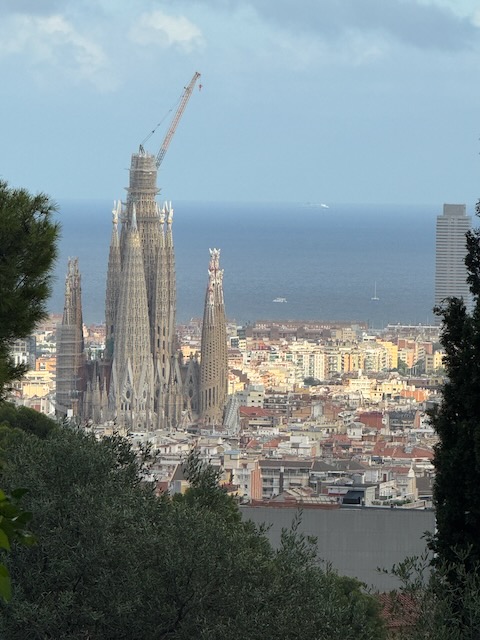
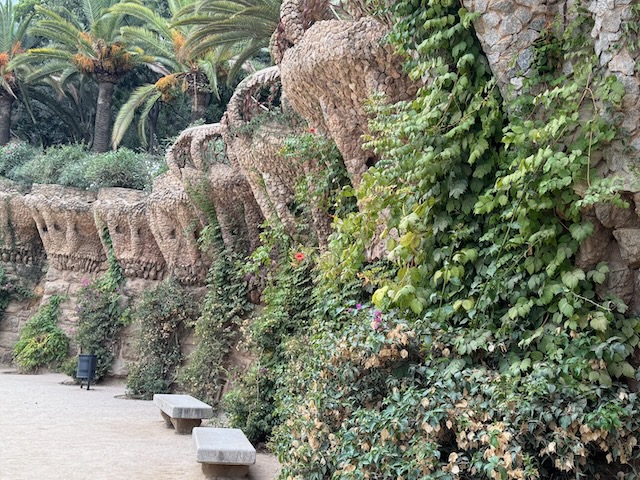
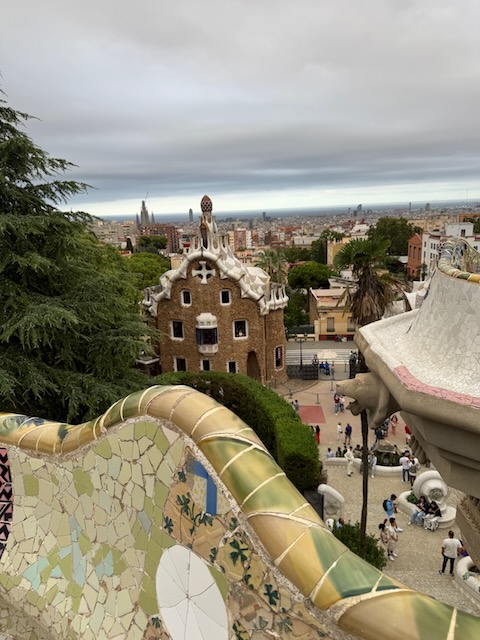
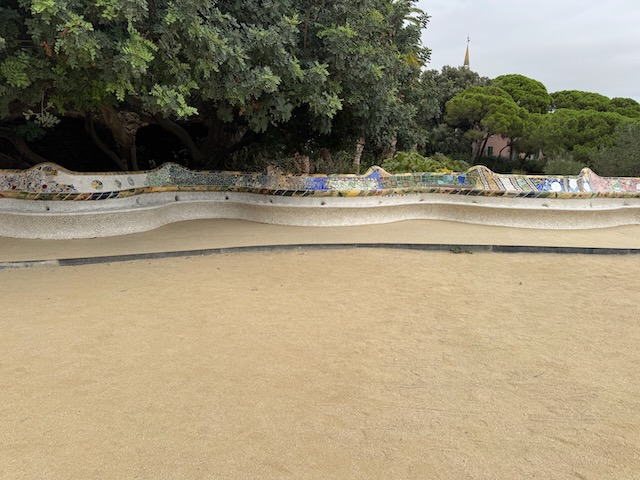
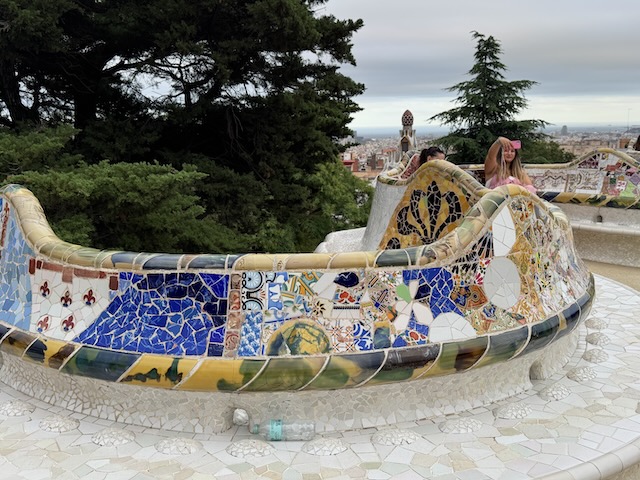
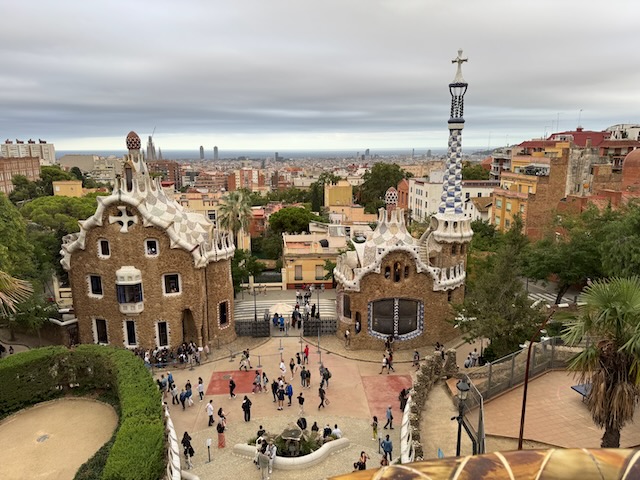
One of our most eagerly anticipated destinations in Spain was The Sagrada Familia, the basilica in Barcelona that was designed and partially built under the direction of the brilliant architect and artist Antoni Gaudi – whose truly distinctive work we had also seen the day before in Park Güell. Gaudi’s designs are also on display in several Barcelona residences, three of which are open for tours (next time!), and other buildings.
The itinerary for the group we were joining later on the 13th for our ten-day tour of Northern Spain would include only a walk-around of The Sagrada Familia, so we booked tickets for earlier in the day so we could take our time and see the interior as well.
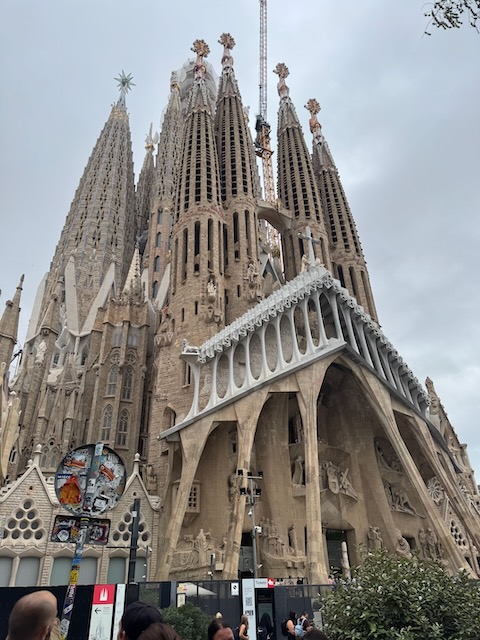
Gaudi began his work on The Sagrada Familia in 1884 and continued until his death in 1926. I was surprised to learn that he was not the first architect to have been selected to design and build the new church. He was appointed to the position only after Francisco de Paula del Villar y Lozano resigned after two years’ work, following a bureaucratic disagreement. Villar had planned a fairly standard neo-gothic church for the site, but Gaudi transformed the project into his magnum opus when he was awarded the position in 1883.
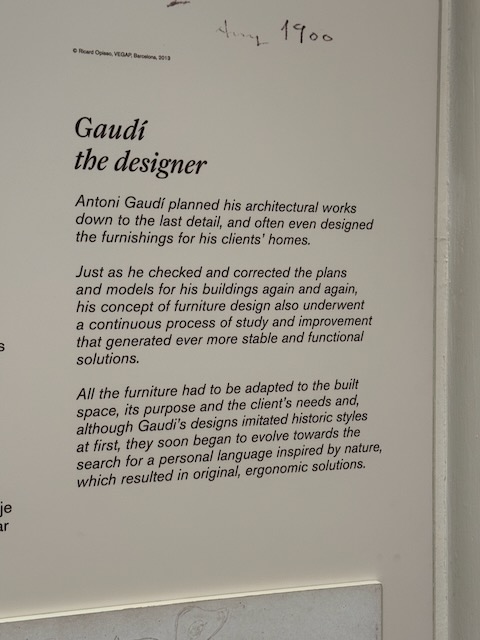
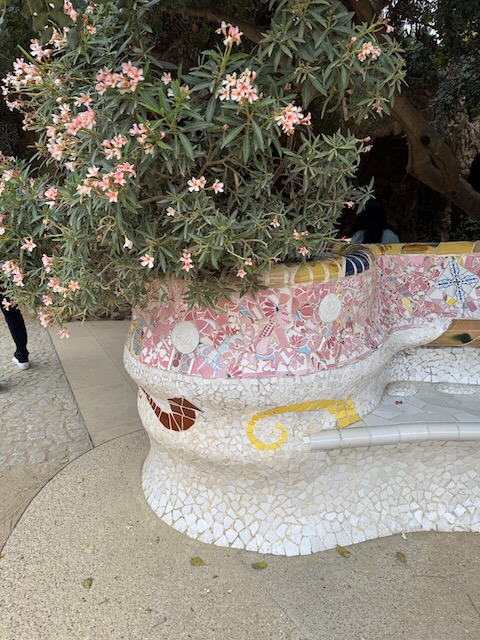
A deeply religious man, Gaudi was already an acclaimed Catalan architect when he took on this assignment. “Gaudí’s work was influenced by his passions in life: architecture, nature, and religion. He considered every detail of his creations and combined crafts such as ceramics, stained glass, wrought ironwork forging and carpentry. He introduced new techniques in the treatment of materials, such as trencadís which used waste ceramic pieces.” (Wikipedia)
Gaudi became so focused on the project that he moved from his house in Park Güell, where nuns had been looking after him, into the cathedral itself. As time went on he increasingly neglected his appearance, his diet, and his hygiene. On June 7, 1926, at the age of 74, Gaudi was walking down a Barcelona street on his way to confession at a nearby church when he was hit by a tram car. Due to his unkempt appearance and the fact that he was carrying no identification, passersby mistook him for a beggar and paid him little attention. Finally someone arranged for him to be transported to a nearby hospital, where he was admitted to the pauper’s ward. It was several days before his assistants at the basilica located and identified him. By then it was too late for him to receive the kind of treatment that might have helped him to survive his injuries, and he died soon after. He is buried in the crypt of his famous cathedral.
The Sagrada Familia was only about 25% complete when Gaudi died. Aside from a few years during the Spanish Civil War, work has continued ever since, but the cathedral is still not finished. While Gaudi was alive, most of the work on the “Nativity Façade” on the eastern side of the cathedral was completed, and his wishes for the entire project had been outlined. His creation reveals the unique inspiration he found in natural forms and shapes, in his religion, and in his Catalan heritage. His vision still guides the work, despite the contributions of other architects and artists who have created or supervised the realization of various components over the years.
The Cathedral
Like many Christian churches, the basic footprint of The Sagrada Familia is oblong, in the shape of a cross. The congregation sits in rows of pews and chairs down the middle of the nave, with the chancel, including the altar, near the top (north) end. A transept crosses the nave just below the chancel and on the east and western exteriors of the transept are doors, or portals. The main entrance, when it is finished, will face south.

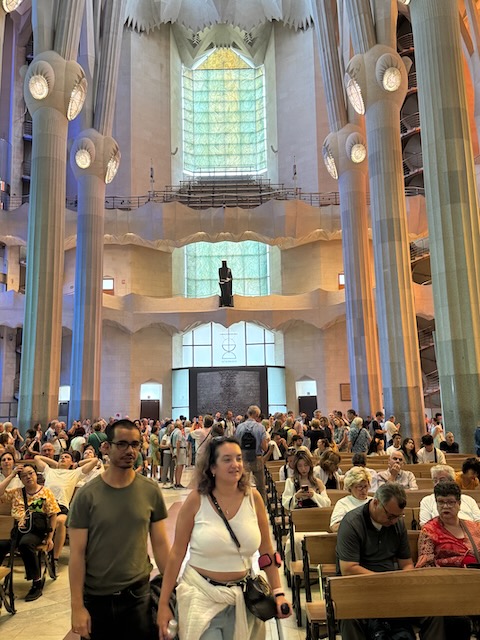


As well as supporting the enormous weight of the spires that rise from the cathedral, the columns suggest trees and are finished in various natural colours.
Gaudí’s original design for The Sagrada Familia “called for a total of eighteen spires, representing in ascending order of height the Twelve Apostles, the four Evangelists, the Virgin Mary and, tallest of all, Jesus Christ. Thirteen spires had been completed as of 2023, corresponding to four apostles at the Nativity façade, four apostles at the Passion façade, the four Evangelists, and the Virgin Mary” (Wikipedia). The Jesus Christ spire is due to be finished in 2026. At 172.5 metres with a cross on top, it will make The Sagrada Familia the tallest church in the world. A couple of the towers are open (for an additional fee) to those who wish to climb them (next time!), at which point (I have read) you are rewarded with great views of the city.
The official name of the magnificent structure is “Basílica i Temple Expiatori de la Sagrada Família.” “La Sagrada Familia” means “The Sacred Family.” A “basilica” is a special designation given to a church by the Pope, based on criteria that include its architecture, history and spiritual significance. The Sagrada Familia was consecrated on November 7, 2010 by Pope Benedict XVI, who also designated it a “minor basilica.”
The Nativity Facade
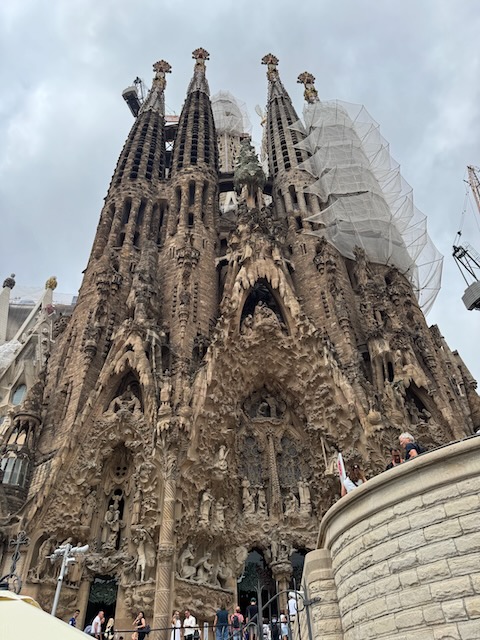
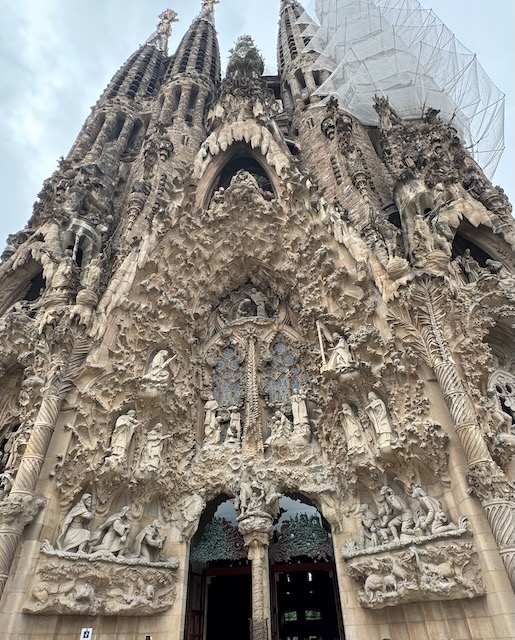
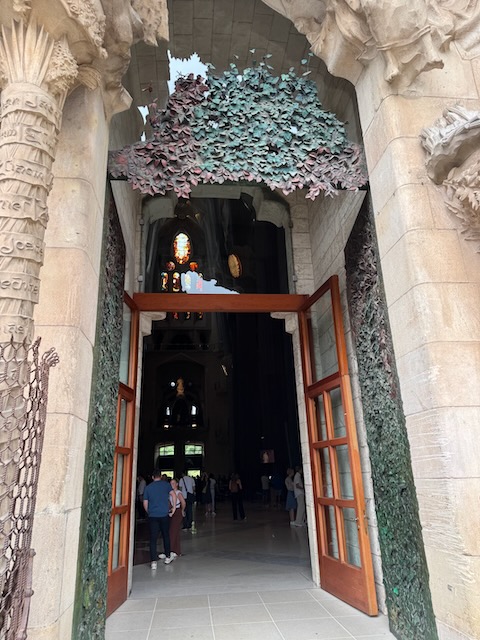
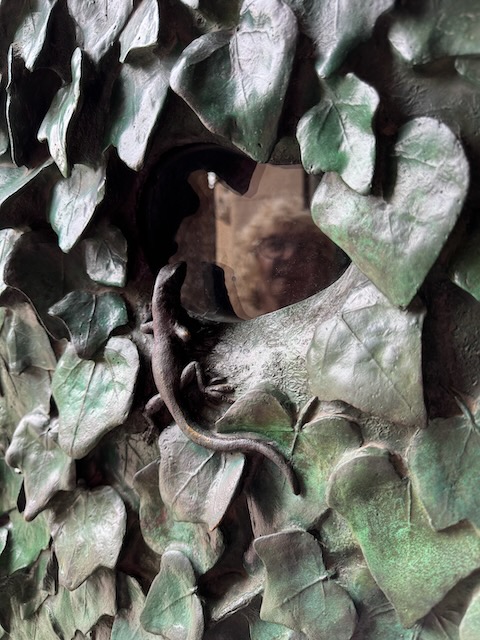
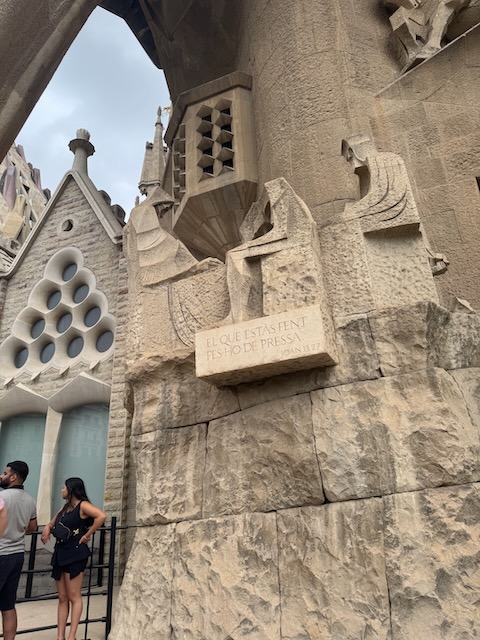
The Nativity Facade was completed first, in 1930. It features three portals (representing faith, hope and love), several towers (representing The Holy Trinity and four of the Apostles), and many decorative carvings and statues. It faces east, in honour of the birth of Jesus Christ, and includes many depictions of Biblical scenes describing Jesus’s early life.
You will notice the sculpture of a cypress tree above the middle portal. It is the symbol of the Tree of Life. A person could spend months tracking down the meanings associated with the adornments that appear everywhere on and in The Sagrada Familia.




The Passion Facade
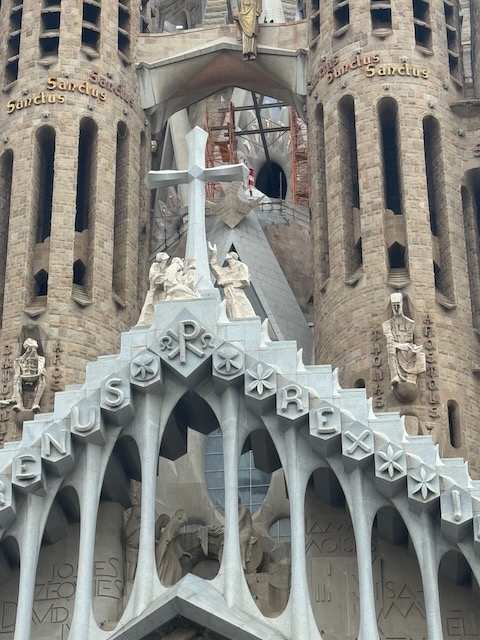
Several of Gaudi’s models for the cathedral were damaged and destroyed during the Spanish Civil War. Their restoration was overseen by Francesc de Paula Quintana, who had been one of Gaudi’s assistants. In 1954, Quintana initiated the construction of the Passion Facade, which Gaudi had instructed should be a stark, skeletal contrast to the rich and detailed Nativity Facade. The “look” is indeed different from the lavish detail that distinguishes The Nativity Facade: it is minimalist, abstract, spare and open. Themes of this facade (which faces west) include the Last Supper, the Way of the Cross, the Crucifixion, and other scenes from Jesus’s final days. Towers honour four more of the apostles.



The Glory Facade
While most of The Sagrada Familia is finally nearing completion, the Glory Facade, which faces south, in which the main entrance will be situated, is not finished. Its design represents the path to eternal glory, including Christ’s final judgement and ascension into heaven. Seven pillars represent the seven deadly sins and seven heavenly virtues.
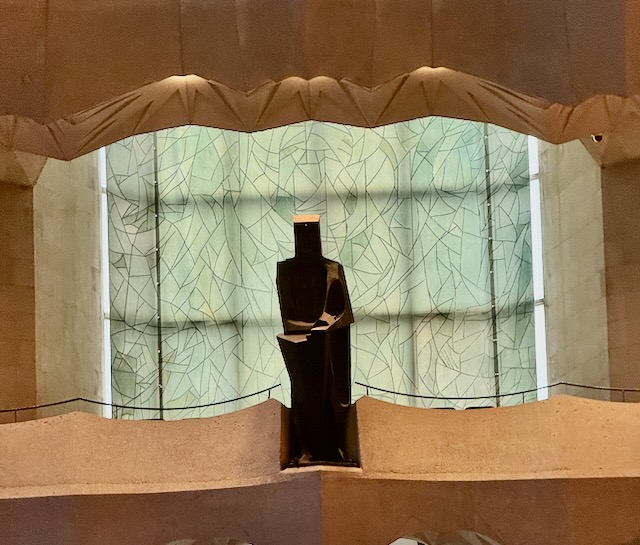
Josep Maria Subirachs (1927 to 2014) was commissioned to create the Glory Portal in 1987, and his distinctive style raised much controversy because his work (expressionist, abstract) is very different from that of Gaudi and the other designers involved with the project. (Note: I have no opinion on whether Subirachs’ designs are appropriate to The Sagrada Familia, but I did develop a great fondness for his work as we travelled through the region and saw several pieces he had done. Dark, haunting and evocative, his work is definitely nothing like Gaudi’s. Watch for his Crucifix in the next post.)
Plans for the construction of The Glory Facade are in conflict with the wishes of Barcelona residents who live nearby – approximately 3000 of whom will need to be relocated if the current plans are executed. With zoning issues as well as construction of the portal still ahead, a completion date in 2026 sounds somewhat optimistic.
The entry fees charged to the 4 to 5 million visitors who visit The Sagrada Familia each year are what pay for the construction. Due to the basilica’s popularity, it is wise to purchase tickets (online) several months in advance of a visit, as they are usually unavailable at the site. (One person told us that if you go to a Sunday morning service, there is no admission charge. But don’t quote me.)


The Group
After we returned to the hotel from The Sagrada Familia, we enjoyed a well-earned nap and then, at 5:30 p.m., we met with the others on our tour for the first time, in the hotel’s breakfast room. The group of about forty-five people included four or five other Canadians, a lot of Americans, two people from the UK and a family from the Philippines. Our tour guide’s name was Celia. Originally from Madrid she was extremely knowledgeable, well organized, attentive and personable. I can’t think of how she – or our driver Paolo – could have done anything better than exactly how they did it.
After some introductory remarks (such as a warning that we heard over and over again to keep an eye out for pickpockets in Barcelona), we were handed the headsets that we would use to hear our guides throughout the tour, and our luggage tags. (Our suitcases were collected from outside our room each travel day, loaded onto the bus, and delivered back to us after we arrived at our next destination. The system worked perfectly.)
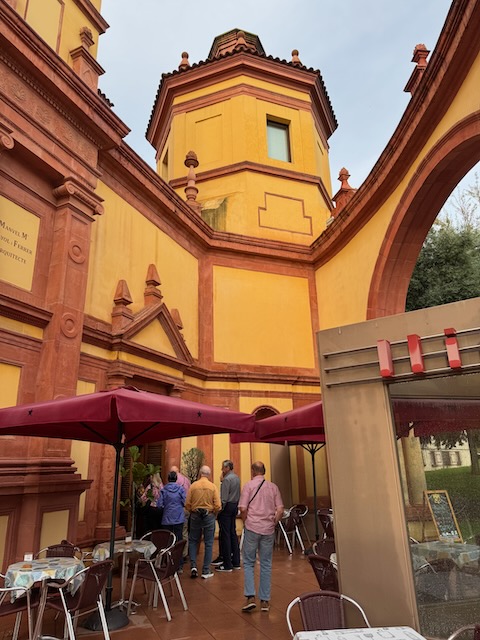
Then we climbed onto our bus and were driven through Barcelona to a restaurant on a hill above the city. The restaurant where we ate is a community initiative sponsored by the Fundacion Mescladis, that works to train people in vulnerable situations (particularly immigrants) and to prepare them to enter the workforce. The staff was attentive and the food was delicious.

















 I'm All Write