
Travel Date: Sunday April 28, 2024
[Note to readers: If you receive these blog posts by email and some of the photos look stretched or squished, I apologize. I recommend you click the link in the upper right hand corner of the email, where it says “Read on Blog or Reader” to read the post online. I think the problem has to do with the aspect ratio of the photographs, but I can’t figure out how to fix it. Please drop me a note if this doesn’t work.]
After a week of industrious touristing, we took it a bit easier on April 28th. I wanted Arnie to see Sir John Soane’s Museum, to which my friend Rhona McAdam had introduced me on my previous trip to London 25 years ago. The museum is close to Covent Garden and Drury Lane, which are part of London’s “West End Theatreland” so we decided to take in a matinee as well as the museum, have dinner and call that a day. (Drury Lane was, of course, also the home address of the famed Muffin Man. Do you know him?)
Sir John Soane (1753-1837) was a highly respected architect whose neo-classical designs included a number of buildings for the Bank of England as well as private commissions. He ultimately taught architecture at the Royal Academy.


Despite the best efforts of two recalcitrant offspring, Soane had a fascinating and productive life (you can get an overview of it on Wikipedia), and he travelled widely. Although the buildings he designed are mostly gone now, he continues to be well known primarily because he turned his house and office in Lincoln’s Inn Fields (really two adjoining houses, to which a third was later added) into a museum, and filled it literally to the rafters with an intriguing and massively diverse collection of antiquities from all over the world, including bronzes, urns, sculptures, tiles, stained glass, busts and even the Sarcophagus of Seti. (Apparently Soane threw quite a party after the sarcophagus was safely delivered.) In addition to all that, he collected paintings – you can see Hogarths, J.M.W. Turners and Canalettos among others at the Soane – and over his life he also acquired nearly 8000 books including illuminated manuscripts, and architectural drawings from around the world.


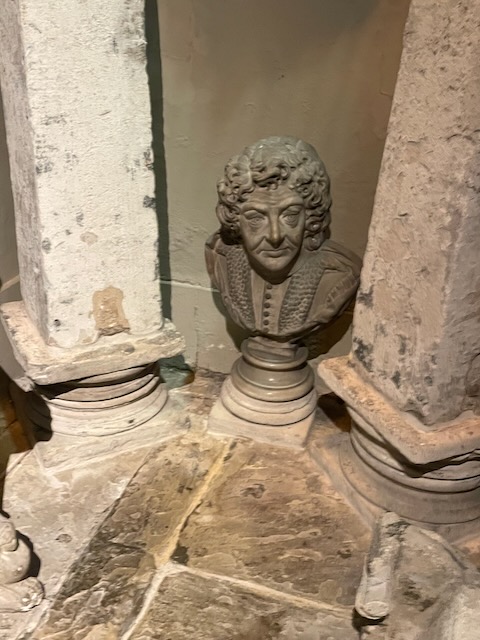


Having purchased our matinee tickets in advance at the Gillian Lynne Theatre box office, we waited in the rain for half an hour to get into the Soane, then saw as many artifacts as we could before heading off to see the musical Standing at the Sky’s Edge.
Standing at the Sky’s Edge had rave reviews when it was at the National Theatre in London, before it moved to the West End. It also won several awards. It is deeply grounded in the experience of Great Britain in the past seventy years (including Thatcher’s devastations, Brexit, etc.). The profusion of English accents meant that we missed a bunch of lines because our ears didn’t tune into the vernacular/accents quickly enough. But we really enjoyed the production.
“Hailed as ‘the greatest new British musical’ (Daily Express), Standing at the Sky’s Edge is a kaleidoscopic portrait of life on an ever-changing estate, charting the highs and lows and loves and losses of three generations over six tumultuous decades.” – National Theatre


 I'm All Write