On our sixth day in Spain, we crossed from the Basque country in Spain to the Basque country in France for a quick look at the cities of Saint-Jean-de-Luz and Biarritz (also spelled Miarritze). Saint-Jean-de-Luz is only about forty kilometres along the Bay of Biscay from San Sebastian, and Biarritz about 20 km beyond that, so it was a perfect half-day excursion.
Biarritz
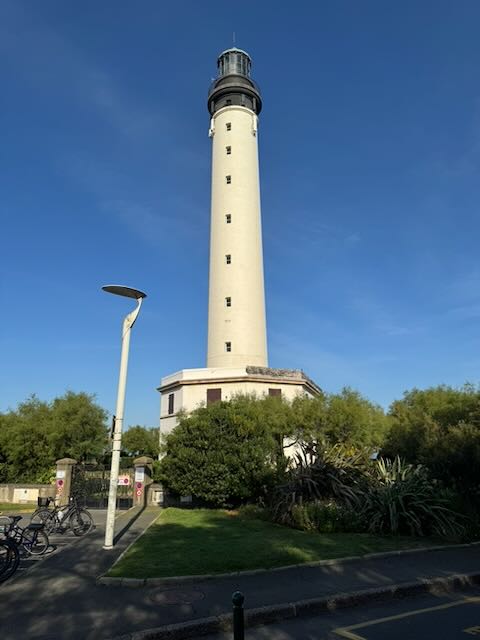
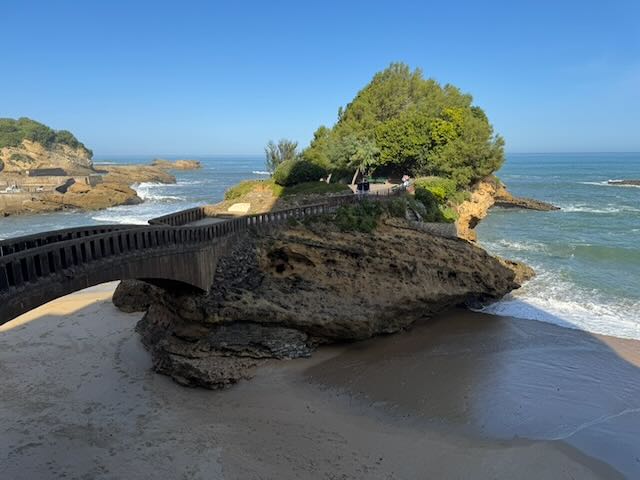
Phare de Biarritz....
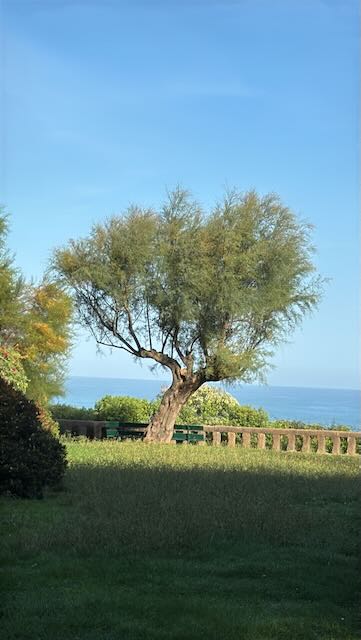
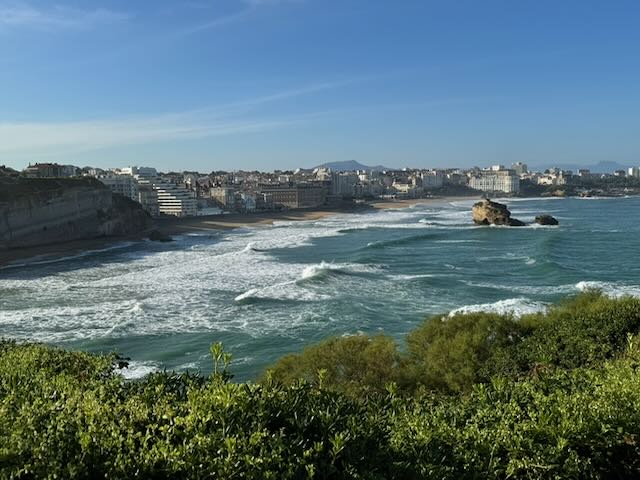
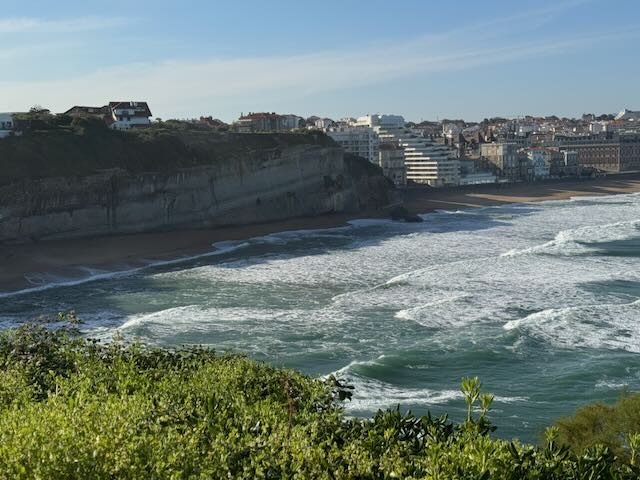
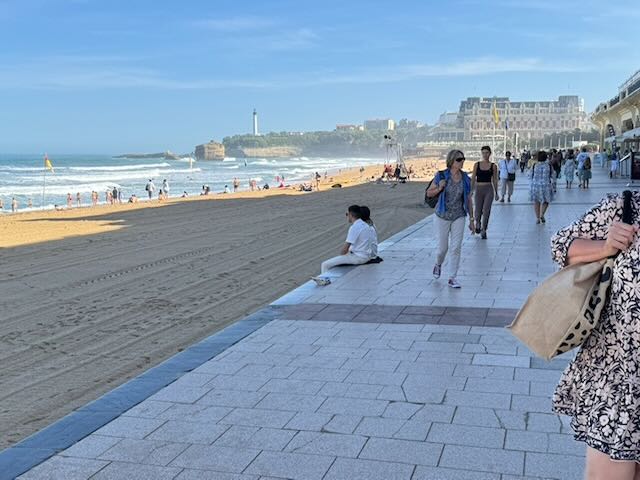
Our first stop was the farthest point of the day’s journey, the Phare de Biarritz (“phare” means “lighthouse”), from which we were able to look back at Biarritz before we visited it. Wikipedia describes the town as “a luxurious seaside tourist destination known for the Hôtel du Palais (originally built for the Empress Eugénie c. 1855), its seafront casinos, and its surfing culture.”
....
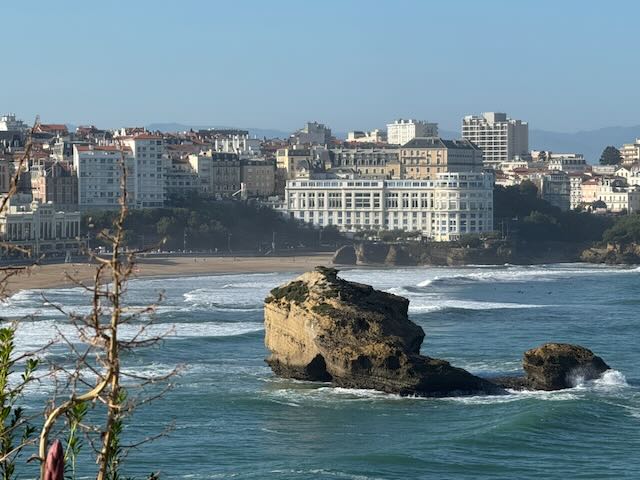
Empress Eugenie was the wife of Napoleon III. In 1893 the palace that had been built for her was converted into a hotel-casino complex, which was later rebuilt after a fire in 1903. There are nearly a dozen casinos in this region.
....Hotel du Palais in the upper right
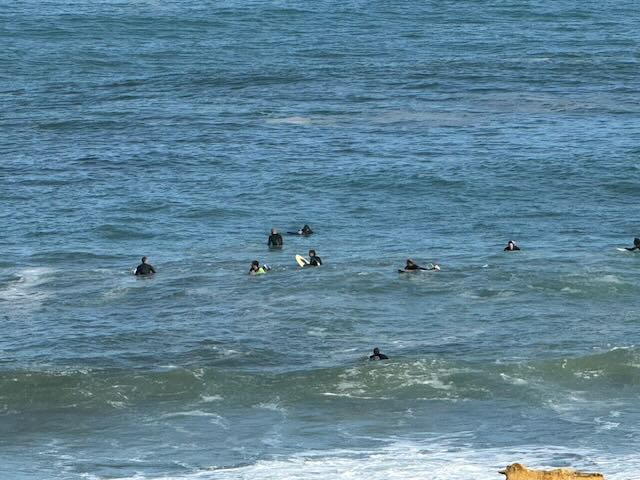
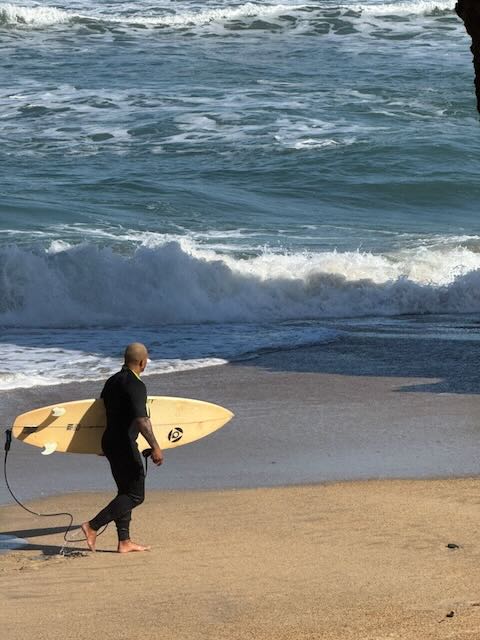
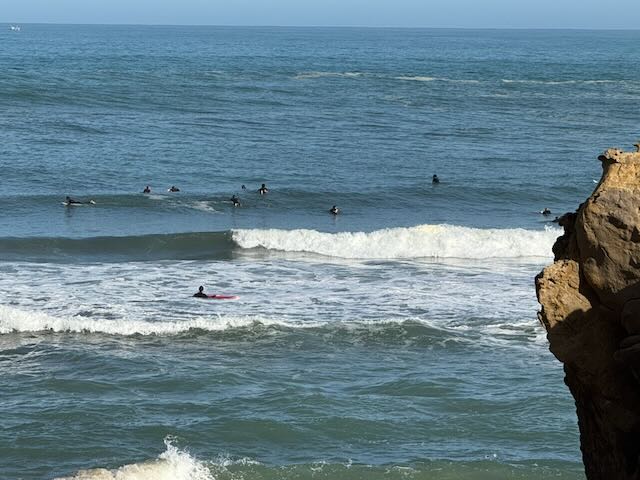
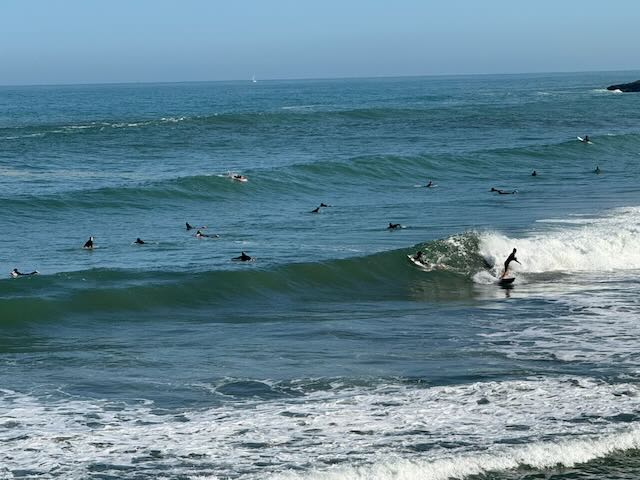
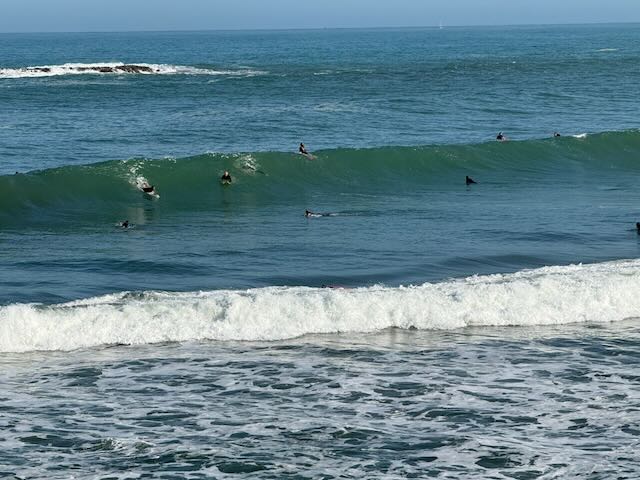
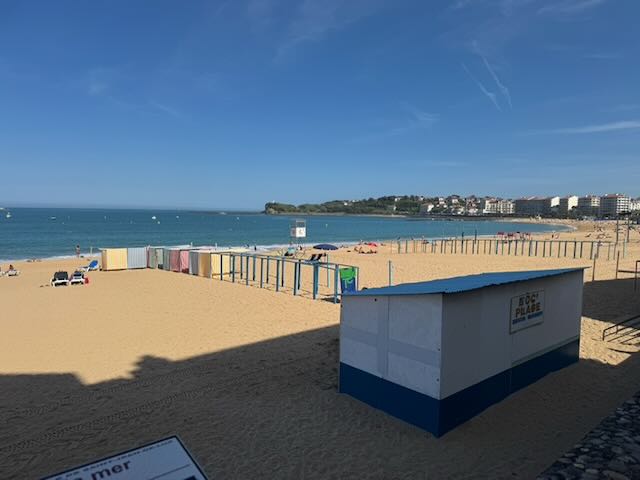
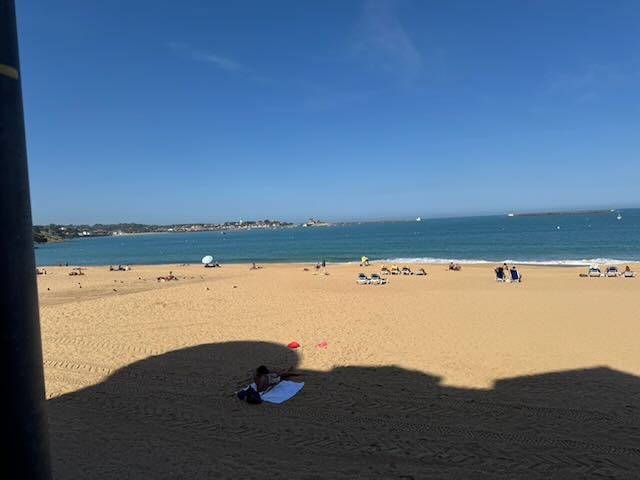
I personally could just sit on the beach in Biarritz all day and watch the surfers and the waves. (If you are reading this as an email, you will miss the video. It is here.)
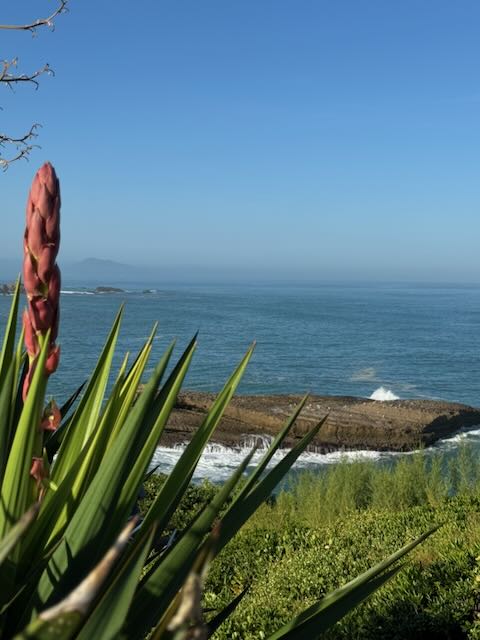
..,,,Rocher de la Vierge
A website promoting Biarritz says, “You may not know it, but Biarritz is the birthplace of surfing in France and even in Europe. The discipline, which arrived at the end of the 50s thanks to a filming on the Basque coast, aroused the curiosity of a few young locals who played the pioneers.”
Saint-Jean-de-Luz
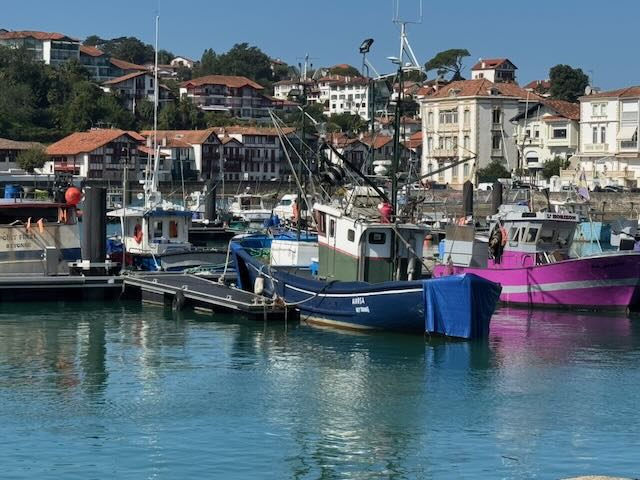
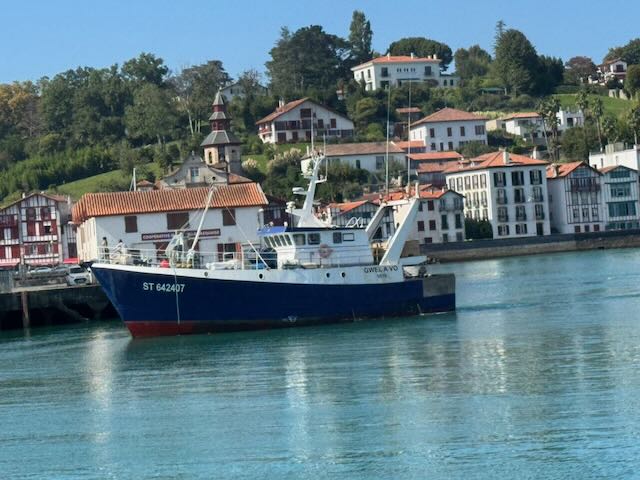
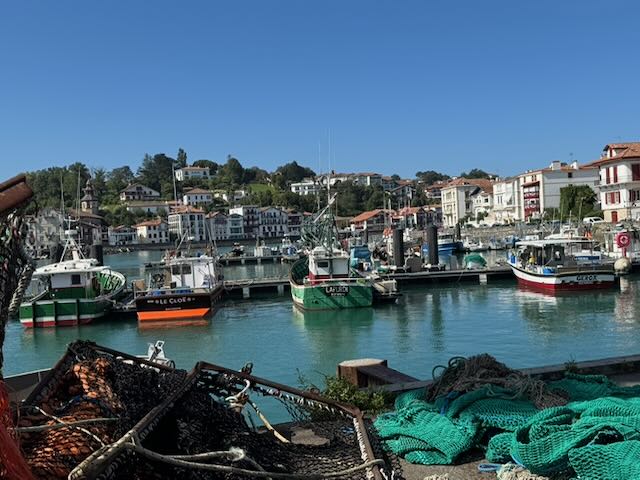
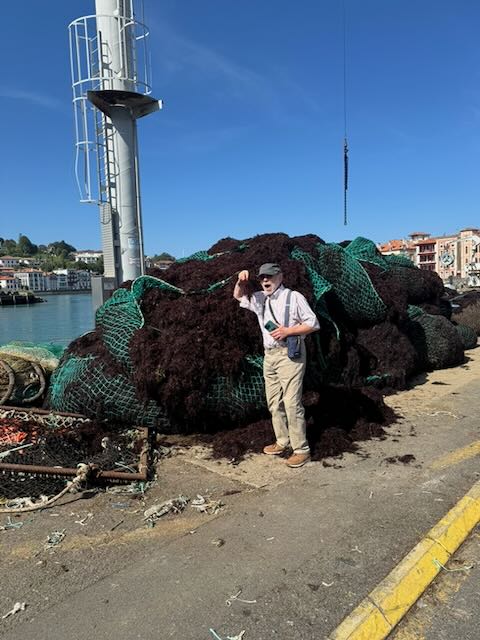
We had lunch in Saint-Jean-de-Luz, which was also lovely. It is a busy fishing town, and the harbour is particularly picturesque.
......
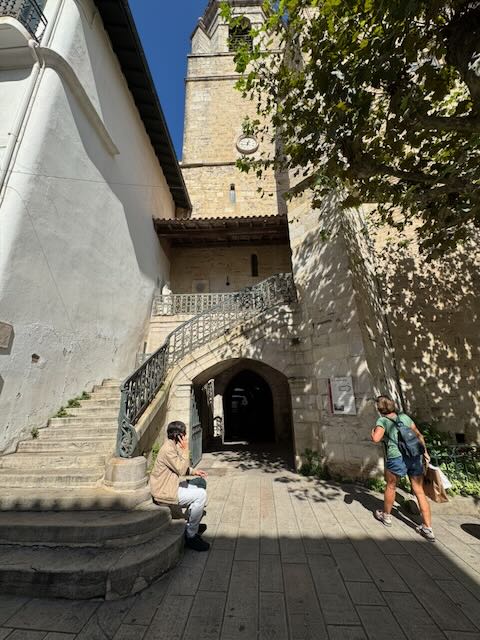
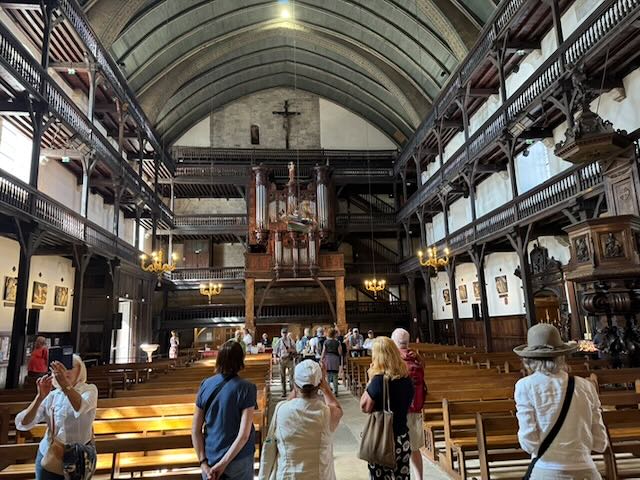
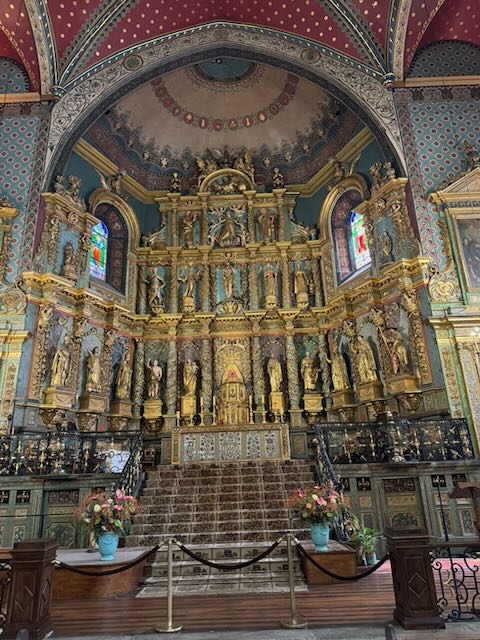
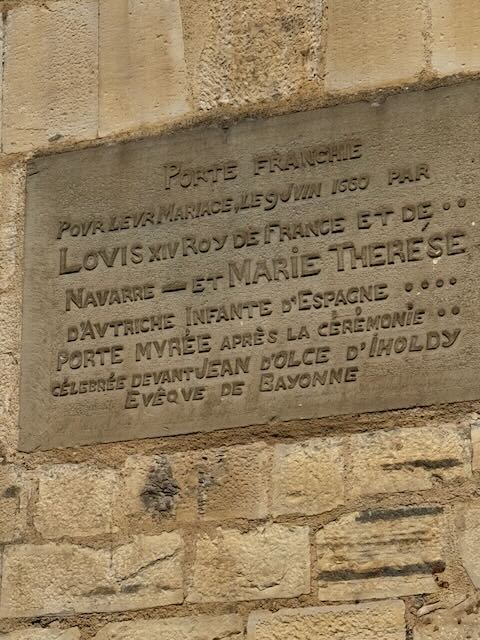
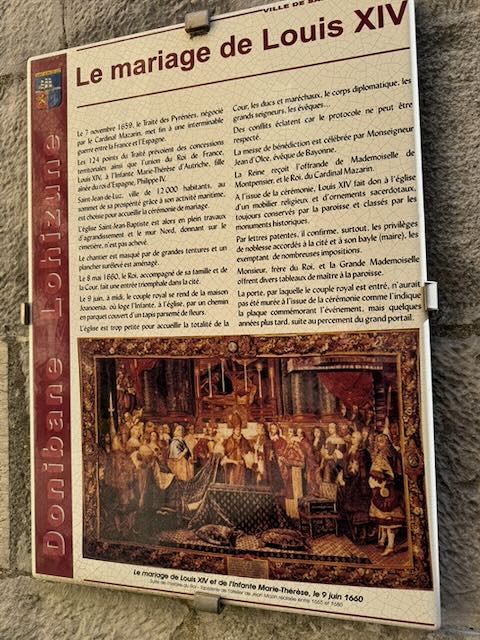
Saint-Jean-de-Luz is the location of the church where Louis XIV, the “Sun King,” married Spanish princess Maria Theresa (another Hapsburg. They really were everywhere) in 1660. This marriage marked the end of the Franco-Spanish War (1635–1659) – but of course one thing always leads to another, and French control of Spain ultimately led to the War of the Spanish Succession, which extended from 1701 to 1714).
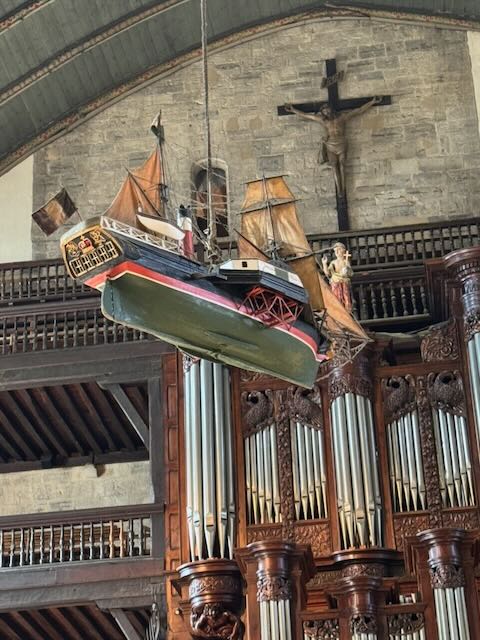
.The suspended ship is an ex-voto, a traditional offering made by sailors or their families to seek divine protection or give thanks for surviving a peril at seaChurch of Saint-Jean-Baptiste...
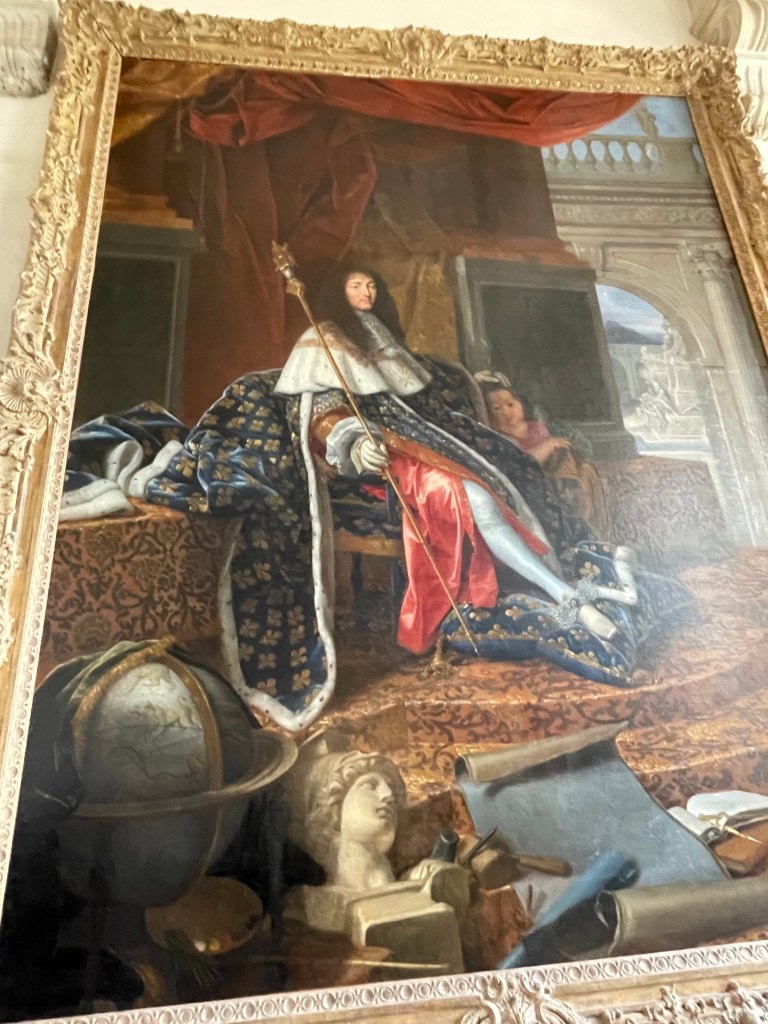
Louis XIV adopted the sun as his personal emblem, “symbolizing [according to the AI summary] his absolute power and centrality to France, much like the sun is the center of the universe, a concept reinforced by his self-styled image as the source of all light, life, and order in his kingdom, famously depicted as the Greek god Apollo.” Sounds familiar.
In the past few days I have written at some length about how I have wished that I had learned more about the history of France in general and the French Revolution in particular before I went to France, rather than after I returned to Canada, so that I’d have had a greater appreciation for the historical significance of several of the sites we visited. Among these were the Champs de Mars, a large green space southeast of the Eiffel Tower, where Bastille Day was first celebrated on July 14 1790 to mark the first anniversary of the storming of the Bastille and where the first major massacre of the Revolution occurred, and Place de la Concorde, which was the location of many of the 17,000 public beheadings that took place during the Reign of Terror.
The Palace at Versailles also played a central role in the French Revolution. The primary impetus for the Revolution, which ultimately lasted for more than ten years and expanded from a civil uprising to involve several neighbouring countries, was the terrible social and economic circumstances in which most French people were living, largely due to the onerous tax burden that the “ancien regime” (“old order”) imposed on them. The economy was on the verge of collapse but in the meantime, King Louis XVI (a popular king) and his wife Marie-Antoinette (not as despicable as her reputation would have it, from what I have now read) were living with their son the Dauphin and other relatives in the most luxurious conditions imaginable. One early, unsuccessful attempt to quell the fomenting unrest took place at the Royal Tennis Court at Versailles in 1789, and it was from Versailles that the king and queen were moved to the Tuileries Castle in Paris and thence to prison and after that to their own public executions.
I highly recommend Hilary Mantel’s novel A Place of Greater Safety and the French Revolution podcast episodes of The Rest is History for fascinating in-depth explorations of this decade in French history – which did not go well at all but ultimately did lead to a democracy in France that has lasted till this day (and which we desperately hope will continue).
Where I was going with that draft, now revised to become this draft, was to draw comparisons between the social and economic conditions in France that precipitated the overthrow of the monarchy, then the failure of one replacement system of government after another, with conditions that are contributing to the popularity of far-right movements around the world today. But I decided that whole line of thought was too depressing, and also that it would take me weeks to research my argument to the extent that I could support it with citations, so (you’ll be relieved to hear) I’ve decided to just show you some of the many photos we took when we went to Versailles and toured the chateau. ‘ll leave you to crawl down the rabbit holes that lead to political parallels if you so desire.
.
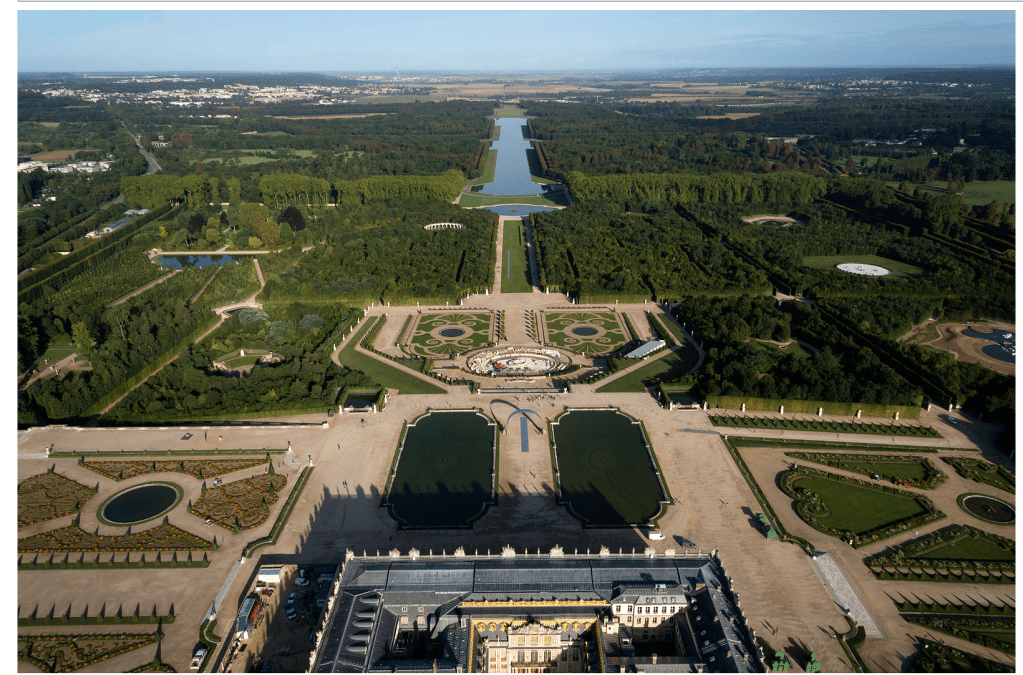
Versailles palace , which is now a UNESCO World Heritage Site, was built originally as a hunting lodge in 1623 by Louis XIII, and expanded to its current massive size by Louis XIV. It was the latter Louis who moved the seat of the French government from Paris to Versailles (no. I will not mention Mar-a Lago here), and it was at Versailles where Louis XVI was living when all hell broke loose.
Today “The palace is owned by the government of France […]. About 15,000,000 people visit the palace, park, or gardens of Versailles every year, making it one of the most popular tourist attractions in the world” (Wikipedia). The Versailles experience begins as soon as you board the train that carries visitors along the 10.7 k route from Paris.
Paris to Versailles train: interiorLeaving Parisen routeOur train in Versailles StationVersailles City HallApproaching the palace
The walk from the train station to the palace takes ten or 15 minutes, which provides visitors an opportunity to begin to absorb the sheer size of the chateau and the vastness of the estate (800 hectares).
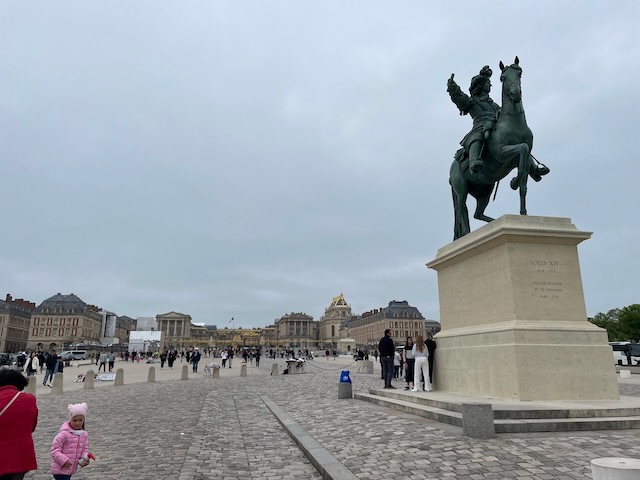
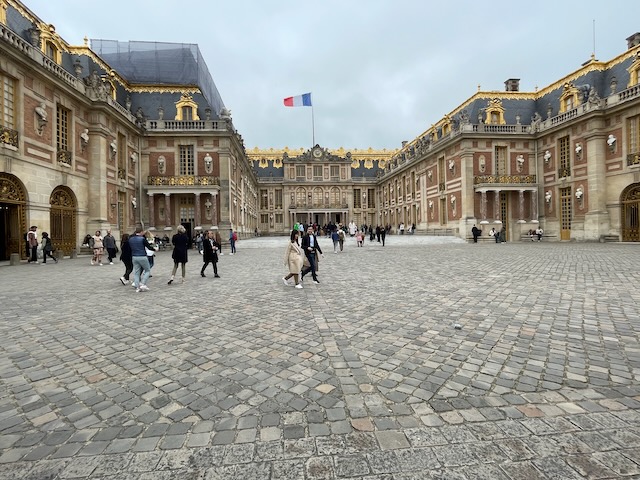
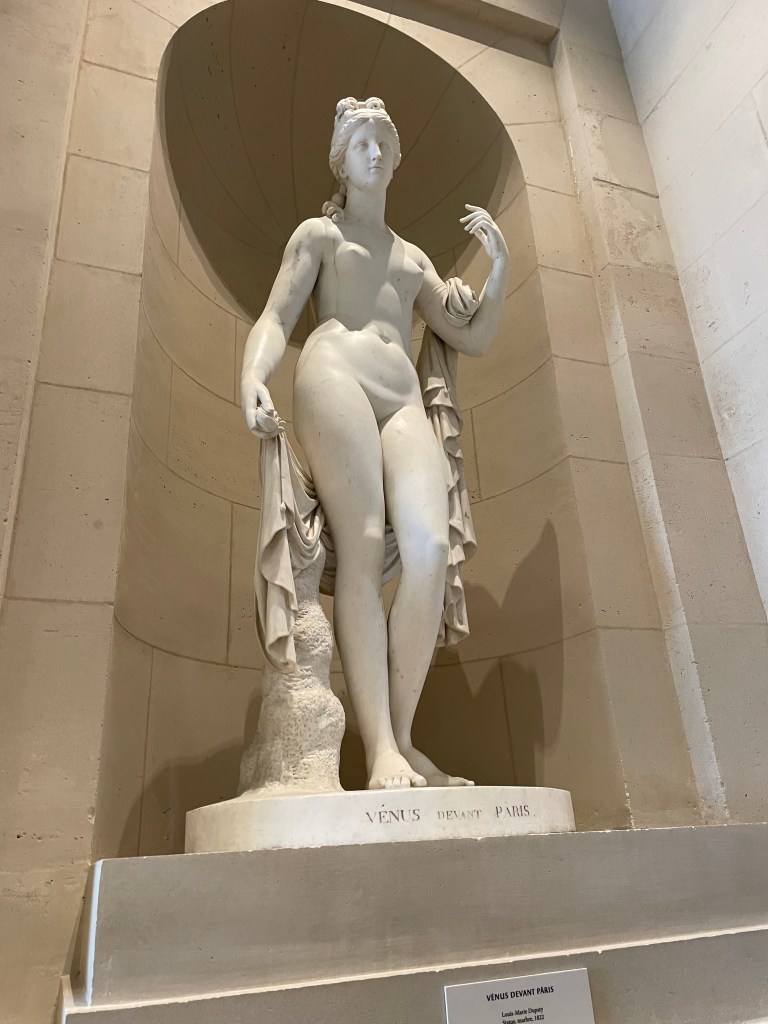
.Louis XIV on horsebackMain entranceEntranceInside hallway“Venus devant Paris”
Early in our tour we saw the living quarters of Mme Victoire and Mme Adelaide, two of King Louis XVI’s sisters. They survived the Revolution, as did the Dauphin (who was later recognized by royalists as King Louis XVII, although he did not reign).
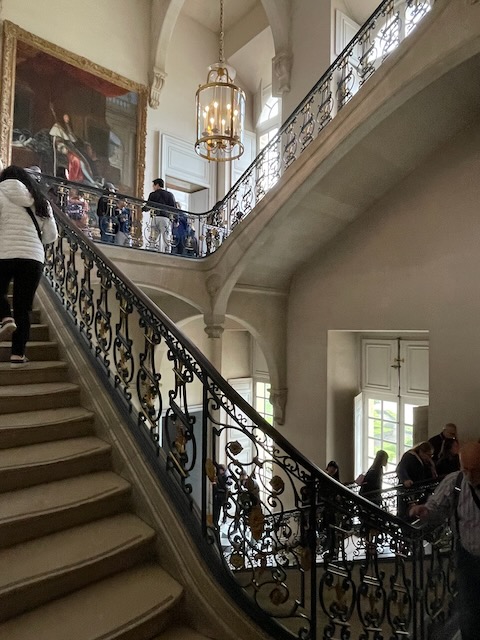
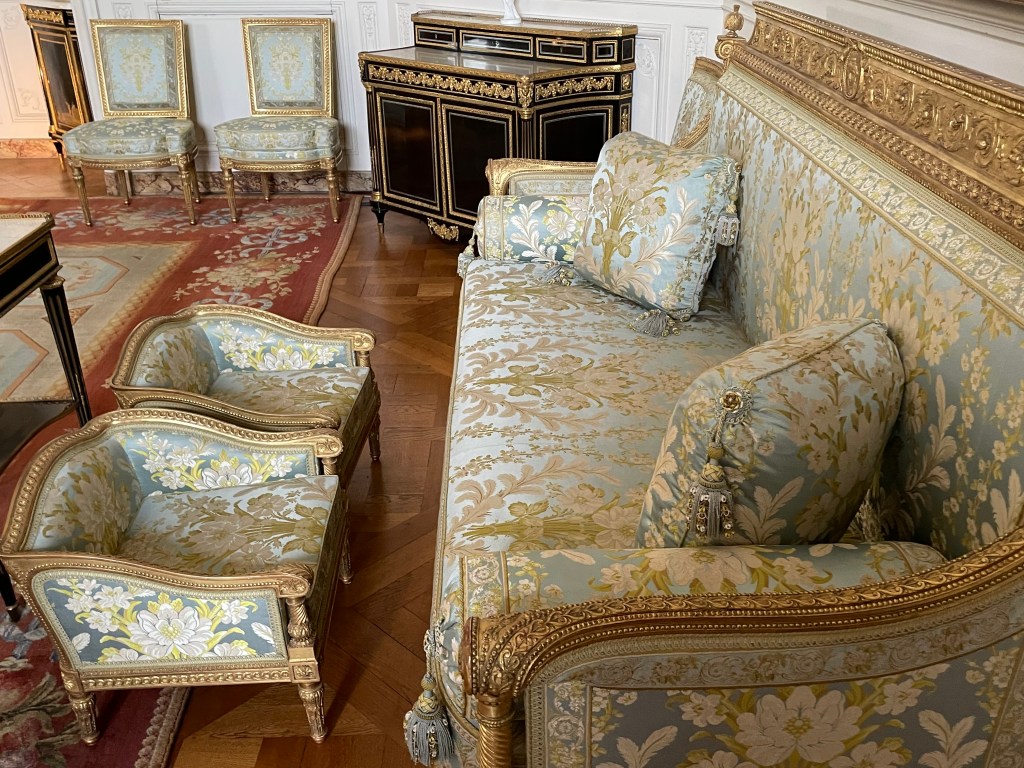
....Painting of Louis XIV at the top of the stairsThe brocade!
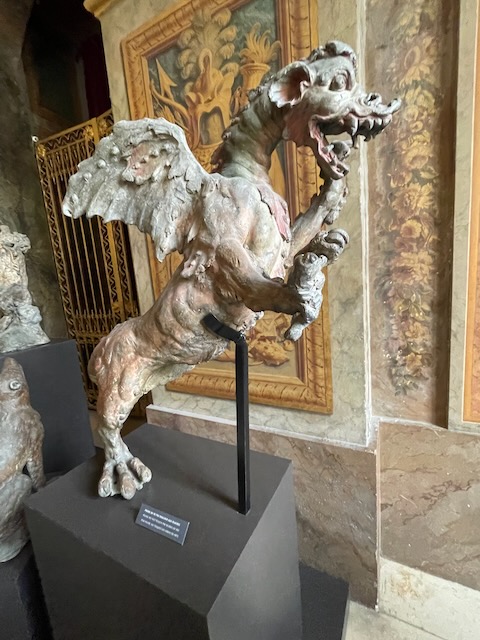
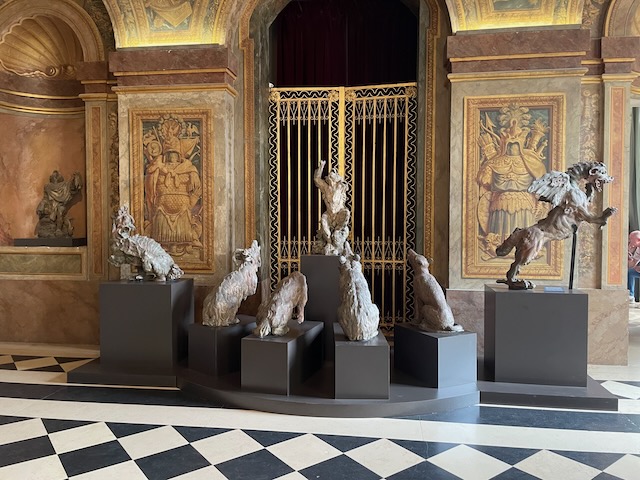
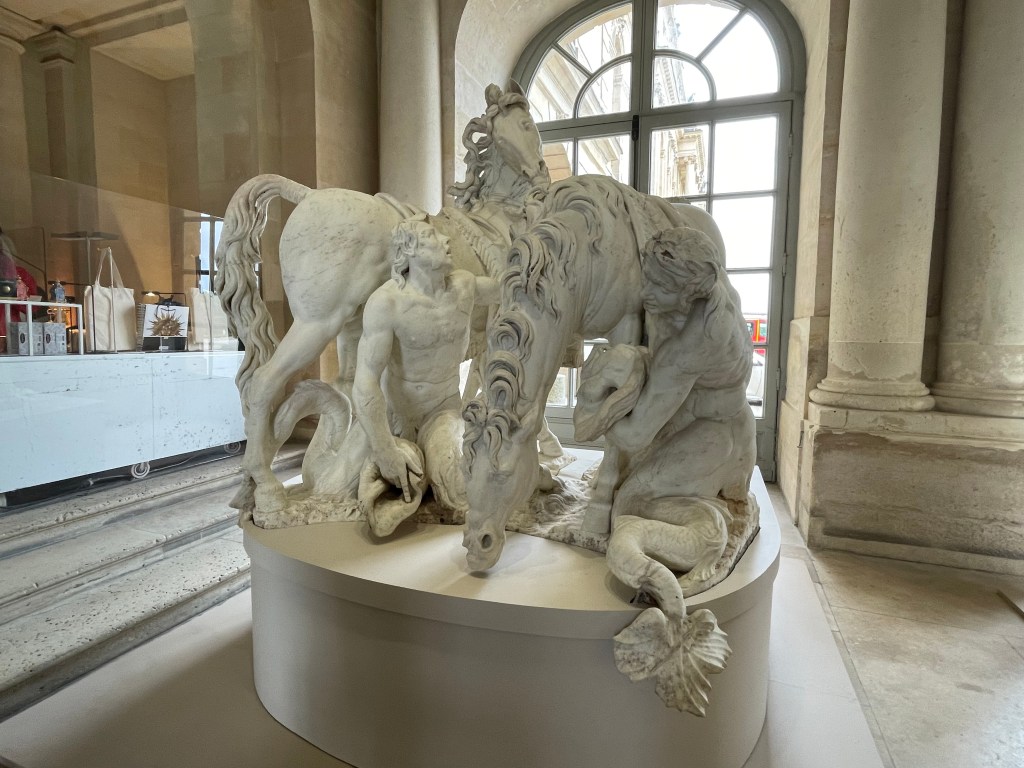
We saw sculptures in nearly every room of the palace, some strangely attractive and some really breathtaking. In the former category are the statuary shown in first four images below, which were formerly fountains with water spewing from their mouths and heads. The last two photos are of more classical statues, made from white Carrara marble. They date from the mid-1600s.
....“Horses of the Sun Groomed by Tritons”“Apollo Served by the Nymphs”
We visited the royal family chapel, which was larger and more ornate than many free-standing churches I’ve been in. There were also a lot of interesting paintings in the palace, not only hanging on the walls but also decorating the ceilings.
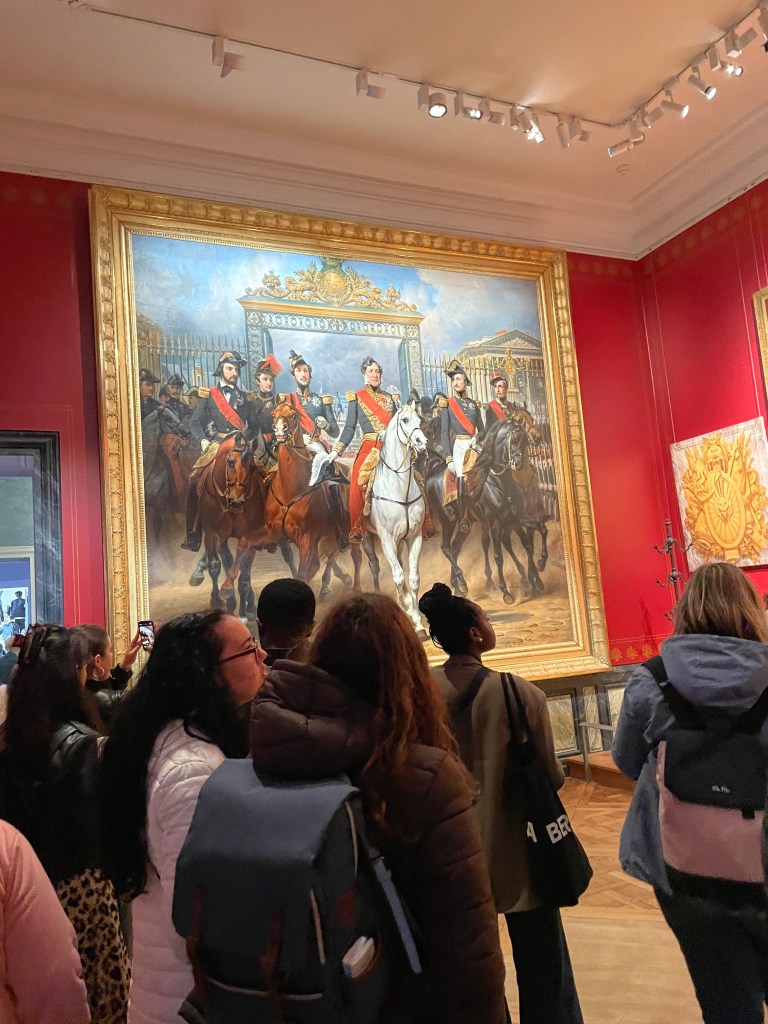
“Illumination of the Belvedere at the Petit-Trianon” Claude Louis ChateletLouis XIVLouis Philippe and His Sons, by Horace Vernet
Versailles today is a museum. Not all of the art we saw would have been there during the reign of Louis XVI; some of the works were created long after he was relieved of his regal responsibilities.
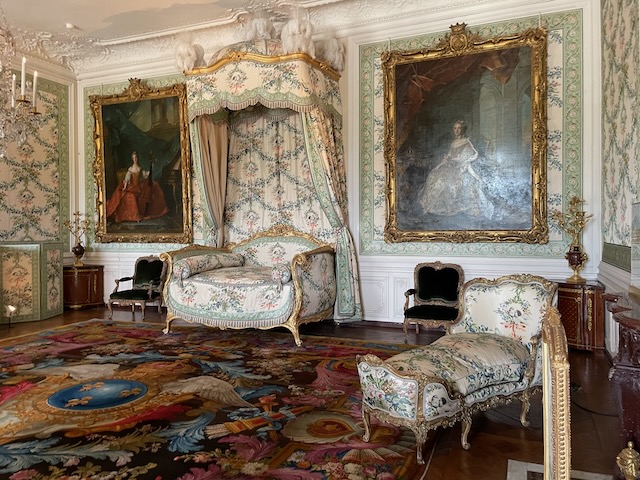
The state rooms of the king and queen, including their private bedchambers, extended through nine or ten large rooms. Here is a sample:
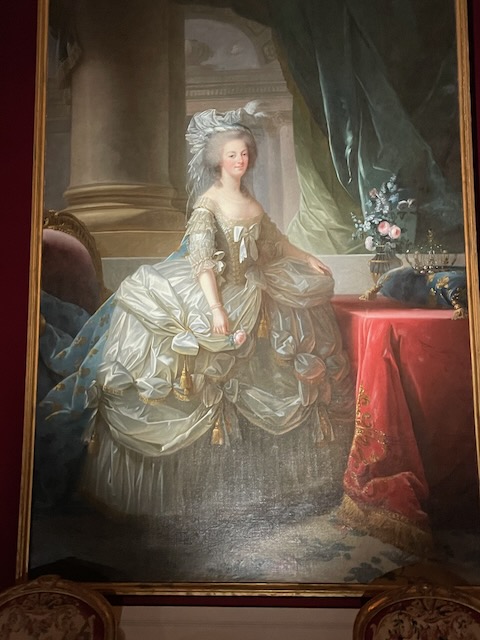
.....Marie-Antoinette
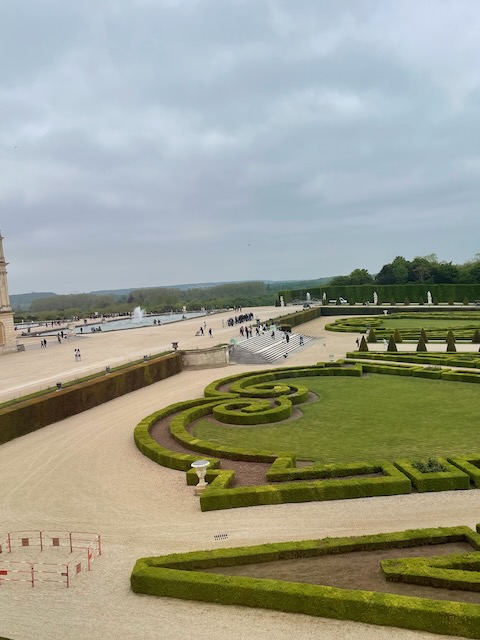
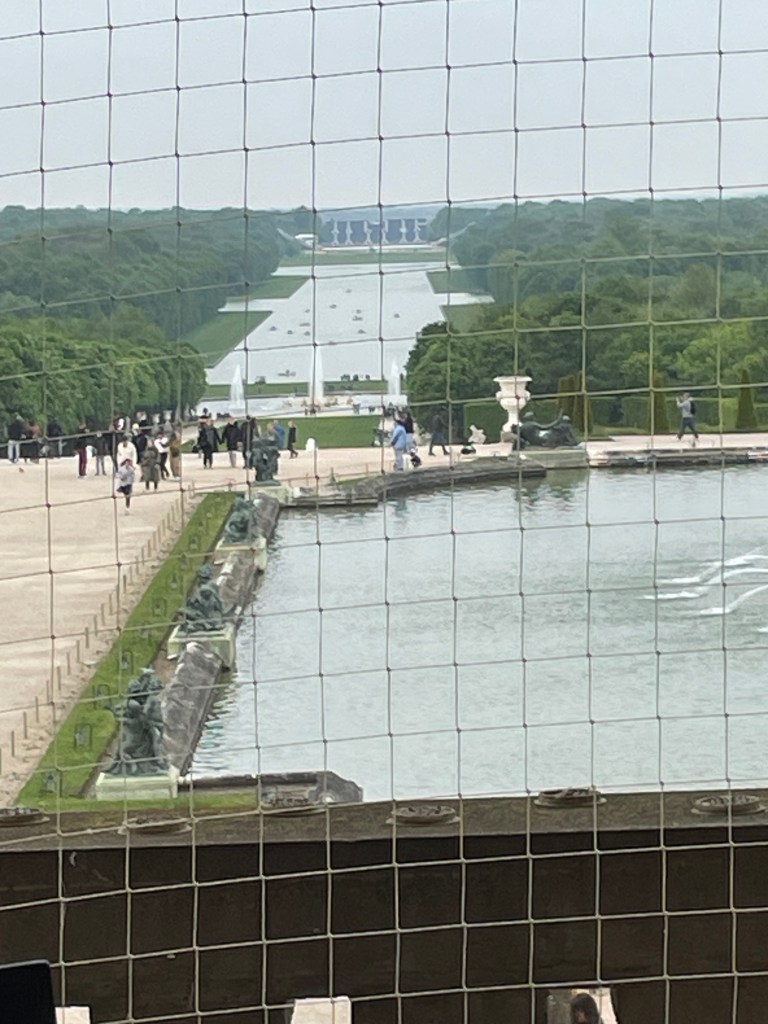
We saw the famous gardens at Versailles through many of the windows in the rooms we visited, but we ran out of time and energy before we could wander around outside
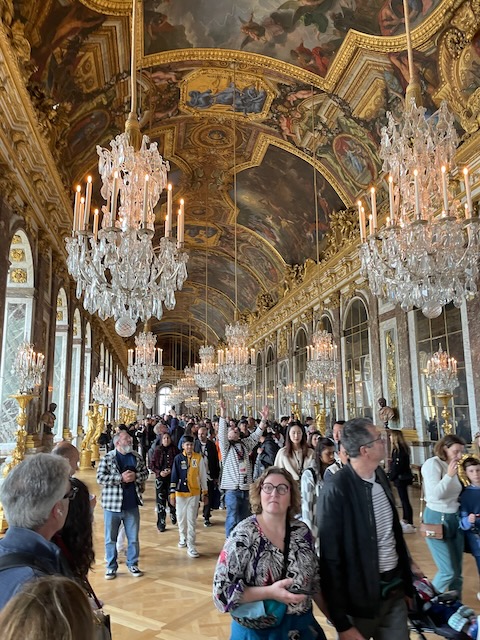
The Treaty of Versailles which ended the first world war was signed in the Hall of Mirrors on June 28, 1919.
The Hall of Mirrors
.
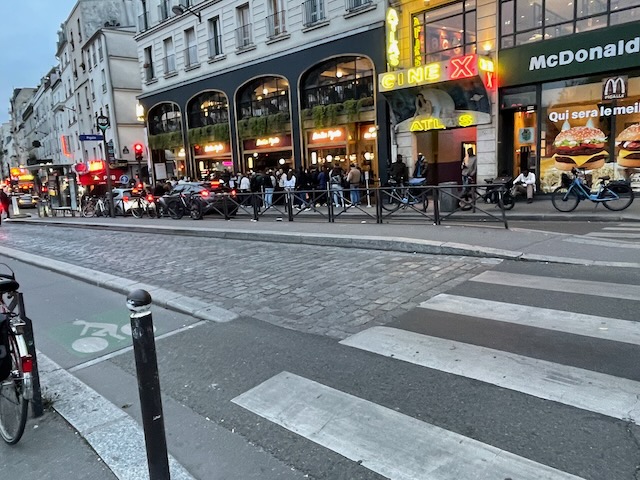
After returning to Paris, we decided to eat dinner at Bouillon Pigalle restaurant. We had seen the long lines waiting outside this restaurant a few days previously and had become interested in eating there, but it seemed to have no accessible system for taking reservations. We decided that waiting in line must be worth it, since so many other people were doing that. The line is so long that it runs down the whole block and around the corner. Thanks to a special agreement between the restaurants, there is a break in the line in the middle so that patrons of the McDonald’s next door can get to their destination.
The wait was worth it, as it was so often on this trip. Le Bouillon Pigalle serves delicious French food in a very efficient manner, where patrons sit close to one another and orders are taken almost as soon as you’ve been seated. But the system works: there is no sense of being rushed, the food is excellent, and the price is reasonable.
It costs about £30 (C$50) and takes approximately 8.5 hours to get from London to Paris on a bus. (This includes the cost of the ferry the bus drives onto in order to cross the English Channel). It costs about £125 (C$221.25) to travel from London to Paris through the “Chunnel” on a train. It costs about £80 (C$140) to fly from London to Paris.
Partly because of the cost, partly because we had no deadlines, and partly because I wanted to see the English Channel as we crossed it, we took the bus.
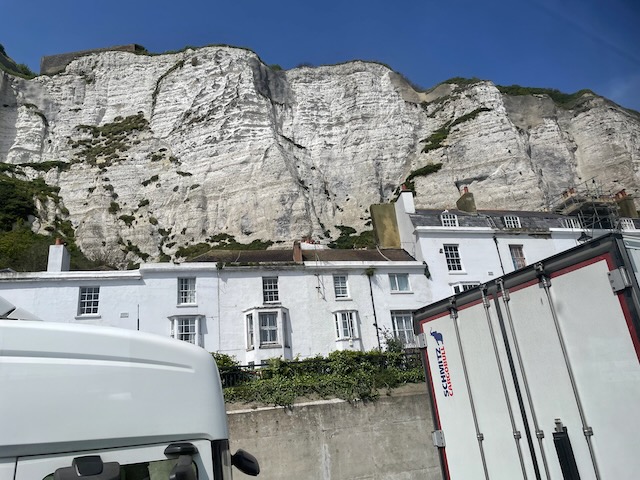
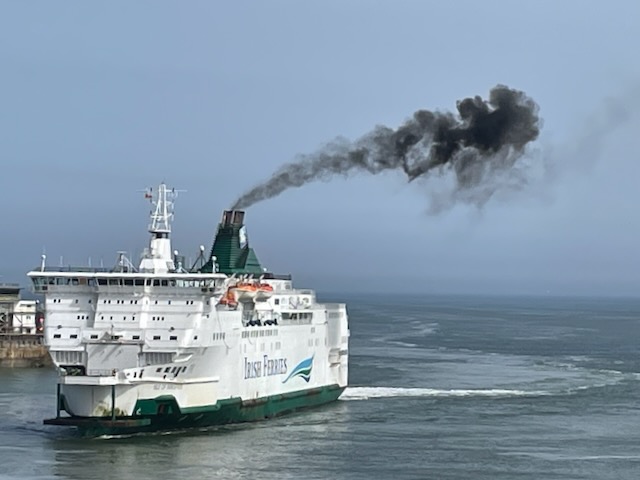
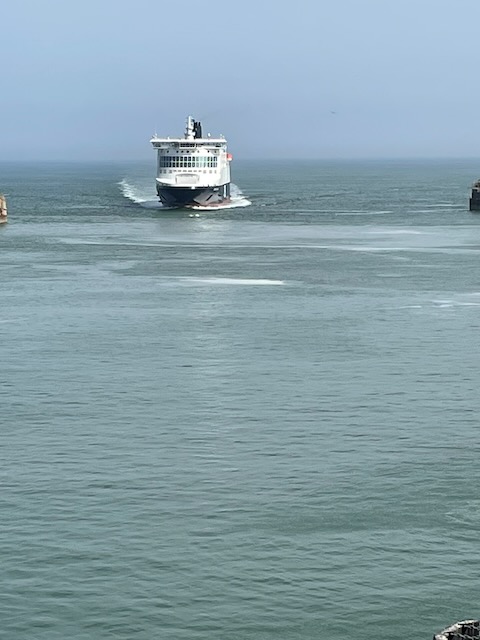
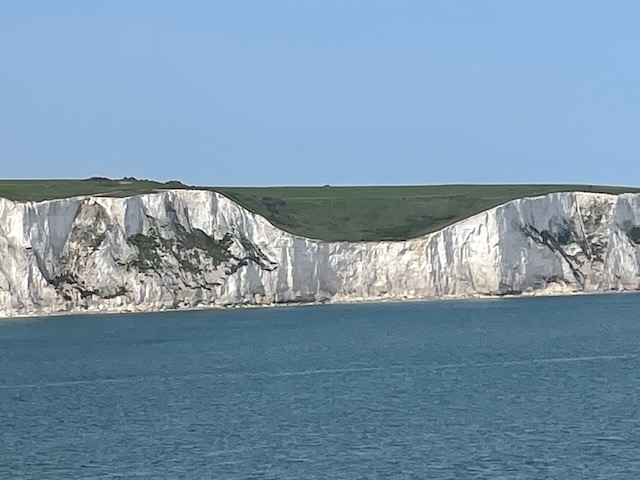
We had been warned that a rough crossing could be a nauseating experience or worse, but we were fortunate to make our trip to France on a wonderfully calm day. This was the second time we’d been to Dover, but we had much better views of its white cliffs this time, particularly after the ferry left the dock.
English countryside en route to Dover
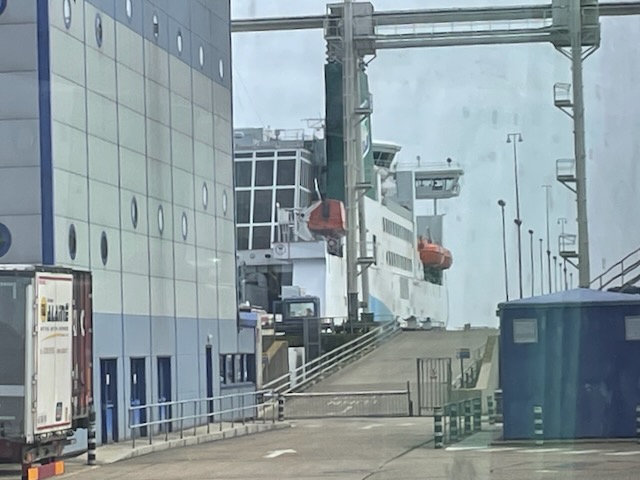
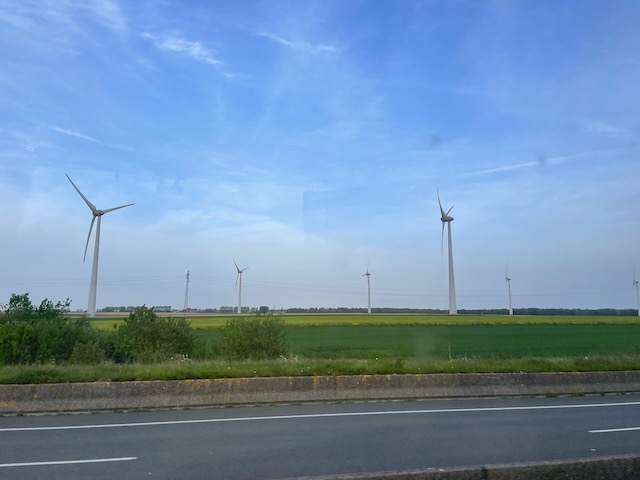
The actual crossing by ferry takes about 2.5 hours, and the trip was calm and picturesque. We arrived in Calais to find le temps there as pleasant as the weather had been in England. As we drove between Calais and Paris, I tried to get my brain around the fact that I was actually in France for the first time in my life. Since I was a young teenager, I’ve been studying French, reading books by French authors, watching French films, learning some French history, and envying absolutely everyone who got to be in France while I did not, so perhaps it is not difficult to understand why I found the experience almost unreal. As we travelled through the French countryside (where , by the way, I noticed happily – as I had in Germany a year or two before – that there are a lot of wind farms), I peered eagerly toward the horizon for my first sight of Paris.
The Storm
But le temps had other ideas. The skies grew dark with clouds as the night fell, and as we reached Paris, a monstrous storm let loose. The torrent of hail and rain was intensified by near-constant flashes of lighting and crashing thunder. The bus, being largely a metal object, intensified the sound of the hailstones clattering down upon us, and I felt as though we were in a tin bucket – fortunately one with a lid on it, and windows.
I’m including a couple of the videos I took after the bus had pulled over to the side of the road, to wait for the worst to pass.
All hail breaks loose.
The Station
All of this meteorological excitement meant that we arrived at Paris’s Bercy Seine bus station a couple of hours later than scheduled, after ten at night. Delayed buses and storms be damned, all the service staff were heading home on time. Loiterers were being shooed out of the waiting room and asked to stand on the platforms until their connecting buses arrived. The lights in the office areas were extinguished, and doors and windows that might provide access to any useful information were securely locked.
At first sight, the streets of Paris were not how I’d imagined them
Not being entirely fluent in French (not bad, but not fluent), we had some serious difficulty trying to figure out where to leave the building in order to find a ride to our hotel. We asked other travellers on the platform where the exit was, but those who did understand our questions and gesticulations all seemed to be waiting for connecting buses and didn’t know any more than we did about the layout of the station.
Several days later, when I finally had some time to try to figure out where we had gone wrong with la Gare Bercy Seine, I discovered that our challenges were not entirely due to our inadequacies in French (although our fellow-sufferer was also from Toronto, so maybe it’s a Canadian thing to expect that there be signage). On Trip Advisor I came across a review by “Oyster Boys” entitled “Flixbus Station at Bercy Seine in Paris is the Bermuda Triangle!!!!” Turns out its authors had had the same experience as we did, only in reverse: they’d been trying to leave Paris to go to Brussels when they’d encountered the mysteries of the Gare from Hell. “Finding the Flixbus station is like looking for the North Korean nuclear missile site,” they wrote. “You can’t find it. It’s almost as if they don’t want you to find it. It’s hidden underground inside a park….yes a park full of trees and some kind of playground full of graffitis…. It’s like walking into the abyss of the underworld. There’s no sign that says it’s a bus station. You just have to walk to a park with no sign to lead you to the entrance. I could see people circling around the park looking for the station.”
The only exit we could find opened into the aforementioned park. As we peered through the ongoing downpour we noticed that past the park, a couple of city blocks away, there was a street with cars on it. Although the worst of the storm had passed, we knew we were about to get very wet, but we had little choice. So off we went toward the street where we could call an Uber, dragging our suitcases through the park’s puddles as we walked.
After being tricked once by a non-Uber driver who convinced us he was an Uber driver, and then shouting at him until he returned us to the original meeting spot and let us out of his vehicle, and after finally connecting with our actual Uber driver (yes. I know. Check the license plate. We won’t forget again), we were dropped off after midnight at our small hotel – on one of those wonderful Paris streets I’d come so far to see. It was no longer raining, and the reflections of the street lights glinted on the wet stones and pavement.
However, the day was not quite over. We had to wake someone up inside the hotel in order to be let in and register. Our third-floor room, it turned out, was only a few feet larger than the double bed, but we were exhausted: we’d figure out how to manage the unpacking of the suitcases in the morning. I plugged my power bar into the wall so I could recharge my phone and my watch, and promptly plunged the entire hotel into darkness.
After Arnie went down to confess my sin, and received a small lecture from the night manager, we heard a caretaker (or most likely the manager himself) open a door just outside our room, and fiddle around with things a bit. Suddenly the lights came on. We turned them out and went to sleep.
The next morning we got up and looked around, now even more fully aware of how much time we might need to spend just to figure out how to sort our stuff so that we could get at it when we needed it, and still have enough floor space to get from the bed to the bathroom and to the doorway to the hall. But after a superb petit déjeuner in the downstairs breakfast room (it included fruit, eggs, sausages, bacon, croissants, real coffee, pain chocolat and more, and was included in the price of our room), we went to the desk to ask about something else, and the person who was then on duty said, “Hey. You guys are here for an extended stay. Wouldn’t you like a larger room?”
The next thing we knew we were in a main-floor “suite,” at no additional cost (a very small suite, but it had a very large bathroom and a hallway and a window to the patio outside and lots of room for suitcases).
And so, as it turned out, May 1 was the only truly difficult day on our entire trip. We had other moments of frustration (getting lost in the subway system, for example, which happened several times in Paris, as it had in London), but despite their reputation, every Parisian we encountered was helpful and friendly (aside from one or two who worked in booths at the Métro, see above), and no day that followed was anything like the day we went from London, England to Paris, France.
And even that one day had caused us only a few hours of grief. After that, we were in Perfect Paris, which was all that I had ever dreamed it would be, and more.
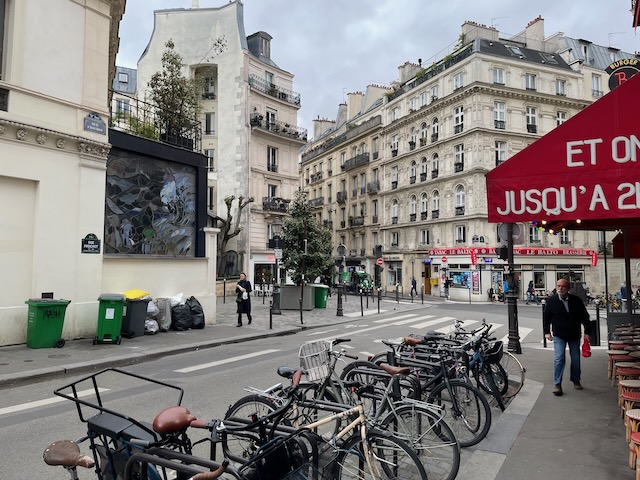
A street near our hotel, just south of Place Pigalle
As I move closer to fulfilling my years-long resolution to finish reading the entire 1.3-million-word novel In Search of Lost Time (ISOLT) by Marcel Proust, I considered it a lovely coincidence that a couple of weeks ago, I came across an extended passage in the book that intersected with my own life at that very moment – and not in just one way, but in two.
Volume I, published in 1996, which I purchased many years ago.
For about fifteen years, I have been perusing the seven parts (contained in six volumes) that make up Proust’s monumental opus, at the rate of one thick tome every three or four years. Clearly I was not so gripped by his writing that I felt compelled to read the entire novel in one sitting, but neither was I ever reluctant to pick it up again. Last month, I decided that the weeks in advance of my first-ever trip to France – which will be occurring around the start of May – were the perfect time to start reading the one volume I still hadn’t read.
In Search of Lost Time proceeds at an extremely leisurely pace and, fortunately for people like me, the final volume comes with a synopsis of the volumes that came before, along with an index to real and fictional characters and places appearing in the book. Since I started ISOLT, I’ve come to think of reading it as a way of life, rather than an event: it is always there waiting for me when I want it. It has occurred to me that finishing it might not augur well for my own longevity – what reason will I have to go on? – but then I remembered that I can always start the book again. It is, after all, a story that was prompted by the main character’s recollection of his childhood, a recollection that was in turn prompted by the taste of a madeleine. Not to get too meta, but who is to say that some event or scent or view may not, at some point in the future, prompt me to start the entire book from the beginning?
I have been enchanted enough by In Search of Lost Time that the many sights I want to see when we go to France this year include several locations that have become familiar to me thanks to Proust. He gave a number of his locations fictional names but his book is so widely known and respected that one town, Illiers, even renamed itself “Illiers Combray” in recognition of its role as model for the fictional town of Combray, where Proust’s protagonist (M.) grew up. Other locations that provided settings for various events in Proust’s novel are easy enough to find: Balbec, the seaside resort in Normandy, where much of Volume II (which I read under the title Within a Budding Grove; titles of the different volumes change depending on the translator) is set is actually Cabourg.
In Paris, the setting for much of ISOLT, there will be many things to see that are non-Proust-related. But I’ll be getting in touch with him there as well. (I have been told that that I must see the Carnavalet Museum in that city where Proust’s bedroom has been recreated, including the bed in which he wrote much of the novel.) All in all, reading the concluding volume of the book before I went to France became imperative.
So imagine my pleasure to come upon a passage in Volume VI which seemed almost presciently relevant to my life. To start with, I was reading it in the days immediately prior to March 9, when we turned the clocks forward for daylight saving time this year. In those few days, Facebook was alive with opinions about the impending devastation the upcoming time change would wreak on mental and physical health and/or the joys of longer evenings (opinions varied depending on the constitution, the age, and the employment status of the person posting). But secondly, due to our forthcoming trip, as I read I was thinking about Paris more personally than usual – for example, wondering how far the Hotel de Paris Invalides, where we will stay for part of our visit, might be from certain locations Proust mentions.
Then I came upon this:
I had gone on walking as I turned over in my mind this recent meeting with St. Loup and had come a long way out of my way; I was almost at the Pont des Invalides. The lamps (there were very few of them, on account of the Gothas[1]) had already been lit, a little too early because “the clocks had been put forward” a little too early, when the night still came rather quickly, the time having been “changed” once and for all for the whole of the summer just as a central heating system is turned on or off once or for all on a fixed date; and above the city with its nocturnal illumination, in one whole quarter of the sky – the sky that knew nothing of summer time and winter time and did not deign to recognize that half past eight had become half past nine —in one whole quarter of the sky from which the blue had not vanished, there was still a little daylight. Over that whole portion of the city which is dominated by the towers of the Trocadéro, the sky looked like a vast sea the colour of turquoise, from which gradually there emerged, as it ebbed, a whole line of little black rocks, which might even have been nothing more than a row of fishermen’s nets and which were in fact small clouds – a sea at that moment the colour of turquoise, sweeping along with it, without their noticing, the whole human race in the wake of the vast revolution of the earth, that earth upon which they are mad enough to continue their own revolutions, their futile wars, like the war which at this very moment was staining France crimson with blood. But if one looked for long at the sky, this lazy, too beautiful sky which did not condescend to change its timetable and above the city, where the lamps had been lit, indolently prolonged its lingering day in these bluish tones, one was seized with giddiness: it was no longer a flat expanse of sea but a vertically stepped series of blue glaciers. And the towers of the Trocadéro which seemed so near to the turquoise steps must, one realized, be infinitely remote from them, like the twin towers of certain towns in Switzerland which at a distance one would suppose to be near neighbours of the upper mountain slopes.
Time Regained, In Search of Lost TimeVolume VI by Marcel Proust (Mayor, Kilmartin and Enright translation, 1981, 1992)
Volume VI, now underway
In Proust’s world, almost everything is a reminder of something else, and the evening sight described in this passage takes his mind back to a scene one hundred years before (which, of course, he could only imagine, as it happened before his birth), when in 1815 Bonaparte (hoping to build public support for his Charter) filled the Champs de Mars – the very boulevard down which Proust was by now walking, having left behind the Pont des Invalides – with an exotic parade of soldiers in dress uniforms from across Europe.
I have plotted out the Pont des Invalides on a map (a 20-minute walk from our hotel in Paris) and you can be sure that I will be standing “almost at” it and looking toward the Trocadéro one evening during our stay. And I have located the Champs de Mars nearby. Depending on our time and available modes of transportation, this may be the closest I will get to sharing the literal vision of the work that has created so many imagined pictures in my head over these past years. I will report to you on how that goes in a forthcoming series of travel blog posts.
With its lingering passages of description, philosophical ramblings, gossip, snapshots of France at the end of the 19th century, political discourse, conjectures about homosexuality, and artistic musings, Proust’s long novel is more like a stroll in the park with a voluble friend than any kind of tension- or action-driven novel most of us might choose to read to divert our attention today. It is strong on descriptions of everything – people and places in particular become etched in the mind, increasingly familiar as Proust’s world unfolds volume by volume, but his language is beautifully repetitive too, as fully-leaved trees might seem to be when you are driving down a country road. Just as you will note repetitions in phrasing between one sentence and the next in the passage I’ve included above, the events move, for the most part, at such a languid pace that one can lose one’s page location and spend an extensive period of time reading very similar passages until you locate the one you were actually reading last. Proust on an e-reader would be a nightmare, particularly if the bookmark function didn’t work.
That said, if you think that reading Proust’s novel would be too difficult for you, think again. It is very accessible, and very lovely. Granted, it is very long, but “long” does not mean insurmountable (i.e., does not equal “high,” as in the context of Everest, but continues on a stroll-able path at mostly the same altitude). You can read one volume or half of one and leave it at that, or you can read a volume every couple of years as I did. And you can borrow the first one from the library before adding the entire novel to your book collection: something you will definitely want to do, however, if you finish the whole thing. (Bragging rights are important for both Everest and Proust.) Proust is a pleasure that should intimidate no reader.
(Note: Today I learned that Proust’s full name was Marcel Valentin Louis Eugène Georges Proust. No wonder he felt comfortable with using so many words to tell his story.)
✻✻✻✻
I have been pleased with the response to my previous travel blogs (including ones to India, Cuba, Italy and Germany) and hope readers will find material of interest to them this time too, as Arnie and I explore England for ten days and then cross the channel into France. I have never been to France, but have been eager to visit the country since I started learning French – about sixty years ago (??? How did that happen???). I’ve been brushing up on my French with Duolingo and am amazed at how much I remember. Whether I’ll actually be able to speak the language when I reach the country of its origin remains to be seen. When I was in Italy I could remember no Italian, only French.
If you are interested in following along, please sign up (no charge) to get a notice each time I post a new instalment. We depart on April 21, and return on May 11. I’m looking forward to sharing our experiences with my readers.
P.S. I am cross-posting this and the upcoming travel articles on I Am All Write on WordPress and I Am All Write Too on Substack. This is the first step of a process on which I intend to embark upon as soon as I have finished writing my current novel, in which I will discontinue writing fiction for the most part and focus on my blogs – offering free posts at WordPress but monetizing those at Substack.
[1] German bombers, which mainly flew at night. Volume VI, “Time Regained,” takes place during World War I.






























 I'm All Write
