Travel Date: Thursday, May 2, 2024
On Thursday morning, after settling in to our new, improved quarters and checking out the neighbourhood, we set out to discover Paris. (Arnie had been to France in the 1970s, but I had never been before.) It was still raining, but for the most part the rain was a fine drizzle so it didn’t interfere with our stroll.
After consuming a bowl of French onion soup at one of the many small cafés that edge the streets of Paris (because of course we did. Very tasty), we took the Métro to the south side of the Seine, emerging near the Quai D’Orsay, and began to walk west along the Left Bank/ Rive Gauche. First we passed the Assemblée Nationale, which is France’s lower House of Parliament, the upper being the Senate.
France, like most democracies, has three branches of government: legislative, executive, and judicial. The President (currently Emmanuel Macron), a position for which an election is held every five years, appoints the Prime Minister (normally the head of the party with the most seats); the Prime Minister and his or her deputies make up the Government. I understand that elected representatives whose politics are on the left sit on the left side of the PM in the Assemblée, and those whose politics are on the right sit on the right. Seems sensible.
(Please click on a photo for a better look. If you are reading this as an email, click “Read on Blog” (at the top of the email) to see larger versions of the photos.)



The French electoral system is somewhat confusing to an uneducated outsider (as are most countries’ electoral systems, come to think of it. Autocracies and dictatorships are easier to understand: rulers like Nicolás Maduro in Venezuela just retain control of everything, no matter what the voters decide they want). The French system of government is additionally confusing since France is a founding member of the European Union, so some of its legislative functions now fall under the purview of the European Commission.

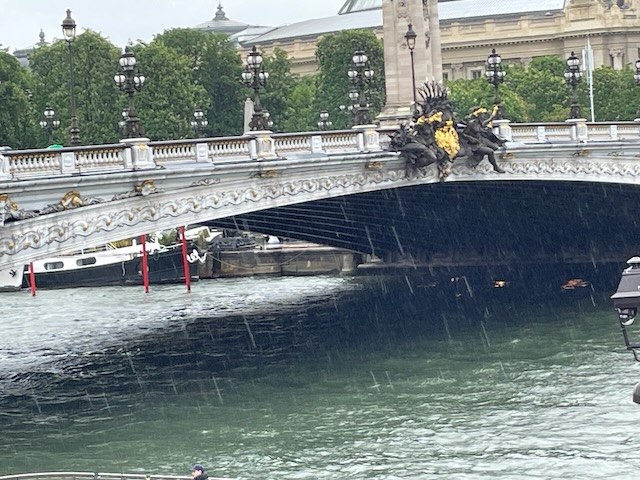


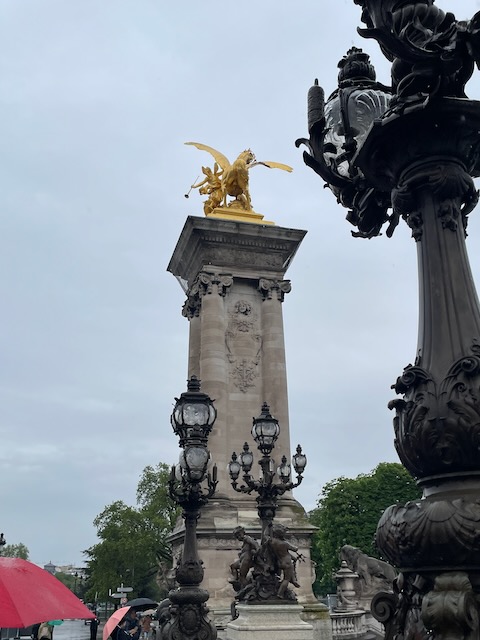


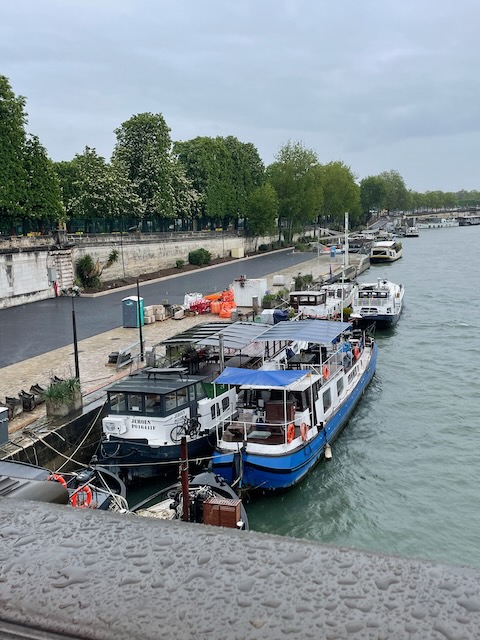
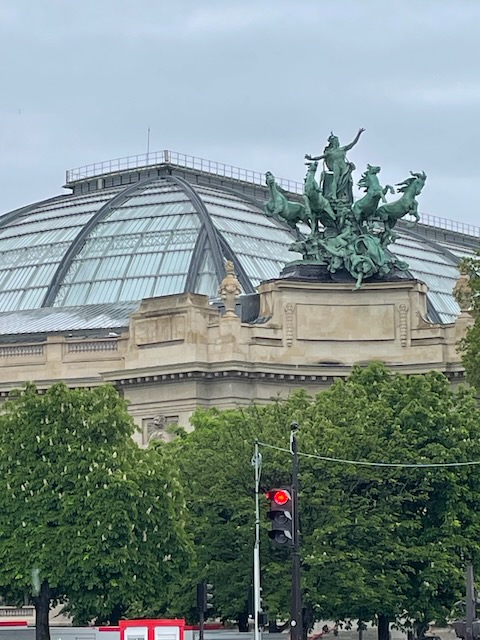
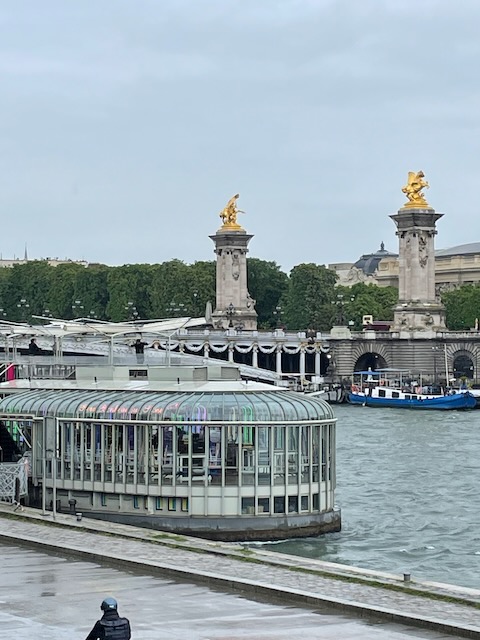
We continued along the Left Bank until we reached the Pont Alexandre III. From Wikipedia, I learned that “[This] Beaux-Arts style bridge, with its exuberant Art Nouveau lamps, cherubs, nymphs and winged horses at both ends, was built between 1896 and 1900. It is named after Tsar Alexander III of Russia, who had concluded the Franco-Russian Alliance in 1892. His son Nicholas II laid the foundation stone in October 1896. The style of the bridge reflects that of the Grand Palais, to which it leads on the right bank.” (Well said, Wikipedia.)
The Grand Palais was closed for renovations when we were there, but would reopen temporarily for the Olympics in August. (The fencing and taekwondo events were held there.) The full site will reopen to the public in 2025. The Grand Palais is an exhibition hall, museum and historic site dedicated to French art, and it sounds as though it is quite spectacular. We’ll have to go back to investigate it (and Notre-Dame Cathedral, of course, which was still closed for restoration following the terrible fire in 2019).
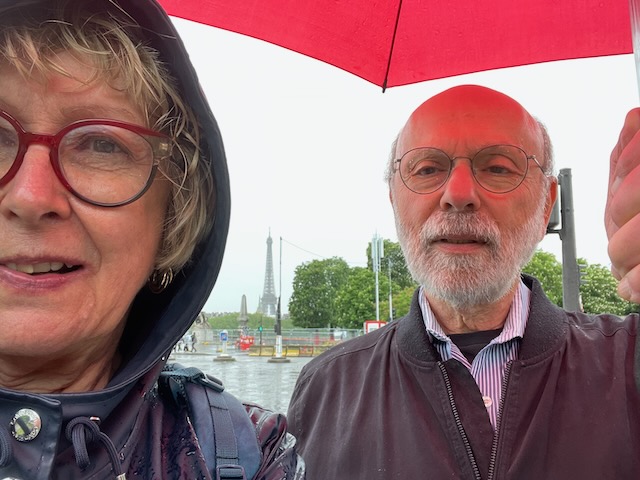
We kept catching sight of the Eiffel Tower and since I couldn’t get over the fact that we were actually IN Paris looking at THE ACTUAL Eiffel Tower (of which I have owned a small replica since my sons visited the city in about 1992), I kept taking photos of it. As a result, I now have about 200 photos of the Eiffel Tower. I will not post them all.


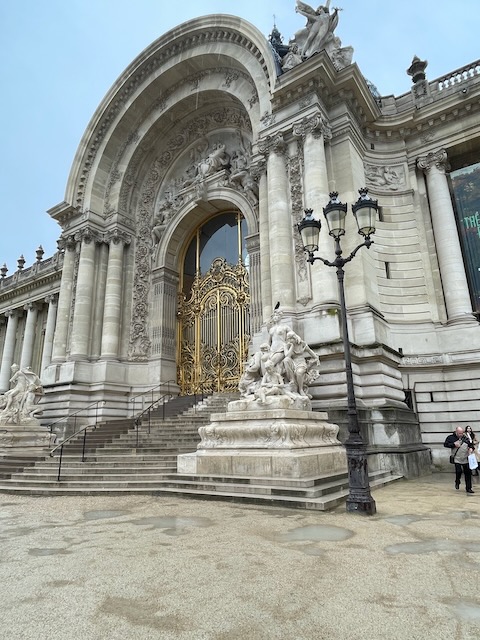


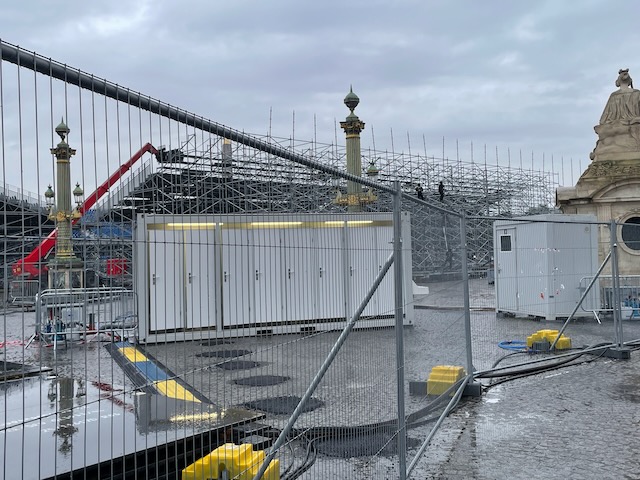
After walking in front of the Grand Palais we took a right turn and headed up the Champs-Elysées to the Place de la Concorde, the largest square in Paris, where there was a lot of activity going on to prepare for the upcoming Olympics. The Place Concorde was the site of the BMX freestyle, breaking, skateboarding and 3X3 basketball events and as the photos illustrate, a lot of temporary seating was being created when we were there.


As we walked, I spent a lot of time just marvelling to myself that I was actually on the Rive Gauche, walking by the Quay D’Orsay, crossing the Seine, catching glimpses of the Eiffel Tower, standing in the Place de la Concorde. It was both magically surreal and exactly as I had expected it would be: a perfect combination. It also made me think that if you read enough books and see enough films set in a certain location (or point in history, I suppose), it is almost as good as visiting it.
Almost, but not quite.


_________________
Addendum
Did you know that “I Love Paris” was written by Cole Porter and published in 1953? It’s been “covered” by just about everyone – notably Bing Crosby, Andy Williams, Ella Fitzgerald, Doris Day, Dean Martin, Frank Sinatra and Screamin’ Jay Hawkins. It’s a short song, but long enough to become an ear worm.
 I'm All Write