Travel date: Friday September 12, 2025
Last month we went to Spain. Now I’m going to tell you about our trip. It may take me a long time to do all the posts, because the longer I draw out this account, the more time I have to relive each stop we made along our way. Also, I want to get it right, because I have just realized that one or more of my grandkids might be reading these accounts someday, and I want them to know what I saw and what I thought. So I thank you in advance for your patience. (You can subscribe to this blog for free if you want to get an email when each new post appears, although I recommend you come back to the blog site to read it, as the photos show better here than they do in the emails.)
Spain has been on the list of countries I have wanted to visit for many years, probably since I started studying Spanish when I was in my first year of university. As my interest in art and architecture matured, I wanted to see Antoni Gaudi’s famous (so far uncompleted) cathedral, the Sagrada Familia, as well as the Guggenheim Museum at Bilbao and the Prado in Madrid. A number of years ago, I became fascinated by Northern Spain thanks to a book called Roads to Santiago by Ceec Nooteboom, and our trip took us to many of the places he’d written about. A friend who travelled widely and had lived in Europe for an extended period of time once told me that Barcelona was the most beautiful city she’d ever seen. I loved Don Quixote. I needed to see the plain where the rain stays mainly. In short, I had numerous reasons for wanting to visit Spain.
On no count was I disappointed. This was one of the best holidays ever – and all of our trips have been excellent so that’s really saying something. (Of course it helps to have a congenial travelling companion like Arnie, who seems to have grown used to my need to peer around every corner to make sure we’re not missing anything.)
This time, rather than travelling independently, we joined a tour. More on that later. But it was the right way to do Northern Spain as we saw places we would never have sought out on our own, and learned about the cultural (and historical, and culinary, and many other) aspects of different regions from people who actually live there.
We even went to France for half a day.
Barcelona
We arrived in Barcelona at about nine in the morning on Friday, September 12, after an uneventful direct flight from Toronto that had lasted approximately eight hours. In order to give ourselves an opportunity to explore a couple of places in Barcelona that the tour wouldn’t take us – specifically Park Güell and the interior of the aforementioned Sagrada Familia – we had booked an extra day and a half for ourselves before the group’s first meeting. Since I have a theory about jet lag that involves not sleeping on the plane, and then adhering to the local time for meals and naps and full-night sleeps (an approach that seems to work for me), after making our way by public transit and on foot to our hotel, we checked in, and then set out to have some lunch and then to find the famous Park Güell.
One of the first things we noticed about Barcelona was the number of motorcycles. According to surveys, Barcelona has the most motorcycles per inhabitant of any European city, with more than 500,000 motorbike registrations for a population of 1.7 million people.


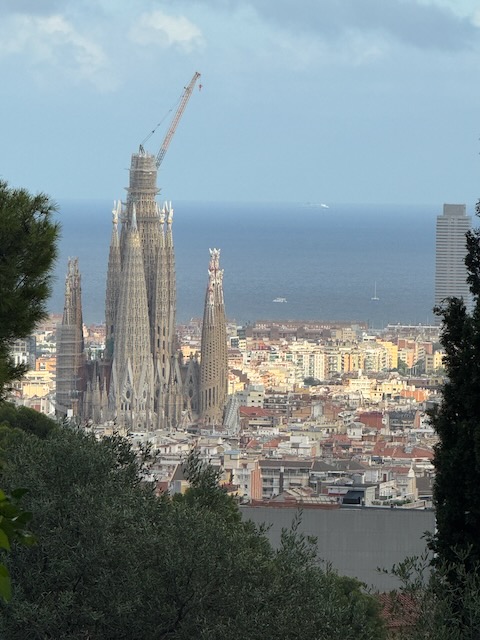
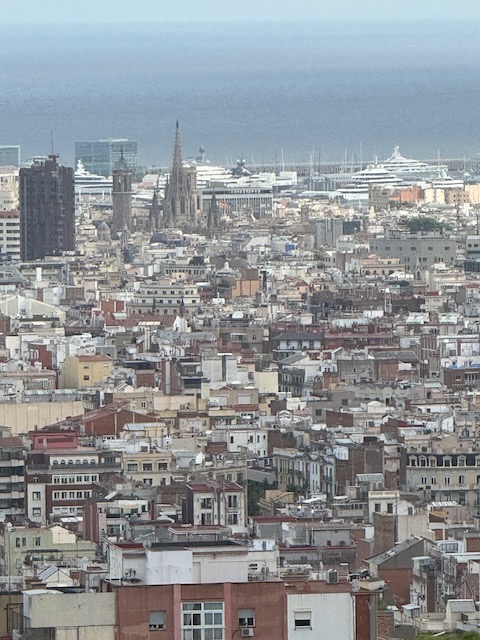
We also noticed that Barcelona, or at least the parts of it we saw, was remarkably clean (much cleaner than Toronto, for example). This may be due in part to the fact that the standard of living in Barcelona is so high that most people can’t afford to live there: many of those who do own real estate are making a killing renting out space to tourists. So maybe they can afford to clean up after everybody else.
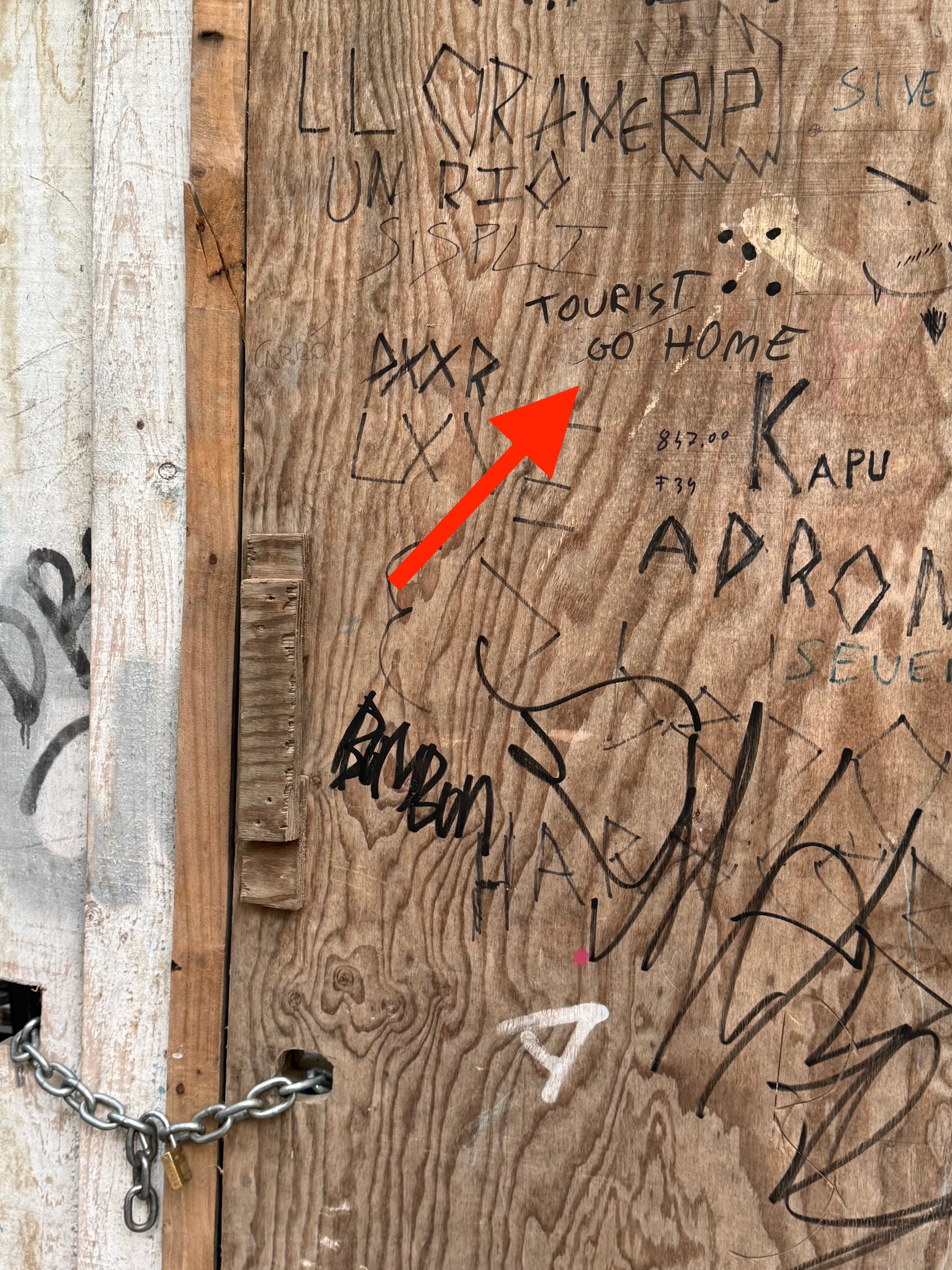
Overtourism is a major problem in Spain generally, and Barcelona in particular. Obviously, tourism is an important part of the economy, and they don’t want to get rid of it completely, but the effects are currently overwhelming. An article from EuroNews says that almost 66.8 million international tourists visited Spain in the first eight months of 2025 – 22.3 million of them during July and August, which is almost a million more than visited in those two months in 2024. As our tour guide confirmed later, not only has overtourism driven up prices and driven out locals, the hordes of visitors are undermining the culture and damaging the environment. Cruise ships are particularly resented as passengers typically eat and sleep on board, and don’t put any substantial amount of cash into the local economy. The graffiti we saw in English that told tourists to go away represents the tip of the iceberg when it comes to Spaniards’ unhappiness with the situation. Plans are underway to create legal and financial barriers that will at least reduce tourism in future.
I was glad we were visiting in September, when the crowds of tourists were still considerable but not as bad as they would have been in spring to late summer. Shopkeepers and people on the street whom we asked for directions were very helpful and kind, and we noted no (obvious) irritation or resentment anywhere. However, the number of times we remained lost after asking for directions did made us wonder if a few locals had deliberately sent us in the wrong direction. I actually wouldn’t have blamed them if they had. Aside from all the threats to Barcelona’s economic balance and way of life, it must get very tiresome to answer all those questions, mostly in English, asking for directions to tourist attractions, or wanting to know what the words on the menu mean.
Park Güell
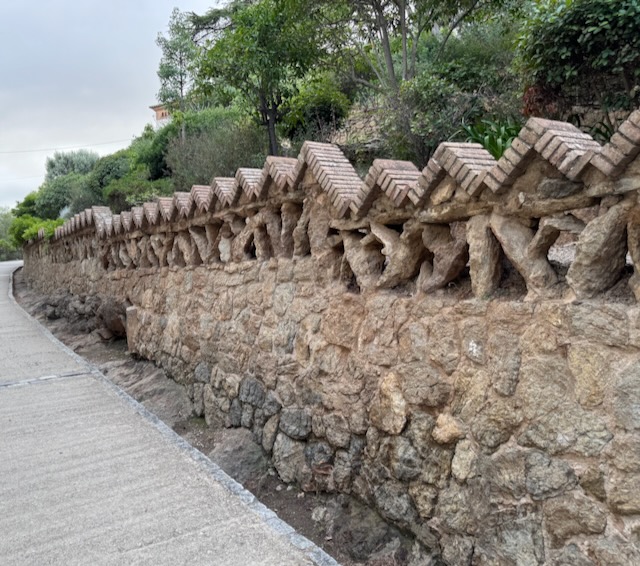
Park Gūell is a large property that overlooks the city of Barcelona. A wealthy industrialist and art patron named Eusebi Güell bought the land to build an exclusive housing development, and then hired the already highly regarded Catalan modernist Antoni Gaudi to design the parks and gardens, walkways and carriage paths that would form the backdrop for the luxury estate.
While he was doing his design work on the park, Gaudi lived in one of the two “model homes” in Güell’s development. This building is now a museum, where furniture, ornaments and other household and small industrial items designed by Gaudi are displayed. Gaudi had moved into the house with his father and his niece after his sister died, but then his father and then his niece also died. After that, he lived an ascetic life alone, his few domestic needs attended to by nuns, until much later when he moved into the Sagrada Familia itself to focus his attention on that project. As well as being deeply religious, Gaudi was a very disciplined artist. He got up early every day and worked until late into the night. Like so many people all around the world, I am a Gaudi nut, so I am very grateful that he accomplished so much in his lifetime that we and future generations can enjoy. His work – which includes several buildings in Barcelona in addition to the Sagrada Familia and Park Güell – is distinctive and remarkable.

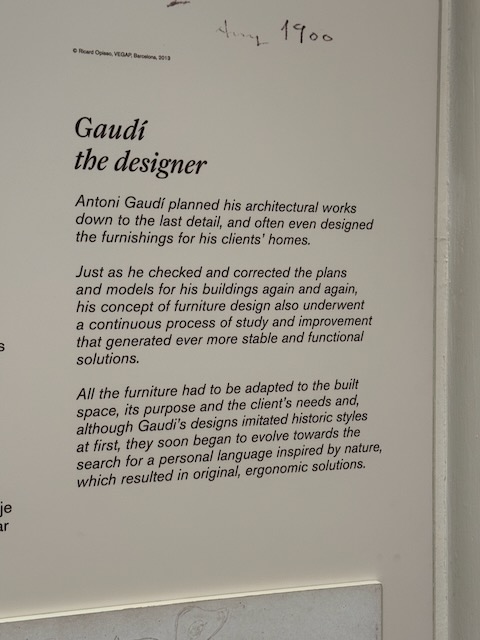
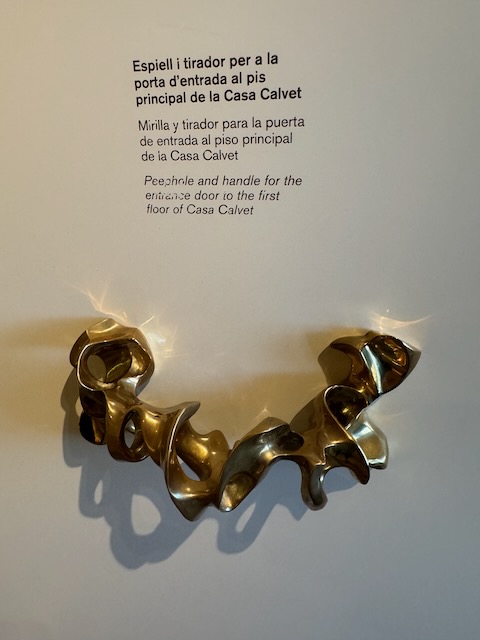


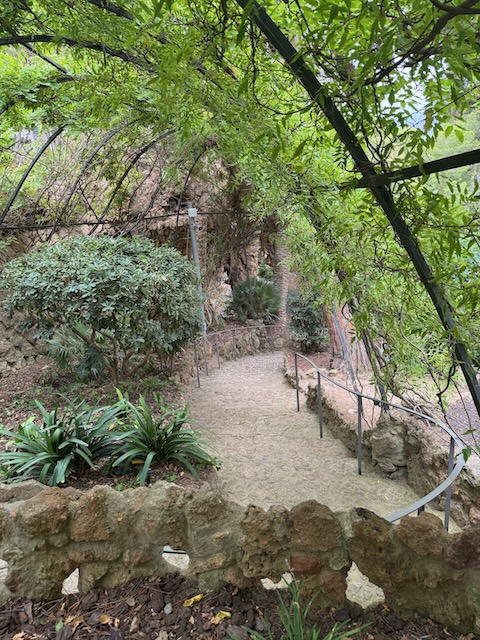
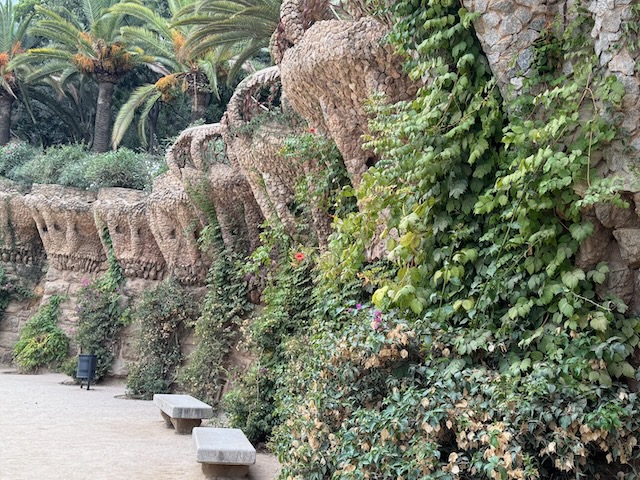
Park Güell was constructed between 1900 and 1914, and the stairways, viaducts, terraces, and gardens were designed to embody political and religious ideals and to reflect Gaudi’s interest in the geometric infrastructures of natural forms. His work has been described as being rooted in the Baroque, while also being much more expansive and open than the work of other artists from that era.
It is very difficult to do justice to the Park Güell with words, as is true of so much we saw in Spain, so there are going to be a lot of photo “galleries” in this series. As I mentioned above, if you’re reading this in an email message, you might want to click through to the actual blogsite in order to see the photos more completely.


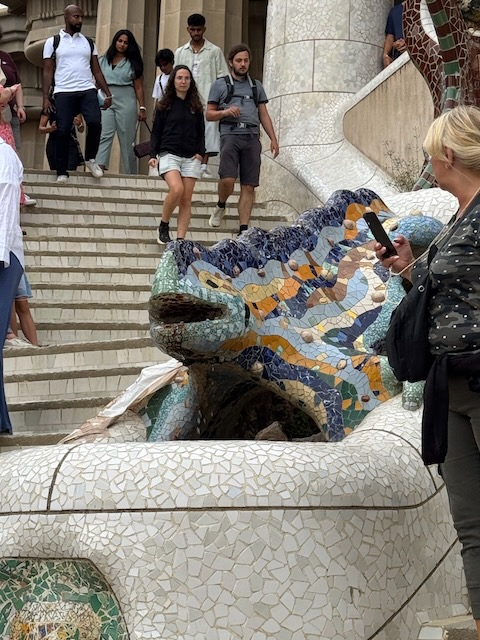




The Serpentine Bench
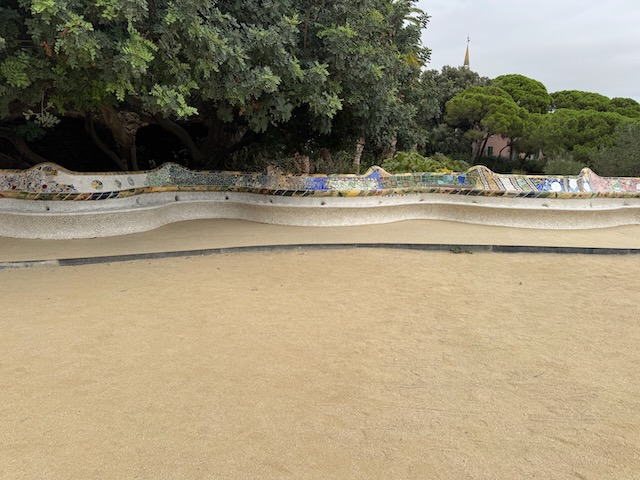
In addition to the walkways, pillars and viaducts, a focal point of Park Güell is a terrace at The Nature Square that is bordered by a long (110 metres) curving bench shaped like a serpent. Designed to be comfortable as well as visually appealing, the bench was designed by Josep Maria Jujol, who was mentored by Gaudi. Its mosaic decorations are distinctive, as is the entire installation.
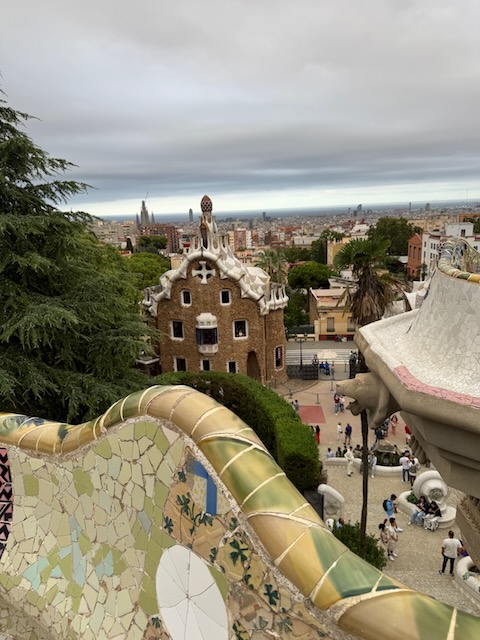
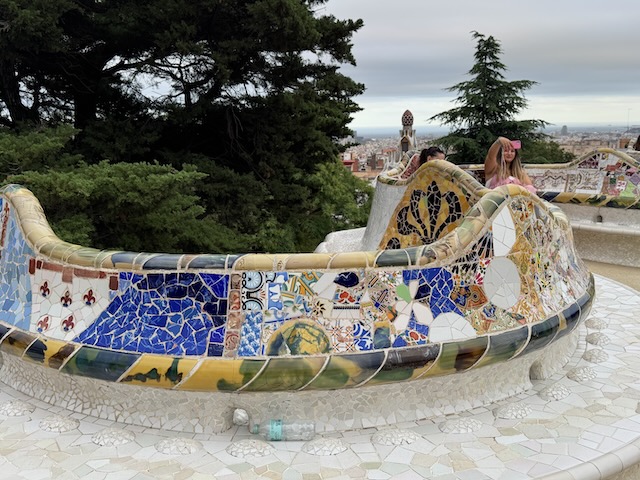

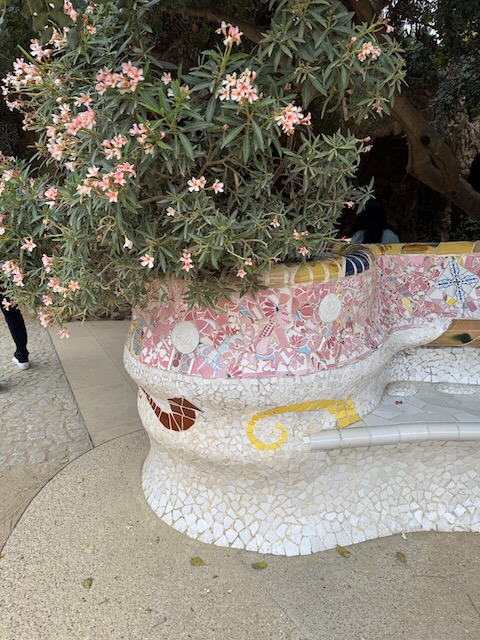
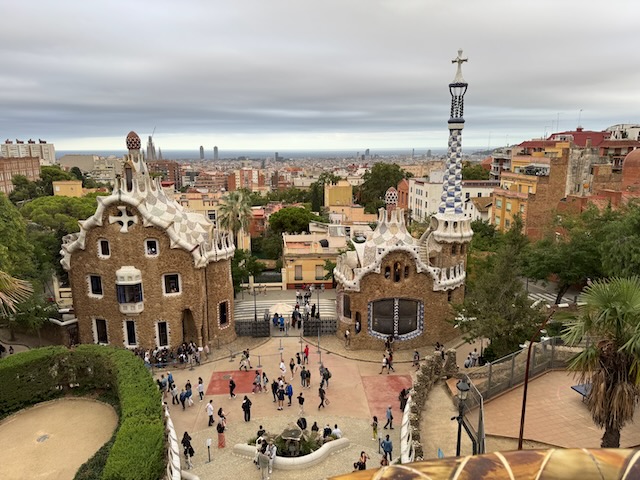

As it turned out, only the two model houses in Park Güell were ever built. Ultimately declared a UNESCO site, the park became a public space that is one of Barcelona’s most photographed tourist destinations. (Book weeks ahead if you want to see it!) While there is a visitor charge for tourists (and an additional fee to see the Gaudi house), locals are able to enjoy the park at no cost, anytime they want.
The Greenery
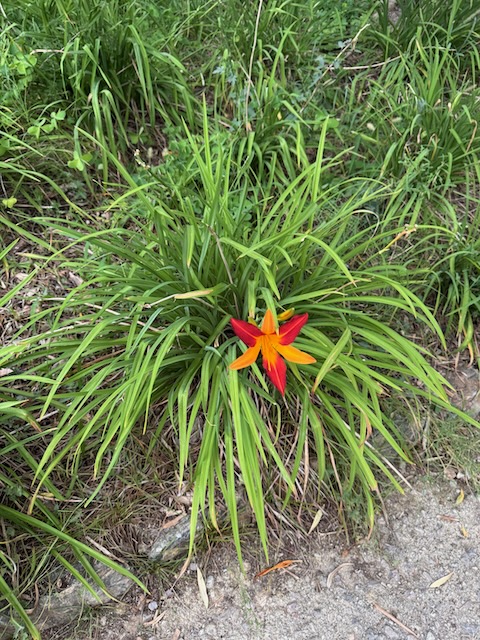
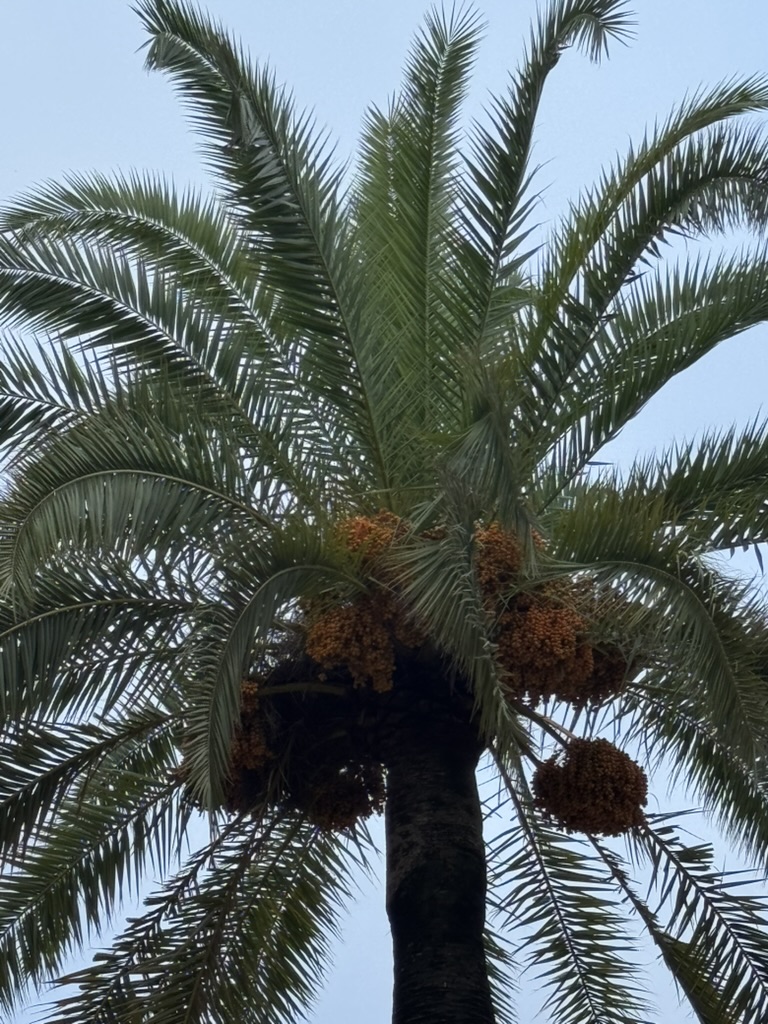
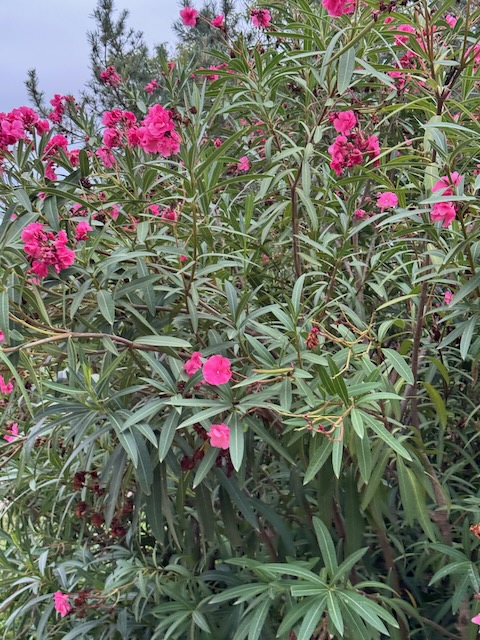
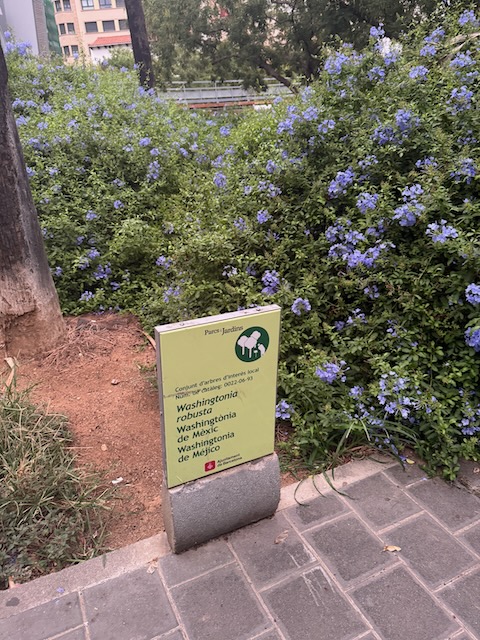
We were very very tired by the time we finally put our heads down on our pillows that night at our hotel in Barcelona. In addition to not having really slept since the morning of the day before in Toronto, we’d seen quite a bit of this beautiful Spanish city, travelled on the transit system, visited one of the city’s most famous destinations, seen plants and trees that were unfamiliar to these North Americans (see below), and sampled some Spanish food. We had wandered more airport concourses and city streets than we’d ever intended, hoped or wanted to wander in one day. As it turned out, aside from the lack of sleep, this would be a solid preparation for the physical demands of the following ten days.



 I'm All Write