Tag Archives: London

London, etc. and Paris, 20: Final Thoughts

Unlike many of my contemporaries, I was unable to travel much outside of the North American continent until I was in my 50s. Over the years, however, my reading and other interests (art, film, theatre, culinary) have taken my imagination far and wide, and made me long to see more places in the world than I will ever actually get to visit. About forty years ago, I made a list of places I wanted to see. I am enough of a paper hoarder that I could probably find that list again if I put my mind to it, but it would undoubtedly depress me: after all, I’m suddenly three-quarters-of-a century old and my travelling days are likely coming to an end. (Not yet! But soon.)

My interest in travelling both literally and figuratively has also meant that throughout my life, I have usually been studying one language or another, never attaining fluency but always enjoying the exercise. I studied Russian, French and Spanish at university, and have since taken several courses in the latter two languages with the intent of brushing up. I’ve used Duolingo to give me some knowledge of Italian, and I am currently working on German. My literary interests have always been international in scope as well, and books set in countries from Burma/Myanmar through China and Russia, to Japan and Iceland, across Europe, down through Africa, and over to Brazil and Patagonia and Chile, have piqued my interest in actually seeing the places where they are set. At the age of fifty, I finally got to the UK, home of my forebears, where I visited London and saw a tiny bit of Wales.

When it finally became possible for me to make a major excursion to a foreign land, India was at the top of my list – much to the dismay of my elder son, who had generously shared his air travel points with me as a 60th birthday gift. He was not keen on the idea of his mother travelling alone to India, much less on feeling any sense of responsibility if anything happened to her. But I felt that if I had only one chance to see an entirely different geography and culture from my own, I wanted it to be as entirely different as possible. Plus, I didn’t travel alone: I joined a group trip. (The eldest of my travelling companions was barely half my age, but after they all got used to having someone older than most of their parents in the group, it was fine. It was even better once they basically forgot that I was in their midst.) I loved India, and confirmed that I loved travelling.

Most of my travels since have been with my husband, Arnie, especially since his retirement ten years or so ago. Together, in addition to several U.S. trips, we have been to Cuba, Italy (& Croatia), Germany (& Prague), and this past year to London (etc.) and Paris.

I have gained more than I can ever explain from these travels, most of it positive. Travelling has changed me for the better, enriched my life, widened my perspectives, deepened my feelings of connection with people around the world, and made me appreciate our differences. Perhaps the most frustrating lesson to learn has been that it would not be possible for me to cross travel destinations off my life list, even if I knew where it was. There is not one place of those I have travelled to (at least so far) that I would not relish going back to again for an extended stay. In fact, in most cases the hankering is worse now that I’ve seen the places than it was before I went. When I watch a TV series or a movie set in Berlin, or London, or Mumbai, or Mexico City, or read a book from or about somewhere I have been, I long to be back there again.

Our most recent trip was no exception. If you asked me right now if I would rather visit a country I haven’t ever seen before or go back to Paris (and maybe see some more of France), I would be hard pressed to answer the question. I did love Paris.

But then I think of the night markets in Japan, or the Sagrada Familia, and my imagination is off and running once again.

My only hope at this point is that in my 90s, when I can no longer travel, I will at least be able to afford some kind of virtual-reality headset so I can visit a few places my actual body has not yet been to. (I hope the device comes with smells. Food would be nice, too.)

Paris may feel like it’s half way around the world, but on May the 11th we woke up in a hotel room in Paris and went to sleep around midnight the same day in our own bed in Toronto. That boggles my mind, even though I know that this experience was only possible because of time differences, and that these differences also mean that it would take us two days to get back to that hotel again.

The speed of our return was also of course due to a few miracles of modern travel. On May 1, when we took a bus from London to Paris, which included crossing the English Channel on a ferry, the trip took ten hours. On the 11th, we returned by train through the “Chunnel,” and the trip from the Gare du Nord in Paris to St. Pancras Station in London was only two hours and twenty minutes. (It would have taken about the same length of time to fly, and the cost would have been almost the same.)

At St. Pancras we transferred to the Tube, which delivered us to Heathrow Airport in about 45 minutes, and our plane for Toronto left not long after we arrived at the airport. Smooth sailing, as it were.

While the train trip back to London saved us time, I would not have wanted to miss the worst day of our entire trip, which had happened on the day we travelled the opposite way by bus.

It is my hope and expectation that the current fad of people posting almost nothing but photos of themselves online will come to an end shortly. However, the fact that many selfie addicts (younger women in particular) have found a way to monetize the practice is not conducive to the likelihood of an early end to this trend.

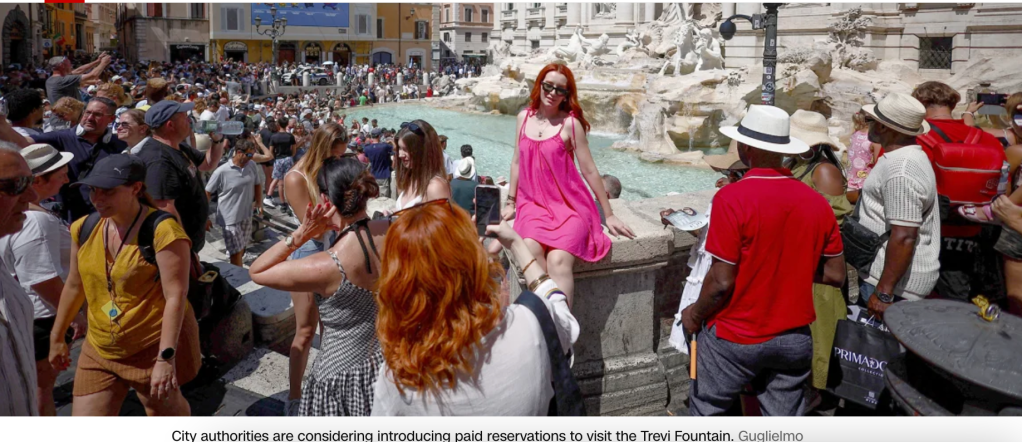
As I have previously written in a blog post on the matter, influencers are an increasing eyesore (ironically) at tourist spots around the world. “Influencers” (at least in this context) are people who get all dressed up in clothing, makeup and accessories from name-brand fashion and cosmetics outlets, and then go and stand in front of something that makes an interesting backdrop and get their photos taken, and then they post the photos on their Instagram or other social media platforms, and hope that the clothing, accessory or cosmetics outlet will pay them for promoting their products. People who are famous from other initiatives – e.g. the tackily clad women from Selling Sunset – are ready-made influencers: they just add sponsored products to the photo shoots they are already doing in order to promote their programs and themselves. I expect that they are paid for the number of “hits” that their images receive online, and that the more popular the influencer, the more they can charge.

I would also guess that a lot of the (literal) poseurs we saw on our travels were wannabe, rather than established, influencers: not all of them can have financially viable web presences. I wonder whether these people have to pay for their own clothes. No doubt the reason so many of them show up at places like the Eiffel Tower or Niagara Falls is because these landmarks are also popular Google search destinations, which increases the odds that people will come across their photos.

Several times on this trip, like the ones that preceded it, we walked farther than we’d intended. One day early in our visit to London we tracked more than 18,000 steps (including eleven flights of stairs). By the time we got off the underground at the station near our hotel that night, I was promising my feet that if they’d just carry me the final few blocks, I’d never make them go anywhere again. My back was not happy either. But each time when I thought I’d really overdone it, I was relieved to discover that a night’s sleep was all I needed to recharge, after which I was able to head out one more time. (Arnie, by contrast, just kept going and going, without complaint. Very impressive.)

The lesson I learned from this is that you should visit all the interesting foreign places you can when your limbs are still limber and walking is easy. However, if you can’t go until you have achieved the age of aches, pains and sore feet, you should go anyway. You’ll be surprised how far you can get when there’s something around the next corner or at the next Tube stop that you just have to check out. (Of course, good shoes are essential. I say this at the risk of sounding as old as I am.)

A backup power supply for your phone is also essential. There is nothing worse than running out of battery power before you’re ready to call it a day, especially if you need GPS to get you the final few blocks back to your hotel.

Here is a photo Arnie took of the inside of the Shakespeare and Company bookshop. I didn’t realize he had taken this when I wrote my post about the shop. This really captures the feel of the place.

Arnie also got a great video of a charming busker who provided a musical accompaniment for part of our trip from Paris to Versailles.

And that FINALLY concludes my blog series about London, etc. and Paris. I am most grateful to those who have been reading, and for the many positive comments!

A Page from My “Trip Planner”

London, etc. and Paris, 9: The Globe Theatre and the Tate Modern. Our last day in London

I can’t think of a better way to have spent our last day in London than with two long-time friends.

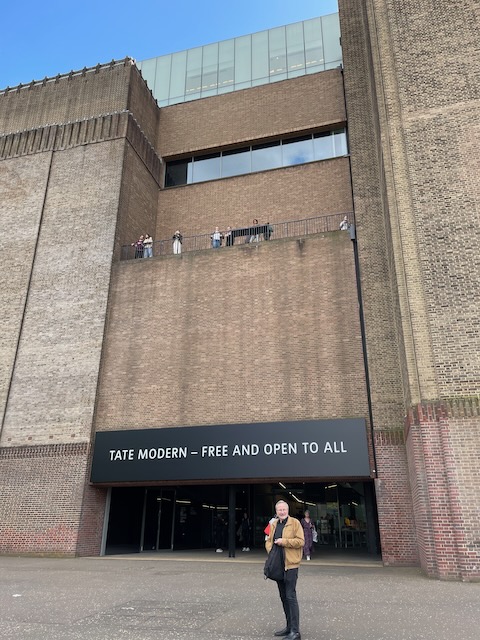
We began our day by making the familiar trek from our hotel to Paddington Station, and I found I was feeling nostalgic in advance for the neighbourhood where we’d felt so at home (and eaten so well) for the past ten days. We emerged from the underground at Mansion House station, walked past St. Paul’s Cathedral and then across the Millennium Footbridge to the south side of the Thames. There, at the entrance to Shakespeare’s Globe Theatre, we met Nancy Mattson – whom I’ve known since both of us lived in Edmonton, many decades ago – and her British-born husband Michael Bartholemew-Biggs. We were amazed to learn that they had never done the Globe tour before, although they had seen many plays at the theatre. We were all in for a treat.

The original Globe Theatre was built in what is now the Borough of Southwark by Shakespeare’s theatre troupe in 1599, but the building was destroyed by fire in 1613. A second Globe opened a year later on the same site, but it closed along with all the other theatres in London in 1642 when, at the start of the first English Civil War, “lascivious Mirth and Levity” and other unhealthy states of mind that might be incurred if one attended a play were officially deemed incongruous with the spirit of the times.

Shakespeare’s Globe,” the newest incarnation of Shakespeare’s theatre, opened in 1997. It is located 500 feet away from the original, but the design is very much the same. Our well spoken young guide related intriguing structural details about the original theatre, how both players and patrons were accommodated there, and how the theatre’s attributes (and drawbacks, such as the lack of a roof over those standing in front of the stage) had been reproduced in the current building. We wore headsets and our guide spoke quietly into the microphone so we wouldn’t disturb a rehearsal for Much Ado about Nothing that was taking place on the colourfully decorated stage. It was an excellent and interesting tour.

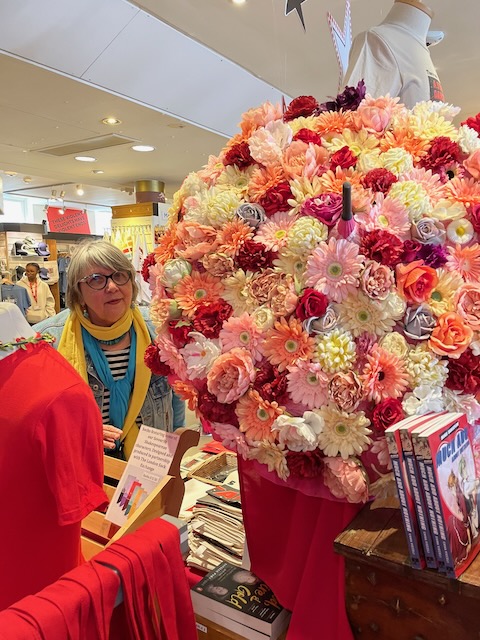
After checking out some displays in the lobby, and giving the gift shop a quick look (Note the umbrella: so charming, but how would you manage it on the Tube, especially if it got wet?), we walked over to Tas Pide, a middle-eastern/Turkish restaurant that Nancy and Michael knew. The food was outstanding.

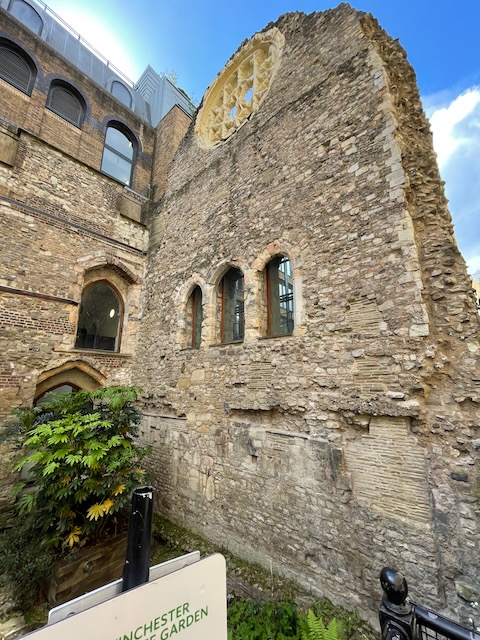
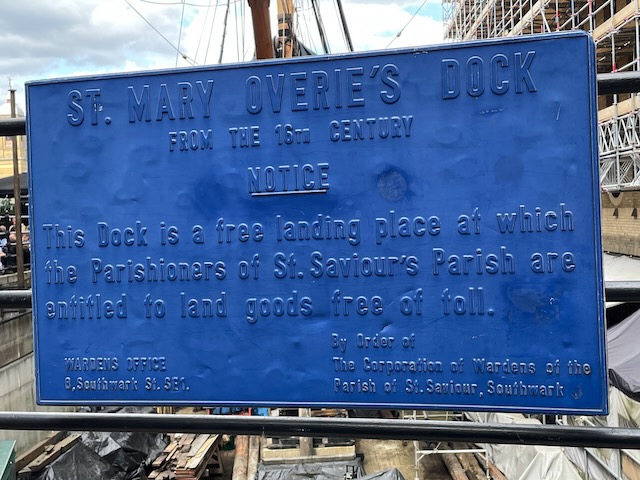
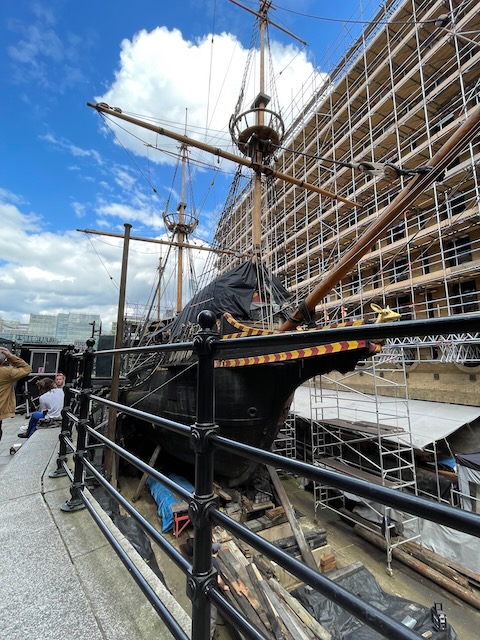
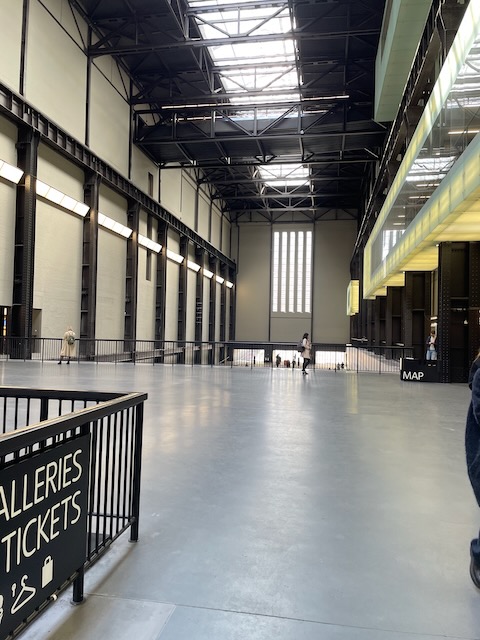
Our route from the Globe to Tas Pide and then back to the Tate Modern – our final destination for the day – took us past a number of interesting sights along the waterfront in Southwark, including: the original site of Globe playhouse; a museum in honour of The Clink; the remains of 12th-century era Winchester Palace, which includes the rose window from its Great Hall – one of the remaining pieces of the original structure that was mostly destroyed by fire in 1814 – and its lovely medieval-themed garden; a replica of the Golden Hynde; St. Mary’s Overie’s Dock; and Dirty Lane. The British have a definite talent for giving names to things.

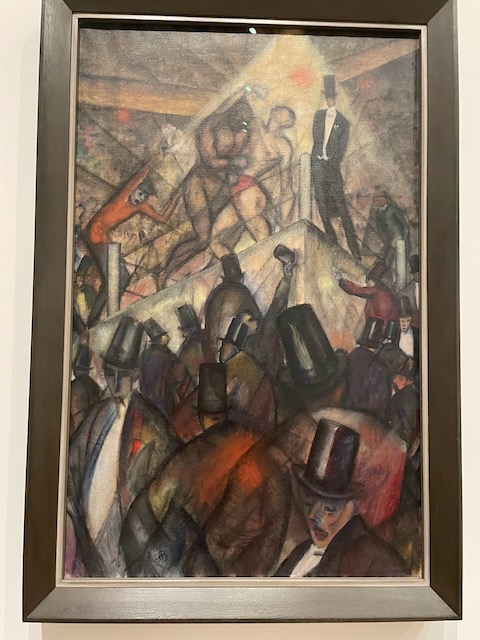
We saw a fabulous exhibition at the Tate Modern: The Expressionists: Kandinsky, Münter and the Blue Rider. The Blue Rider [Der Blaue Reiter] was a group of avant-garde artists in Munich at the start of the 20th century. Gabriele Münter and Wassily Kandinsky were two of its founding members. The Expressionists intended through art to portray emotions and responses to real and spiritual experiences, as opposed to creating realistic depictions of objects and scenes. Their works often featured distorted forms and bold colours.

The show was huge. Before long, my feet were causing me serious grief so I wasn’t able to enjoy the pieces near the end as much as I had the ones at the beginning. (Nor, as you will note, was I too particular about how I was holding my phone as I snapped photos of the works of art.) If we’d been in London longer, I’d have gone back a second time so I could have absorbed more than I did. I’d had no idea how much I liked Expressionist art!

Most of the artworks in this show were created in the first decade of the 20th century.

Nancy Mattson and Michael Bartholomew-Biggs are both poets, and in my next post I’ll be taking a side trip from this travelogue to profile their most recent books. Each poet has a distinctive voice, but both works are accessible, intelligent and eloquent. Stay tuned.

London, etc. and Paris, 3: A Changing of the Guard, the Victoria and Albert Museum, and a Play at The Old Vic

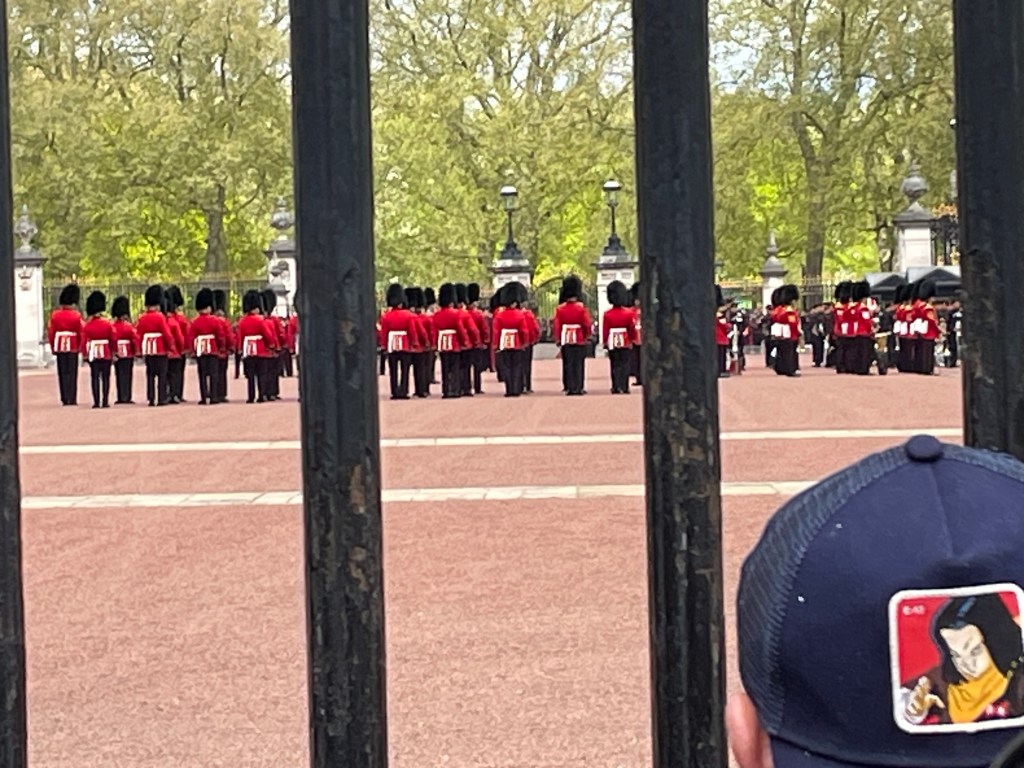
We decided to start this day with a stroll past Buckingham Palace. It seemed only proper to drop by the Royal Domicile since we were in London, whether or not the Monarch Himself was at home. (He wasn’t.) However, we did not realize until we got there that the Palace’s ceremonial Changing of the Guard takes place on Mondays, Wednesdays, Fridays and Sundays at 11 a.m. (I am not sure what happens to the guards on duty the other days of the week, but I presume they are changed in some other, quieter way.) Since we’d arrived at exactly 11 a.m. on a Wednesday, the entire area was jammed with people. We could get nowhere near the Royal Edifice until the event was over, which took about an hour. There were times when we common folk were packed together to an almost alarming degree, but I believe that all of us survived.

We’d have been more than happy to see the Palace without the Changing of the Guard, but it is quite a production and very colourful. And clearly, four times every week, people come from everywhere to see it. Once we’d managed to extricate ourselves, I decided I was glad that we had seen it too.

(Click on photos for bigger images.)

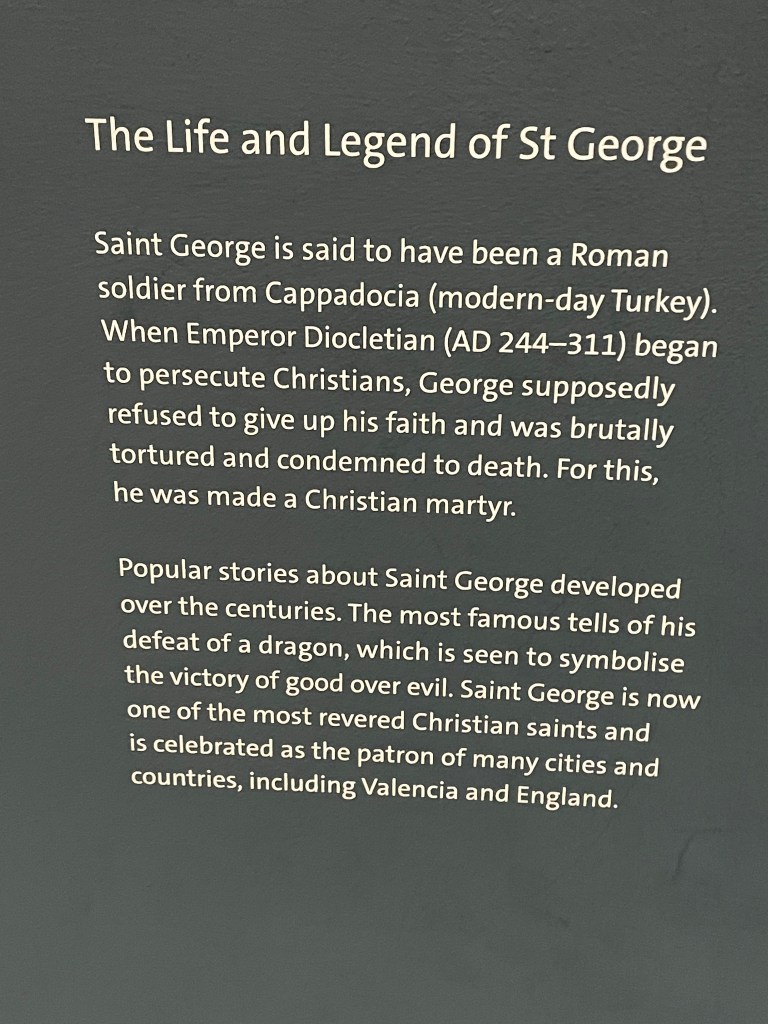
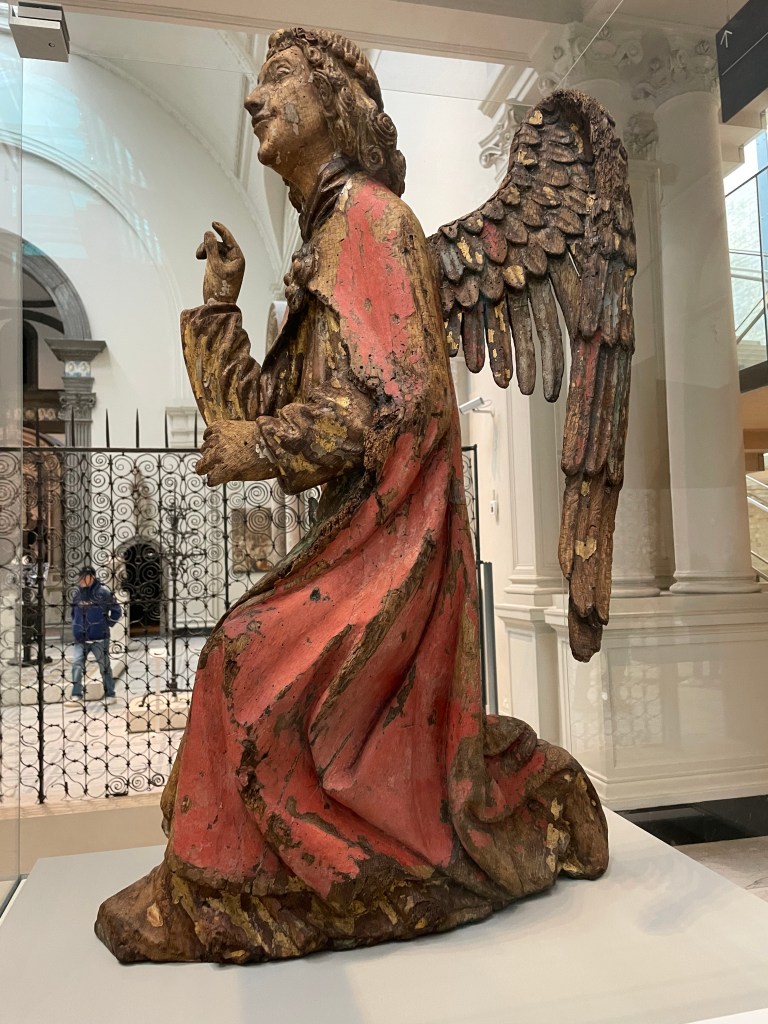
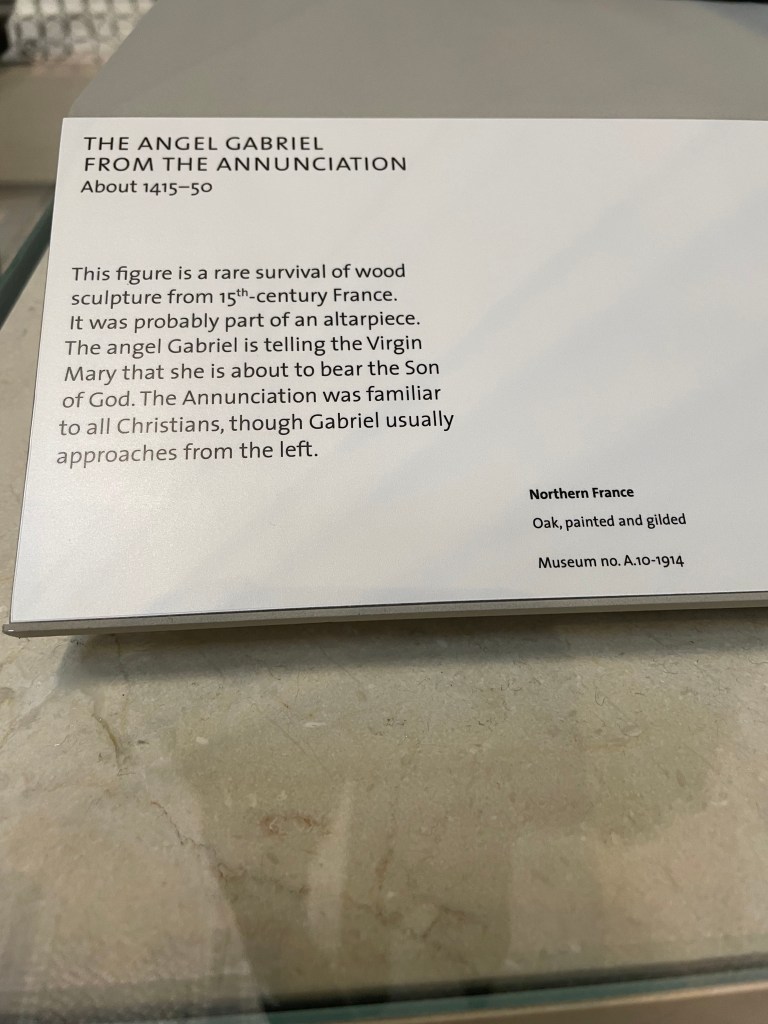
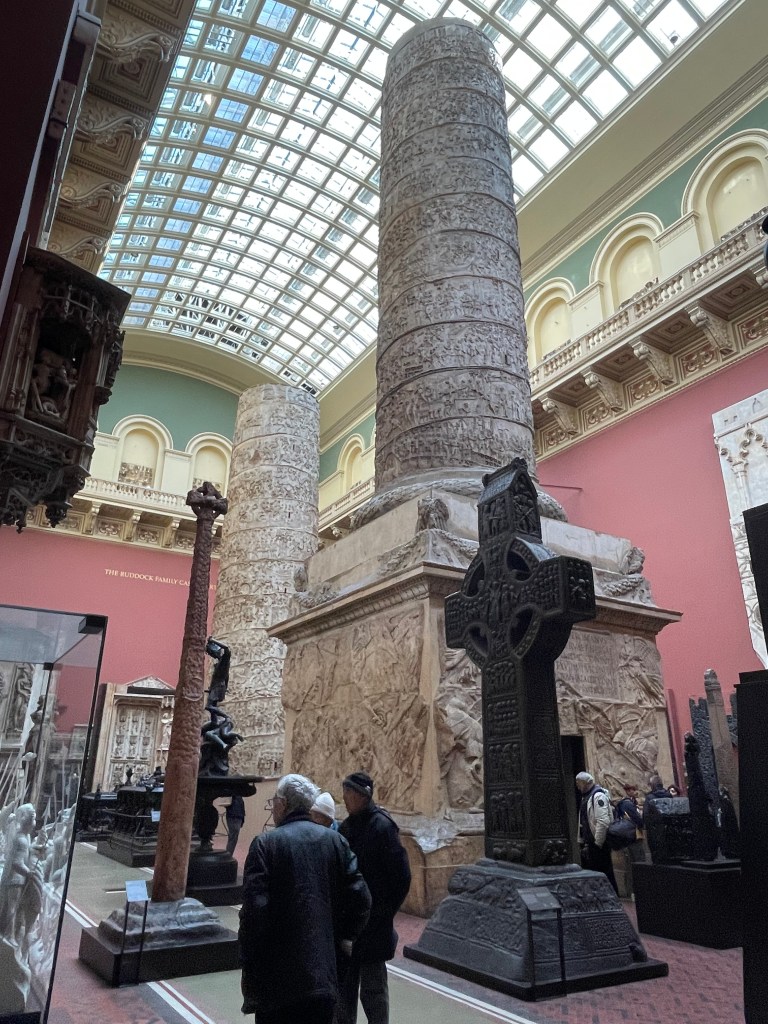
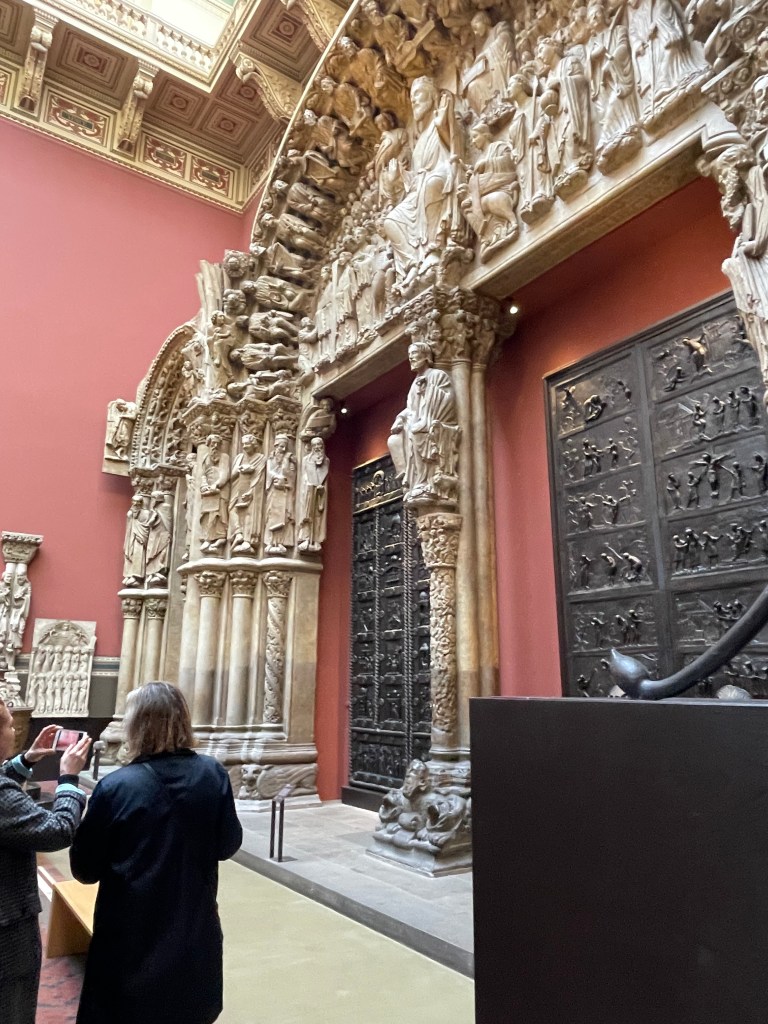
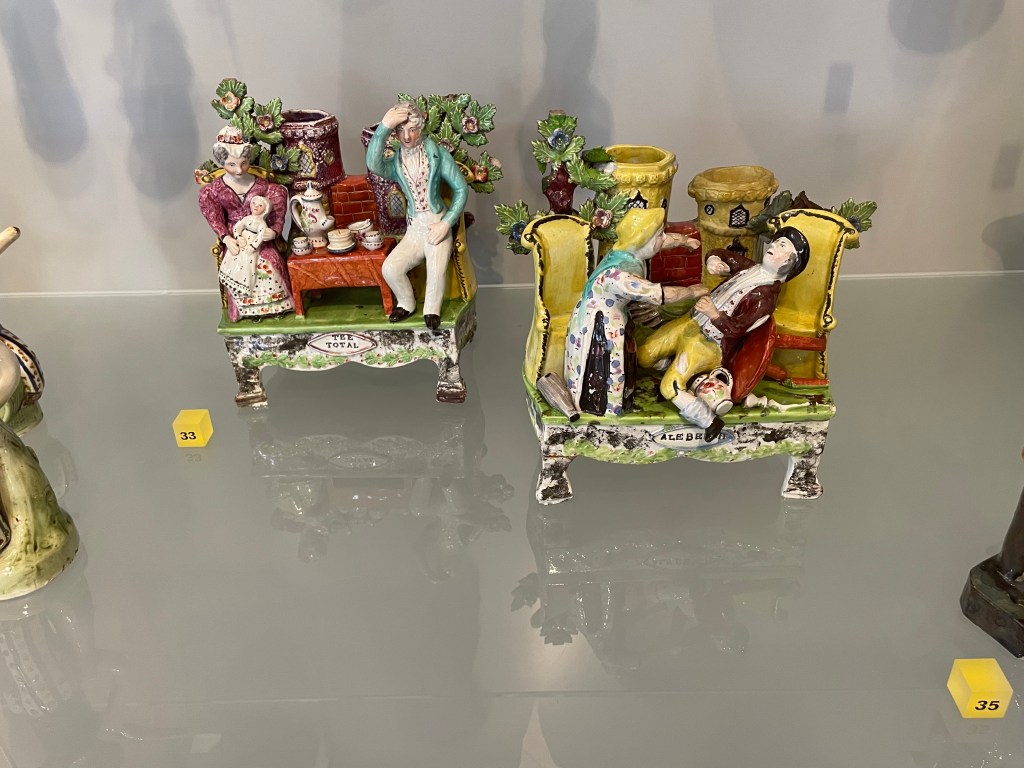
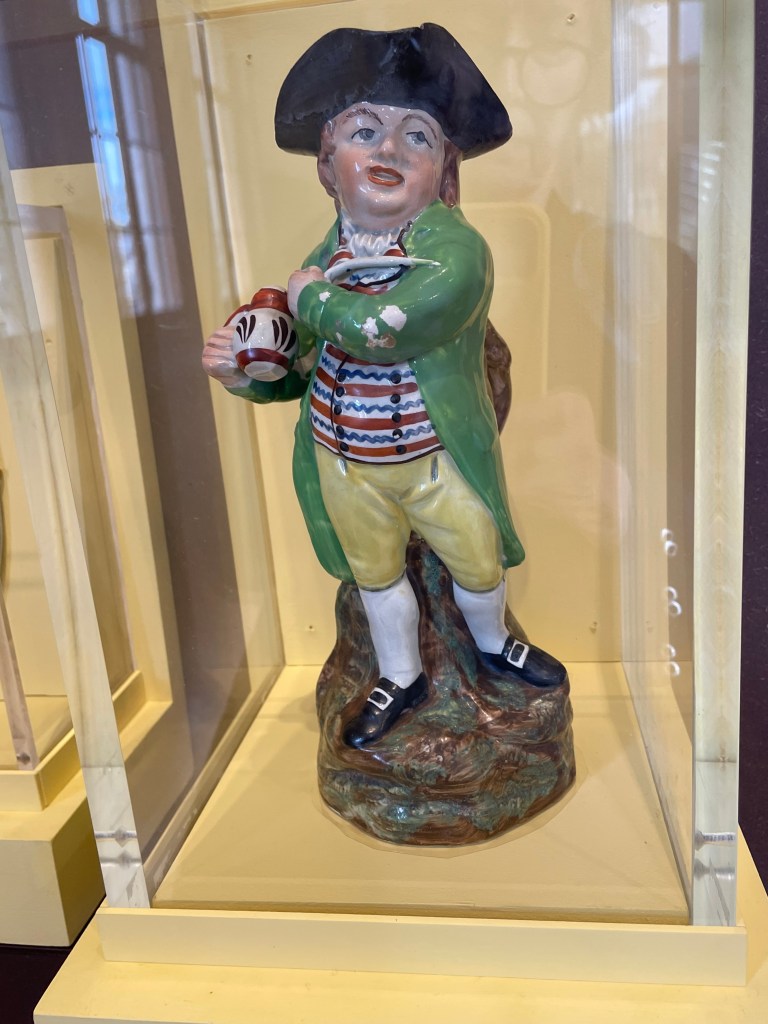
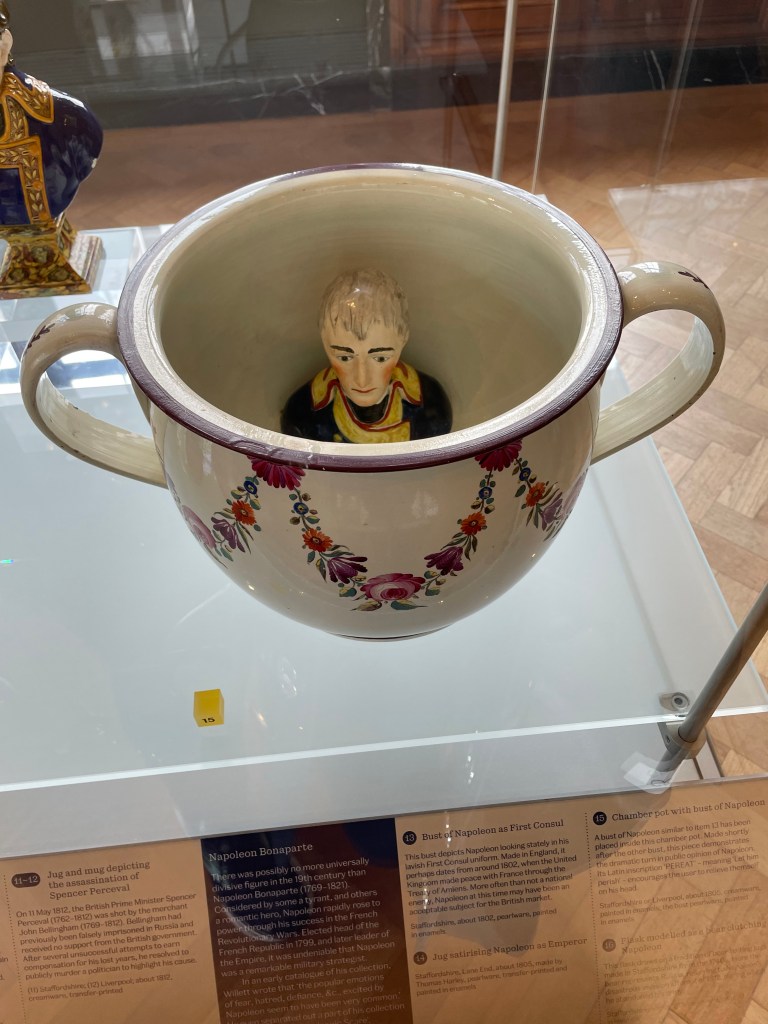
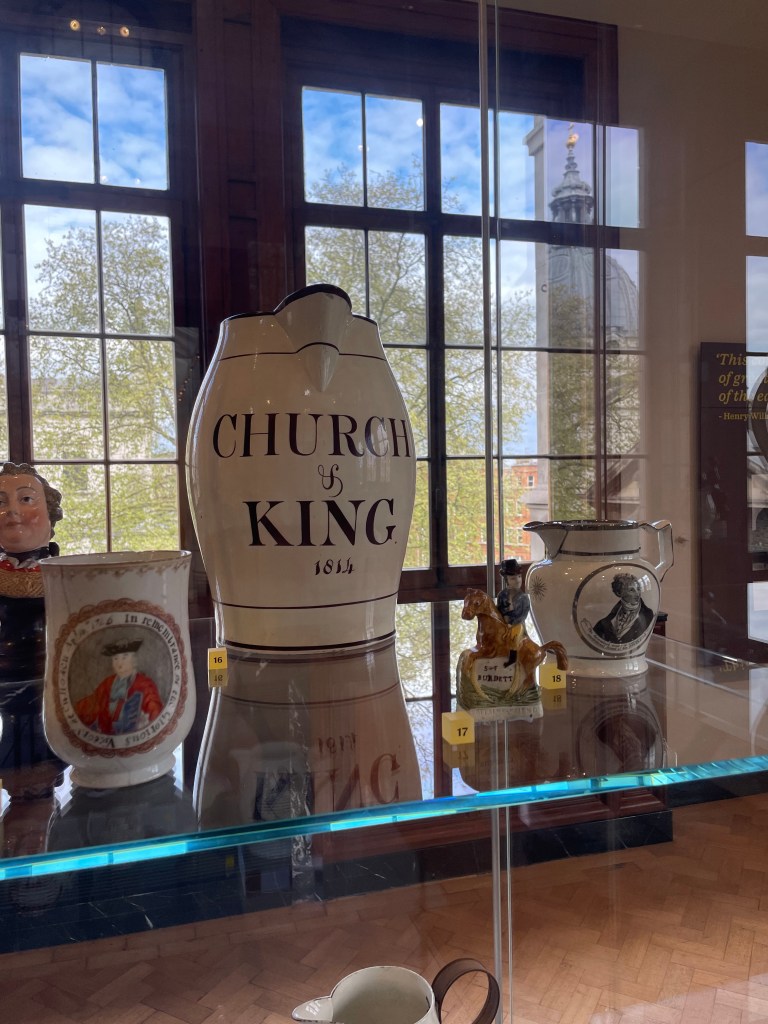
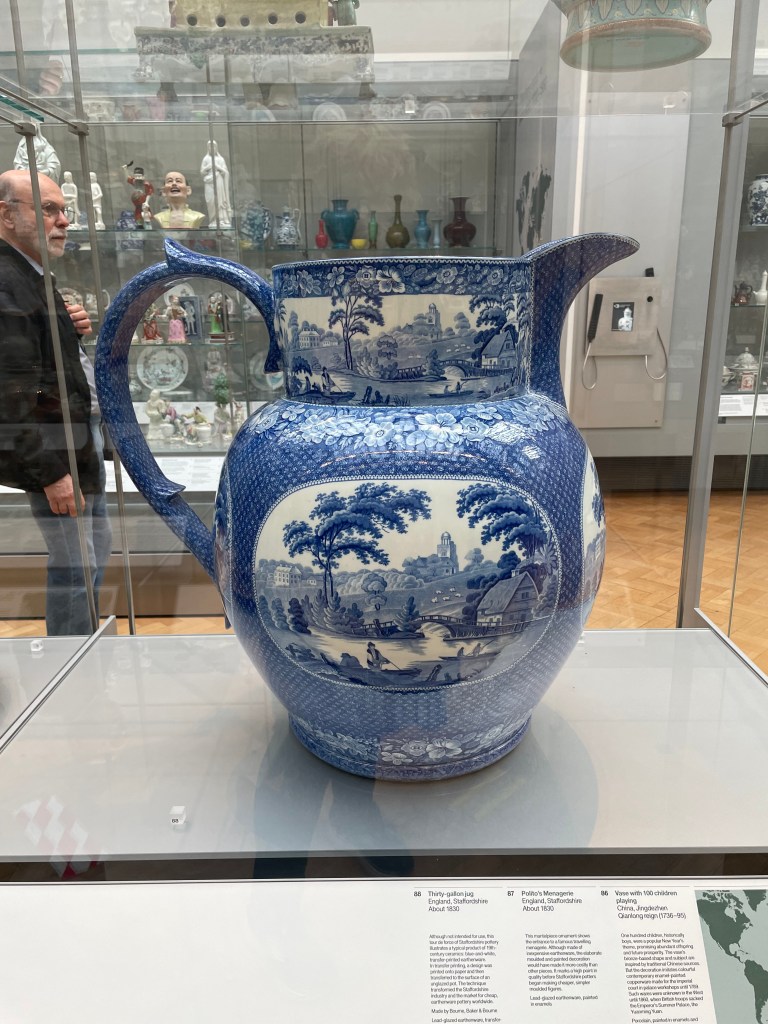
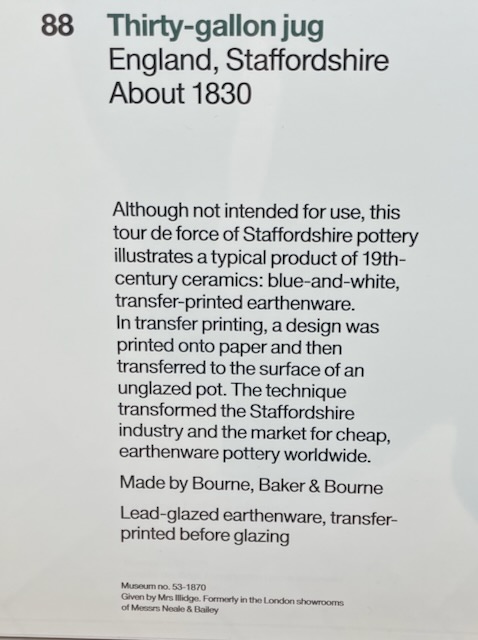
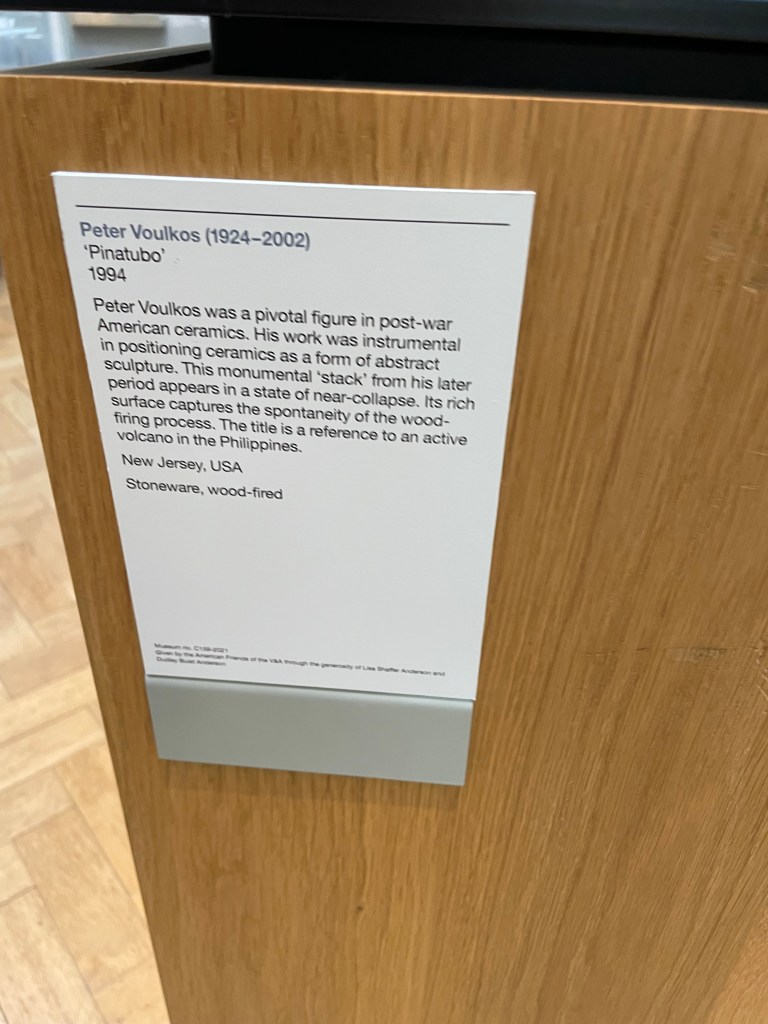
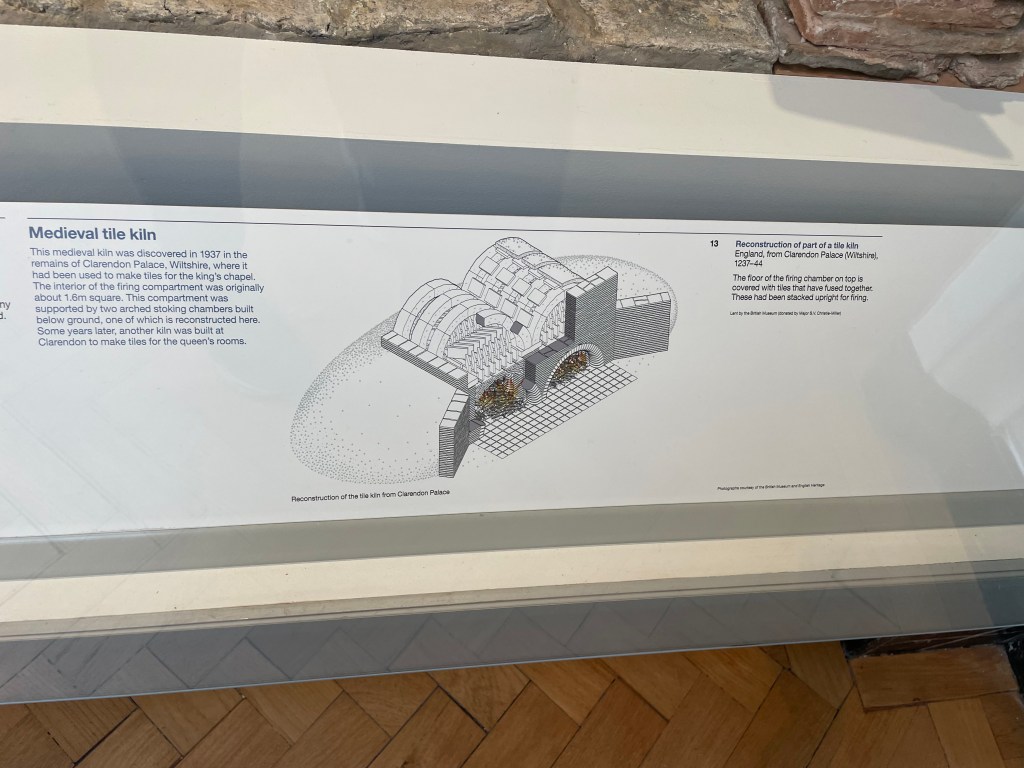
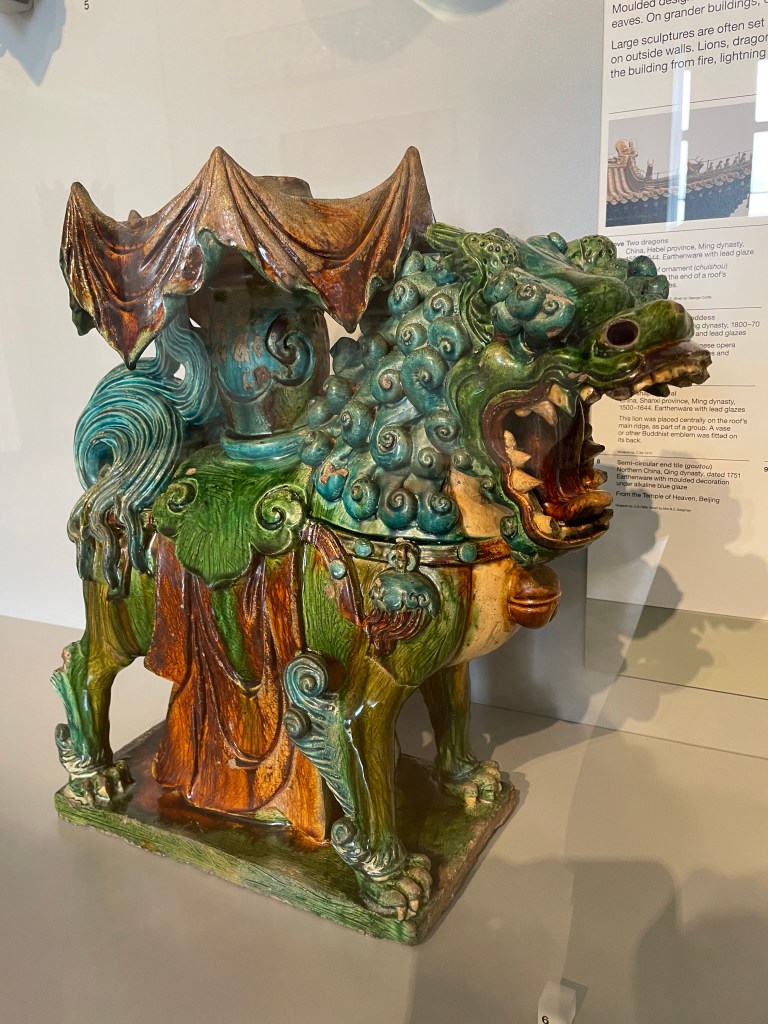
Our next stop was the Victoria and Albert Museum. I’d loved the V&A on my previous visit a couple of decades ago, and I’d seen a notice about a temporary ceramics exhibition that interested me. It was on the fourth level of the Museum, and on our way to and from it we had an opportunity to check out several other works that delighted and amazed us. Here are just a few of them.

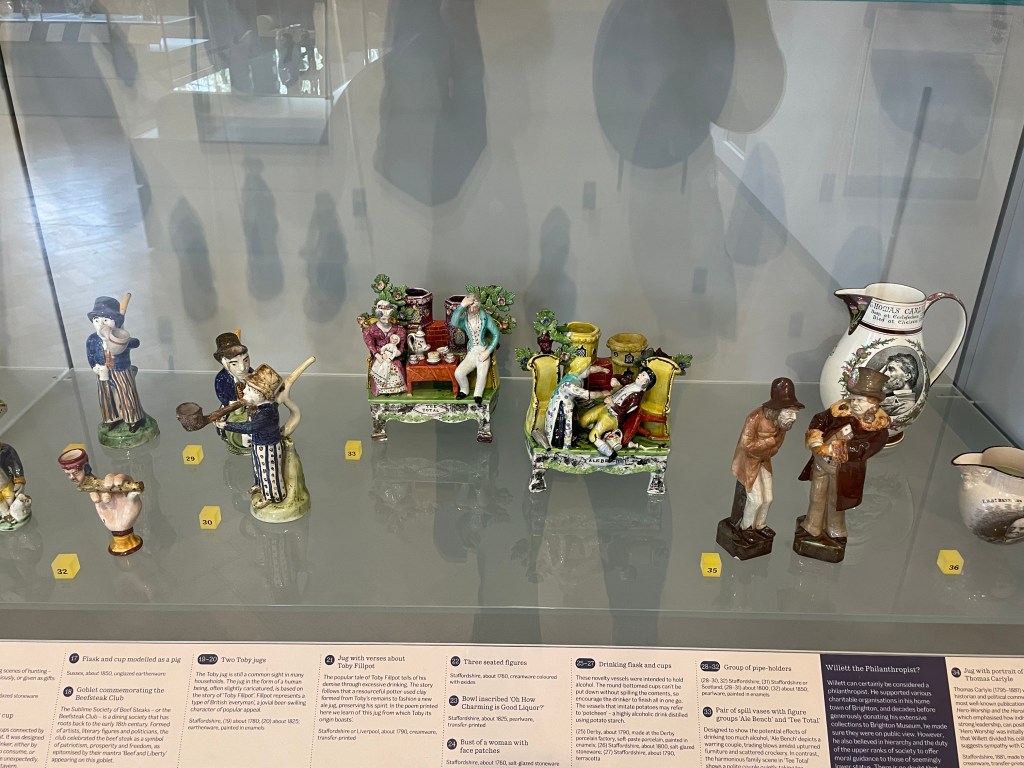
The ceramics show I wanted to see was entitled “Henry Willett’s Collection of Popular Pottery.” (How could a person resist that appealing title?) I am including the explanatory sign about the exhibition, which was as charming as it sounded. It included dozens of intriguing pieces that Willett had collected from “cottage homes” around England in the late 1800s.

There are a whole lot of other interesting pieces in the Museum’s permanent ceramics collections. In fact, according to the V&A website, “The V&A’s Ceramics collections are unrivalled anywhere in the world. Encyclopaedic and global in scope, they encompass the history of fine ceramic production from about 2500 BC to the present day.” If only we’d had a week, just for this one museum… or even perhaps just for this one set of collections in this one museum.

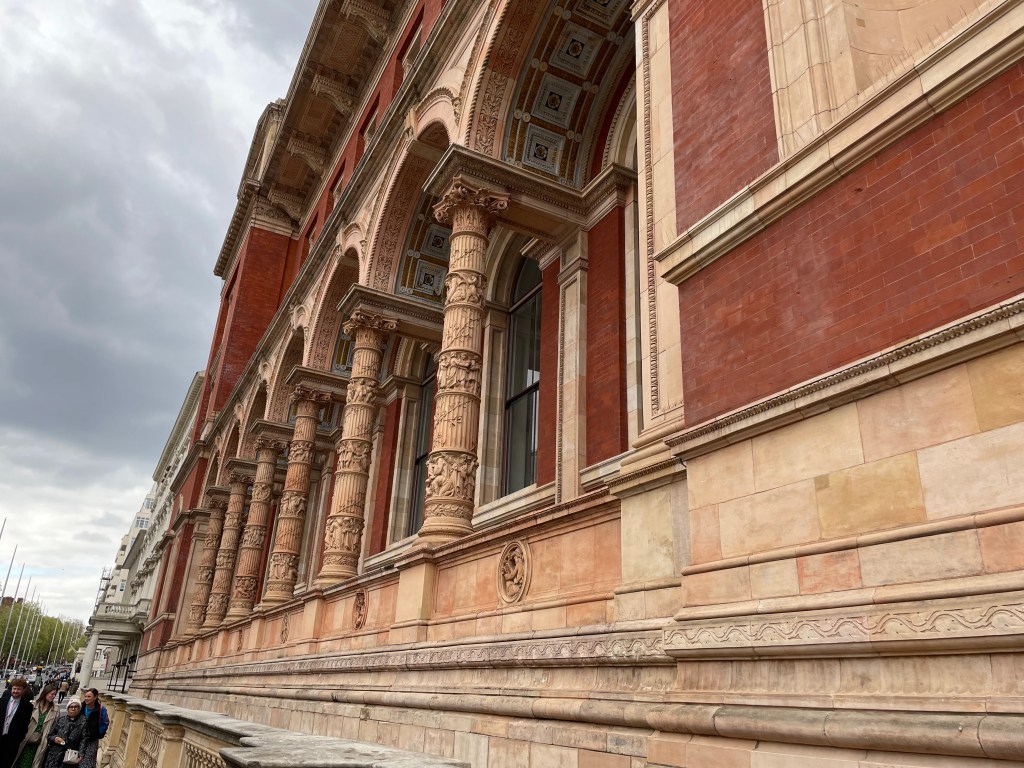
The view from the top floor of the V&A was lovely, as was the architecture in the streets surrounding the museum.

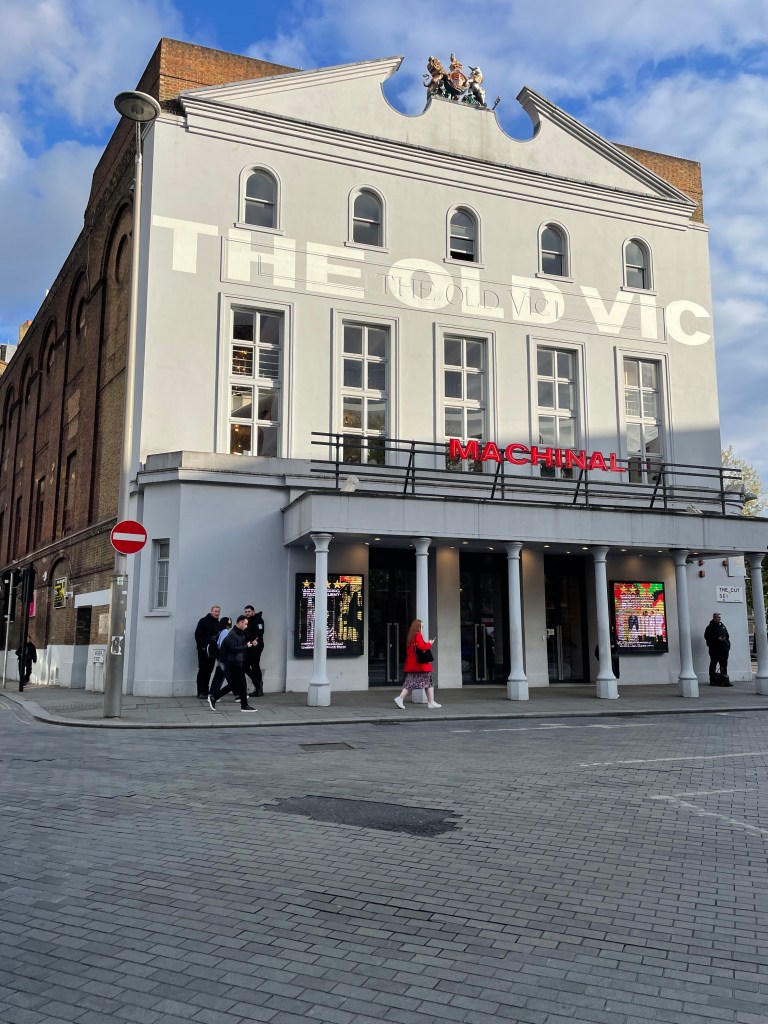
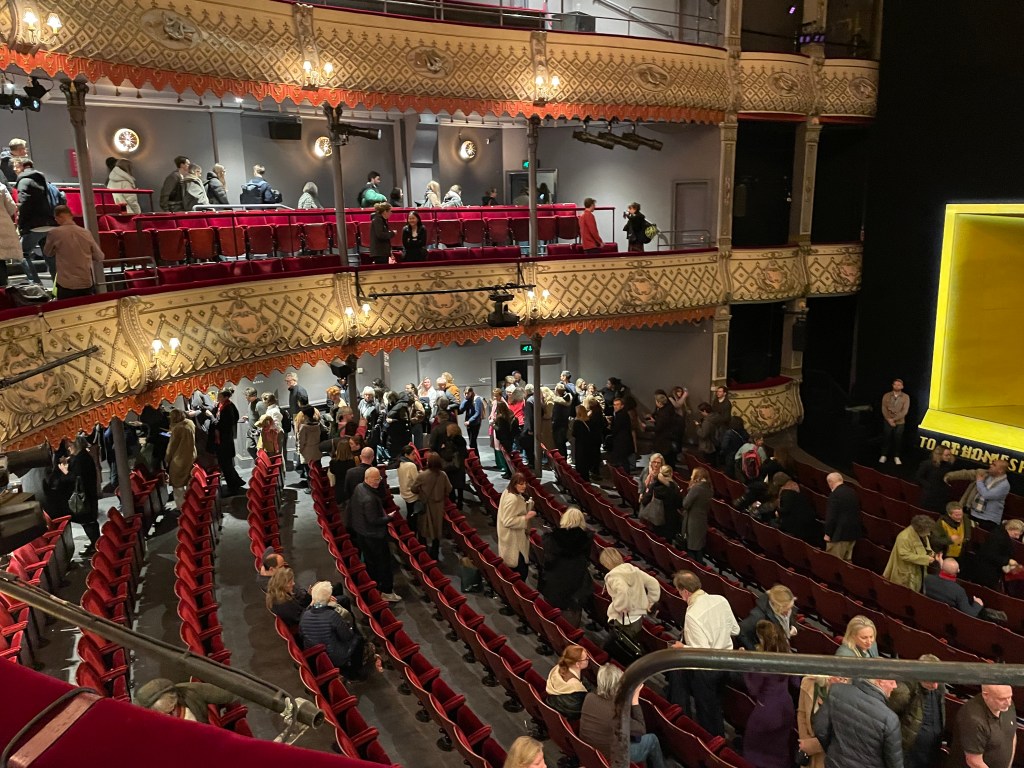
We made our way from the Victoria and Albert just in time to have a delicious sourdough-crust pizza at one of outlets in the excellent Franco Manca pizzeria chain, before taking in a really impressive play entitled Machinal at The Old Vic Theatre. It was a thrill to be in a theatre that I have read about so often in books, articles and reviews over the years. The quality of the production was a (not-unexpected) bonus: how could it be anything but excellent if it was at The Old Vic? (No need to answer this question if you attend the place regularly.) Machinal has a lyrical, devastating script, and the cast was outstanding. I was also taken with the totally offbeat stage design. If the play ever comes to Toronto, or appears in a broadcast somewhere accessible to me, I’m definitely going to see it again.

The Times Literary Supplement said of Machinal, “The Old Vic’s production, transferred from the Ustinov Studio at the Theatre Royal Bath, is an almost perfect piece of total theatre: Richard Jones’s direction, Hyemi Shin’s set, Adam Silverman’s lighting and Benjamin Grant’s phenomenal sound design all work together with Sophie Treadwell’s words and a fully committed cast….”

So that was quite a day. While we were gadding about (or in my case, limping about), according to my watch we added 18,250 steps to our walking total, and 11 flights of stairs.

London, etc. and Paris 1: Intro/Arrival

[Note: In the past I have tried to write my travel blogs as I’ve been travelling. This has always been difficult because it takes time to write down what you want to say in the way you want to say it, and sometimes there just isn’t the time or energy to do that in addition to the enjoying the trip. I usually ended up finishing the series of posts after I got home to Canada. This time I decided to write the entire blog after the trip was over. Here is the first instalment of what will eventually be… quite a few. Facebook friends will have seen some of these photos and a few of my thoughts on our trip already, as I couldn’t completely resist the urge to share while we were away.]

We departed from Toronto for London, England at 8:30 p.m. on Sunday, April 21 and arrived without incident (!) at about 9 a.m. on Monday April 22. Of course in our heads, it was still late on the 21st so we took it fairly easy the first day, having a nap after we’d checked in, and then wandering about our new neighbourhood to get our bearings.

Our hotel was in one of dozens of boutique hotels and apart/hotels that have been made out of what appear to have previously been adjoining apartment buildings on a street called Sussex Gardens, about five blocks from Paddington Railway Station and the Paddington Underground Praed Street Station. I would stay in that area again anytime: there are many many excellent and reasonable restaurants with a wide range of ethnic (and veg-non-veg) options in the area, the people are friendly and helpful (used to dealing with tourists), there’s a laundromat, a grocer, and convenience stores nearby and the Underground links the neighbourhood to anywhere in London you want to go, promptly and efficiently.

The hotel room was reasonable because it was small, which might make it tricky if you had children with you, or had to spend any significant time in the room, but it was fine for a couple that was mainly using it to sleep and shower between adventures. The staff of the Orchard Hotel was friendly and helpful but the establishment offered the worst breakfast buffet we’ve encountered anywhere in the world: no fresh fruit or juice at all, and no fresh coffee (instead serving instant made in advance in large pots). No hot food either, just cheese and bread and sliced meats and boiled eggs. But considering the price of the hotel comparatively speaking, the fact that we ate such wonderful food the rest of the day, and our awareness (constantly sharpened by the sight of tents and destitute humans throughout the city) that lots of people don’t even have as much as we did for breakfast, we survived just fine.

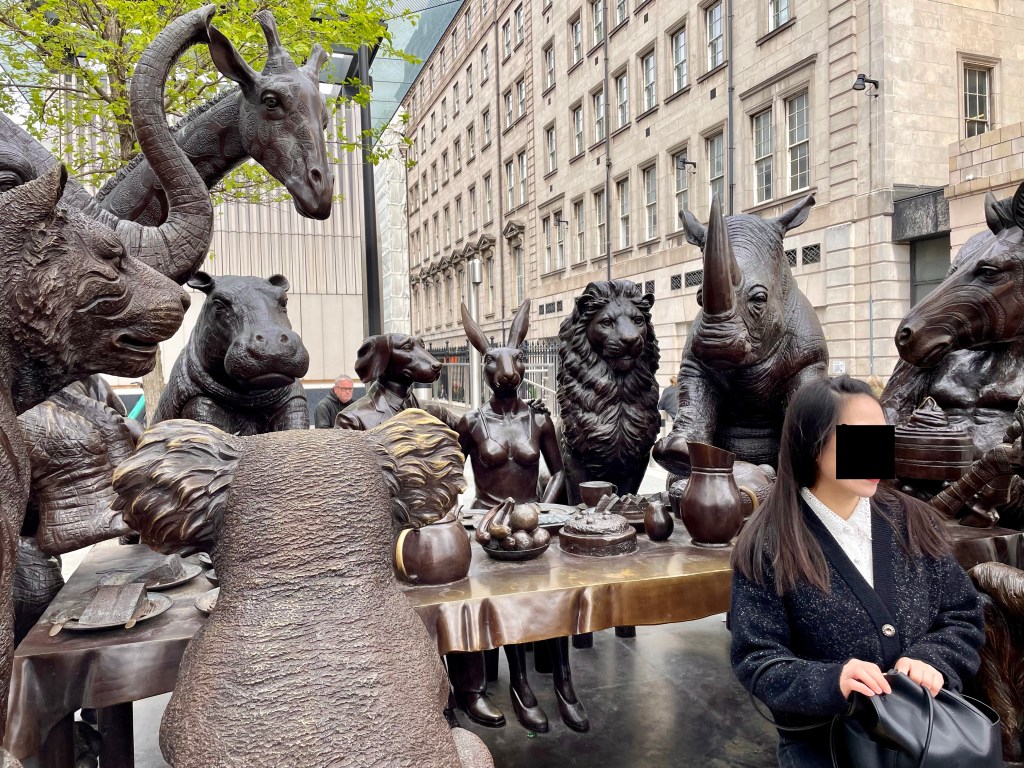
In Paddington, I was intrigued by the street art. In one (apparently temporary) installation that dominates the square outside the railway station, a very large group of twelve brass animals dine together – with a couple of seats left open in case you’d like to join them. According to Londonist, this is the work of Gilli and Marc and is entitled “Wild Table of Love.”

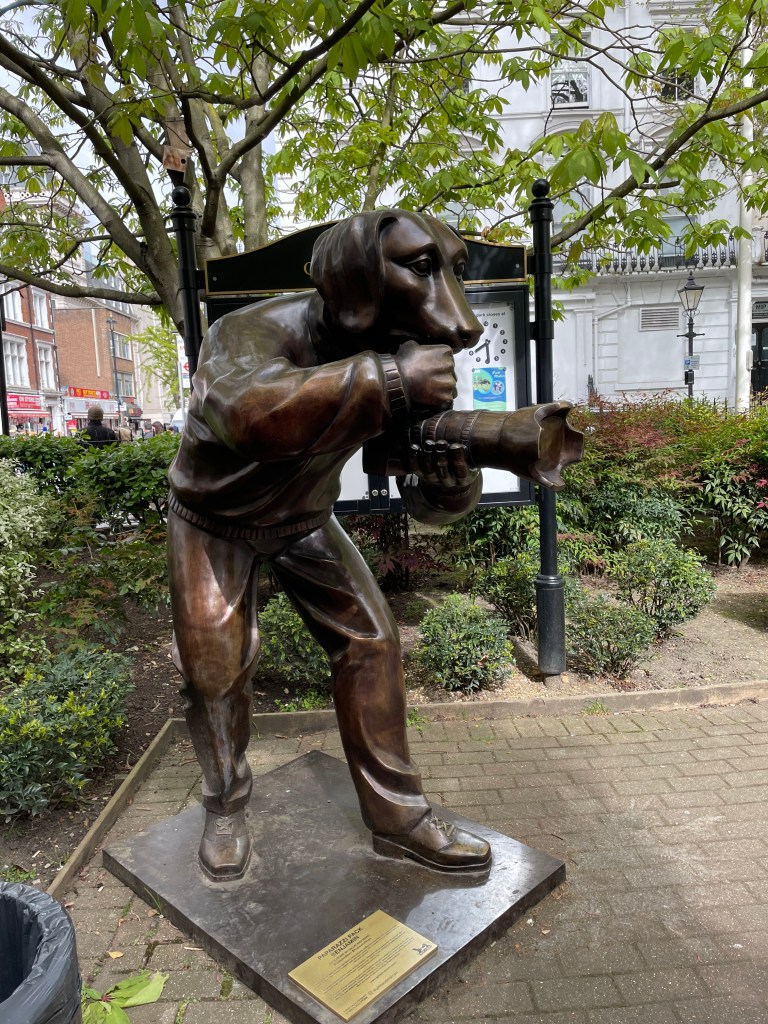
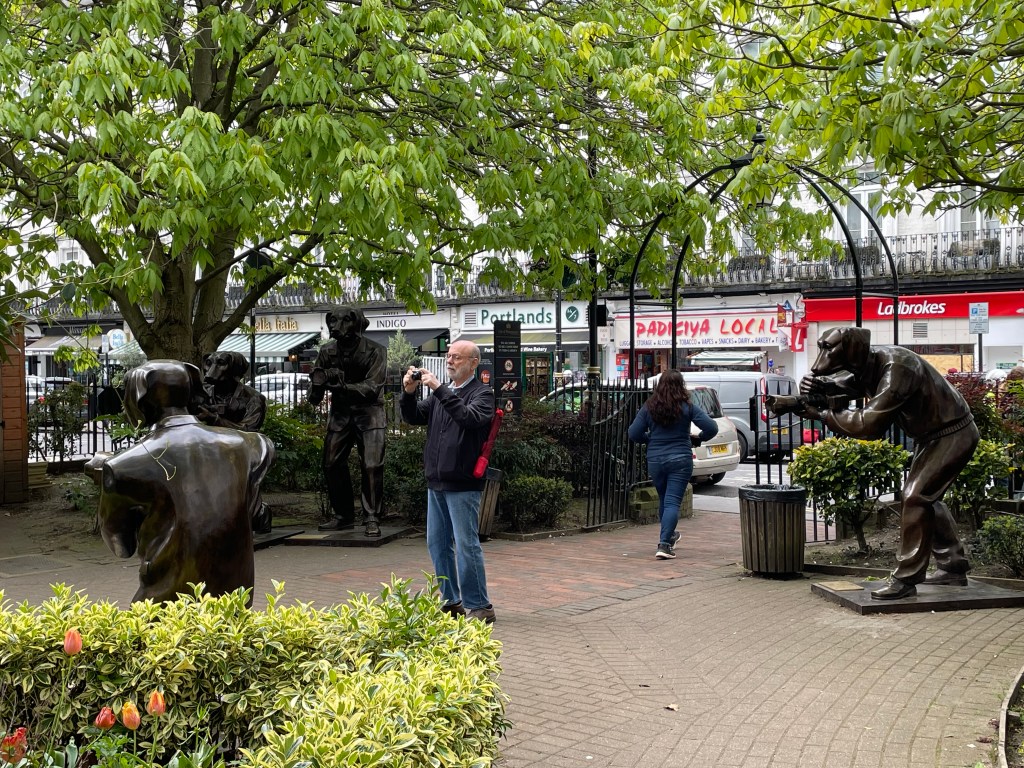
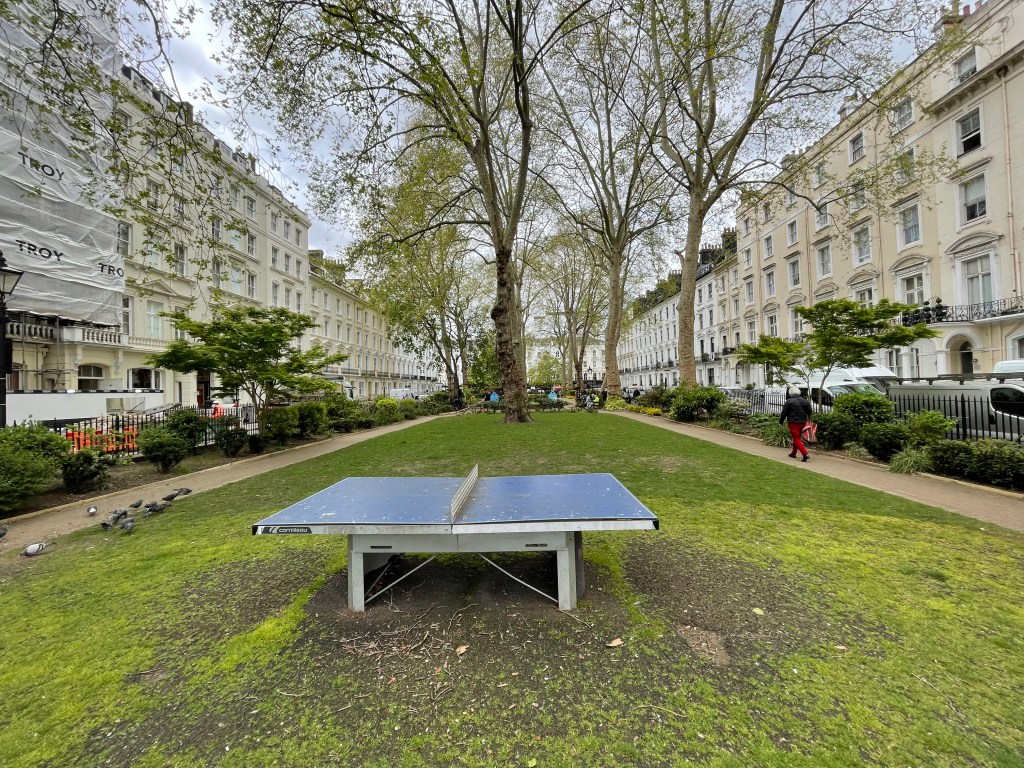
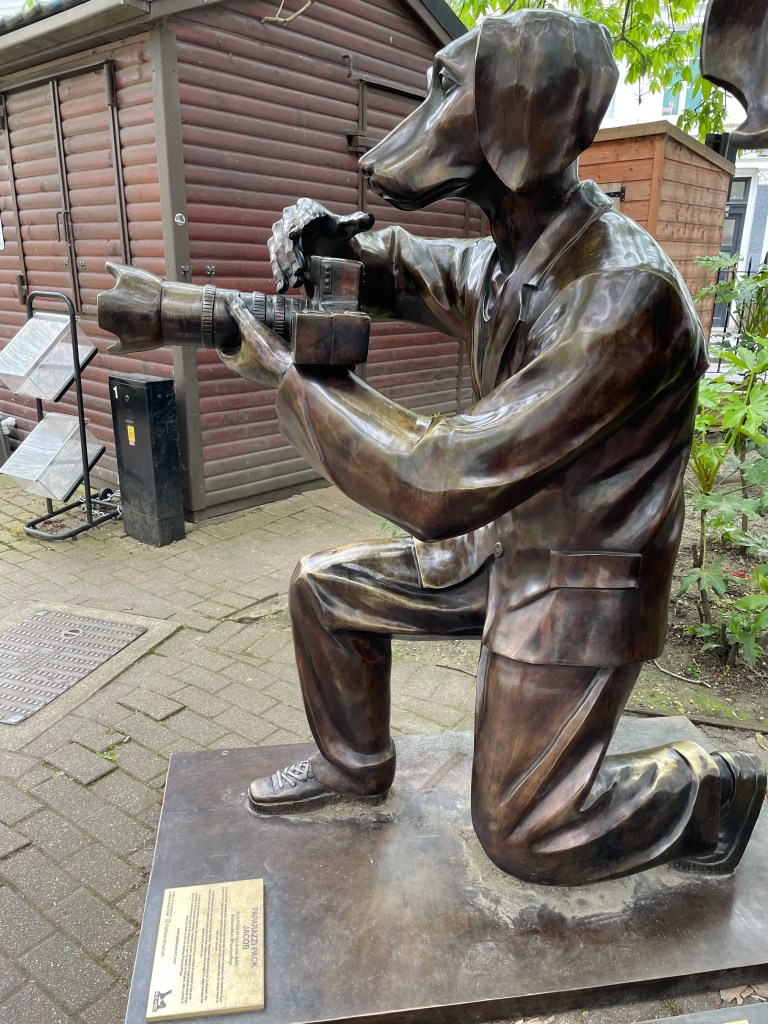
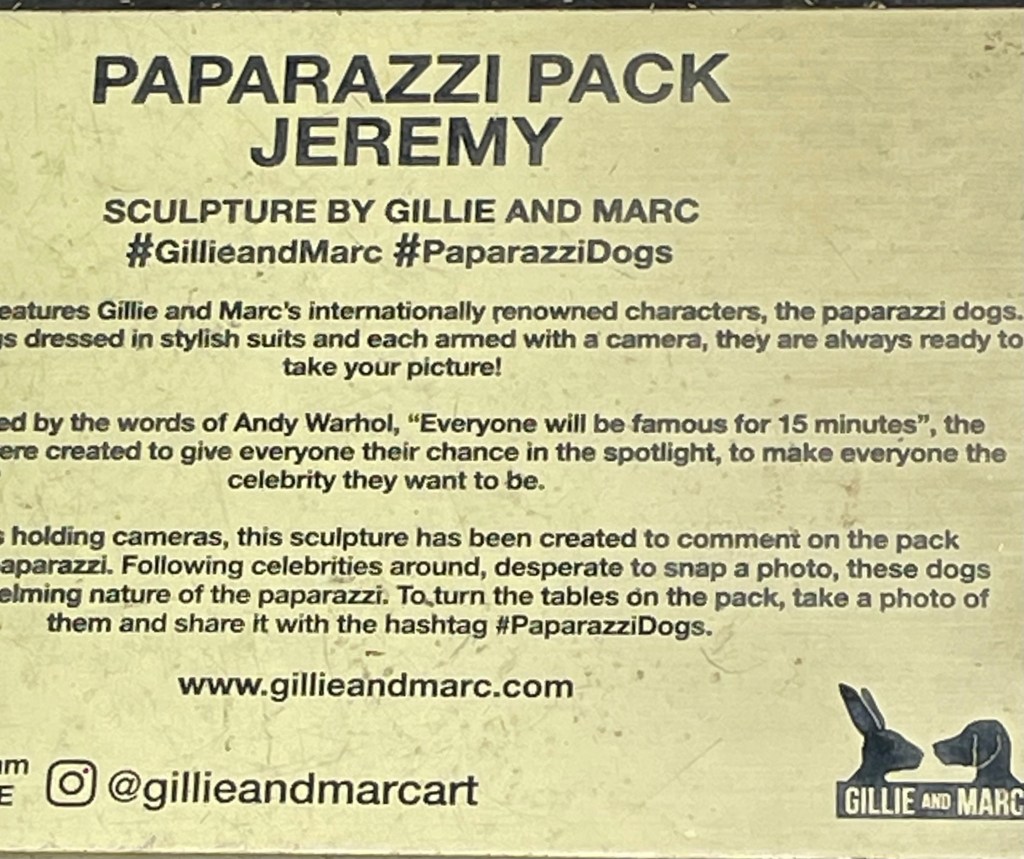
A bit closer to our hotel, in a long cozy park with a ping-pong table, we found another instalment by Gilli and Marc of brass animal sculptures – dogs this time – entitled Paparazzi Pack.

And then near the end of our stay in Paddington I noticed for the first time an animated (but accurate) clock that appears to have a person inside it, cleaning and repairing it and peering out at passersby. It was great fun to watch.

Having sussed out our immediate “home” surroundings for the next ten days and secured SIM cards for our phones (primarily so we could communicate with one another when we got separated, as we inevitably do), we had a solid sleep and were ready to really begin our adventure on Tuesday morning.