Travel Date: Thursday, April 25, 2024
Did you know that England’s Thames is a “tidal river”? I did not, until I noticed that the water levels along the banks were much lower when we set out on our “sightseeing cruise” of London on the morning of April 25 than they were when we returned several hours later. So I started asking questions.
In summary, I learned that “Twice a day the Thames undergoes an incredible transformation – from a slow-moving river to a brimming marine environment as the North Sea floods inland. This remarkable event – governed by the moon – changes river height by up to 7m in just six hours. This 95-mile stretch from Teddington to Southend influenced by the ocean tides is the tidal Thames. As the sea water recedes it reveals a vast and beautiful riverbed that makes up London’s largest natural space.” – Thames21
Once I knew about the tides, all those scenes in movies and books where people (mostly murderous hooligans or poor innocents who are being chased by murderous hooligans, along with an occasional Royal Personage) descend ladders and stairs into the water or boats onto the Thames took on a whole new aspect.


When a major city has a river running through it, we have found guided boat trips to be a great way to orient ourselves and to see notable sights we’d never have time to cover any other way. Our voyage through London from near Westminster Pier to the Borough of Greenwich, about seven or eight miles upstream, took just under an hour. It was a chilly morning, but at least it wasn’t raining so we were able to sit on the upper deck outside.




Along with dozens of other people (including at least one “Influencer” who stood up in front of us to pose every time we passed something interesting. More on Influencers in a later post), we took in the sights along with a dry commentary by a young fellow who seemed to be steering our boat as well as serving as our tour guide. (He kept telling those in the centre aisle on top to please sit down because he couldn’t see where he was going.) He groused about the proliferation of “Uber” river taxis that kept zooming by us, and seemed unimpressed with the more expensive tourist options in the vicinity. He told us, for example, that it was easy to get a ticket on the Millennium Wheel: “There are never any lineups because it’s so expensive.” Pointing out the Savoy Hotel, he advised us that “A room is £500 a night, but you do get coffee and a croissant.”
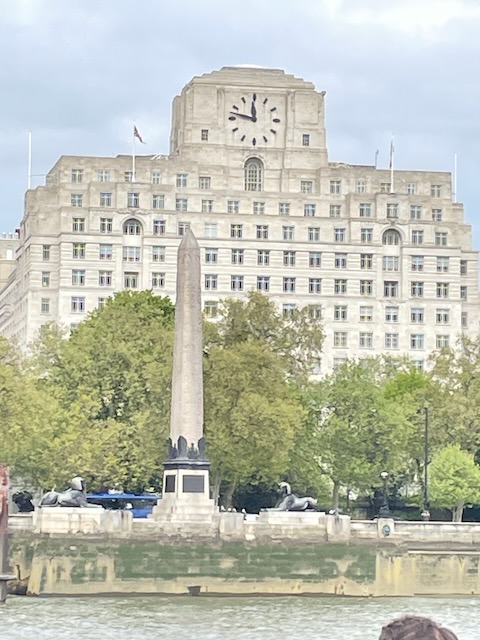
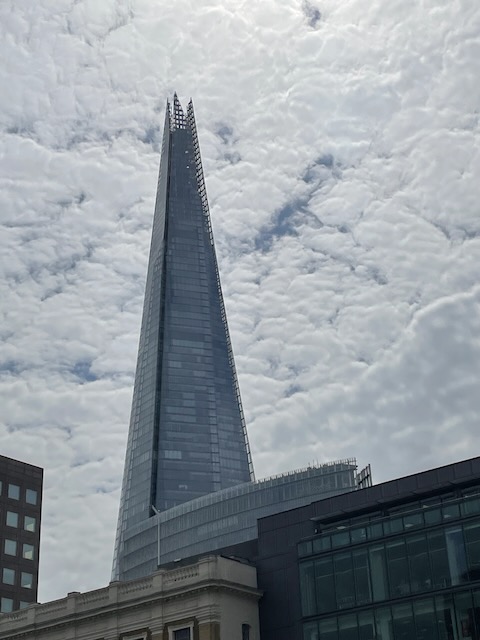
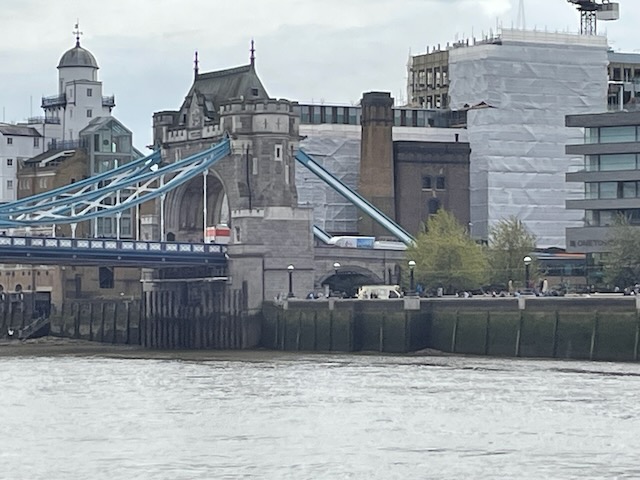
Our trip took us under the Charing Cross (Hungerford) Rail Bridge and past London’s Cleopatra’s Needle (a gift to the UK from Egypt in the early 1800s, the obelisk is 3500 years old! It’s one of a pair; my elder son and I once saw the other one, which is located near the Metropolitan Museum of Art in New York City). We saw the Waterloo Bridge, the rebuilding of which was allegedly completed in record time and within budget primarily by women during World War II, the Tower of London and the Tower Bridge, the National Theatre (“The ugliest building in London,” we were told), the Shard (“Where it’s £40 for a look outside”) and St. Paul’s Cathedral, to which architect Christopher Wren went to work by boat so often (almost daily for about 35 years) that one of the stairways up from the river is named after him.




Greenwich
Greenwich is a lovely spot. After disembarking, we had a very tasty lunch then wandered past the University of Greenwich, the Royal Military College and the National Maritime Museum to an enormous park area where – at the top of a very long hill – the Royal Observatory is located.


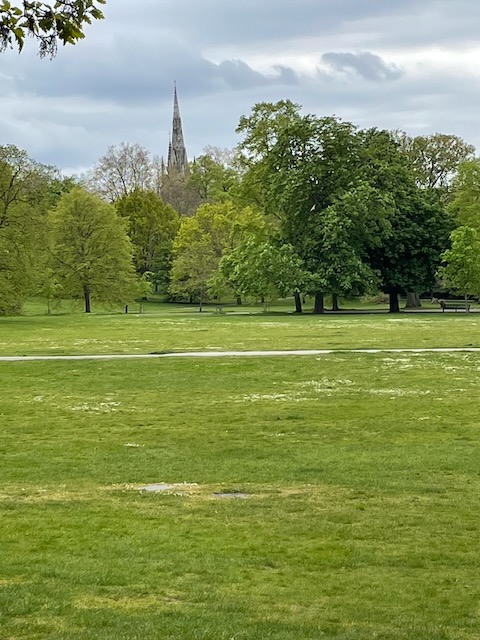
To get to the park where the observatory is located, we passed through the colonnaded walkway between the National Maritime Museum and the Queen’s House. The birdsong in the park on the way up was spectacular (according to my trusty Merlin app, among the birds we heard were a Eurasian Blue Tit, a Rose-Ringed Pheasant, and a Eurasian Wren), as was the flora. We even saw a fox.


The Royal Observatory was designed by architects Christopher Wren and Robert Hooke, and it opened in 1676. Most notably, it is the “home” of Greenwich Mean Time, about which there is much of interest to note (Thanks, as always, to Wikipedia, to which I donate regularly and hope you do as well):
Greenwich Mean Time (GMT) is the local mean time at the Royal Observatory in Greenwich, London, counted from midnight. At different times in the past, it has been calculated in different ways, including being calculated from noon;[1] as a consequence, it cannot be used to specify a particular time unless a context is given. The term GMT is also used as one of the names for the time zone UTC+00:00 and,[2] in UK law, is the basis for civil time in the United Kingdom.[3][a]
Because of Earth’s uneven angular velocity in its elliptical orbit and its axial tilt, noon (12:00:00) GMT is rarely the exact moment the Sun crosses the Greenwich Meridian[b] and reaches its highest point in the sky there. This event may occur up to 16 minutes before or after noon GMT, a discrepancy described by the equation of time. Noon GMT is the annual average (the arithmetic mean) moment of this event, which accounts for the word “mean” in “Greenwich Mean Time”.[c]

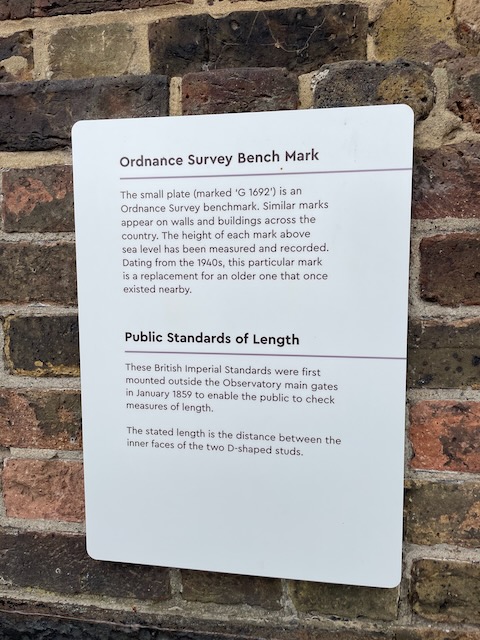


A prime meridian is an arbitrarily-chosen meridian in a geographic coordinate system at which longitude is defined to be 0°. Together, a prime meridian and its anti-meridian form a great circle. This great circle divides a spheroid, like Earth, into two hemispheres: the Eastern Hemisphere and the Western Hemisphere. For Earth’s prime meridian, various conventions have been used or advocated in different regions throughout history. Earth’s current international standard prime meridian is the IERS Reference Meridian. It is derived, but differs slightly, from the Greenwich Meridian, the previous standard.[2]
(Note: The IERS Reference Meridian is so close to the Greenwich Meridian that even though I’m not sure which one we were standing on, it is a difference that makes much more difference to an astronomer than a fiction writer.)
On our way back down, we did a tour of the Queen’s House, a former royal residence that now contains an art collection. We strolled past the Cutty Sark, which was one of the last and fastest clippers to sail the seas before the advent of steamships, but decided not to tour that: by then, we were more than ready to catch our return “cruise” back to central London.


 I'm All Write