Tag Archives: Trafalgar Tours

Spain 4: We visit Zaragoza, and “Hemingway’s” Pamplona

Some of the destinations on our Trafalgar Tour of Northern Spain seemed more incidental than essential. This was probably true in part because I was not there as a pilgrim, seeking out specific sacred sites. Zaragoza, for example, was just over half way between Barcelona and Pamplona – our ultimate destination for the day – so it was a natural place to pause for lunch and a stretch. But unlike Pamplona itself  – or San Sebastian, or Bilbao further down the road – I couldn’t imagine that too many people would put Zaragoza on a list entitled “Places I want to see in Spain.”

As it turned out, the lesser-known (to me) centres we visited on this tour offered a whole range of fascinating historical, cultural, geographical and even culinary marvels. From those experiences, plus information I’ve acquired about other parts of Spain before and since (e.g., the other day I read somewhere about the Aranjuez Palace near Madrid, which looks quite spectacular), I have come to understand that no matter where you go, you are probably going to find some really interesting stuff to look at. Rather than making me want to get back on the bus so we could move on to the next notable destination, such places just made me wish we had about a year to poke around to see the stuff in Spain that isn’t in the tourist books as well as the stuff that is.

Zaragoza is about three hours from Barcelona, and about two hours from Pamplona. While recognizing that the very definition of “tour” involves the process of getting from one place to another, some people in our group did not enjoy the long travel days on our agenda. (Happily for one woman who was prone to travel sickness, these were relatively few in number.) I don’t mind spending most of a day on a bus or train: I fill such extended travel time quite contentedly by listening to a book while watching the countryside go by, and occasionally trying to photograph what I see (not always easy through a bus window. The reflection from the window itself often becomes an issue).

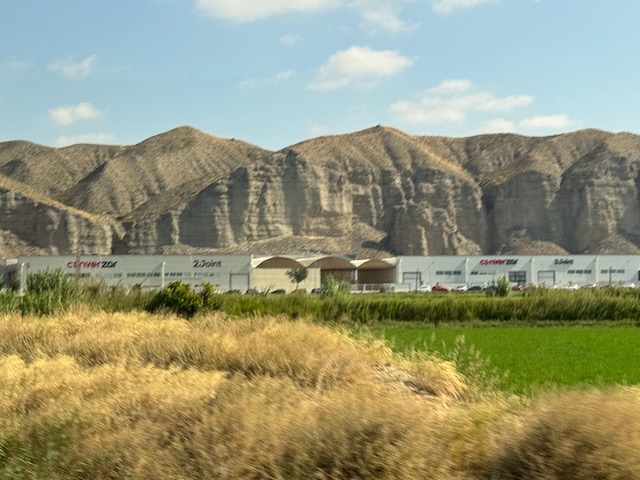
This is some of the countryside we saw as we drove from Barcelona to Pamplona.

Zaragoza is the capital of the autonomous community of Aragon (Spain has 17 autonomous communities as well as two autonomous cities), and is also the capital of Zaragoza, one of three provinces in Aragon. As of 2024, the city’s population was about 680,00 people, which makes it the fourth most populous city in Spain. So while it may not be as famous as Barcelona or Madrid, it’s not exactly a whistle stop.

The city was founded more than 2000 years ago. Among its landmarks, it is known for: its Roman foundations; the Aljaferi Palace, a unique example of Islamic architecture that was built in the 11th century and is still in use as a government building; its Aragonese food and nightlife; and (especially) for the colossal Basilica del Pilar, a baroque cathedral with multiple domes and a shrine to the Virgin Mary. Thousands of pilgrims do make this a destination every year.

We did not see the Roman ruins or the palace, but during our visit we had time to wander some of the streets of Zaragoza, enjoy a delicious lunch at a kebab-felafel restaurant, and see the interior of the basilica.

In each town or city we visited, a “local specialist” took over the microphone from our travel director, Celia, and in almost every case these people were excellent resources – interesting, patient, and deeply steeped in knowledge about their particular regions. This is one of the initiatives Trafalgar has instituted (as, I am sure, have most reputable tour companies) to funnel some of the money paid by travellers into local communities. Other such practices include patronizing local restaurants and businesses, and making time at most stops for groups to visit local shops.

The specialist who guided us around Pamplona told us that the city’s residents credit Ernest Hemingway with putting Pamplona on the map. Indeed, I expect that I first heard of Pamplona when I read The Sun Also Rises in university. (I’ve just finished listening to it again on Audible, read by William Hurt. Hurt has the dry, uninterested voice that is perfect for Hemingway’s prose. I’d forgotten most of the plot, and I’d also forgotten that Hemingway was a racist antisemite, among his other flaws. Which is too bad because his evocations of Pamplona, San Sebastian, Biarritz and other places we visited, not to mention his tormented characters, are masterfully done, but I doubt most self-respecting readers want to put up with his debased and ugly biases any more.) Everywhere you look in Pamplona, the memory of Hemingway is interwoven with the story of the city.

When his book was published to great acclaim in 1926, Hemingway brought the literary world’s attention not only to Pamplona, but also of course to its bullfights and to the annual encierro de toros (better known in English as “the running of the bulls”). Largely thanks to him, every year thousands upon thousands of tourists come to the city during the Feast of Saint Fermin (July 7 to 14) to watch the spectacle unfold – and often even to participate. The fiesta is an important contributor to Pamplona’s economy.

Each morning during the fiesta, at least six bulls and six steers are sent running along a short route through the streets of Pamplona to the bullfighting arena. There, the bulls are penned up until it is their turn to “participate” in the bullfighting event that takes place later in the day. Every year, thousands of tourists and locals try to outrun the bulls during the encierro. Since the bulls are running at 25 k per hour (about 15 mph), staying ahead of them is no mean feat, and those foolish enough to actually allow themselves to be chased typically run out of oomph and make their escape from the fenced-off running corridor after only a few metres.

Our group was invited to guess how many of the two to four thousand people who have attempted to run with the bulls each day since Hemingway made the activity famous in the 1920s have been killed. Guesses were mostly more than a hundred. Turns out the number is 12. Their names are carved on the base of the “Monumento al Encierro,” a statue by Rafael Huerta that depicts the annual event. Many more than 12 have, of course, been injured, many seriously.

El encierro de toros has been part of the local culture for hundreds of years, and evolved (as did the spectacle of bullfighting) from the annual herding of the bulls to market through the city’s streets. Our local specialist suggested that the custom came about when some bright bull breeder realized that it was cheaper and easier to get the beef to market on foot rather than by trying to transport the huge animals on wagons.

At the end of the encierro, the steers (who are used like pilot boats; they are veterans of previous corrida and know their way through the city to the bull ring) are sent back home, and the bulls are corralled in stalls in the bullfighting arena. Later in the day, they are confronted in a battle to the death by matadors and their attendant picadoresrejoneadores, and banderilleros, the latter three groups being lesser participants in the bullfight who help to wear the animal out in preparation for the kill.

Bullfighting occurs not only in Spain and Portugal (as it has in one form or another since prehistoric times), but also in Mexico and several South American countries. If you are interested in learning more about the actual bullfight, there are plenty of resources available, such as this write-up on Wikipedia, but I don’t want to read them or see any videos that may be available, so you are on your own. Thanks in part to the work of a number of animal welfare activist groups, bullfighting is now banned in several regions of Spain, Mexico and South America, and attendance at such events grows smaller every year so maybe one day they will be only another unwelcome historic memory.
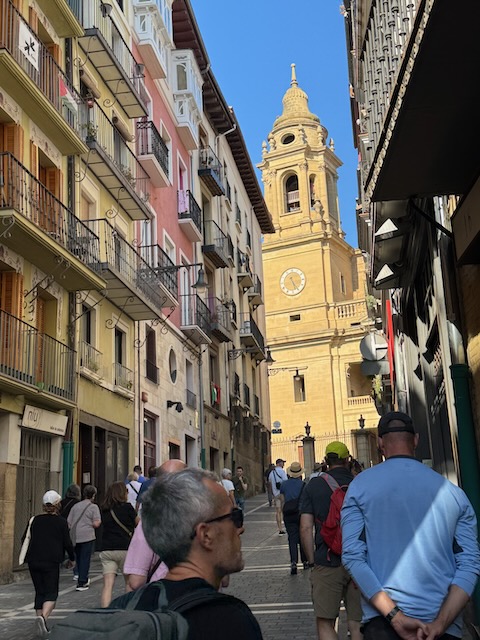
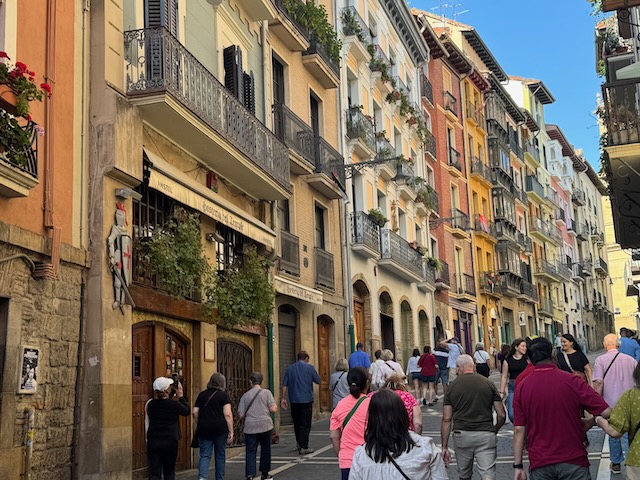
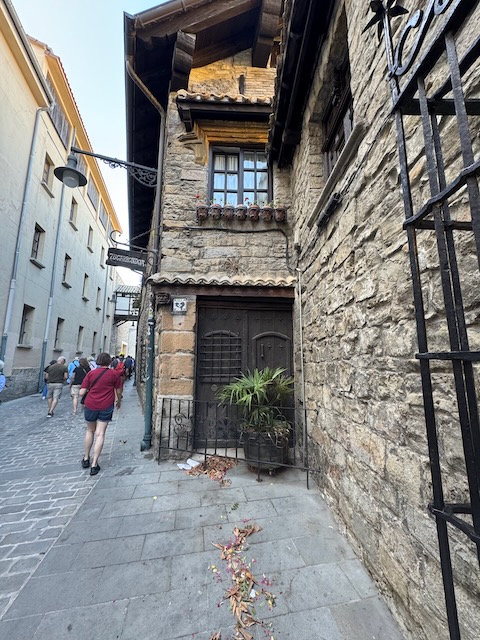
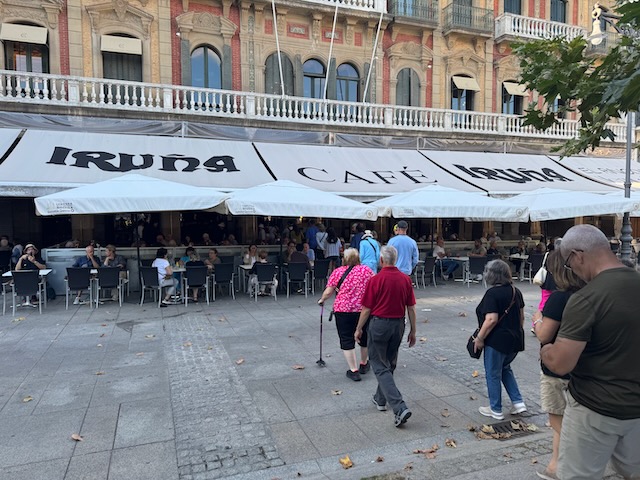
Pamplona is a lovely city (and again, so clean!). With our guide, we wandered the famous streets, and saw La Ciudadela (a Renaissance military fort built in the 16th and 17th centuries, which is now a park). Then we settled into the Iriba, the café and watering hole that features largely in Hemingway’s novel The Sun Also Rises. The cafe has been preserved very much the way Hemingway would have known it. There we were treated to a drink (appropriate since Hemingway was a notorious drunk. I had lemonade) and an assortment of tasty tapas.  

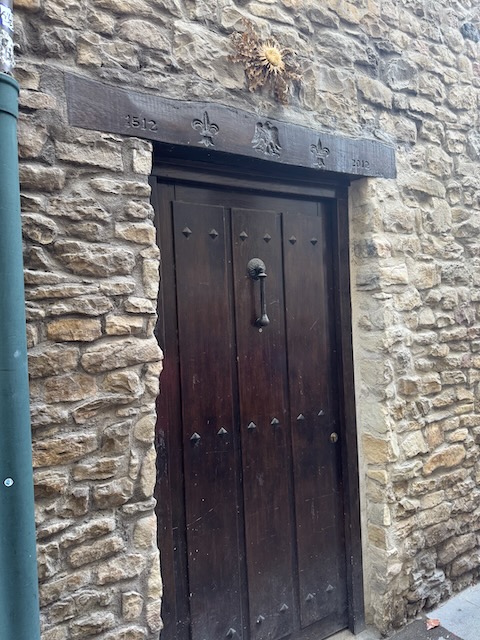
It is a custom in Pamplona to mount a dried flower over doors of homes and shops to keep evil away. The ornament looks like a sunflower, and indeed it is called an eguzkilore, which is the Basque word for “flower of the sun.” However, this traditional protective symbol is actually the dried bloom of the wild thistle Carlina acaulis or Carlina acanthifolia.

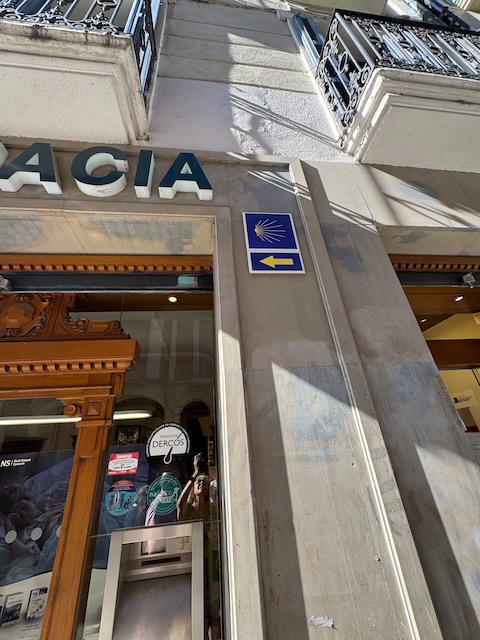
The scallop shell symbol that is seen all over Spain indicates that you are on one of the many roads (caminos) to Santiago de Compostela in northwest Spain, where it is believed that Saint James is buried. Santiago de Compostela is a sacred destination for thousands of pilgrims, most of whom travel to it on foot each year from all of the regions of Spain, Portugal, France and other countries. (More on that later.) As you can see from the blue and yellow sign, the hinge of the scallop shell, where the radiant lines meet, serves as a pointer in the direction of the holy site. One of our guides explained that the symbol not only offers directions, but reflects the way in which pilgrims from all around the world meet at the sacred destination.
Spain 3: The Abbey of Santa Maria in Montserrat and the “Black Madonna”

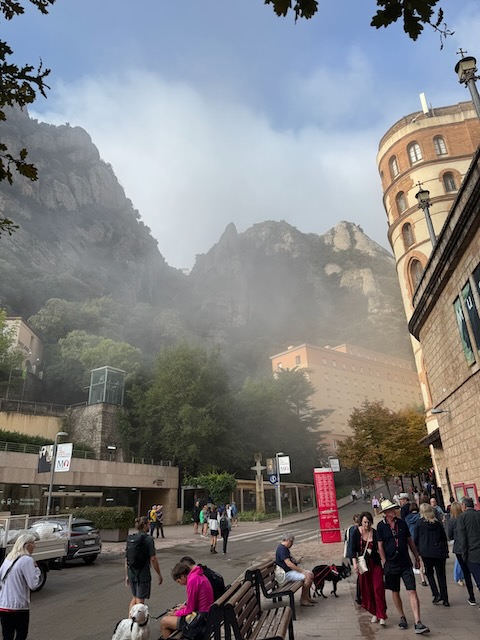
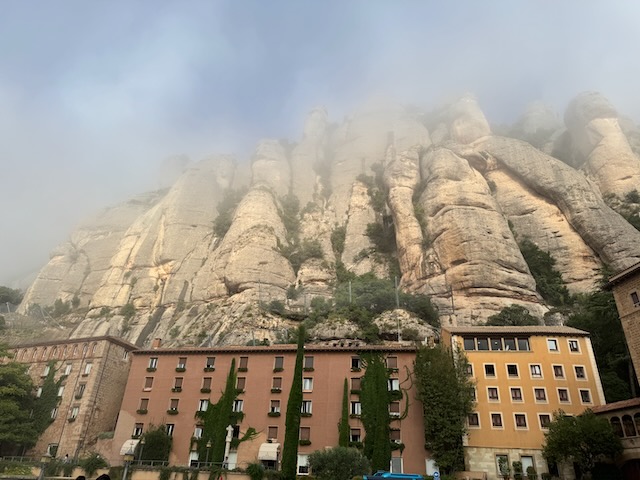
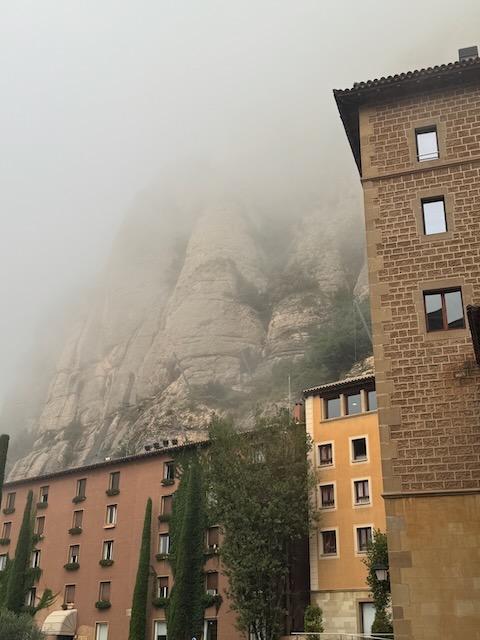
Traces of sunlight through mist and fog put the magical final touches to this excursion. At first we were disappointed to drive into low-hanging clouds as we ascended the mountains northwest of Barcelona toward the Benedictine abbey that was our destination. But in the end, instead of forming an opaque blanket, the clouds fell into shifting curtains of mist  that revealed what was ahead of us, behind us, beside us for a few moments or minutes, then hid it away again. It was a haunting, almost otherworldly experience.
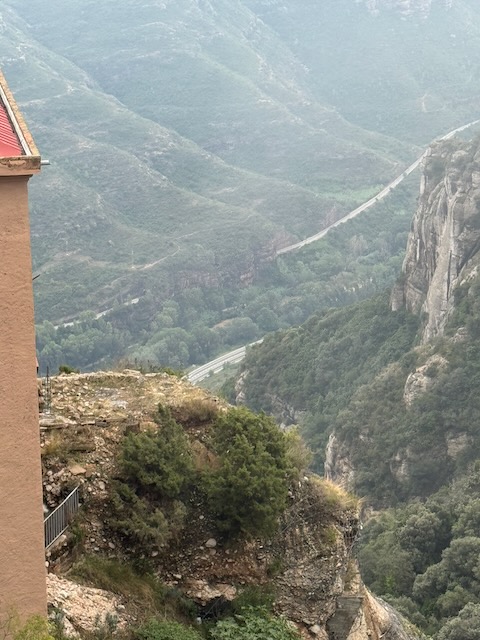
Montserrat (“serrated mountain”), the site of the Benedictine abbey Santa Maria de Montserrat, with its famous “Black Madonna” statue, is located in the Catalan Pre-Coastal Range about 45 km northwest of Barcelona. It is composed of a type of sedimentary rock called “pink conglomerate” that is formed from a mixture of hard and soft fragments including pebbles, gravel and sand, held together with a fine-grained binding compound. Over millennia, erosion – or, more specifically, the ability of this particular rock combination to partially resist it – has given Montserrat a stunningly distinctive appearance, more evocative of the limbs and digits of huge living creatures than of the jagged rock formations they actually are.

“Montserrat Mountain […] gives the appearance of being higher than it actually is, due to the fact that it rises straight up from the Llobregat River. There are no other mountains in its vicinity that come close to its height – making it look very distinctive in this part of Catalunya”  (From the very useful Montserrat Tourist Guide).

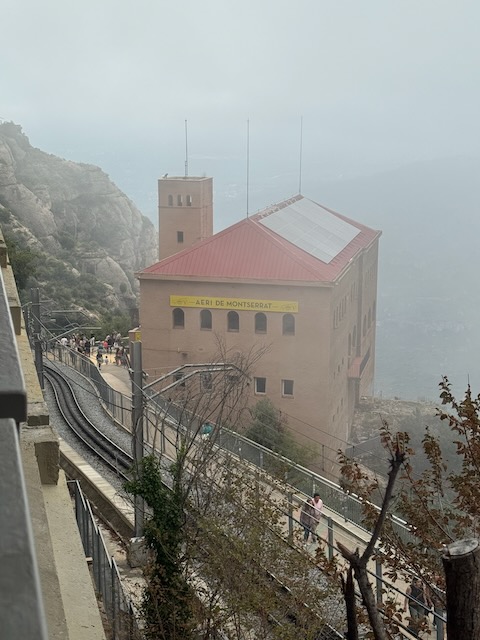
The Funicular at Montserrat

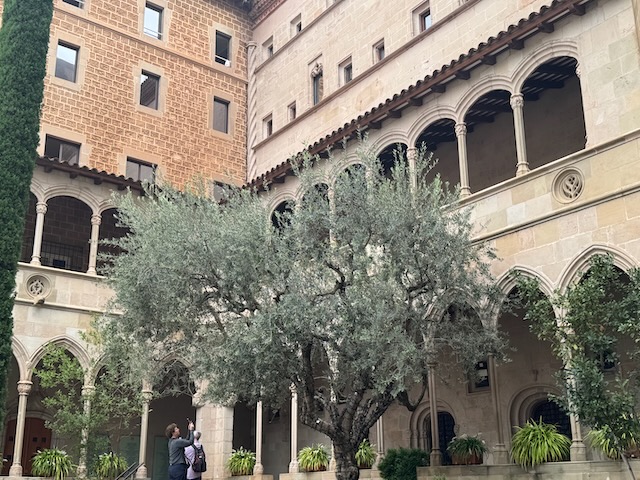
It is believed that it was during the ninth century that a group of solitary monks – of the variety that don’t talk to one another – started building the chapels that formed the foundations of the Santa Maria Abbey. Little of their work remains, although one of the original chapels – St. Iscle – can still be visited. (I just found this out today, so I didn’t get there in September. Adding it to my list of things to go back and see next time.)

Between the eleventh and thirteenth century, the monastery was officially established with the construction of a church in the Romanesque style, and pilgrims began to come to Montserrat. In 1492, one of the monks from the abbey went to the New World with Christopher Columbus, which is how one of the islands in the Lesser Antilles came to be named “Montserrat.”

The history of Montserrat Abbey is not entirely one of a peace cloaked (like the mist on its mountains) in silence and prayer. In 1811, Napoleon’s army destroyed the abbey; subsequently all of the monks but one left when the property was confiscated under new legislation. Reconstruction did not begin until 1858.

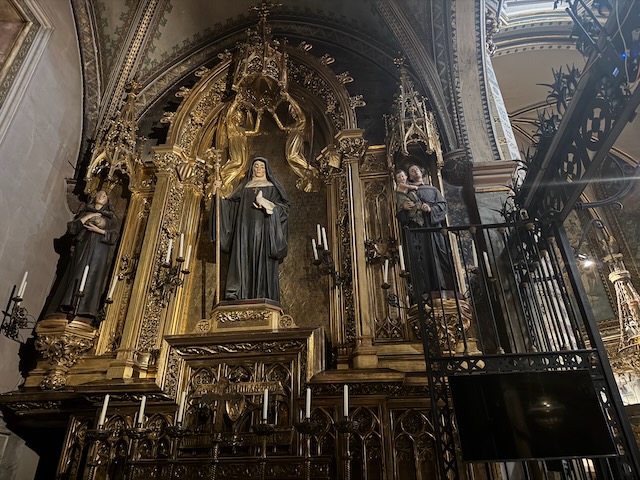
The monks were forced to leave again during the Spanish Civil War (1936 – 1939), and during this period 23 monks were killed. The Catalonia government protected the Abbey as much as it could during this period, and after the war, the monks returned and reconstruction continued. The church now standing on the site is Gothic in design.

The Black Madonna, or “Black Virgin” as it is also known, has helped to make the Abbey at Montserrat famous.

The statue, which is carved from wood, is located high above the chancel of the abbey. We did not have time to go up to see it, but we caught a glimpse from the main floor. The online tourist guide tells us that the Madonna figure “sits behind a sheet of glass, but one of her hands that is holding a sphere (which symbolises the universe) is not behind the glass. It is tradition for you to kiss or touch the Virgin’s hand whilst opening out your other hand to Jesus.”

Here is a close-up photo  from the Monastery website.

The Montserrat statue is only one of many Black Madonnas found around the world, but it is one of the most famous. Some believe that this sculpture was carved in Jerusalem when Christianity was new (possibly even by Saint Luke), was later given as a gift to monks in Barcelona, and then was hidden in a mountain during a century of Muslim rule. It was ultimately rediscovered only thanks to a miracle involving shepherds who saw light coming from a cave. The name “Black Madonna” comes from the colour of the wood, which was not dark when the statue was carved, but has darkened over time. (According to The Internet, historical analysis suggests that this Madonna sculpture is Romanesque, from the late 12th century.)

The Enthronement of the Image of the Mother of God was celebrated in 1947, and since then the Basilica’s restoration has been completed, a museum has been added, and the site has been visited by a Pope (John Paul II). Many people come to Montserrat each year for meditation and prayer, and a large hostel is located just below the abbey to accommodate these pilgrims.

My interest in sculptors in general and those from the region we visited in particular was extended when I learned that contributions to the Basilica included the chapel of the Image of the Mother of God, which was completed in 1885 under the direction of Francesc de Paula del Villar i Lozano with the assistance of “a young Antoni Gaudí.” We also saw two pieces by my latest favourite Catalan sculptor, Josep Maria Subirachs.

After we had returned from Montserrat, we and our Trafalgar group headed out for a bus tour of Barcelona that included a walk around the Sagrada Familia. The day concluded with a lovely dinner at a Barcelona waterfront restaurant in which tapas figured largely. During our travels, I became a big fan of tapas, which are called by other names in other parts of Spain. More on that in another post.

Spain 2: The Sagrada Familia, and we meet our travel group

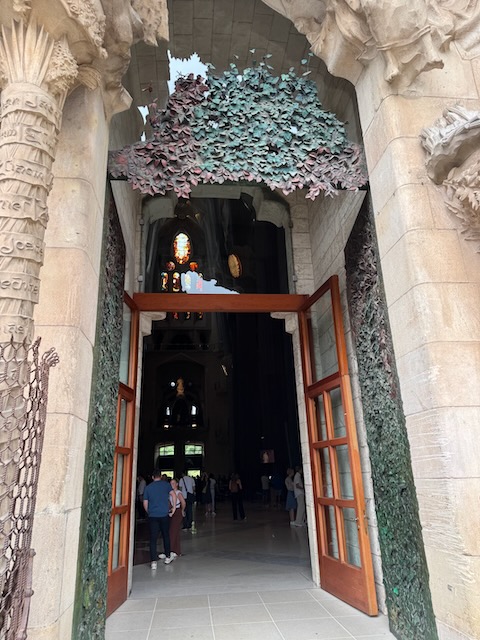
One of our most eagerly anticipated destinations in Spain was The Sagrada Familia, the basilica in Barcelona that was designed and partially built under the direction of the brilliant architect and artist Antoni Gaudi – whose truly distinctive work we had also seen the day before in Park Güell. Gaudi’s designs are also on display in several Barcelona residences, three of which are open for tours (next time!), and other buildings.

The itinerary for the group we were joining later on the 13th for our ten-day tour of Northern Spain would include only a walk-around of The Sagrada Familia, so we booked tickets for earlier in the day so we could take our time and see the interior as well.

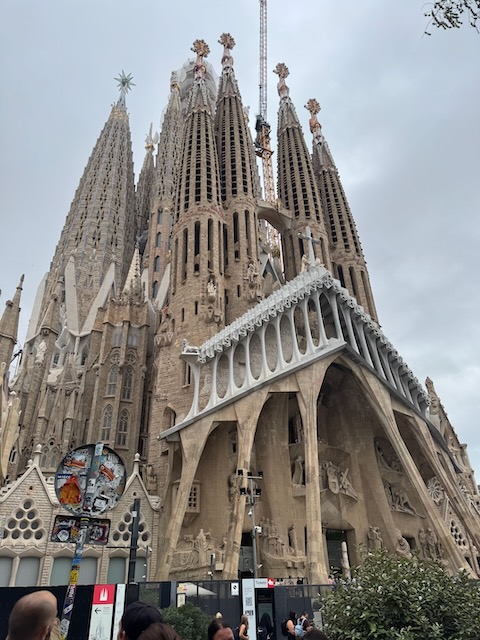
Our first sight of The Sagrada Familia when we emerged from the nearest Metro station. In front of us is the Passion Facade, which faces west.

Gaudi began his work on The Sagrada Familia in 1884 and continued until his death in 1926. I was surprised to learn that he was not the first architect to have been selected to design and build the new church. He was appointed to the position only after Francisco de Paula del Villar y Lozano resigned after two years’ work, following a bureaucratic disagreement. Villar had planned a fairly standard neo-gothic church for the site, but Gaudi transformed the project into his magnum opus when he was awarded the position in 1883.

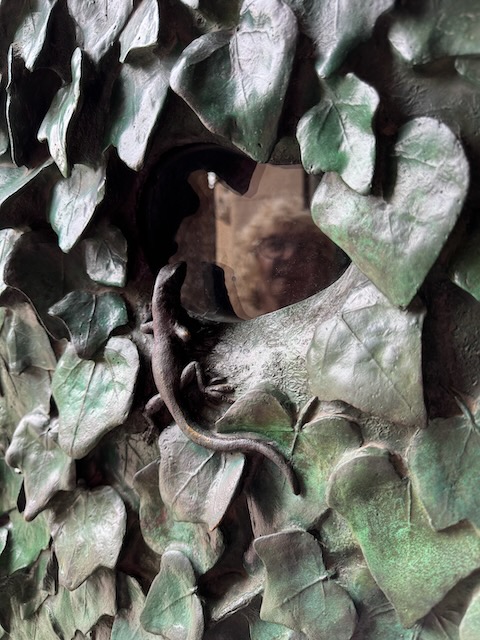
A deeply religious man, Gaudi was already an acclaimed Catalan architect when he took on this assignment. “Gaudí’s work was influenced by his passions in life: architecture, nature, and religion. He considered every detail of his creations and combined crafts such as ceramics, stained glass, wrought ironwork forging and carpentry. He introduced new techniques in the treatment of materials, such as trencadís which used waste ceramic pieces.” (Wikipedia)

Gaudi became so focused on the project that he moved from his house in Park Güell, where nuns had been looking after him, into the cathedral itself. As time went on he increasingly neglected his appearance, his diet, and his hygiene. On June 7, 1926, at the age of 74, Gaudi was walking down a Barcelona street on his way to confession at a nearby church when he was hit by a tram car. Due to his unkempt appearance and the fact that he was carrying no identification, passersby mistook him for a beggar and paid him little attention. Finally someone arranged for him to be transported to a nearby hospital, where he was admitted to the pauper’s ward. It was several days before his assistants at the basilica located and identified him. By then it was too late for him to receive the kind of treatment that might have helped him to survive his injuries, and he died soon after. He is buried in the crypt of his famous cathedral.

The Sagrada Familia was only about 25% complete when Gaudi died. Aside from a few years during the Spanish Civil War, work has continued ever since, but the cathedral is still not finished. While Gaudi was alive, most of the work on the “Nativity Façade” on the eastern side of the cathedral was completed, and his wishes for the entire project had been outlined. His creation reveals the unique inspiration he found in natural forms and shapes, in his religion, and in his Catalan heritage. His vision still guides the work, despite the contributions of other architects and artists who have created or supervised the realization of various components over the years.

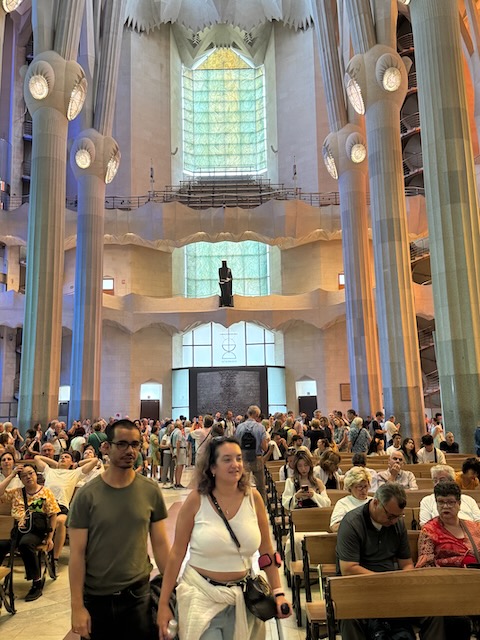
Like many Christian churches, the basic footprint of The Sagrada Familia is oblong, in the shape of a cross. The congregation sits in rows of pews and chairs down the middle of the nave, with the chancel, including the altar, near the top (north) end. A transept crosses the nave just below the chancel and on the east and western exteriors of the transept are doors, or portals. The main entrance, when it is finished, will face south.

As well as supporting the enormous weight of the spires that rise from the cathedral, the columns suggest trees and are finished in various natural colours.

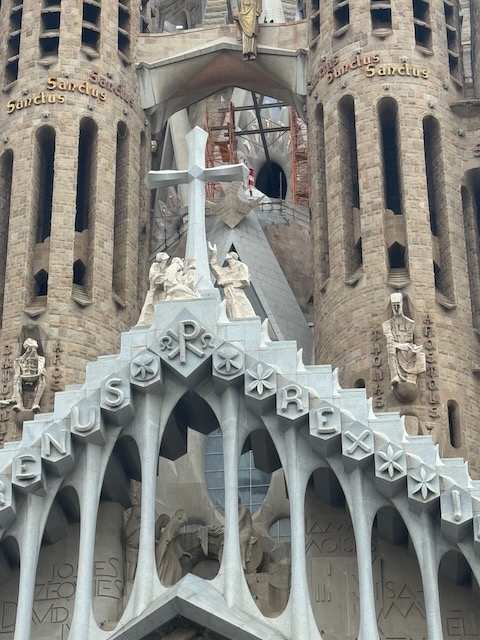
Gaudí’s original design for The Sagrada Familia “called for a total of eighteen spires, representing in ascending order of height the Twelve Apostles, the four Evangelists, the Virgin Mary and, tallest of all, Jesus Christ. Thirteen spires had been completed as of 2023, corresponding to four apostles at the Nativity façade, four apostles at the Passion façade, the four Evangelists, and the Virgin Mary” (Wikipedia). The Jesus Christ spire is due to be finished in 2026. At 172.5 metres with a cross on top, it will make The Sagrada Familia the tallest church in the world. A couple of the towers are open (for an additional fee) to those who wish to climb them (next time!), at which point (I have read) you are rewarded with great views of the city.

The official name of the magnificent structure is “Basílica i Temple Expiatori de la Sagrada Família.” “La Sagrada Familia” means “The Sacred Family.” A “basilica” is a special designation given to a church by the Pope, based on criteria that include its architecture, history and spiritual significance. The Sagrada Familia was consecrated on November 7, 2010 by Pope Benedict XVI, who also designated it a “minor basilica.”

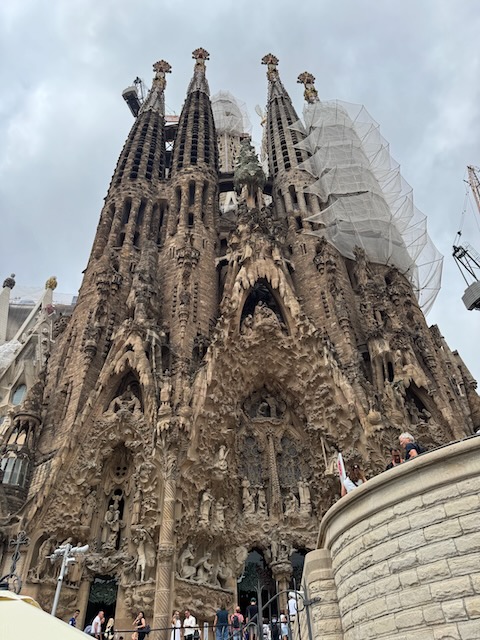
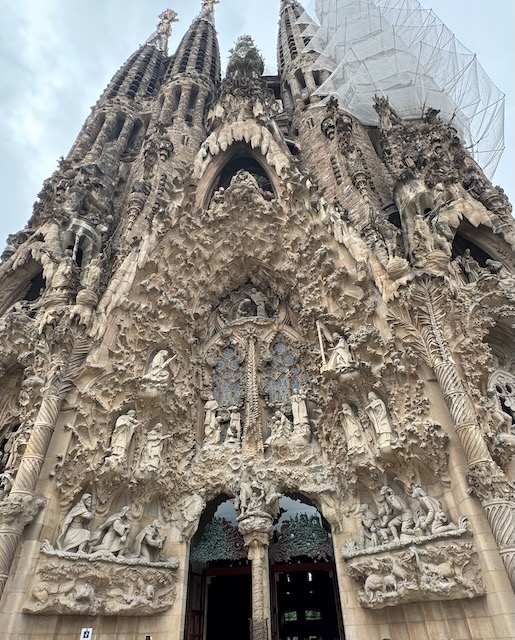
The Nativity Facade was completed first, in 1930. It features three portals (representing faith, hope and love), several towers (representing The Holy Trinity and four of the Apostles), and many decorative carvings and statues. It faces east, in honour of the birth of Jesus Christ, and includes many depictions of Biblical scenes describing Jesus’s early life.

You will notice the sculpture of a cypress tree above the middle portal. It is the symbol of the Tree of Life. A person could spend months tracking down the meanings associated with the adornments that appear everywhere on and in The Sagrada Familia.

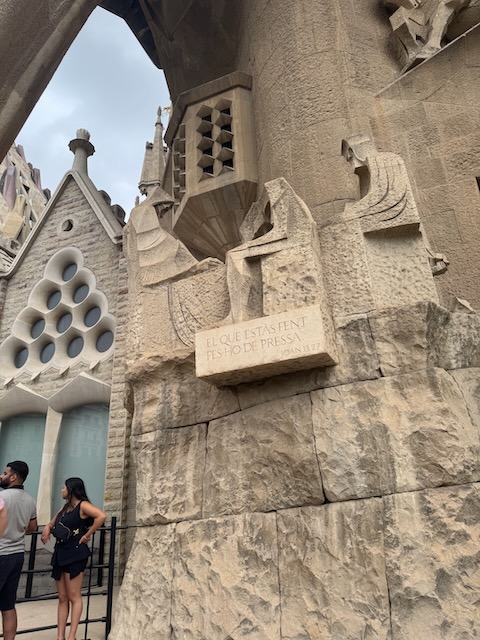
Several of Gaudi’s models for the cathedral were damaged and destroyed during the Spanish Civil War. Their restoration was overseen by Francesc de Paula Quintana, who had been one of Gaudi’s assistants. In 1954, Quintana initiated the construction of the Passion Facade, which Gaudi had instructed should be a stark, skeletal contrast to the rich and detailed Nativity Facade. The “look” is indeed different from the lavish detail that distinguishes The Nativity Facade: it is minimalist, abstract, spare and open. Themes of this facade (which faces west) include the Last Supper, the Way of the Cross, the Crucifixion, and other scenes from Jesus’s final days. Towers honour four more of the apostles.

While most of The Sagrada Familia is finally nearing completion, the Glory Facade, which faces south, in which the main entrance will be situated, is not finished. Its design represents the path to eternal glory, including Christ’s final judgement and ascension into heaven. Seven pillars represent the seven deadly sins and seven heavenly virtues.

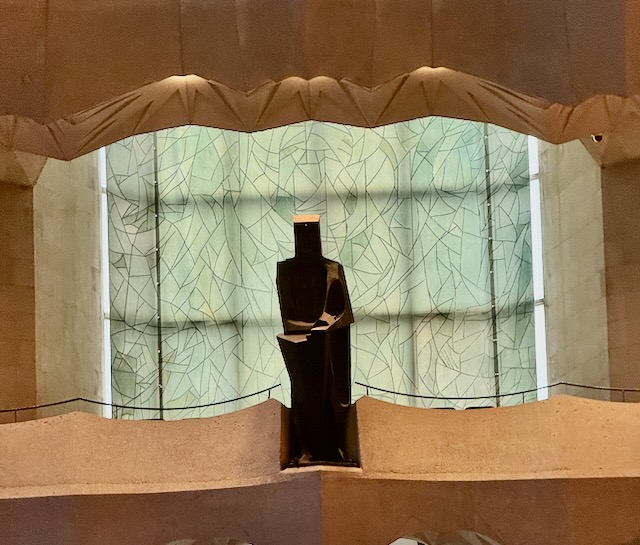
Subirachs’s sculpture of Saint George

Josep Maria Subirachs (1927 to 2014) was commissioned to create the Glory Portal in 1987, and his distinctive style raised much controversy because his work (expressionist, abstract) is very different from that of Gaudi and the other designers involved with the project. (Note: I have no opinion on whether Subirachs’ designs are appropriate to The Sagrada Familia, but I did develop a great fondness for his work as we travelled through the region and saw several pieces he had done. Dark, haunting and evocative, his work is definitely nothing like Gaudi’s. Watch for his Crucifix in the next post.)

Plans for the construction of The Glory Facade are in conflict with the wishes of Barcelona residents who live nearby – approximately 3000 of whom will need to be relocated if the current plans are executed. With zoning issues as well as construction of the portal still ahead, a completion date in 2026 sounds somewhat optimistic.

The entry fees charged to the 4 to 5 million visitors who visit The Sagrada Familia each year are what pay for the construction. Due to the basilica’s popularity, it is wise to purchase tickets (online) several months in advance of a visit, as they are usually unavailable at the site. (One person told us that if you go to a Sunday morning service, there is no admission charge. But don’t quote me.)

After we returned to the hotel from The Sagrada Familia, we enjoyed a well-earned nap and then, at 5:30 p.m., we met with the others on our tour for the first time, in the hotel’s breakfast room. The group of about forty-five people included four or five other Canadians, a lot of Americans, two people from the UK and a family from the Philippines. Our tour guide’s name was Celia. Originally from Madrid she was extremely knowledgeable, well organized, attentive and personable. I can’t think of how she – or our driver Paolo – could have done anything better than exactly how they did it.

After some introductory remarks (such as a warning that we heard over and over again to keep an eye out for pickpockets in Barcelona), we were handed the headsets that we would use to hear our guides throughout the tour, and our luggage tags. (Our suitcases were collected from outside our room each travel day, loaded onto the bus, and delivered back to us after we arrived at our next destination. The system worked perfectly.)

Then we climbed onto our bus and were driven through Barcelona to a restaurant on a hill above the city. The restaurant where we ate is a community initiative sponsored by the Fundacion Mescladis, that works to train people in vulnerable situations (particularly immigrants) and to prepare them to enter the workforce. The staff was attentive and the food was delicious.
Update: in today’s news (October 31, 2025):