Caves, Cocktails and Cannons (Part 1)
Saturday, January 9, 2016
Viñales is home to the most extensive cave system in Cuba and before we left the area we had the opportunity to visit the Cueva del Indio (Cave of the Indian) about five kilometres north of Viñales town, in the Parque Nacional Viñales. A note in Lonely Planet says that the cave was an “ancient indigenous dwelling rediscovered in the 1920s.”
Before we entered the cave itself, we had the opportunity to see a display of objects that have been used for centuries by indigenous people of Cuba. Members of our group were particularly taken with the conches, which made a keening sound when you blew into them.
-
- Arnie on the conch shell
-
- To the cave
We then entered the cave and walked along a narrow passage to a waterway. There, a motorboat took groups of ten or twelve from a small dock through the cave and out to a landing on the other side. It was a short trip but memorable. There were (of course) bats but (of course) I couldn’t get a photo of them.


-

- Our boat returns to the cave
Havana: A walking tour
 We arrived in Havana in the early afternoon and had time to check into our casa particulares (the same one we had stayed at the previous Sunday night) before heading out in a bicycle cab to join the group for a walking tour of the city.

Drivers await hires near the Inglaterra
We had wandered around old Havana on our own the previous Sunday, but we learned a good deal more when we had someone to explain what we were looking at. To list everything we saw on the two-hour walk, which included Havana’s five major plazas among other attractions, would make this a very very long entry, and it is already going to be quite long. So instead, below and in the next post I’ll give you what I thought were the most interesting highlights.
The Most Interesting Highlights

Hotel Inglaterra
We met our guide Manny and most of the rest of the group at the Hotel Inglaterra, near the National Capitol Building which marks the centre of Havana. Completed in 1926, El Capitolio was built with the US capitol building in mind, however, as Manny explained with pride, the one in Havana is six metres taller than the one in the US. El Capitolio housed government activities until the Cuban revolution in 1959. Like many many notable buildings in Havana, it is now being reconstructed, and when it is finished it will again become the seat of the National Assembly.

Hotel Manzana
We then walked past the Saratoga – the most expensive hotel in Cuba – and the Gran Teatro de La Habana and into Central Park (“where they argue loudly about baseball”). Nearby, a hotel (the Manzana), currently under reconstruction, features bullet holes incurred during the Revolution.

Obispo Street
We set off down Havana’s famous Obispo Street (where no smoking is allowed), walking past one of Hemingway’s favourite haunts — the Floridita bar – where a few years ago, in honour of what would have been the author’s 113th birthday, the owners blended 27 bottles of rum with proportional amounts of the other requisite ingredients to make the biggest daiquiri in the world.
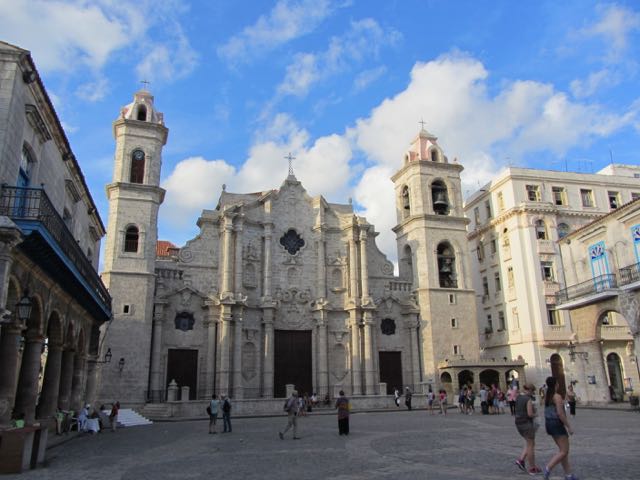
Our next stop was Cathedral Plaza, which was lovely, spacious and – save for a few young boys playing soccer – nearly deserted. Manny told us that this neighbourhood – built on what was originally swampland – has some of the best restaurants in Havana, and that the Doña Eutimia tops the list. The Cathedral of the Virgin Mary of the Immaculate Conception is also on the square and, just to bring things full circle, the Bodeguita del Medio – Hemingway’s favourite stop for a mojito. (For an alcoholic, it seems to me, Ernest was pretty particular about where he drank what.)
Where There Were Pirates (long long ago)
Havana used to be the most attacked city in the world, with pirates from everywhere descending on the harbour with greed in their eyes. Around 1600 the Spanish decided to fortify, and the remains of the resulting battlements can be  seen at Parque Histórico Morro y Cabaña. During the Colonial era, every night at nine a cannon was fired from the fortification to announce the city’s curfew, and the traditional continues at the Cabaña Fortress today – although (one can assume from accounts of the nightlife in Havana) now it is ceremonial only. Near to the remains of the fort, there is also a display of boats that have been retrieved from the bottom of the Caribbean Sea, a warning to others who – like the boats’ original owners – might be tempted to flee the island.
 We moved on to the Plaza del Armas, which is well known for its hundreds of local vendors of old books, antiques, and artworks (and the typical scenes of men playing chess). On the eastern side of the plaza is the Palacio de los Capitanes Generales, the former residence of the governors (capitans) of Havana, and current home of the Museum of the City (Museo de la Ciudad). A part of the street itself is made of wood, rather than stone; it was re-surfaced in response to complaints from visitors at nearby hotels about the sounds of horses’ shoes clip-clopping on the cobbles.
(to be continued)
 This morning Arnie and I went our separate ways: he to do a horseback trip through the Viñales valley, and me to join a walking tour of a few farms in the same area. We compared notes after we met up again and discovered that we’d both watched the owners of different tobacco farms make cigars by hand. We’d learned about the different leaves that go into the creation of the perfect cigar, and been told that the finer the cigar, the lower the level of nicotine. We’d been advised that inhaling is not a recommended part of the cigar-smoking experience anyway. After the demonstration, each member of both groups was given a Cuban cigar to smoke. Arnie smoked all of his. I just took one puff.
 Rain had pounded down all night and into the day, to the point where when a few members of our group stepped out into a Viñales street after breakfast, they found water going over the tops of their trekking boots. Their feet were wet all morning. I didn’t get wet feet until I started walking around the countryside, but when I did it was not only wet but red. I assume a high iron content in the soil, but I forgot to ask about that.
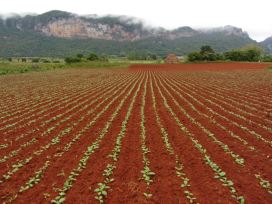 Our guide did tell us that the soil here is very good for tobacco growing and that they use no pesticides or fertilizers. The farm workers plant all the seeds, pick all the leaves, and harvest the leaves by hand. It takes three to four months to grow a tobacco crop and the farmers in this area sell 90% of their crops to the government and turn the rest into cigars with their own brands. (Our host said his were called “Geraldo’s cigars” but I think that was a joke.)
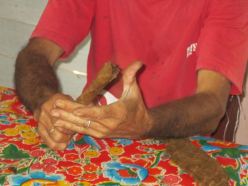 The inside leaves that are high in nicotine content are fed to animals. The better leaves are soaked in honey, guava and rum, and then put into home-fashioned humidors (made of plastic wrap) to cure for a year or two. The result is a cigar that tastes wonderful and has very little nicotine. (Geraldo pointed to his 70-year-old mother who was smoking a very large Cuban cigar as evidence that cigar smoking will not harm your health. [See slide show album below for photo of her.] I was not impressed, as 70 seems very young to me. Show me your 100-year-old mother. Then I will pay attention.) Geraldo hand wraps approximately 100 cigars a day.
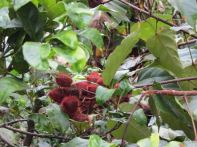
 In addition to tobacco crops and drying barns, we saw fields and groves of mango, bananas, coffee beans (arabica), black beans, calabash (from which maracas are made), taro and cassava. I have discovered here in Cuba that I love taro, which is the basis for arrowroot and according the locals cures almost everything. (And anything it doesn’t cure is cured by the root of the royal palm so it is all covered here. Although there is also excellent health care in Cuba if anything else is required.)



 I'm All Write
