Category Archives: My Trip To India

Watch. Listen. Learn. (India 5: “On Dirt”)

Some thoughts on dirt (a confused and meandering aside) —

Two of our group left today for home, halfway through the tour. The rest of us are disappointed that they didn’t love India as much as we did.

In fact, I think they hated it.

Both of the two who left had been suffering from stomach ailments off and on for several days. It’s been hot and there have been long bus trips, and am sure that experiencing that when you’re unwell is no fun. But they complained that India was too dirty and too crowded, and that they didn’t like it.

I am now feeling badly for complaining about the dirt myself for I have been wondering what those two thought they were going to find in India. Certainly the dirt has been no surprise to me, and certainly the open sewers and poverty are hard to handle. But anyone who has read about India and is planning to visit here must surely know what to expect. The dirt I complain about in the hotel rooms and buses is caused by the dirt in the air which gets on everything. It is caused by ancient crumbling cities and dry topsoil being blown around, and all the pollution and industry that relate to a developing nation. It is not that the people are dirty: those who can afford to be are very clean.

Indian innkeepers are learning the expectations of westerners, but slowly. We are on a budget tour, and a “sustainable communities” tour, and the hotels we are staying in are cheap. They are old and run down, don’t always have hot water and lose their electricity regularly. This is not Toronto. But the hotels have been secure, the staff helpful, the food excellent, and the prices right.

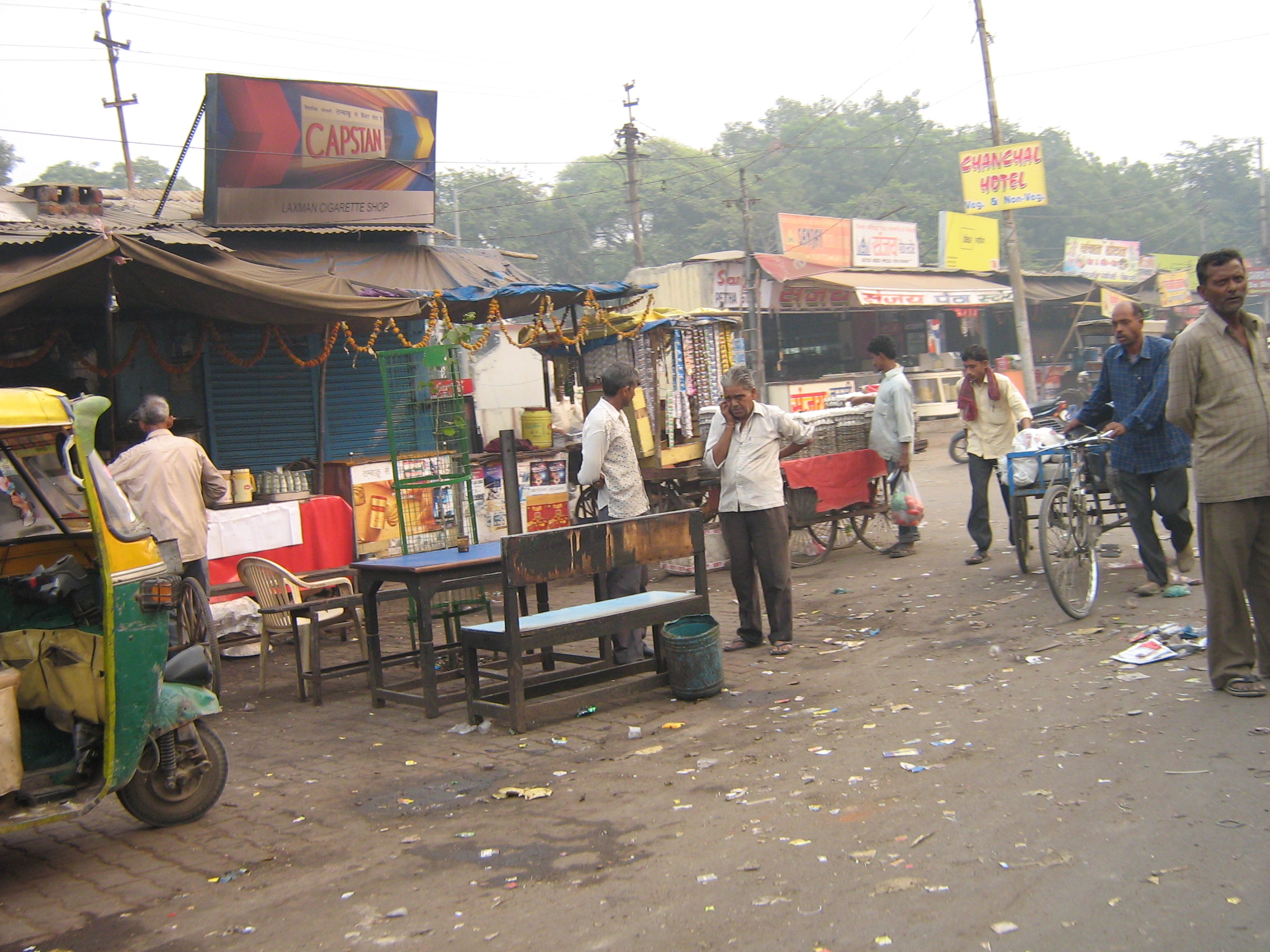
There is certainly garbage everywhere — in the streets, in the fields, by the highway, near the beach. But this speaks more of hundreds of years of inadequate or non-existent municipal garbage systems than it does of intent. I also have to admit that I have never in my life seen so many men peeing outside as I did in India, and I gather that teaching people to use bathrooms for defecation in the slum areas is a challenge. There are certainly cleanliness problems to deal with here, and it is going to take a lot of work.

The other day I used some soap and water and cleaned off the faceplates on the light switches in my hotel room here in Udaipur — the light switches have been black from ages of use in many of the hotels we’ve stayed in. With clean switchplates, suddenly the whole room looked much better.

All of the care-taking staff everywhere have been men and it has long been my opinion that men do not see dirt, so that probably explains everything.

And yes, it is crowded here: it’s India. But there are quiet places too.

And besides, as I told our tour guide (who was feeling very badly that two of our number had disliked his country so much that they had bailed mid-tour — first time in five years it’s happened to him, and certainly not his fault), when I visited London, that city seemed pretty dirty and overcrowded to me too — compared to Canada.

So it’s all a matter of perspective.

Sunday, November 13, Udaipur

Garbage on the beach, Goa

(Update: November 29, 2011, Toronto — I keep editing and re-editing this post and the more I think about the subject, the more I realize that I don’t know what I think about the subject. India is dirty. That is a given. It may always be dirty. And maybe that matters in the big picture [because it spreads disease and signifies poverty], and maybe the whole world needs to do what we can to help address this situation. But in the meantime, if you want to go to India, just accept it, try to avoid stepping in it if you can, but don’t let it spoil your trip. If you can’t hack dirt, don’t go to India.)

Another update: Just noticed this article: ‘Ugly Indians’ Clean Up Bangalore

20111114-075727.jpg

20111114-075821.jpg

20111114-075915.jpg

20111114-075945.jpg

Watch. Listen. Learn. (India 4: Jaipur)

Nov. 7-8, 2011, Jaipur

In which I take a wrong turn and visit a fort atop a mountain rather than one that is far more accessible and elaborate and therefore the usual destination of tourists.

Agra to Jaipur

We took a local bus from Agra to Jaipur at noon on November 8. Our group had 17 seats in the middle of the dirtiest bus I have ever seen in my life (not surprising, as the air is full of dust and dirt — and since the fans that are positioned over the seats every few rows don’t work, the bus travels with the windows open). There is no bathroom on the bus: an ongoing concern for those members of our group who have been coming down with various stomach ailments, although the drivers have been quite agreeable to stopping by the side of the road when we feeble-bellied foreigners absolutely need them to.

“This is India,” we keep reminding one another when something or other is not up to our usual standards. At least the bus was running….

Famous last words.

After we’d travelled for about ten minutes (we were still in the madness of Agra traffic), the bus rolled to a stop. I thought perhaps we were taking on a few more passengers, but the driver stood up, turned to those already on the bus, and yelled something at us in Hindi. Our guide translated: the bus needed a push. So all the men got off (clambering over a few suitcases in the aisles on the way) and pushed. The engine caught almost right away and we were off again, without further incident in that department.

The highway traffic was like city traffic except more spread out: there were trucks, other buses, motorcycles, tractors, a few SUVs, pedestrians, camels (mostly led by their owners) and cows and bulls (not apparently owned by anyone). The vehicles’ horns are used as frequently and as with as much purpose on the highway as they are in the city, and the traffic lines are ignored as often. The only real difference on the highway is that everyone is going faster. It is important not to try to watch the traffic coming toward you when you are a passenger on the bus any more than when you’re in a tuk-tuk: you have no control over what is going to happen to you, so there is no point in looking.

We stopped regularly in towns to let local people on and off, and we drove by very poor, crowded, stinky semi-urban areas as well as more rural scenes. The image of women crouched in fields at work in their brightly coloured saris will not soon leave me. (Neither will my encounter with an aged woman at the one scheduled lavatory stop we made. She was handing out strips of toilet paper to the tourists, dressed in a bright yellow sari, nearly toothless, wizened, talking cheerfully on a cell phone. I gave her a small amount of money for her efforts. She pocketed it [? Are there pockets in a sari?], gave me a long look and then offered me another piece of toilet paper, which I declined. It is not common practice to say “thank you” if you’re Hindu. So we were cool.) The farming methods I saw were very primitive compared to those I’m used to: I saw one group of people sweeping the grain off stalks of wheat onto tarps, using long poles. Many of the towns have high towers rising from them which are the chimneys of kilns for making bricks.

I was seated next to our guide for this leg of the journey and as we travelled down the highway (it was about a six-hour trip), I asked him questions. From him and a highway sign, I learned that:

  • the reason there are so many unfinished buildings in India is that they are works in progress for practical reasons — the owners only start to get taxed when the buildings are complete;
  • the low stone fences around large sections of fields that have nothing growing or grazing in them are there to keep out squatters;
  • the common myna bird likes to wander around under trucks and other vehicles that are stopped at the regular toll booths on the highway;
  • several of the highways on this route have improved considerably since our group leader started working for G Adventures five years ago — the bus trips used to take much longer; and
  • if you are driving a police vehicle or a funeral van, or are a member of parliament or the winner of a gallantry award, you don’t need to pay a toll fee (see complete list of those who do not need to pay toll fees, and other photos from the bus trip between Agra and Jaipur, here).

I also learned a lot of cool stuff from our guide and my books about the state of Rajasthan and its feisty chiefs, who — unlike those from many other states — fought off or figured out ways to work around or with various would-be conquerors over the years and in 1947, when the country was officially divided into states, they were able to have their state named after them. Here, the rajas also retain stature and respect.

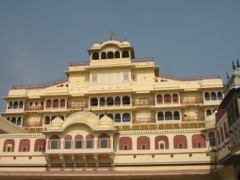
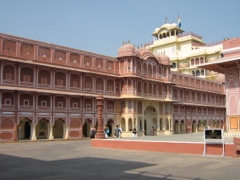
The descendants of Jai Singh II, for example — who built the city of Jaipur starting in the mid-1700s, naming it after himself — are still considered heads of state by the people of the region. The royals maintain a residence at the magnificent City Palace, which I toured, and the Raj’s flag is raised over the palace when the royal family is at home… sort of the same way as the Windsors’ is at Buckingham.

(My photos of Jaipur and area are here, on Picasa)

Jaipur is known as the Pink City, as many of its buildings were painted pink in the late 1800s to reduce the glare from the sun, and many still retain a deep peach-pink cast, but aside from its historic buildings, it is the architecture of the city that is its main claim to fame. Jai Singh II survived being supplanted by the Mughals because Akbar recognized his brains and creativity when he was still a boy — giving him the honorific name “sawai,” meaning “one and a quarter” — and left him to do his thing. Sawai Jai Singh certainly fulfilled his promise, proving not only a wise, kind ruler of his people but also a scientist, mathematician and architect. He built the city of Jaipur according to a very precise set of measurements so that all the streets intersect at exact angles around a central circle. Even the stores on the main streets were built according to strict specifications, and all are exactly the same size.

Other highlights of Jaipur include:

  • Jantar Mantar, one of five observatories built by Jai Singh which contains a fabulous array of huge instruments used during the medieval era for measuring the sun, the planets and the stars (click to see photos here);
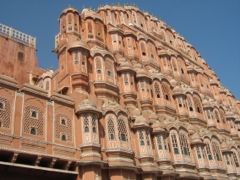
  • the Palace of Winds (Hawa Mahal), really only a facade behind which, in the 18th century, the women of the palace were able to see the activity in the city without being seen — an amazing sight when the morning sun is on it;
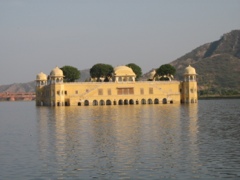
  • several forts and palaces built by several Rajputs over the centuries, including Jai Mahal in the middle of the Man Sagar Lake; and
  • the Amber Fort and Palace.

I will need to go back to Jaipur to see the Amber Fort and Palace as I missed it completely, having inadvertently had another adventure instead (see below), but I will not complain about this as I loved Jaipur and would be happy to go back any time.

To other prospective travellers to Jaipur, I highly recommend staying at the Jaipur Inn which is almost European in its wide stone hallways, mosaic tiles, screened windows, balconies, and a bar on the rooftop that overlooks the city. It is VERY clean, and friendly: the owner offered to take any of us along who wanted to accompany him on his daily hike to the top of a nearby hill to watch the sun rise over the city. Having done my own hike, I did not join him, but I felt safe and happy in Jaipur and highly recommend a visit there.

Bollywood!!

In Jaipur in addition to the sights, we took in a Bollywood film, which is an adventure in itself, and only INR70 (about $1.50) per head. You get a reserved seat and everyone is let in just before the movie starts. The theatre was huge and ornately decorated, and the film that we saw has had the largest take of any film in Bollywood history, and it’s only been out for a few weeks. It is a science fiction film named Ra-One (for “Random Access Version 1.0”) and it is the story of a video game that goes badly wrong and starts wreaking havoc on the life of its inventor (Shahrukh Khan), his wife (Kareena Kapoor) and their very cute son (Armaan Veena). It was in Hindi without English subtitles, but it was easy enough to follow. The movie was terrific but the audience was the best: they shouted encouragement at the good guys, yelled and booed at the bad guys, cheered the hero, sang along with the songs, calmed their screaming babies when necessary, danced to the music, and talked on their cell phones. It was amazing.

I am going to take in a Bollywood film in Toronto (maybe the same one. Wouldn’t mind seeing the subtitles because I missed a few jokes and other language-based plot points) to check out the atmosphere created by the Indian-Canadians who attend. Now that I’ve seen it, I wish I had attended some of the Bollywood Film Awards festival that was held in Toronto earlier this year.

The Wrong Turn de Jour

So. I took a tuk-tuk to the Amber Palace and Fort, 11 K from Jaipur. The complex, built by a series of rulers over a period of two centuries, is considered a major highlight of a trip to Jaipur. My driver warned me not to buy anything at the Fort because it would be too expensive (“I will take you to a place later where the price is good.” This is a common tout by tuk-tuk drivers: they get a commission if tourists buy from their friends’ shops), and also not to accept the offer of a ride up to the Fort from the road where he dropped me because “It’s easy for you to walk. Ten minutes,” he said. “No more.”

I descended from the tuk-tuk and headed up toward the fort. After a ten-minute walk, I realized that no one had offered me a ride, and only one vendor — whose hopes I’d raised by asking the price of a hat he was selling, then dashed when I decided not to buy it despite the way he cut the price from his original high of 600 rupees to about 200 — had tried to sell me anything. The wide path was essentially deserted.

Thinking that perhaps all the rest of the tourists had been suckered into the offer of a ride, not having access to the wisdom of my tuk-tuk driver (where do I get such crazy ideas, anyway?), I kept going. Fifteen minutes after that, I stopped and looked around me and realized that the palace I had been heading for was now below me. Above was another intriguing looking fort. But it was far, far above, and it was very hot out (about 32 Celsius, I think, and hotter in the direct sun). I had my backpack and no hat. But when I saw the extensive battlements above, and realized that I was half way there, I could not turn back.

Three young people, two European-looking and the other Indian-looking, all three of the age and appearance of university students, were sitting in the road in the shade of a tree. I asked them how much farther it was to the top of the hill and the Indian person said, “Two or three kilometres.”

More???” I asked.

“Yes,” he said. He suggested I walk with them, but I didn’t want to slow them down so I declined.

“Walk slowly,” he advised as they started off. “You’ll get there.”

A few minutes later a trio of teen males came by and also gave me encouraging signs and signals, although they spoke no English. They suggested that I follow them up a rocky shortcut but I acted out how I would tip over if I tried that. They laughed when they realized what I was “saying” and carried on.

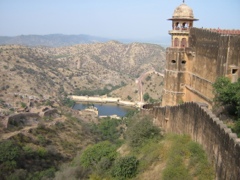
Where I ended up was worth the hike but it took me about two and a half hours to ascend to the upper fort, which is called the Jaigarh Fort, and make my way around it, and by then I was worried that if I didn’t go straight down — without a detour to the Amber Fort — my tuk-tuk driver would give up and return to Jaipur without me.

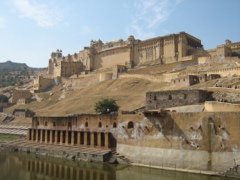
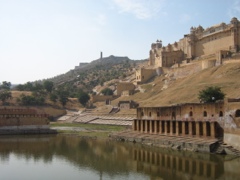
Jaigarh Fort was where the royal family went when there was a threat of war, and according to a pamphlet I read, “is one of the few military structures of medieval India preserved almost intact, containing palaces, gardens, open and closed reservoirs, a granary, an armoury, a well planned cannon foundry, several temples, a tower and a giant mounted cannon — the Jai Ban, which has a twenty feet long barrel” (Go Jaipur). When the Amber Palace below was threatened, drums would sound and the royal family would beat a hasty retreat to Jaigarh Fort.

There, I saw intriguing and amazing artifacts including weapons, farming implements, tools and cooking vessels. I saw:

  • where the servant women cooked and the royal men and women ate (separately, due to their being under seigr when they were at Jaigarh);
  • a royal bedroom that can only be compared in size to an assembly hall;
  • secret passageways to protect the royal family from unwanted intruders;
  • a water system that mainly involved elephants and camels bringing water up the hill from the lake below;
  • a fantastic view of the cities of Amber and Jaipur.

I also astounded the two guides who showed me around when I told them I’d walked up. “That’s a long hike!” one said. “How old are you?” He obviously thought that I must look much older than my age if I had managed to scale that mountain on my own.

It was a long hike and, tired and sun-burnt, I took a tuk-tuk down to my tuk-tuk. As is the usual outcome of my misadventures, I had an experience I’d never have had without my little mistake, got a spectacular view of Jaipur and a great chunk of exercise. And really, I did see the Amber Fort — from a bird’s eye view. It looked fabulous.
20111113-165652.jpg

20111113-165853.jpg

20111113-165922.jpg

20111113-165952.jpg

20111113-170043.jpg

20111113-170135.jpg

20111113-170241.jpg

Click to see more photos here

Watch. Listen. Learn. (India 3: Agra)

Nov. 6, 2011 — Agra, and The Taj Mahal

Where the only horns in the streets that aren’t blasted every few moments are the ones on the cows.

Agra Street Scene

I was more impressed with the traffic in Agra and the massive Red Fort than I was with the Taj Mahal, but the title of this blog post would have been far less interesting if it had read, “Red Fort, Agra.”

“More impressed” probably isn’t the right term. I was impressed with the Taj Mahal: how could one not be impressed with a 186-foot-square mausoleum that is considered one of the seven wonders of the world, is made entirely from white marble with floral designs and arabesques inset with jasper, carnelian, emerald, crystal, jade and many other precious stones, is perfectly symmetrical in four directions in the Muslim style — even its four gardens subdivided into four and four again — and stands as a testimony to the greatest love in the world ever, from all accounts: that of the mighty Mughal emperor Shah Jahan for his third wife Munoz Mahal. When she died during the birth of their fourteenth child, a still-born girl, the emperor went into such a terrible depression that he did not emerge from seclusion for seven days and when he did (according to our guide) he had “lost his height.” What a lovely way of expressing the effect his sorrow had on his physical presence!

The Taj Mahal

The queen had told him that if anything happened to her he should create something to commemorate her, and the Taj Mahal is the result. It is a truly astounding edifice, and if I had not seen Agra’s Red Fort earlier in the day, I would have been knocked flat. My biggest wonder, though, is what wives One and Two thought of all of the attention bestowed on wife Three: “What have you done for me lately, my Esteemed Husband?” they might have wondered — with some justification.

Queue at the Taj Mahal

When we were there, it was a Sunday during the holiday season, and there were thousands upon thousands of Indians there to see the Taj, mainly Hindu people.

We observed that the many fine qualities of Indians we have observed so far do not seem to include the ability to stand patiently in line (as, for example, Canadians and Brits have been raised to do). As we approached the main mausoleum in single file, the line ahead of us grew as flocks of Indians stepped into line ahead of us — despite the frantic disapproving whistles of security guards. We finally got in to the inner sanctum just after dark, saw the crypt by artificial light and made our way around by flashlight. (I did have the opportunity to go back the next morning before our bus for Jaipur but I declined. I needed coffee and a bit of quiet by then.)

Backflash: From Delhi to Agra

That morning we’d taken a six a.m train from Delhi to Agra, which meant we were up at 4:30, and as promised the trip by Indian train was an experience — although thankfully, we did not need to climb onto the roof or hang out the door… quite the contrary, in fact: a two course-breakfast was served on board and we were given the Sunday papers with which to amuse ourselves for the two-hour trip. The Sunday papers include the “matrimonials” (personals section) in which suitors advertise for prospective brides and grooms in the most flowery language they can think of, making what seemed to this skeptical outsider at least to be some doubtful claims to fortune and stature.

Gridlock, Agra style

We checked into our hotel in Agra, which was very safe, but plain and filthy. (Later in the day, exhausted and desperate for a shower, I realized there were no towels, so I called the desk and the towels were delivered by a man with an expectant look like an extended hand. But since our group had decided that we would all pitch in to cover tips at all the hotels throughout the trip and that the tour leader would pay them, and since I felt that towels were fairly basic, I just said, “The group is tipping.” He left, wearing an expression that said, “Oh well. I gave it my best shot.” That much achieved, I pulled off my clothes and turned on the water: nothing came out of the faucets. I put my clothes back on and called the desk. They sent someone up who magically turned the water on then expectantly waited for a tip. Sigh.)

Constructing a wall

I have come to trust few people in the “service industry” in India when it comes to money, and I leave the dickering to the tour guides and just don’t engage in conversation with the street vendors and beggars. We’re warned to make sure we’ve agreed to a price for travel before we enter a cab or a rickshaw, and not to pay until we’ve alighted at the end of the trip. I sure don’t begrudge anyone their fair share, or a bonus for extra service, and the prices are very cheap, and I understand that to many of these people we are simply rich foreigners with bottomless pockets — and that relative to them, we all are. But I tip what I am told is reasonable. (I am sure the situation is quite different for those with more expansive budgets: I’m talking “service industry” at a fairly basic level here.)

I also follow the instructions of our group leader not to give money to kids who ask for it (“We do not want the next generation to grow up to be beggars,” he said) or to take an elephant ride in Jaipur (“G Adventures does not believe the elephants are well treated”) or to admire the snake charmers, whose cobras are defanged and kept in baskets, which is also cruel. Our guide pointed out that there are excellent foundations and programs to which we can donate if we want to help the poor in India, especially the children, and if we felt we wanted to give money to poor women or the disabled in the street, that was up to us. Unfortunately, there is no shortage of opportunity to do that.

Agra’s Red Fort

Almost immediately after our arrival in Agra, we headed out to the Red Fort which is magnificent and I will try to post some photos of it here as soon as I figure out how to get them off my iPad. (An iPad is a great thing to travel with, by the way. It’s light to carry and I haven’t even needed to buy a SIM card: we’ve had access to wireless internet here and there, and I supplement by using hotel computers and internet cafes to do the things the iPad can’t.)

The Red Fort

The Red Fort was built by the Mughal emperor Akbar in the 16th century, on the site of the ruins of a 2500-year old fortress, and it incorporates both Muslim and Hindu art and architectural styles — showing the deep roots of the respect for other religions in addition to one’s own that makes India so remarkable (even if the Mughals did steal everything in sight when they took over the territory — including untold wealth that included what later became known as the Koh-i-Noor diamond). The fort, a UNESCO World Heritage site, has been described as a “walled city,” and that is a good way to envision it. Akbar’s grandson, Shah Jahan extended the fortress even further, using marble which was his preference (he was the one who built the Taj Mahal) and which is much cooler than sandstone.

Every room is different, but all of them are enormous. There are passages with filigree stone screens from which the women watched proceedings in the more public areas (i.e., where the men were), extensive women’s quarters, vast open areas where the rulers heard petitions from the public and made decisions, rooms that were built to capture the coolness of the air and to encourage breezes, stone planes that created indoor water cascades and fountains (also intended to cool the air). Outside were massive gardens whose flowerbeds provided not only colour but also scent to be carried inside on the carefully captured breezes.

Our guide showed us where the musicians would have been posted in the middle of spacious courtyards and, there, one can feel the ambiance they must have experienced in those huge stone rooms with their pillars and carved arches (both Moslem and Hindu shapes), nooks and crannies; it is possible to imagine the perfumed breezes, the brilliant flower gardens, the curtains wafting against the pillars, the music. The excesses of both detail and scale of the Agra Fort are magnificent. There is even an enormous square right in the middle of the fort where the Mughal installed a great deep pool that he stocked with fish. Our guide showed us where the emperor would lean against a pillar and expansively cast off the balcony.

The son of Shah Jahan overthrew his father (in good old Mughal fashion) and allegedly locked him up in a section of his own wing of the Fort, where he lived for the last eight years of his life: the only concession to his lifetime achievements being a view of the Taj Mahal in the distance (now almost impossible to see from the Fort through the humidity and smog).

Traffic

The traffic in Agra was an eye-opener for me. It made me realize what terrible drivers we are in North America: we can’t even get down relatively empty roadways sporting lane markers, street signs and signal lights that other drivers actually respect, much less talk on a cellphone and smoke a cigarette at the same time. We’re wimps. Here, although they are certainly travelling at much lower speeds than the ones in North America, the confusion is something one can only sit back and admire.

There are trucks of every description imaginable in the streets, from tiny to large, full of people and goods and brightly painted to honor various Hindu deities and to speak to their fellow drivers (“Blow horn!” they urge, as though any other driver needed an encouragement.) There are auto rickshaws or tuk-tuks — so named because of the sound they make. There are bicycles, bicycle rickshaws, buses, camels, horse- and mule-drawn carriages, pedestrians and motorcycles, and they are all going wherever the hell the want to go, and they are all doing it at the same time with their horns blowing. I would not last five minutes as a driver in this traffic — and until I realized nobody seemed to be bumping into anyone else and began to just sit back and watch and marvel, I did not think I would last five minutes as a passenger, either. Sometimes your knees are so close to the rider’s of a motorcycle that they nearly touch — and it behooves you to keep your elbows and belongings well inside. Sometimes a bicycle comes across an intersecting road ahead of you going east-west as you go south-north and a collision seems inevitable, but your driver swerves, narrowly missing a pedestrian, a dog, a hugely horned cow and another tuk tuk, and suddenly all is well. I loved it.

So on Sunday, we travelled from Delhi to Agra, we saw the Red Fort, the Baby Taj (… look it up), and the Taj Mahal and somewhere in the middle of all that had a fabulous South Indian lunch. By the time most of us got back to the hotel, we were dead on our feet and the amount of dirt in the bedrooms no longer seemed to matter.

Watch. Listen. Learn. (India 2: Delhi)

Saturday, Nov. 4, 2011

Delhi

Delhi airport

Delhi. The only way I can describe Delhi at this point is, Yikes! And I can only begin to imagine what it would be like in July — “Yikes times ten,” perhaps.

Today I set off on my own to see two Mughal-era landmarks the Rough Guide insisted I should not miss: The Red Fort and the Jama Masjid, “India’s largest and most impressive mosque.” I did not see either, but I did get a personal tour of a Hindu prayer site and I also got whacked by a woman in the street as hard as she could hit me. So it’s not like nothing happened.

The major problem with Delhi for me is that a lot of people really don’t speak English very well, and I speak Hindi even less (namaste being the only word I know). So I set out for the Metro with only general instructions on how to get to it and no real sense of what the hotel manager had told me to do when I did get there. It’s about 80 degrees F. today, and the streets of Delhi are just like you see on tv — an absolute maelstrom of vehicles of all kinds, from bicycle rickshaws to trucks, none of them adhering to any of the lines that are painted on the street (a woman on the plane who is originally from Delhi and was coming back here from Brisbane for FOUR weddings in the next two months told me that in Delhi, the lane markers are considered no more than decorations on the streets. No one pays any attention to them). Our tour guide, who I met just an hour ago for the first time, told our group that the reason there are so few accidents in Delhi are “good brakes, good horns and good luck.” As I sit in my hotel room here in Karol Bagh (an area of many inexpensive hotels) the sound of horns in the streets outside my window is incessant. The sidewalks are few and far between, and usually jam packed with people both horizontal and vertical, hub caps, motorcycles, garbage, dogs, you name it. So the pedestrians kind of just walk around the vehicles (and through/between them, when it’s an intersection) on the edges of the streets themselves.

So I made my way to the Metro station about six blocks from the hotel, darting through the traffic as best I could and attempting to follow close behind other pedestrians when crossing busy intersections, and then I faced the challenge of finding someone else to ask about how to get to where I was trying to get to. The ticket seller at the Metro seemed not to have heard of the Red Fort so I pointed it out to her on my map, and that didn’t seem to help her much, but she did sell me a tourist ticket for INR20 or thereabouts that would get me around the city for one day.

I entered the station (which has a security system where you need to get patted down before you can go through, then send your bags through a scanner. Women go in a different patting-down line than men, as I found out by trial and error. 😉 ) When I got onto the platform I asked two other people (I chose people in uniforms wearing guns who were positioned as security around the station, thinking that they seemed to be fairly safe bets) and by the time I actually got on the train I had learned that I’d need to go two stops then get off and transfer.

I did that, and then went through the same rigamarole at the station I got off at (a pretty central one named Rajiv Chowk), trying to find someone to tell me where to get another subway for the Red Fort in Old Delhi, and finding almost no one who could help me. I also appeared to be the only Western female in the entire city today, so I was trying my best to act like I knew what was going on but I’m sure no one was fooled.

I disembarked at the correct station and emerged into a very busy market area, crowded with shoppers, vendors and street people. I walked steadily in the direction I thought was correct (and probably was) but there were no signs in English and at a certain point the market thinned out and there were more street people than shoppers and as always many many more men than women.

I grew unsure of myself so I turned back and near the Metro I stuck my head into an intriguing-looking building, dark pink with small towers and many rooms containing (it turned out) statues of various holy men and gods that Hindu visitors were coming by in droves to honor. Despite the fact that the place was packed with devotees, a woman at the door welcomed me in, asked me to remove my shoes and wash my hands, and then gave me a tour of the premises, explaining who each of the statues depicted and showing where I could drop a bit of money into that deity’s coffers. I understood almost nothing of what she said and she didn’t know where the Red Fort was (although she did know of Canada. Lots of people here know of Canada and have relatives and friends in Toronto.)

As I was leaving the prayer centre another woman came over and pointed to a narrow arched lane nearby and told me to go down it and turn left to get to the Red Fort. The lane was standing room only, accommodating at most four people across, who were all basically pushing their way along the lane. It was lined down one side with with tiny shops selling brightly coloured fabrics and other goods which people paused to check out, slowing progress further, as did those who struggled against the tide to go in the opposite direction.

Finally, I emerged from the tunnel to the light and turned left. The streets here too were crowded and noisy and there was no sign of other tourists. After a few blocks when I could still see nothing resembling a red fort or any minarets, I decided it was pointless to go farther: I felt that I could not stop to take out my guidebook and look for a map or even dare to take a photo, as revealing my “tourist” status would just reveal me as a mark. There were no signs to the landmarks I was looking for — at least not in English — and there seemed to be no one official anywhere to ask. So I turned back, and this is when a woman in a sari, about 40, maybe about five foot three, came across the sidewalk at me with her fists raised. I thought she was shouting angrily at a man nearby but she kept coming at me at and she struck me hard on the chest and arms with her raised fists. It hurt but not a lot: mostly I was just amazed. I just kept walking, trying to appear as though nothing had happened, and the woman didn’t follow me.*

I made my way back to the tunnel lane and pushed my way back up it toward the Metro. A couple of children attached themselves to me, asking for money, but I refused — concerned that if I gave them anything, swarms of other children would emerge from the crowds also looking for money.

Back on the Metro, which was now more crowded than it had been earlier, I decided to get off at Rajiv Chowk and have a look at Connaught Place and maybe see India Gate and some of the more upscale market promised in the Rough Guide. But up top when I emerged from the Metro station, it was store after store (many western ones there) and again few tourists, so again I was unsure how to get to the sights I wanted to see.

I decided to admit defeat, and to take the Metro back before rush hour got any closer. By then I felt like a pro at using the subway system and I think the achievement of my day was going as far as I did without much signage I could read, through all of those crowded confusing streets, and then making it back safely to my hotel — because if I’d got lost in Delhi, I’d have been really lost. It’s amazing what a little fear does for my sense of direction!

*Please note that I don’t attribute the woman’s behaviour in any way to the fact that she lives in Delhi: there are crazy people everywhere. And if she does live on the street in that city, she probably has a right to hate me on sight anyway.

Watch. Listen. Learn. (India 1: En Route)

Hong Kong Airport, November 4, 2011

One thing I like about airports is that you don’t need to pretend that you’re not a tourist, like you do in major cities when you don’t know your way around. Here, everyone looks lost.

So I’m sitting in the Hong Kong airport and it’s about 6 a.m.. local time but it’s about 6 p.m yesterday in my head, so I’m having supper. I’m eating spicy chicken noodle in fish soup and HK really means it when they say “spicy.” With a tea, it was only HK$54! (Honestly, I don’t know either, but I gave them US$20, and got back HK$90. So not much.)

I extend my gratitude to all those who suggested books they’d take with them if they had a 16-hour flight and several other long hauls ahead of them. There were great suggestions for books and authors I hadn’t heard of. I’m going to check out quite a few of those when I get back. The books I finally did bring with me are, in paperback: Hilary Mantel’s Beyond Black and Peter Carey ‘s Illywhacker (thanks, Bert and Victor, respectively). On the iPad I have Arivand Adiga’s Last Man in Tower and Russell Banks’s Lost Memory of Skin (thanks for both suggestions, Charles, but how come every book you suggested is available only in hardcover? Do you think I’m made of money and built like Hercules?) (actually, I think I know: you read review copies, right?). I also (thanks to Rhona) have with me The China Study: The Most Comprehensive Study of Nutrition Ever. So I’m well nourished every which way. So far I’ve started the Adiga and the Carey, and they’re both light-handed but engaging, and they’re going to be perfect.

Some of the suggestions I liked about the kinds of books to take on long trips from other people were: to take classics so you’d be forced to finally get to them; to bring an old favourite; to include a Calvin and Hobbes collection to break up the heavier reading; and to take a selection of genres such as a mystery, a local history and some more challenging books as well.

As I started to write this post, I was nearing the end of the first leg of my journey, the 16-hour flight from Toronto to Hong Kong. I had read a few chapters, slept for a while, done some crocheting, watched a movie (Bollywoodish), and been wellfed (as Joyce might have spelled it) twice. It was crowded in my window seat with my own stuff plus the blankets, pillows and headphones they handed out, and the plane was full. Still, it was much better than I’d thought it was going to to be and I hope the rest of the flights go as easily.

I saw nothing out the window as it was night from the time we left Toronto till we landed in HK, except one brief time when I noticed a bit of light under the lowered blinds. I am not sure where that happened, as we flew up over the top of Canada and Alaska before heading south again towards Hong Kong, where it was about 5 a.m. when we arrived. Where could there have been light? Also mysteriously (to me) it was 5 a.m. on November 4 when we arrived although we left Toronto at 1:30 a.m. on November 3. Time to learn about the International Date Line, I guess.

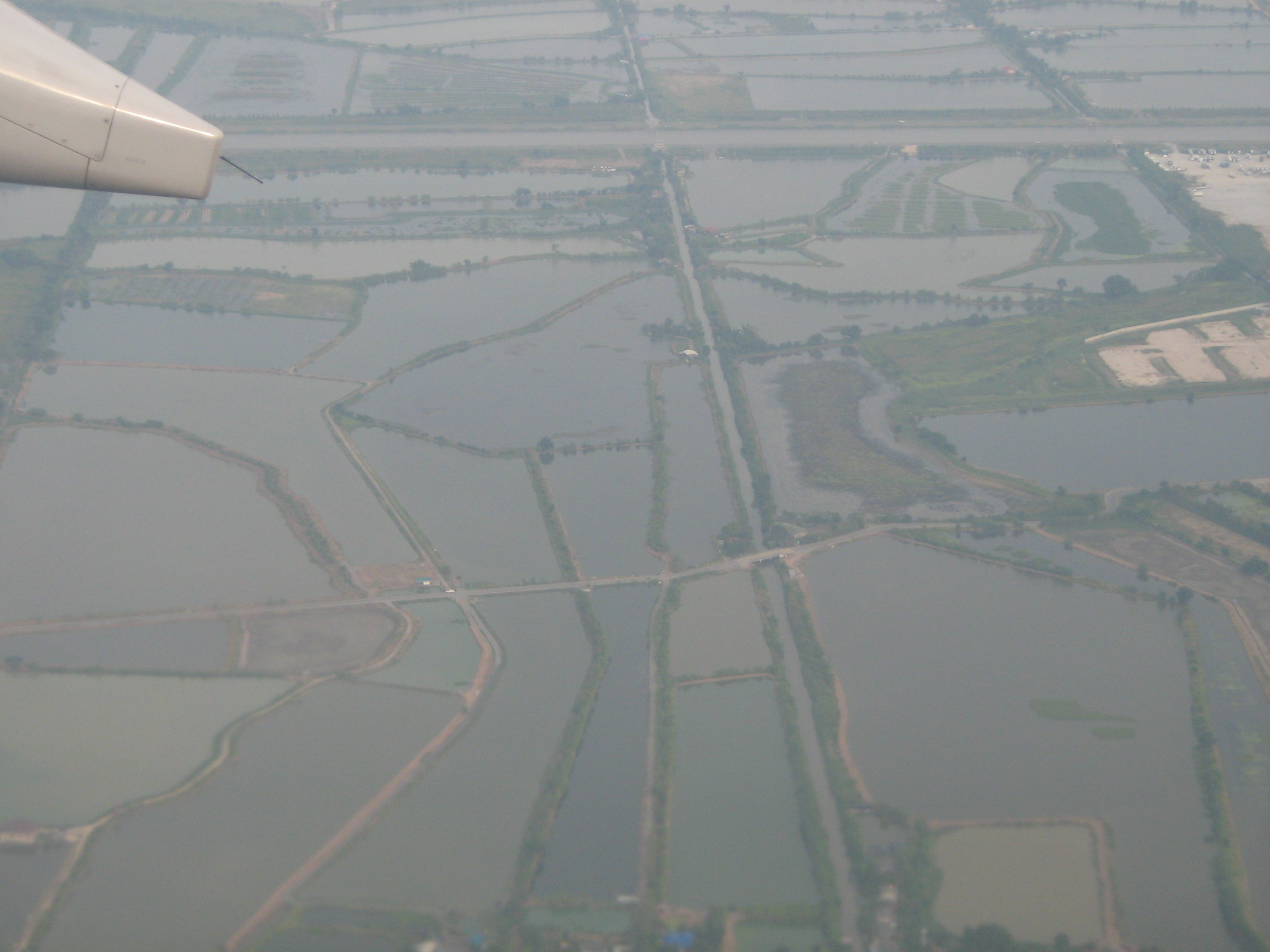
Bangkok looking very wet, Nov. 4/11

I have no idea what happened to my photos of Hong Kong but here are a couple I took as I landed in Bangkok briefly on the way from HK to Delhi. Bangkok was just beginning to recover from the flooding. I thought the airport was appropriate — its arches looked “Siamish” to me —

Bangkok Airport, Nov. 4, 2011

What to read on a 15-hour plane ride?

So my trip to India involves a bunch of looong plane rides, and I’m looking for titles of books that are going to totally distract me for a few hours. It has to be a “good” book — not just a quick read. I need to get involved in it, hooked by it, transported by it. What do you suggest?

I’ll post some of the responses and my decisions here. I have read in the Rough Guide that there are some neat bookstores in places I’m going like Pushkar! Imagine buying a book in Pushkar! (Of course, if you live there, it wouldn’t seem so exotic, but to me it does.) I think I will leave whatever books I take there, with someone who wants them, and get more in India for the return trip.

Five days to liftoff!! I read this article today and I was reminded that it’s not all pink cities and taj mahals: http://www.guardian.co.uk/sport/2011/oct/27/india-grand-prix-formula-one?INTCMP=SRCH but my anticipation is undiminished.

TMI!

I have been (pleasantly) inundated with Indian history all week. Having finished reading Empire of the Soul, I have turned my attention back to India: A History. Revised and Updated"" by John Keay. There is no way I’ll get it finished before I leave, and I won’t take it with me because it’s two inches thick, but I am still taking my leisurely time with it rather than trying to skim, and hoping I will retain at least a little of the knowledge I am picking up.

In recent days, the history has hit solid ground – instead of to informed speculation, Keay can now refer to documents that provide at least general dates of battles and invasions, and lives of specific individuals – most notably that of Siddharta Guatama, better known to us as the Buddha, who is thought to have been born c. 563 BCE in the area now known as Nepal. I have also read about Alexander the Great’s remarkable advance through northwestern India, starting in about 326 BCE. He withdrew several years later, mainly because his men were about to mutiny after eight years on the road, but they took the first known Indian expatriate back to Greece with them. Calanus, whose recorded behaviour indicates that he may have been a Jain, was a towering figure who impressed the Greeks not only by walking around naked but also by unflinchingly immolating himself on his own funeral pyre when he felt his end was drawing near: he didn’t want become a burden.

Tonight I turned on TVO to see an episode of The Story of India, a fascinating PBS/BBC series narrated by Michael Wood. Tonight’s segment, fifth in the series although it’s the first I have seen, was entitled “The Meeting of Two Oceans.”  It concerned itself with India’s history from about 12oo to 1600. During this period, which includes the Renaissance, India was the richest and most powerful nation in the world. One of the most remarkable characters from that era was the Mughal ruler Akbar, whose fictionalized story I read only a few years ago in The Enchantress of Florence by Salman Rushdie. Akbar in real life, according to the PBS/BBC program, was remarkable for, among other reasons, his efforts to find a common ground among India’s religions.

Between leaping from 500 BCE to 1600 CE, and trying to keep a close enough grip on the present to keep track of what I need to take with me when I leave on my adventure (such as a plug adapter so that I can recharge my camera batteries and iPad), I have already got a sense that I am gradually losing touch with the mundane matters of my life (which also need my  attention for at least another ten days!)

The Rough Guide Has A Sense of Humour. Who Knew?

I’ve been diligently reading the opening section of the Rough Guide to India to get a clear idea of what I should expect, what I should take with me, what I should leave at home, what I should get jabbed with before I go, etc. I keep coming across statements in the travel guide that make me laugh out loud.

Since the tour company I am travelling with recommends bringing a sense of humour to India in order to survive the inevitable unexpected last-minute changes and confusions and unfamiliar practices and customs, I am beginning to think I’ve already packed one of the most important contributors to a positive experience (along with the Imodium and the pre-treated mosquito net), because I am certainly amused.

Here are a few examples from the Rough Guide that have made me laugh:

  • “Getting good maps of India, in India, can be difficult. The government – in an archaic suspicion of cartography, and in spite of full coverage of the country on Google – forbids the sale of detailed maps of border areas, which include the entire coastline.”
  • “Sending a parcel from India can be a performance. First take it to a tailor to have it wrapped in cheap cotton cloth, stitched and sealed with wax. Next, take it to the post office, fill in and attach the necessary customs forms, buy your stamps, see them franked and dispatch it. Surface mail is incredibly cheap and takes an average of six months to arrive – it may take half or two times that, however.” (I am very tempted to mail myself something, just to experience this.)
  • I want to try the laundry system, too: “In India, no one goes to the laundry: if they don’t do their own, they send it out to a dhobi . . . . The dhobi will take your dirty washing to a dhobi ghat, a public clothes-washing area (the bank of a river for example), where it is shown some old-fashioned discipline: separated, soaped and given a damn good thrashing to beat the dirt out of it. Then it is hung out to dry in the sun and, once dried, taken to the ironing sheds where every garment is endowed with razor-sharp creases and then matched to its rightful owner by hidden cryptic markings.”
  • Finally, following several pieces of advice to women travelling alone who may need to deal with unwanted overtures or harassments: “If you feel someone getting too close in a crowd or on a bus, brandishing your left shoe in his face can be very effective.”

Countdown to India: 22 days to liftoff

Pieces are falling into place. I have completed the requirements for applying for a tourist visa to India and need only go back to the passport agency office (for a third time) to pick it up. I have received all the necessary inoculations, and have prescriptions for the meds I will pack but am hoping I don’t need while I am there (Ciproflaxin, for example). I am making plans for walking tours on the two days I will be spending in Mumbai between when my tour is over and when I fly home. I am starting to get so excited about this trip that on a few nights I have been awake far too late, just reading about where I’m going.

I am reading the introductory material (what to bring, what not to eat when you get there, etc) in the The Rough Guide to India (Rough Guides), which I received as a gift from the tour agency, G Adventures, when I booked my trip. And I am reading about the individual cities and sites I will be visiting. I read the entire section on Mumbai the day I went to hand in the application for my tourist visa: that night I barely slept at all because I was so pumped about this trip. So much to see! So much to do! So little time!

I’ve also been reading Empire of the Soul: Some Journeys in India"", a book by Paul William Roberts that a friend of mine gave me for reasons I don’t remember about 15 years ago (thanks, Deb!). I’ve been moving it from one residence to another ever since — waiting for the right moment to read it, I suppose — and I’m glad I did because now I am being transported by it. 🙂

Published in 1994 by Stoddart, the book is the story of the author’s several journeys to India between the mid-70s and  the early 1990s and it is funny, insightful and illuminating. Roberts’s early explorations of India were based largely on his search for enlightenment among the gurus and seers of the subcontinent, and this interest (combined with a nicely skeptical eye) took him to a wildly diverse range of ashrams where he soon found that some holy men were more “holy” than others. His early journeys also took him to the beaches of Goa during the Hippie era, where he had encounters both amusing and alarming: sometimes both at the same time.

Roberts, who has also written about Egypt and was a respected reporter on Iraq during Desert Storm for such notable magazines as Harper’s and Saturday Night, has won a National Magazine Award as well as other accolades. He is a man of diverse interests, so his travel stories focus not only on his spiritual explorations of India but also on such topics as the country’s history, geography, natural history, culture and economics (to name only a few). His recounting of an experience with “Delhi Belly,” while hilarious as a piece of prose, redoubled my determination to drink only bottled water on my trip, to eat no vegetables or fruits unless I peel them or see them being boiled, and to avoid meat unless my tour guide gives it the thumbs’ up.

Empire of the Soul is a fine book, and I recommend it. I was sorry to read on the website of the author, who is “considered one of Canada’s s top experts on Middle Eastern affairs,” that he lost his sight a few years ago and has lived in seclusion ever since.

I also continue my perusal of India: A History. Revised and Updated"" by John Keay. One section explores the history of the word “India” itself which, until late in the last century, had demeaning overtones — largely due to centuries of the subcontinent’s colonization by outside powers, from the Mughals to the British. Keay says that the word “India” itself likely derives from the Sanskrit word for “river” — Sindhu — as transformed during its passage through various other languages including Persian and Greek to finally become “Indus” (also the name of the vast river basin in north-western India). By the time the British had taken control of the subcontinent, “The Indies” had come to mean to outsiders a place to be conquered and exploited, and after Partition, many expected that the new state would take another name. But it did not, and since that time, India has successfully begun to redefine itself as an independent nation, thereby altering for the better the connotations associated with its name.

Keay also presents an interesting account of the beginnings of the caste system in India, explaining that the two highest castes  were originally members of either the ruling or “warrior” families (kings and/or governmental leaders) or the brahmans, a priesthood. These two castes believed they shared a common ancestor and they were associated in the Rig Veda (the collection of sacred Vedic Sanskrit hymns, composed — it is thought — between 1700 and 11oo BC) with the arms (the ksatryia and rajas) and the mouth (the brahmans). The next caste, the agricultural workers and merchants, were called the vaisya and although they were not as well pedigreed, they were still “twice born” — once physically and once through sacred rites. They were the people who created the wealth for the ksatryia and brahmans, and they were associated with the thighs. The lower castes were comprised primarily of the indigenous people of the region that is now northern India. These were the labourers, and the caste was named the sudra and represented by the feet.

In addition to history and travel stories, my attention has been attracted lately to stories in the media about India. I thoroughly enjoyed one that appeared recently in The Guardian, “Delhi’s traffic chaos has a character of its own,” in which Jason Burke shows that cultural and economic patterns of daily life in Delhi dictate traffic flows at various times of the day (and night), and that driving within lanes is simply not part of the script for Delhi drivers. I may be less amused and intrigued by this story in three weeks and a day or two when I am trying to get from the airport to my hotel. Stay tuned.

Countdown to India: 5 weeks, 2 days

Today I went to the Consulate General of India (Toronto) to get a travel visa. I had my passport with me, my vaccination record, my birth certificate and my travel bookings. The on-line information said that people had to apply in person. Still, I had this niggling little feeling that I should have phoned first.

Sure enough. When I got there, they insisted I go away again and apply for the visa on-line, then print out the result and bring it back — in person.

The Consulate General of India (Toronto) is about 1/2 hour from my place by transit, so when they directed me to a nearby Staples, I took the advice. I went to Staples and waited in line for another half hour for the one rentable  computer (someone else was also applying for a travel visa to India). When it was finally my turn, I input two pages of data (father’s name, place of birth; mother’s name, place of birth; religion; passport number, etc etc etc), saving as I went. At the end of Page 2,  the document went BLINK and everything disappeared. Everything from Page 1 was also gone.

I came home.

I figure that many things about India are going to drive my obsessive, goal-oriented, time-conserving Western approach to life around the bend and I should just start to get used to it — so I only threw a small fit, and only when the computer at Staples refused to print my receipt.

I think the Consulate General of India (Toronto) should install a couple of computers with internet access and charge for their use, thereby saving applicants from having to walk over to Staples and pay them.

I have my vaccinations and am starting to deal with the details I didn’t take care of last winter when I made my basic travel arrangements. I am getting very excited.