Watch. Listen. Learn. (India 10: Ranakpur to Mumbai)

Nov. 15-16, 2011

Night Train to Mumbai

The 13-hour journey between Ranakpur and Mumbai comprised the longest and most challenging night of all the nights I spent in India, but in recollection it is a perfect example of why I am happy that I could not afford too many luxuries on that three-week trip. The overnight train ride was an experience I would not have missed for the world – although I will happily go some distance out of my way in future never to have to repeat it.

Just outside the Ranakpur train station

Our group of fifteen arrived by jeep at the train station in Ranakpur at sundown, about ninety minutes before our train was due to depart. We spent most of the intervening time buying food and water and using the bathroom, aware that such activities were going to be more challenging once we had embarked.

The highlight of the wait – and yes, there was at least one highlight for me no matter where I went in India – was that I saw a chai-wallah pushing his cart along the platform and knew what he was called because of all the India-based books I’ve read. Like the moment at the Red Fort in Agra that stirred to life through all my senses Jodha, the favourite (albeit imaginary) wife of Akbar, as Salman Rushdie had created her in The Enchantress of Florence, the sight of the chai-wallah evoked scenes in several other novels: most recently, Aravind Adiga’s Last Man in Tower.

chai-wallah

A “wallah” is a person who performs a certain task or is involved in a specific field – so a rickshaw-wallah or an auto-wallah drives an auto rickshaw, a dhobi-wallah is a laundry worker, and a chai-wallah serves chai tea.

We Embark

Our guide Abhi had gathered us together in the area on the platform where our sleeping car would stop. He warned us that our train would be in the station for only ten minutes and we’d need to get ourselves and our luggage on board within that time. Our experience getting onto another train in Delhi and then off again in Agra had taught us to trust his words: we knew we would need to move quickly. I was burdened not only with my short, full backpack and my suitcase (the others just had full-length backpacks, which was an advantage in situations like this, although the wheels on my suitcase were an advantage when we had to walk any distance), plus I was still carrying The Albatross ­­­­­­­­­–– a pillow-sized object that contained a couple of ill-conceived purchases weighing 6.7 kg.

I was near the front of our group and from the moment I stepped aboard the train I was worrying about those at the back. The train car was jam-packed with travellers and their belongings, train attendants, and vendors and their wares, and the aisle was narrow. It was impossible to move forward without literally pushing ahead – and even doing that I feared we would leave someone behind on the platform. But then to my relief I saw that some of our group had gone to the front of the car and were now pressing their way down the aisle toward the bunks between us to which we’d been assigned. Each bunk had a number, and each of us had been told which bunk number would be ours.

I had booked private rooms throughout my stay (one of the few aforementioned luxuries in which I had indulged) but I had known from the beginning that I would not have my own compartment on this train. What I had not known was that there would be no compartments on the train at all. We would have a fold-out bunk in a crowded public car, and that was it.

Let me describe our third-class air-conditioned sleeping car. Down one wall against the windows closest to the platform were eight or ten ten sets of bunks, each three bunks high. The two top bunks in each set were strapped up against the wall, and before bed, all the people from the two bunks that were above the bench seat (which ultimately became the lower bunk) sat together on the seat with the person who would ultimately sleep on it. Many times, more than one person – often a mother and child – were slated to sleep on one of the bunks, which meant that there could be quite a few people sitting on the lower bench pre-bedtime. They passed the time by tapping or talking on cell phones, watching other people – the “locals” found foreigners particularly interesting to watch, probably for good reason – and eating their dinners: the families having brought food from home.

Photo: Antonia and Janine

Across from these bunks set parallel to the tracks on one side of the car, there were crosswise banks of bunks, two per track-parallel set. There were three levels of bunks on each side there as well, facing one another, so that on the lower bunk/bench before bedtime, there could have been three or four or five people on each side, facing one another. Beneath their seats was their luggage and what didn’t fit there, they carried on their laps or jammed down into any available space on the seat.

In summary, each train car accommodated maybe 100 passengers plus their children and belongings, and all of their sleeping quarters, not to mention the attendants and the vendors who wandered up and down the narrow aisle offering food and chai and other merchandise for sale. The system worked perfectly when all the passengers had stowed themselves into their bunks at night, but before the bunks were let down, it was chaotic.

Our Compartment

When I got to my assigned seat—which was a lower bunk—with two others from our group (Antonia and Janine, young Swedish women who were assigned to the lower and middle bunks opposite me), we found an extended family taking up all of the bench space on both sides of the compartment that we were to share with them. They included an older woman (50s?) and a younger woman (30s), both in saris, doling out food, the husband of the younger woman, their two children, and an elderly man in white. I jammed myself as best I could onto the end of the bench that would ultimately be my bed, with my backpack on the floor between my feet and The Albatross jammed between me and the aisle. Antonia and Janine sat down opposite me. There was, however, no room for our luggage, which blocked the aisle between us and the row of bunks along the window opposite. There, a lovely woman with her child watched us with kindness and amusement.

It seemed impossible that we should travel even two hours under such cramped conditions, much less thirteen, but at that point our guide Abhi suddenly appeared and executed one of his magic tricks. He assessed the situation carefully for a long moment, then started asking our seat companions questions in Hindi. They answered him by bending down to indicate certain items of luggage that were stowed beneath our benches. What Abhi was doing was asking them to point out which pieces of luggage belonged to them. Only one stowable item was permitted per bunk and it came to light during Abhi’s investigation that a couple of the baggage items under our bench did not belong to the people on our bunks. Abhi hauled these out and started wandering around the train car until he found their owners, leaving it to them to figure out what they were going to do with them next.

He then helped us stow our luggage underneath our seats. When he was finished, we were all seated where we were supposed to be, our luggage was all stowed where it was supposed to be, and miraculously, there was room for everything. I use the term “room” loosely: I still had my backpack between my knees and my Albatross stowed at my hip and I was jammed up against the young father. But still I was impressed and my heart filled with delight: yet again, India had showed me how it made order out of chaos.

I started to clap at what Abhi had achieved, and Antonia and Janine quickly joined in – and then so did our Indian fellow travellers until all of us in our little corner of the train car were applauding Abhi’s skill, and he was taking bows. I was moved: it was a bonding experience among strangers who spoke different languages. (As I may have said before, most of us in the group agreed that we would have had a whole different – and much worse – experience in India if it had not been for the street-smarts, intelligence, patience and good humour of our G Adventures guide Abhi [Abhishek] Chhetri. We were very lucky to have him, as is his employer).

Photo: Liam O'Brien

Settling In

At that point, across from me, Antonia and Janine sensibly got out their laptop, put on shared headphones, and watched an episode of The OC. I tried to read but it was hard, especially after the young father next to me got his children onto the top bunk (the older man had previously retreated to the opposite top bunk), arranged the women in his life across from him (so there were now four women on the bench across from him and me) and then proceeded to lie down with his stockinged feet pressed up against my left hip. He clearly felt entitled to stretch out — hence the crowded conditions into which he had placed his wife and mother or mother-in-law, as well as Antonia and Janine – and I didn’t want to move because I was determined not to lose another inch or two of what I considered “my” space. The effort not to jockey for position made it hard to get comfortable and read.

Finally, at about 9 p.m., Abhi wandered by on one of his regular patrols and I suggested that he ask my travelling companions if they were ready to go to sleep yet. He did, and everyone seemed agreeable. The straps that held the upper bunks were released, we were each given a sheet, a blanket and a pillow, we sorted ourselves into our bunks, then we went to sleep . . . or at least attempted to do so.

Photo: Mark Allen

I found sleeping almost impossible because the grandmother in our group had gone to bed on the floor between the bottom bunk that I was in and the one containing her son or son-in-law across the narrow opening between us, so there was nowhere to put The Albatross and my over-stuffed backpack except to stow one behind my head and the other under my feet. It was not a comfortable position, especially since the slippery Naugahyde-type bench was not in any kind of sticking relationship with the sheet and blanket. Every which way I turned, it seemed, I rolled onto one of my running shoes or a water bottle, or heard and felt the crunch and crackle of potato chips being squashed into smaller and smaller bits.

Of course, thanks to all the water we were incessantly drinking, I also had to make a coupe of pit stops in the night. This involved extricating myself from my bedclothes, the Albatross, my backpack, my running shoes, water bottles and chip bags while edging my body down the bench and off the end into the aisle where I could get onto my feet, and then making my way either forward or back (past humans sleeping everywhere and in every position including several men upright just outside the bathrooms) to the toilets situated at the rear of each car.

On one side were western toilets; on the other side the Indian toilets, which are essentially flat openings in the floor. By then I had learned that the Indian toilets were usually cleaner than the western ones, so I used them and as usual admired the strength of the upper legs of the people of India, particularly the women who must get from a squatting position to an upright one several times a day. This is an especially challenging maneuver when you are also trying to avoid letting any part of your body or your clothing touch the floor.

Photo: Antonia and Janine

Enough

It was during that night that the whole “living close to the ground in India” experience wore a little thin – for the first and almost only time. All I wanted was for there to be enough fewer people that I could stretch out and get to sleep. I could not even bring myself to tell myself that at least I had a reserved bunk to sleep on, that I should be glad there was a bunk at all, and that the car was air-conditioned, that I had not been asked to share the bunk with anyone else, that I had a country like Canada to go home to in a week, or anything else of that nature. But I must eventually have dozed off because when I woke at 5 a.m. to the sound of a man walking down the aisle yelling “Chai,” ”Chai,” “Chai!” the Indian family was gone. Feeling as though I’d just won a lottery of some sort, I put The Albatross on the floor (hoping someone might steal it), hooked my arm through my backpack (so no one would steal it), curled up in a golden light, and sank into a deep, sound sleep.

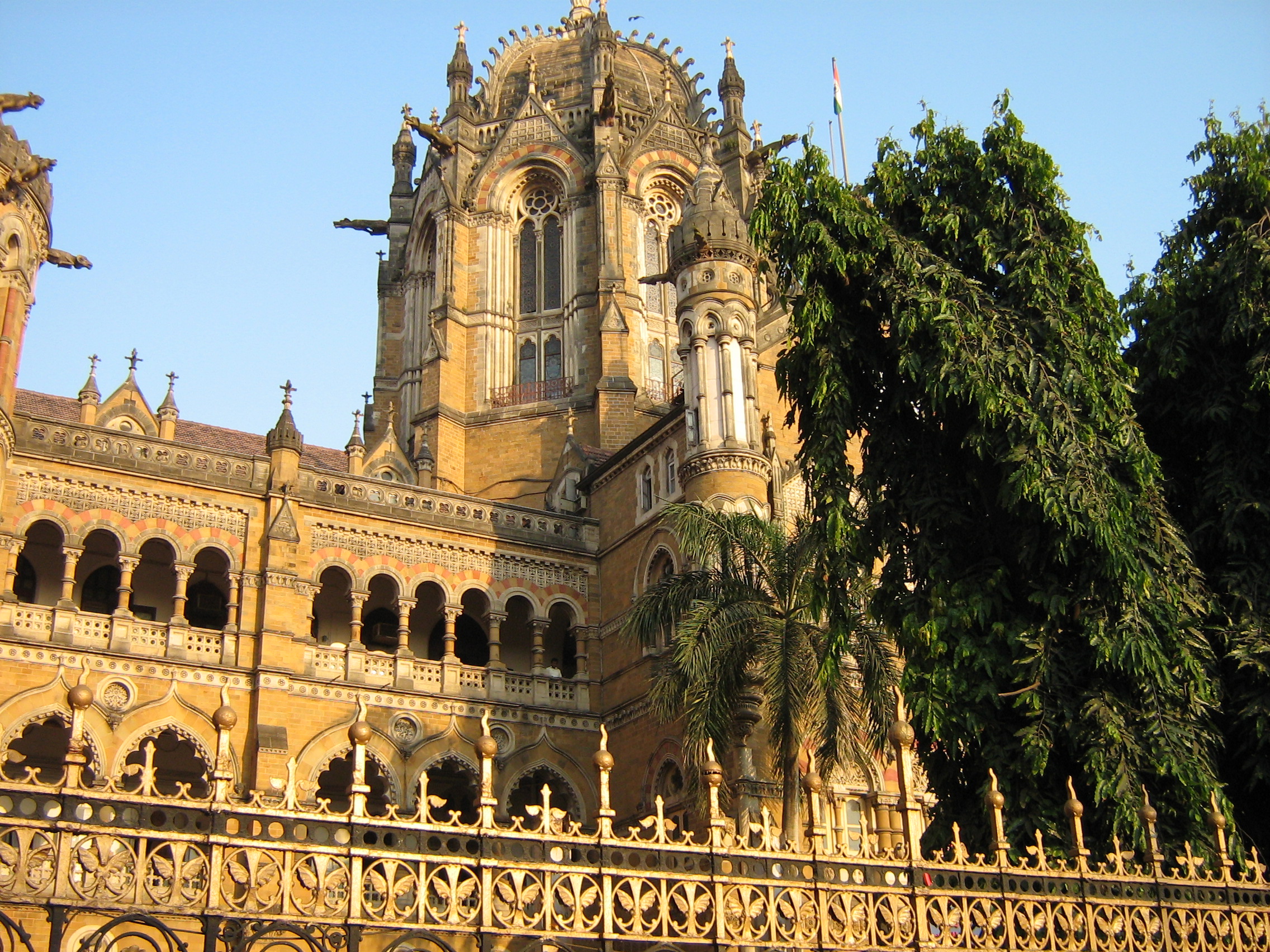
What seemed a moment later, it was time to get up, get organized, get off the train and walk into fourth largest (pop.: 12 million) and most densely populated (20,640 people per sq km) city in the world – and I found myself restored: both wide awake and eager.

(Check out more photos on Antonia and Janine’s blog. If you speak Swedish, you can check out the text there, too! Thanks also to two other travelling buddies, Liam O’Brien and Mark Allen, for giving me permission to use a few of their photos.)

Mumbai Station, morning

Watch. Listen. Learn. (India 9: Ranakpur)

November 14-15, 2011: Ranakpur

Bats, Bees and Black-Faced Monkeys

On our trip to India, our group was treated to a whole range of transportation options, from taxis, through tuk-tuks, to camels, to buses of various shapes and sizes, and later a train and a plane. This time, we travelled between cities by jeep. (A boat ride had been scheduled around the lake palaces of Udaipur but a wedding interfered. November is prime wedding season for Hindus in India; everywhere we went, it seemed, something was either closed or at least complicated by a wedding. A couple of members of our group took to wandering into wedding processions in the street when we came upon them, where they were welcomed by the families and guests and had a lovely time contributing to the celebrations. At the Taj Mahal a newly-wed Australian couple elaborately dressed as a raja and ranee were getting photos taken with their entourage – to the apparent amusement of visitors who looked to me to be far more deeply steeped in Hinduism than did the bride and groom.)

Photo: Liam O'Brien

Travelling by jeep to the Ranakpur region, ninety minutes from Udaipur, allowed us the opportunity to stop along the highway to see a traditional farming enterprise. There, an irrigation system was powered by an elderly blind man, who sat cross-legged on a wagon behind two oxen, which he drove in a circle to raise water from a well. The water was then diverted to different fields as needed. The fields were cultivated by another pair of oxen that pulled a plough behind them.

Click here to see more photos from the Ranakpur/Aranyawas/Jain Temple segment of our trip

Photo: Mark Allen

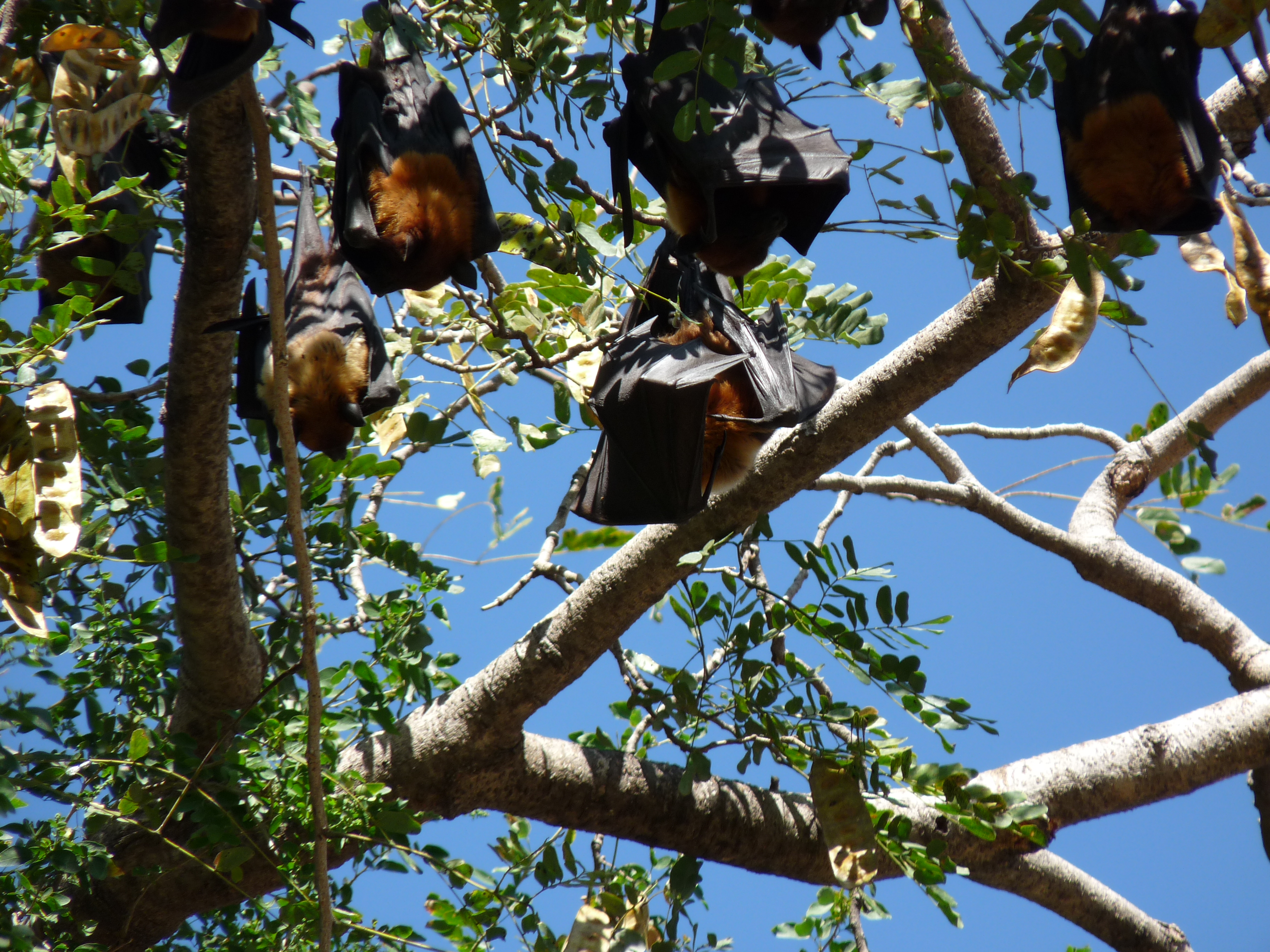
En route to Ranakpur, we stopped a second time to observe about a hundred flying foxes folded and hanging like paper-wrapped fruit in trees above the highway, sleeping away the day (a real treat for me, as many of you will know). We gradually entered a hilly, jungle area and some of the most beautiful country I have seen in India. Monkeys sat on concrete abutments along the roadway, watching us go by, and we passed a “leopard crossing” sign.

Our accommodation near Ranakpur was at the Aranyawas Resort in the Aravalli Hills. There, instead of the blaring noise of street traffic, we were wakened in the morning by the sounds of monkeys galloping across our balconies and rooftops (they are not dainty, quiet creatures, it turns out). There were lots of langur monkeys in the area, and leopards have indeed been sighted (not by us) at the pool created by the human-made waterfall just below the resort. We all enjoyed the greenery, the calls of birds, the hoots of an alpha male monkey and the honks of geese—quite a contrast to the busy and noisy urban scenes that had surrounded all of our accommodation until now.

The Aranyawas facility was spotless and the food outstanding. Like everywhere we went in India, there were the occasional power outages and here, the water also suddenly went off one afternoon — just as I had finished massaging shampoo into my wet hair in the shower. I stood and waited, wondering what my options might be if it never came back on again (a dip in the leopard pool? Simply allowing my lathered self to dry, and moving on like that?) but after a few minutes I was hit by a blast of cold water and resumed my shower. I was used to cool showers by then, and because it is warm in India even in the winter (usually over 30C), I did not mind.

Jain Temples

We took the same jeeps on a three- or four-hour excursion from the resort to see one of the major temples in the Jain religion.  Jainism is a small religion, but small is relative in India—an estimated 4.2 million people are Jains (compare to estimated 827 million Hindus, 150 million Muslims, 37 million Buddhists, 27 million Christians, 19 million Sikhs, etc.) and the religion has many followers outside of India. It is believed by historians that Jainism grew from the same roots as Hinduism, and had its origins in the Indus Valley several centuries before the Common Era. The principles of Jainism are set out in detail in this Wikipedia entry, and some of the more noticeable practices of the Jains arises from their very comprehensive interpretation of the principle of non-violence. They make every effort to harm no living creature – which means of course that they are vegetarians (to an extreme in some cases, not eating certain vegetables if it will require killing the whole plant), and in some more rigorous communities, they wear no clothes and sweep the path in front of them before they walk in order to avoid harming any insects or even microbes.

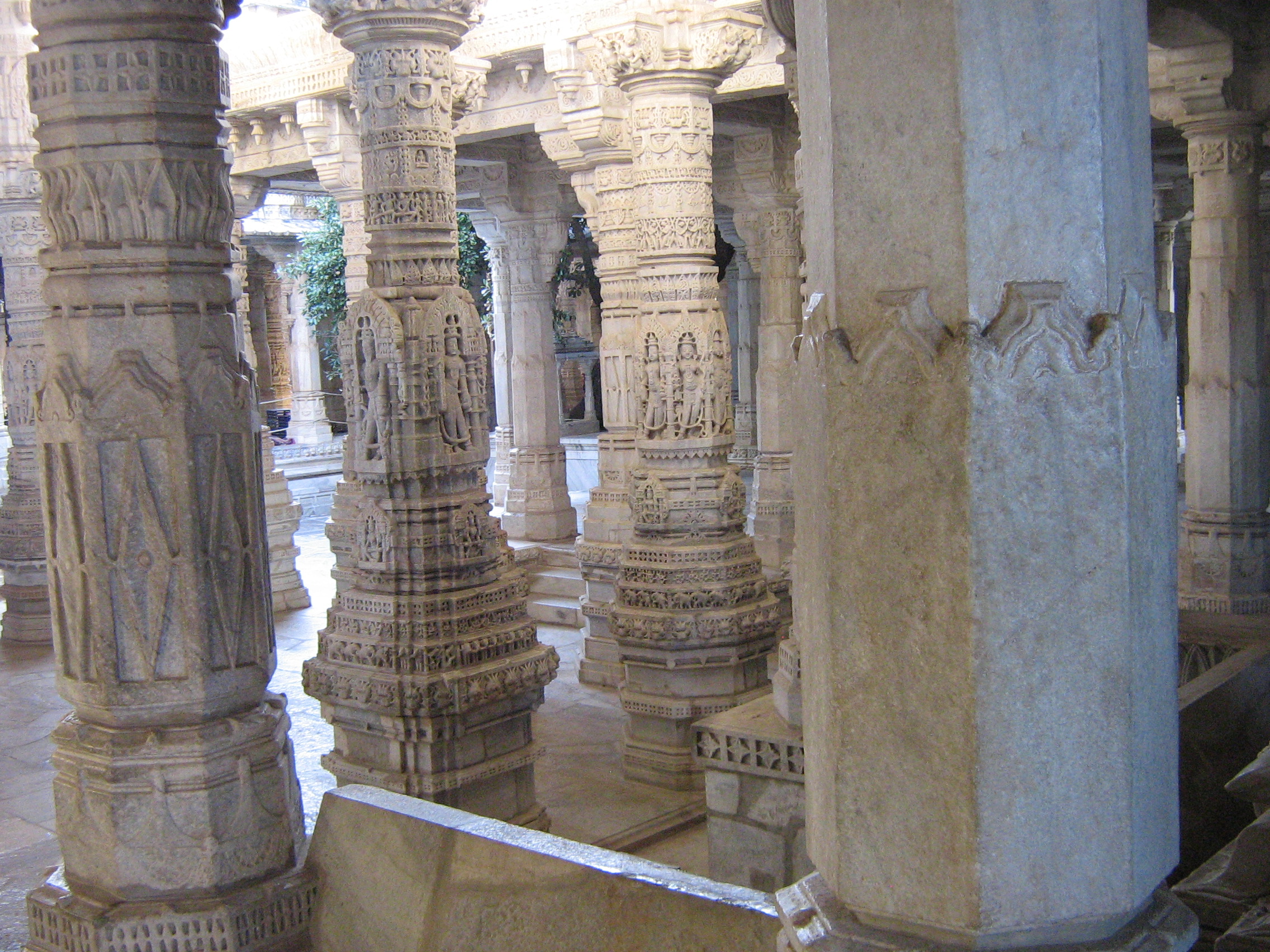
Although the specific history of the temple is not known either, it is believed to have been built between the late 14th and mid-15th centuries. Made of a pale marble, it features 1440 individually carved columns – all different – and is constructed in such a way as to admit the most light possible to the interior of the building. It is an amazing sight, and I kept taking more and more pictures until I admitted to myself the impossibility of capturing it.

As I meandered about the temple, I met a couple of kids who were fascinated by my camera, so I took a photo of their small group and showed it to them in the view finder: they seemed surprised and pleased. I told them I would send them a copy of the photo if they sent me an email asking for it, and I wrote down the email address for them, but they spoke no English and had no internet so I doubt I’ll hear from them.

A colony of wild bees

At one point I stuck my head out of the temple to look at the outside of it and discovered an absolutely enormous colony of wild bees. After I’d finished my tour of the temple, I wandered around outside the building and found that there were at least four bee colonies of similar size. Due to the beliefs of the Jains, I suppose these beehives are safe from destruction, but I would not want to be in the area if one of their number gets aggravated with a human. (I have since read on-line blogs from people who have, in fact, been stung and chased by bees here. We were fortunate — but then, we were careful not to go too close.)

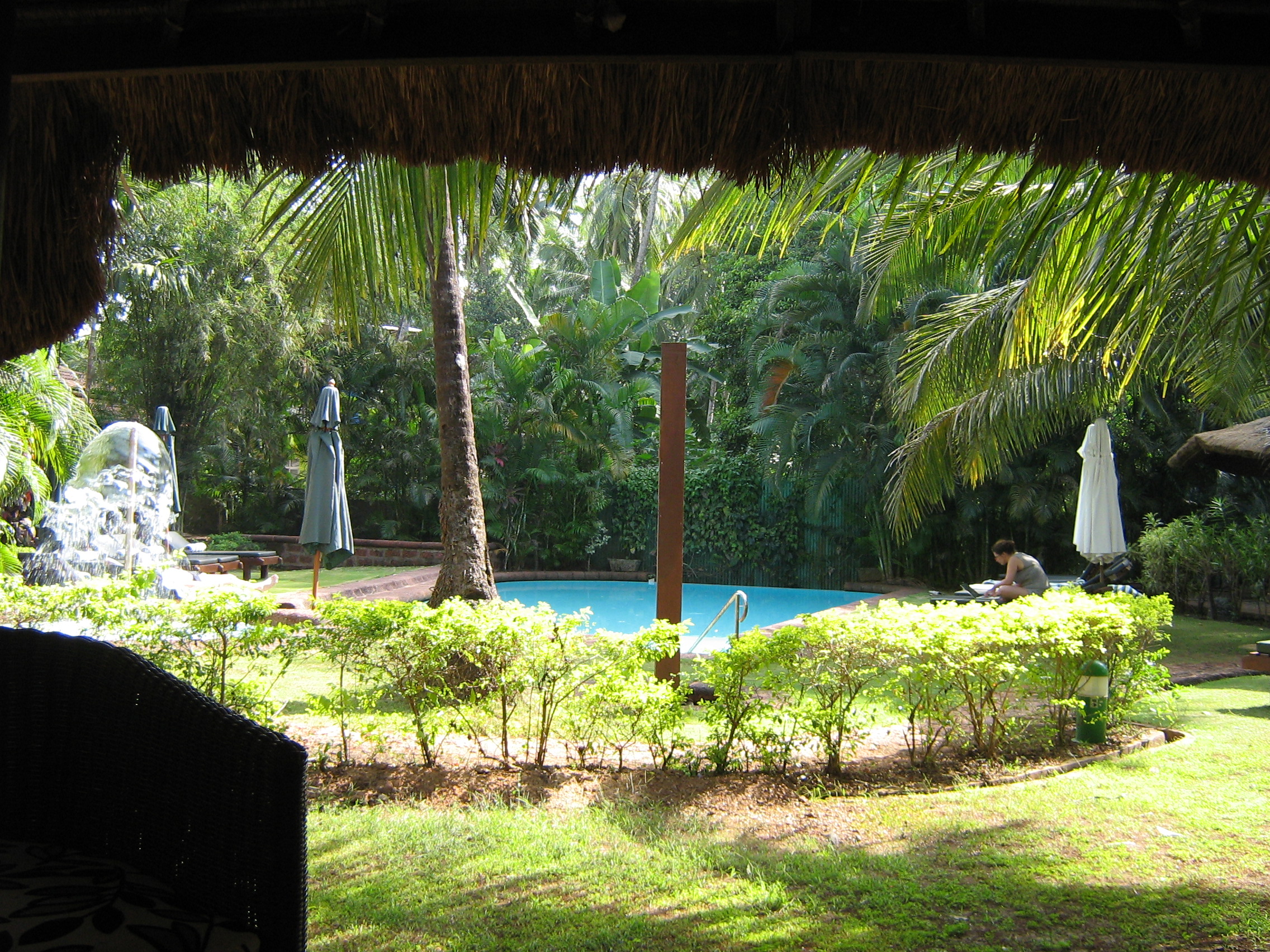
We spent the next day relaxing by the pool at Aranyawas Resort, which was a good idea as it meant we were rested up before the amazing experience of taking a night train to Mumbai – a method of transportation that allowed none of us to get much sleep.

Picasa photos related to this blog post:

Aranyawas, Ranakpur & a splendid Jain temple

Watch. Listen. Learn. (India 8: Travelling With Your Stomach)

At our first meeting on our first day in Delhi, our tour guide Abhi told our group, “It won’t be if you get sick, it will be when.”

He told us cheerfully that “Almost every visitor to India gets sick,” and although he did feel that some of the ailments his charges suffered were more psychologically than physically induced, he was pretty sure that for most of us it was going to be unavoidable that we would come down with something. “You’ll likely feel sick for a day or two,” he said, “but then you will get better.”

I was glad of his reassuring tone, having been advised by just about everyone back in Canada to exercise extreme caution, or risk being flattened by diseases ranging from cholera to dysentery, and symptoms from fever to a prolapsed rectum. (Having a son who serves as the on-air biologist for a series of programs about parasites does not help to reduce your paranoia as you prepare to travel to exotic places.)

However, the problem with feeling as though it is inevitable that some ailment is going to hit you at some point, even if you are assuming it will be mild, is that you spend a lot of time just waiting for that to happen. You do all the reasonable things — like avoiding drinking water out of anything but a bottle you have unsealed yourself, not even brushing your teeth with water from a tap, trying not to let water into your mouth when you take a shower, avoiding any fruits or vegetables you haven’t peeled yourself, and giving a wide berth to food prepared by road-side vendors. Some places where we stayed (such as the “glam-camp” at Pushkar) posted signs to indicate that their fruits and vegetables had been washed in mineral water, but I still wouldn’t eat them. In fact, I didn’t have a fresh vegetable from the time I arrived in India until I reached Goa, where I inadvertently forgot I was still in India and ate a tomato with my scrambled eggs. (Fortunately, it didn’t make me sick, and it tasted great.)

Some of our group avoided meat throughout the trip — and not just the vegetarians. (They didn’t suffer: there are lots and lots of great vegetarian dishes in India.) At times when properly prepared food was not available, mainly on the bus and train trips, we subsisted on pre-packaged products like potato chips (which my British companions referred to as “crisps” so often that it will take me a while to stop thinking of them as that), bottles of pop, and cookies. And lots and lots of bottled water.

But still, a part of me always assumed that nothing I could do was going to prevent my getting an upset stomach somewhere.

As it turned out, the way the stomach ailments went through our group made me think at one point that it could have been a flu bug that someone had brought from home that was being passed from one of us to another — we went down one at a time and then came back up again without much problem. Some people were really sick for 24 to 48 hours — unable to keep anything in their stomachs — while others of us were only mildly inconvenienced. One or two made it all the way through without getting sick at all, while others occasionally exacerbated their problems by enjoying one too many rums the night before: once or twice, imagining what it must be like to have a hangover on a dirty, bumpy crowded bus when it’s about 32 degrees and there’s no air conditioning almost brought on an attack of sympathetic nausea in me.

When the bug (or the bugs) finally did hit me, despite everything I’d done to avoid it/them, I felt almost relieved: now I could stop worrying about getting sick, I thought (although of course I couldn’t let down my guard about what I ate and drank, lest I get something else). When it did happen — somewhere between Udaipur and Ranakpur — I might have got it from a sandwich I bought from a usually reliable coffee chain, or from swallowing water in a swimming pool, or from a restaurant whose meal had caused a few people to feel a bit uneasy — or maybe it was, in fact, just something I’d caught from a fellow traveller. Who knows?

Once you’ve worked your way around travelling with a stomach upset you find that it’s not as bad as you think it’s going to be. You can always ask a driver to stop for you in an emergency — well, of course, unless you are on the train. But what I learned from this trip is that worrying about it ahead of time is almost more hassle than the actual condition.

___________

My tips for those who are travelling to places where they may get sick:

In addition to prescription medications that your travel medical clinic may prescribe, such as ciprofloxacin, bring along Immodium and some kind of nausea-prevention medication. Another way to help your stomach is to consume probiotics, acidolphilus etc. before and during your trip (see first comment below)  

Don’t take the Immodium unless you must — by which I mean because you are travelling in  a public vehicle with no bathroom, or because you need to see some tourist site you’ll never get to see again. It’s better to let whatever is “bugging” you get out. Carry toilet paper in your hand-luggage in case you need to make an unscheduled stop. And bring a rehydration powder that you can add to water if you do lose a lot of fluids in a short period of time. (Add it to bottled water, or you’ll be right back where you started from.)

(Edit: I just remembered that someone in our group brought charcoal pills to stop vomiting. I know nothing about charcoal pills except that once I wrote an article about how some researchers were trying to use a charcoal-based concoction to stop vomiting and diarrhea in kids who had been poisoned with e coli and were getting morbidly dehydrated. I’m not sure how the research turned out, either. I only mention this because I like to be thorough. 😉 )

Rice and bananas are good things to eat if  you have been unwell — stick with them until you get your stomach back for the spices and oily foods. Get extra sleep when you can, but as much as possible, just keep right on trucking….

Watch. Listen. Learn. (India 7: Udaipur)

Friday to Sunday, Nov. 11-13, 2011, Udaipur

Dances with water pots, and one with an Albatross

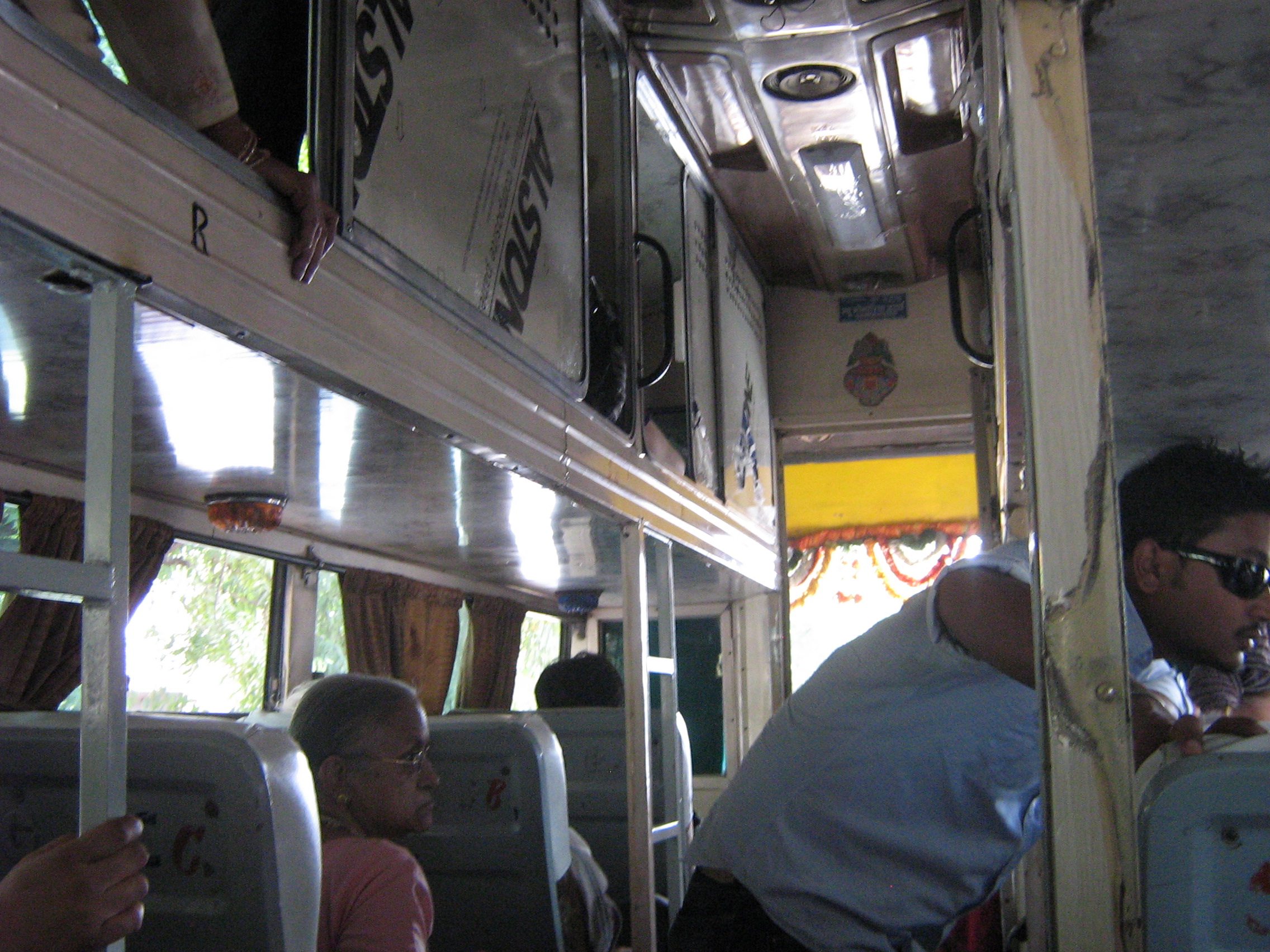
The bus trip to Udaipur (pronounced “You-Dah-Pur” — accent on the first syllable. I kept pronouncing it like “You-Diaper,” and, thankfully, my fellow travellers kept correcting me) was a long one — nine hours — and some people found it quite taxing — especially the few who weren’t feeling well. The bus was crowded and several local families sat on the floor in the aisle with their belongings. Their children looked at us with great curiosity and enough wisdom/caution not to return our smiles. It was the first bus I’ve seen with sleeping compartments above the seats, where the luggage bins usually are.

At one point the driver’s assistant made his way up the aisle, singing out for customers, with a splendidly arranged tray of what looked a bit like trail mix — nuts and coconut flakes — but it delivered the pungent odor of the chiles that were used to decorate the tray. When a passenger requested an order, the seller made a cone from a square of newspaper, filled it with the nut mixture, squeezed fresh lime over the top, and handed it over in exchange for a few rupees. The snack looked delicious but also none-too-sanitary, and the members of our group declined the opportunity to try it.

Highlights of that bus trip were few and far between, although at least we had more leg-room and a bit less dirt than we did on other segments of the journey. However, I was amused by two members of our troupe several rows back from me who sang songs to each other (and to anyone else who would listen) to help to pass the time, and by my seat companion, a young woman whose butt had been rubbed nearly raw by the ornamentation on the saddle of her camel the night before: she rode the last couple of hours with her head hanging off the seat, and her feet up against the neck rest, to give her behind a break. (I have a photo, but I am planning to make some money from repressing it.)

We arrived in Udaipur at about 9 p.m., checked into our hotel (the Vishnupriya — none too clean and the bathroom floor was flooded when I checked into my room; I am not a real fan of that hotel) and we went out immediately again for dinner at a rooftop restaurant with a splendid view of the city all lit up in the darkness. Flying foxes (a fruit bat) swooped over our heads as we ate.

Pretty City

Udaipur has been called the “most romantic city in India,” and it comes by that description honestly. There are several lakes in the area and there are palaces in the lakes, and the town winds uphill and down, revealing intriguing and diverse cityscapes every which way you look. Our guide told us, “People say that when you go to Venice, it is so beautiful it makes you want to die, but they say that Udaipur is so beautiful, it makes you want to live.”

Udaipur is a warm, friendly city with lots of small street-front shops. If you’re up for bargaining, you can find great leather goods, blouses, trousers, art, crafts, shoes, bangles and innumerable other items. The streets are far less crowded than are those of any other city we’ve been to, and they’re cleaner!

We were in Udaipur for three nights and most of us took the opportunity for a bit of R and R — shopping, wandering the streets, and lounging by the hotel pool. We got in a couple of excellent meals, including one at the Whistling Teal — a hookah restaurant — where I had the best tandoori chicken I’ve tasted in my life (but skipped the hookah), and one at The Tiger, where the price fixe menu included papadams, an aubergine-and-tomato-sauce dish with rice, and banana fritters for dessert — delicious, and a great deal at only about $8.00 total for the evening, including the tuk-tuk that got us there. The Tiger is a rooftop restaurant, too, overlooking the bathing ghats of Lake Pichola; in the still, warm night, the reflection of the lights of the temple, palaces and hotels shimmer across the water.

The Pots

A highlight of Udaipur for me was a cultural event I took in with one of our guides, Ricky, on the second night we were there. The Concert de’Indian Cultural Heritage at Bagore Ki Haveli, Gangaur Ghat, included traditional dances and presentations from the states of Rajasthan, Maharashtra, Gujurat and Goa. It included women dancing while neatly tapping consecutive small castanets attached along their arms and legs and feet with a ball attached to a rope, other women dancing with fire-filled braziers on their heads, an amazingly talented puppeteer and — the crowning glory in more ways than one — a woman who danced with two, then four, then five, then seven, then ten clay pots on her head. She was reconstructing the traditional practices of rural women who, needing to travel long distances to get water, make their heads save their heels by carrying as many pots as possible on top of one another.

The dancer, a woman of 65 — who, my guide told me, had recently had hip surgery — not only danced with all of those pots on her head, she did so while simultaneously picking up a kerchief with her teeth, then dancing on broken glass, then dancing with one foot on either side of a pie-plate-like metal pan which she banged back and forth in rhythm with the music. I was delighted to give her a small donation in addition to the entry fee,  and to have my picture taken with her.

Others in our group took advantage of a cooking class and learned to make several of the fabulous dishes we’ve been enjoying since we arrived in India. Some of my favourites so far have been:

  • chicken biryani
  • chicken tikka
  • fish curry (from south India, particularly Goa)
  • thali
  • parathas
  • alu ghobi
  • palak paneer
  • bhaji and
  • pickle

The Rise of The Albatross

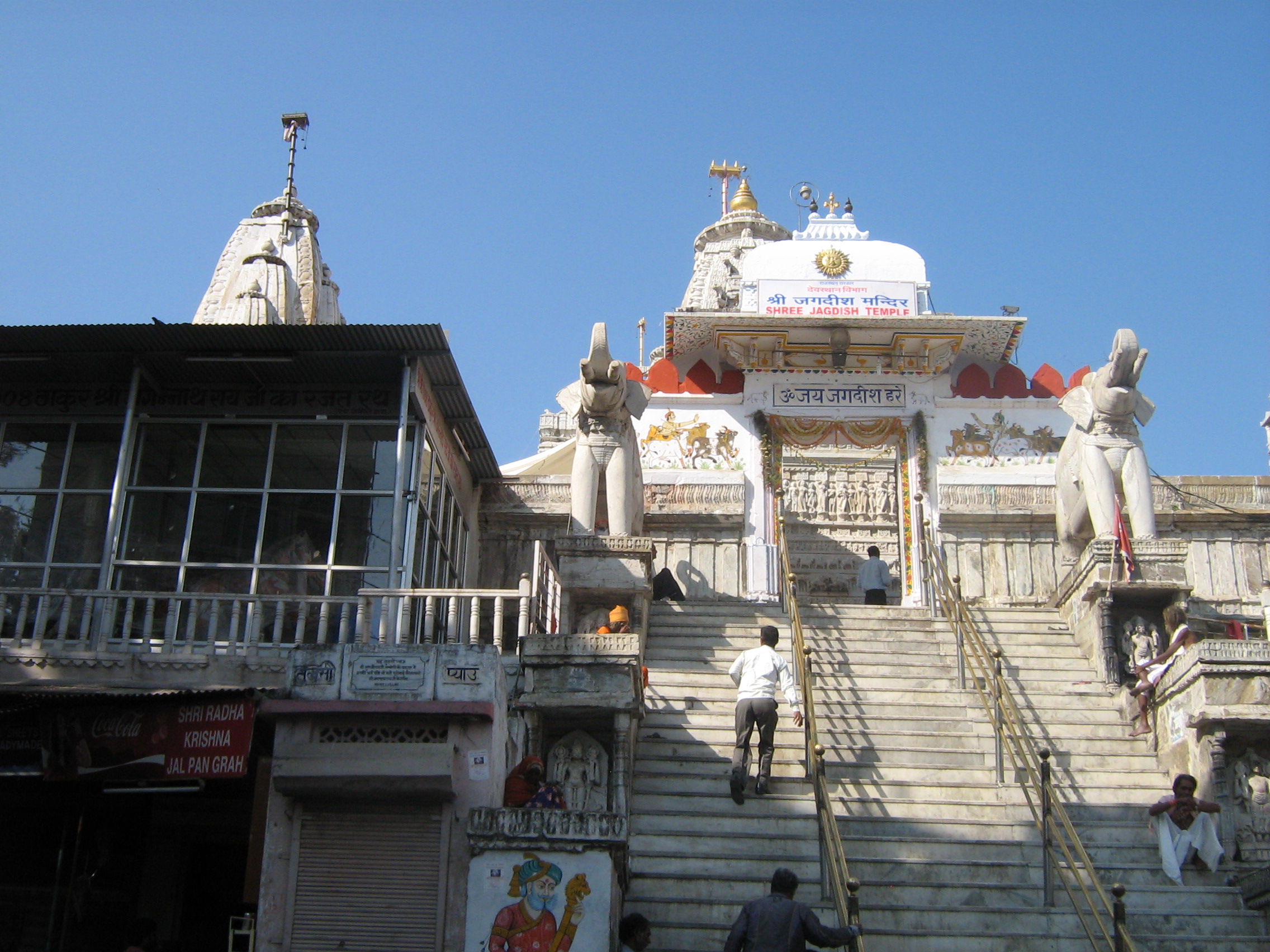
In Udaipur, several of us toured the Hindu Jagdish temple where the stone carvings are intricate beyond belief. I intended to visit the City Palace too, but I arrived at the entrance to that complex with a large package I wanted to mail home only to discover that the post office (which was located next to the gates of the palace) was closed on Sundays, which is what day it was. Aggravated with myself for not having trusted the tuk-tuk driver who took me up there and warned me that the post office was closed (because of stories I’d heard of tuk-tuk drivers misinforming foreigners of many things in order to divert them to businesses operated by their relatives and friends, and because this tuk-tuk driver had offered an express-post outlet as an alternative, which I’d declined), I stubbornly walked back to the hotel with the cloth-wrapped package in my arms rather than paying for another tuk-tuk.

It took me about half an hour to walk back to the Vishnupriya (I only took a wrong turn once). Since I had carried the package since Jaipur, and since it contained a bedspread and a wall hanging that I should not have bought, I was beginning to think of the heavy, pillow-case-sized object as my albatross. By the time I got The Albatross back to my room, I was too tired and hot to go back up to see the palace. Instead, I sank with great relief into the waters of the hotel swimming pool.

I probably sank into them a little too deeply for my own good, perhaps swallowing some of the water in my eagerness to get cool, for I think it may have been there that I got my one small bout of upset stomach. I consider myself fortunate that I did not have my distressed tummy on the day of the nine-hour bus trip or on the overnight train ride to Mumbai, but only on the day we rode in a jeep for 1.5 hours to a wildlife preserve near Ranakpur, then headed out again for a one-hour trip each way to see the most amazing temple we had yet encountered. As it was, if it had not been for several doses of Imodium, I would not have made it.

(Check out more photos from Udaipur here.)

Watch. Listen. Learn. (India 6: Pushkar)

Wed. and Thurs., Nov. 9 and 10, 2011, Pushkar

Why is there never a camel when you need one?

The lake at Pushkar is one of the most sacred Hindu sites in India. It came into being when Lord Brahma, the Creator (Brahma being one of the the top three Hindu gods, along with Vishnu, the Preserver, and Shiva, the Destroyer) dropped a lotus flower to the earth. Where the three petals landed, three lakes appeared in the middle of the desert; of these, Brahma signified that Pushkar would be the most important by convening the entire pantheon of Hindu deities (90,000 at the time) for a meeting there.

But then Brahma made a big mistake. He married a shepherdess instead of Savitri, his intended. It was not entirely his fault: it was augured that he should get married at a certain moment in time and Savitri, busy getting dressed for the wedding, showed up late. He grabbed whomever was available instead. Savitri was beyond enraged, and to punish Brahma, she decreed that henceforward, instead of being worshipped everywhere in the world, he would be worshipped only at Pushkar. This was a big punishment because it means that, in order to worship Brahma, Hindus can’t just build a temple near where they live, as they can for the 3.5 million or so other Hindu deities that now exist: they have to come to Pushkar. And they do: they travel from all corners of the earth to make “Pushkar Puja” — to bathe in Pushkar Lake in order to cleanse their souls. According to my trusty Rough Guide, nearly 500 temples have been built around the lake and the ashes of such famous Hindus as Mahatma Gandhi and Jawaharlal Nehru have been scattered from its bathing ghats (steps down into the lake).

The most auspicious day of the year to bathe at Pushkar Lake is the day of the full moon of the Kartika month — the exact day that our group arrived in Pushkar.

In addition to the thousands of pilgrims who come from everywhere to have their souls cleansed on this important day, thousands upon thousands more travel there during the week preceding the full moon of Kartika to attend the annual camel sale, during which event up to 18,000 camels and their owners from all over Rajasthan are in town. In short, Pushkar is not its normal peaceful self — the population having swelled from the usual 30,000 mostly devout Hindus to more than 150,000 people, not all of whom have Brahma-worship on their minds. The event is called the Pushkar Fair, and it includes the usual attractions of a regional fair anywhere in the world — cultural and arts displays, ferris wheels (4), rides for the kids, fireworks, hawkers, games of chance, competitions and contests, food vendors in the street, and even a guy demonstrating an amazing gadget that will slice and dice your vegetables “very fine.”

For a western tourist who is neither a Hindu nor a camel trader, this is perhaps not the best time of the year to visit Pushkar. Especially at night, the fair is crowded beyond belief, to the point where pedestrians press against one another and can only inch along, and many of the attendees are young men looking for trouble or “fun” who have never before set eyes on a white person, and — perhaps fuelled by alcohol and drugs — appear to have less than the best intentions when it comes to meeting this strange new race of people — especially its young female variety.

Still, I’m more than delighted that our tour (by a coincidence of time that might have pleased Lord Brahma himself) ended up in Pushkar when we did. It was a great lesson in what it’s like to be a visible minority. When we sat down in the stands at the fairgrounds, which were comfortably outfitted in mattresses, blankets and even sofas, to wait for a cattle competition to start, dozens upon dozens of men stood in the grounds and stared at us, as though we were the entertainment. We felt quite safe and relaxed at this point, and thought this was amusing, but the attention turned scary later as we made our way back on foot from dinner to our campsite after dark. We were unable to flag down a taxi, a tuk-tuk or even return to our camp by camel wagon, which was how we’d come out in the first place, because of all the crowds, which were so thick we needed to push our way through them at some points. The families had gone home, and the young men were out in droves, laughing and shoving and ogling the young women in our group. A few of the women were deliberately bumped and touched. I was glad for their sakes that we were in a group, and that we had such an assertive and diligent — and obviously Indian — leader).

(More photos from the Pushkar Fair are here.)

But there were also many other experiences we would never have had if we’d come during any other week. Three examples:

  • Since hotel rooms are not to be had during the Pushkar Fair, a whole encampment of huge tents with power, running water, toilets, showers, guards and even internet had been set up for us and several other tour groups, and aside from the heat which can be managed only by fans and patience (it gets cooler at night), it is a great way to “rough it.” There is a large dining tent, and wagon-equipped camels depart on request for the town, and to take tourists on tours.
  • As more-than-adequate compensation for the less-than-friendly-looking men at the fair at night, during the day many people, including couples young and old, and families with their children, grinned at us, waved and said, “Hi!” With equal pleasure, we waved and grinned and said “Hi!” back.
  • All night, Hindu worshippers chanted by the lake, their prayers magnified by microphones to carry throughout the town and beyond into the desert: it made a lovely, haunting sound that I found particularly poignant as I fell asleep in my tent in the light of the full moon.

Other once-in-a-lifetime events form part of all the company’s tours to Pushkar, no matter what time of year:

  • A local Hindu priest trusted by our tour guide (there are many fake Hindu priests around who will restore good karma to tourists, for a price) offered those of us who were interested a small Hindu rite of purification on the ghats of Pushkar lake near sunset, following which we were given marks on our foreheads and “Pushkar Passports” — strings tied around our wrists. Hundreds of devout Hindus were bathing in the lake at the time, which increased the sense of gravity of the moment (we did not go into the lake. We are not Hindu, and besides, the waters may be holy but they do not look very clean);
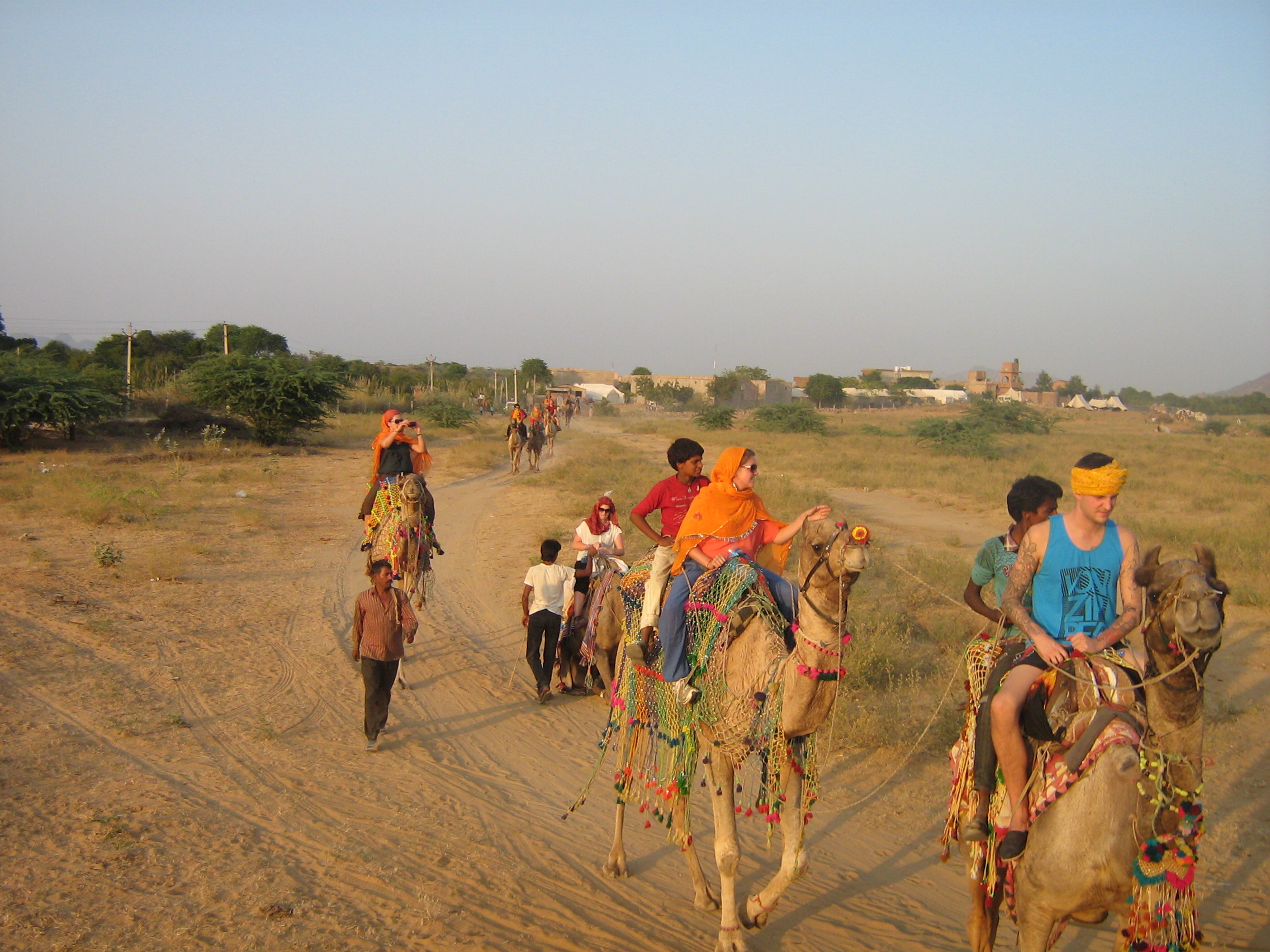
  • We had a one-hour camel ride, each of us on our own camel with our own camel driver, out to a desert site where, just after sunset, we watched a dance performance by a local family, and were fed a most delicious traditional meal in the moonlight, then transported back to our camp by jeep.

The family that danced for us (it included musicians, singers and a fire-eater as well as dancers, plus a baby who crawled around in the dark on the sand and banged on the drums and added to the vocals) used to catch snakes for the snake-charmers, but since snake charming is falling out of favour in India, they now help the universities’ herpetologists catch and manage snakes, and supplement their income by performing traditional dances for tourists.

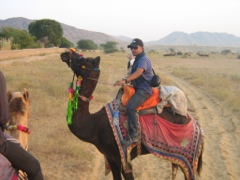
As far as the camel ride, well… camels are not like horses. They give you a look that says, “I’ve got better things to do than to be carrying you around, and if my owner weren’t right here right now, I would be rolling on the sand and you’d be wherever you landed: your fate is no concern of mine.” Aside from the camel attitude, which made me wary throughout the ride, probably wisely, I had a great time and quite a comfortable trip. And when the camel driver got up on the camel behind me and urged him forward at a near-gallop in an effort to beat another couple of camels ahead of me, I looked down at the red bracelet on my wrist and remembered that my karma was in good order, and decided that it would all turn out okay.

Which it did.

20111120-200416.jpg

20111120-203439.jpg

20111120-203614.jpg

20111120-203653.jpg

20111120-203753.jpg

20111120-203834.jpg

20111120-203913.jpg

20111120-203955.jpg

20111120-204111.jpg

20111120-204203.jpg

Watch. Listen. Learn. (India 5: “On Dirt”)

Some thoughts on dirt (a confused and meandering aside) —

Two of our group left today for home, halfway through the tour. The rest of us are disappointed that they didn’t love India as much as we did.

In fact, I think they hated it.

Both of the two who left had been suffering from stomach ailments off and on for several days. It’s been hot and there have been long bus trips, and am sure that experiencing that when you’re unwell is no fun. But they complained that India was too dirty and too crowded, and that they didn’t like it.

I am now feeling badly for complaining about the dirt myself for I have been wondering what those two thought they were going to find in India. Certainly the dirt has been no surprise to me, and certainly the open sewers and poverty are hard to handle. But anyone who has read about India and is planning to visit here must surely know what to expect. The dirt I complain about in the hotel rooms and buses is caused by the dirt in the air which gets on everything. It is caused by ancient crumbling cities and dry topsoil being blown around, and all the pollution and industry that relate to a developing nation. It is not that the people are dirty: those who can afford to be are very clean.

Indian innkeepers are learning the expectations of westerners, but slowly. We are on a budget tour, and a “sustainable communities” tour, and the hotels we are staying in are cheap. They are old and run down, don’t always have hot water and lose their electricity regularly. This is not Toronto. But the hotels have been secure, the staff helpful, the food excellent, and the prices right.

There is certainly garbage everywhere — in the streets, in the fields, by the highway, near the beach. But this speaks more of hundreds of years of inadequate or non-existent municipal garbage systems than it does of intent. I also have to admit that I have never in my life seen so many men peeing outside as I did in India, and I gather that teaching people to use bathrooms for defecation in the slum areas is a challenge. There are certainly cleanliness problems to deal with here, and it is going to take a lot of work.

The other day I used some soap and water and cleaned off the faceplates on the light switches in my hotel room here in Udaipur — the light switches have been black from ages of use in many of the hotels we’ve stayed in. With clean switchplates, suddenly the whole room looked much better.

All of the care-taking staff everywhere have been men and it has long been my opinion that men do not see dirt, so that probably explains everything.

And yes, it is crowded here: it’s India. But there are quiet places too.

And besides, as I told our tour guide (who was feeling very badly that two of our number had disliked his country so much that they had bailed mid-tour — first time in five years it’s happened to him, and certainly not his fault), when I visited London, that city seemed pretty dirty and overcrowded to me too — compared to Canada.

So it’s all a matter of perspective.

Sunday, November 13, Udaipur

Garbage on the beach, Goa

(Update: November 29, 2011, Toronto — I keep editing and re-editing this post and the more I think about the subject, the more I realize that I don’t know what I think about the subject. India is dirty. That is a given. It may always be dirty. And maybe that matters in the big picture [because it spreads disease and signifies poverty], and maybe the whole world needs to do what we can to help address this situation. But in the meantime, if you want to go to India, just accept it, try to avoid stepping in it if you can, but don’t let it spoil your trip. If you can’t hack dirt, don’t go to India.)

Another update: Just noticed this article: ‘Ugly Indians’ Clean Up Bangalore

20111114-075727.jpg

20111114-075821.jpg

20111114-075915.jpg

20111114-075945.jpg

Watch. Listen. Learn. (India 4: Jaipur)

Nov. 7-8, 2011, Jaipur

In which I take a wrong turn and visit a fort atop a mountain rather than one that is far more accessible and elaborate and therefore the usual destination of tourists.

Agra to Jaipur

We took a local bus from Agra to Jaipur at noon on November 8. Our group had 17 seats in the middle of the dirtiest bus I have ever seen in my life (not surprising, as the air is full of dust and dirt — and since the fans that are positioned over the seats every few rows don’t work, the bus travels with the windows open). There is no bathroom on the bus: an ongoing concern for those members of our group who have been coming down with various stomach ailments, although the drivers have been quite agreeable to stopping by the side of the road when we feeble-bellied foreigners absolutely need them to.

“This is India,” we keep reminding one another when something or other is not up to our usual standards. At least the bus was running….

Famous last words.

After we’d travelled for about ten minutes (we were still in the madness of Agra traffic), the bus rolled to a stop. I thought perhaps we were taking on a few more passengers, but the driver stood up, turned to those already on the bus, and yelled something at us in Hindi. Our guide translated: the bus needed a push. So all the men got off (clambering over a few suitcases in the aisles on the way) and pushed. The engine caught almost right away and we were off again, without further incident in that department.

The highway traffic was like city traffic except more spread out: there were trucks, other buses, motorcycles, tractors, a few SUVs, pedestrians, camels (mostly led by their owners) and cows and bulls (not apparently owned by anyone). The vehicles’ horns are used as frequently and as with as much purpose on the highway as they are in the city, and the traffic lines are ignored as often. The only real difference on the highway is that everyone is going faster. It is important not to try to watch the traffic coming toward you when you are a passenger on the bus any more than when you’re in a tuk-tuk: you have no control over what is going to happen to you, so there is no point in looking.

We stopped regularly in towns to let local people on and off, and we drove by very poor, crowded, stinky semi-urban areas as well as more rural scenes. The image of women crouched in fields at work in their brightly coloured saris will not soon leave me. (Neither will my encounter with an aged woman at the one scheduled lavatory stop we made. She was handing out strips of toilet paper to the tourists, dressed in a bright yellow sari, nearly toothless, wizened, talking cheerfully on a cell phone. I gave her a small amount of money for her efforts. She pocketed it [? Are there pockets in a sari?], gave me a long look and then offered me another piece of toilet paper, which I declined. It is not common practice to say “thank you” if you’re Hindu. So we were cool.) The farming methods I saw were very primitive compared to those I’m used to: I saw one group of people sweeping the grain off stalks of wheat onto tarps, using long poles. Many of the towns have high towers rising from them which are the chimneys of kilns for making bricks.

I was seated next to our guide for this leg of the journey and as we travelled down the highway (it was about a six-hour trip), I asked him questions. From him and a highway sign, I learned that:

  • the reason there are so many unfinished buildings in India is that they are works in progress for practical reasons — the owners only start to get taxed when the buildings are complete;
  • the low stone fences around large sections of fields that have nothing growing or grazing in them are there to keep out squatters;
  • the common myna bird likes to wander around under trucks and other vehicles that are stopped at the regular toll booths on the highway;
  • several of the highways on this route have improved considerably since our group leader started working for G Adventures five years ago — the bus trips used to take much longer; and
  • if you are driving a police vehicle or a funeral van, or are a member of parliament or the winner of a gallantry award, you don’t need to pay a toll fee (see complete list of those who do not need to pay toll fees, and other photos from the bus trip between Agra and Jaipur, here).

I also learned a lot of cool stuff from our guide and my books about the state of Rajasthan and its feisty chiefs, who — unlike those from many other states — fought off or figured out ways to work around or with various would-be conquerors over the years and in 1947, when the country was officially divided into states, they were able to have their state named after them. Here, the rajas also retain stature and respect.

The descendants of Jai Singh II, for example — who built the city of Jaipur starting in the mid-1700s, naming it after himself — are still considered heads of state by the people of the region. The royals maintain a residence at the magnificent City Palace, which I toured, and the Raj’s flag is raised over the palace when the royal family is at home… sort of the same way as the Windsors’ is at Buckingham.

(My photos of Jaipur and area are here, on Picasa)

Jaipur is known as the Pink City, as many of its buildings were painted pink in the late 1800s to reduce the glare from the sun, and many still retain a deep peach-pink cast, but aside from its historic buildings, it is the architecture of the city that is its main claim to fame. Jai Singh II survived being supplanted by the Mughals because Akbar recognized his brains and creativity when he was still a boy — giving him the honorific name “sawai,” meaning “one and a quarter” — and left him to do his thing. Sawai Jai Singh certainly fulfilled his promise, proving not only a wise, kind ruler of his people but also a scientist, mathematician and architect. He built the city of Jaipur according to a very precise set of measurements so that all the streets intersect at exact angles around a central circle. Even the stores on the main streets were built according to strict specifications, and all are exactly the same size.

Other highlights of Jaipur include:

  • Jantar Mantar, one of five observatories built by Jai Singh which contains a fabulous array of huge instruments used during the medieval era for measuring the sun, the planets and the stars (click to see photos here);
  • the Palace of Winds (Hawa Mahal), really only a facade behind which, in the 18th century, the women of the palace were able to see the activity in the city without being seen — an amazing sight when the morning sun is on it;
  • several forts and palaces built by several Rajputs over the centuries, including Jai Mahal in the middle of the Man Sagar Lake; and
  • the Amber Fort and Palace.

I will need to go back to Jaipur to see the Amber Fort and Palace as I missed it completely, having inadvertently had another adventure instead (see below), but I will not complain about this as I loved Jaipur and would be happy to go back any time.

To other prospective travellers to Jaipur, I highly recommend staying at the Jaipur Inn which is almost European in its wide stone hallways, mosaic tiles, screened windows, balconies, and a bar on the rooftop that overlooks the city. It is VERY clean, and friendly: the owner offered to take any of us along who wanted to accompany him on his daily hike to the top of a nearby hill to watch the sun rise over the city. Having done my own hike, I did not join him, but I felt safe and happy in Jaipur and highly recommend a visit there.

Bollywood!!

In Jaipur in addition to the sights, we took in a Bollywood film, which is an adventure in itself, and only INR70 (about $1.50) per head. You get a reserved seat and everyone is let in just before the movie starts. The theatre was huge and ornately decorated, and the film that we saw has had the largest take of any film in Bollywood history, and it’s only been out for a few weeks. It is a science fiction film named Ra-One (for “Random Access Version 1.0”) and it is the story of a video game that goes badly wrong and starts wreaking havoc on the life of its inventor (Shahrukh Khan), his wife (Kareena Kapoor) and their very cute son (Armaan Veena). It was in Hindi without English subtitles, but it was easy enough to follow. The movie was terrific but the audience was the best: they shouted encouragement at the good guys, yelled and booed at the bad guys, cheered the hero, sang along with the songs, calmed their screaming babies when necessary, danced to the music, and talked on their cell phones. It was amazing.

I am going to take in a Bollywood film in Toronto (maybe the same one. Wouldn’t mind seeing the subtitles because I missed a few jokes and other language-based plot points) to check out the atmosphere created by the Indian-Canadians who attend. Now that I’ve seen it, I wish I had attended some of the Bollywood Film Awards festival that was held in Toronto earlier this year.

The Wrong Turn de Jour

So. I took a tuk-tuk to the Amber Palace and Fort, 11 K from Jaipur. The complex, built by a series of rulers over a period of two centuries, is considered a major highlight of a trip to Jaipur. My driver warned me not to buy anything at the Fort because it would be too expensive (“I will take you to a place later where the price is good.” This is a common tout by tuk-tuk drivers: they get a commission if tourists buy from their friends’ shops), and also not to accept the offer of a ride up to the Fort from the road where he dropped me because “It’s easy for you to walk. Ten minutes,” he said. “No more.”

I descended from the tuk-tuk and headed up toward the fort. After a ten-minute walk, I realized that no one had offered me a ride, and only one vendor — whose hopes I’d raised by asking the price of a hat he was selling, then dashed when I decided not to buy it despite the way he cut the price from his original high of 600 rupees to about 200 — had tried to sell me anything. The wide path was essentially deserted.

Thinking that perhaps all the rest of the tourists had been suckered into the offer of a ride, not having access to the wisdom of my tuk-tuk driver (where do I get such crazy ideas, anyway?), I kept going. Fifteen minutes after that, I stopped and looked around me and realized that the palace I had been heading for was now below me. Above was another intriguing looking fort. But it was far, far above, and it was very hot out (about 32 Celsius, I think, and hotter in the direct sun). I had my backpack and no hat. But when I saw the extensive battlements above, and realized that I was half way there, I could not turn back.

Three young people, two European-looking and the other Indian-looking, all three of the age and appearance of university students, were sitting in the road in the shade of a tree. I asked them how much farther it was to the top of the hill and the Indian person said, “Two or three kilometres.”

More???” I asked.

“Yes,” he said. He suggested I walk with them, but I didn’t want to slow them down so I declined.

“Walk slowly,” he advised as they started off. “You’ll get there.”

A few minutes later a trio of teen males came by and also gave me encouraging signs and signals, although they spoke no English. They suggested that I follow them up a rocky shortcut but I acted out how I would tip over if I tried that. They laughed when they realized what I was “saying” and carried on.

Where I ended up was worth the hike but it took me about two and a half hours to ascend to the upper fort, which is called the Jaigarh Fort, and make my way around it, and by then I was worried that if I didn’t go straight down — without a detour to the Amber Fort — my tuk-tuk driver would give up and return to Jaipur without me.

Jaigarh Fort was where the royal family went when there was a threat of war, and according to a pamphlet I read, “is one of the few military structures of medieval India preserved almost intact, containing palaces, gardens, open and closed reservoirs, a granary, an armoury, a well planned cannon foundry, several temples, a tower and a giant mounted cannon — the Jai Ban, which has a twenty feet long barrel” (Go Jaipur). When the Amber Palace below was threatened, drums would sound and the royal family would beat a hasty retreat to Jaigarh Fort.

There, I saw intriguing and amazing artifacts including weapons, farming implements, tools and cooking vessels. I saw:

  • where the servant women cooked and the royal men and women ate (separately, due to their being under seigr when they were at Jaigarh);
  • a royal bedroom that can only be compared in size to an assembly hall;
  • secret passageways to protect the royal family from unwanted intruders;
  • a water system that mainly involved elephants and camels bringing water up the hill from the lake below;
  • a fantastic view of the cities of Amber and Jaipur.

I also astounded the two guides who showed me around when I told them I’d walked up. “That’s a long hike!” one said. “How old are you?” He obviously thought that I must look much older than my age if I had managed to scale that mountain on my own.

It was a long hike and, tired and sun-burnt, I took a tuk-tuk down to my tuk-tuk. As is the usual outcome of my misadventures, I had an experience I’d never have had without my little mistake, got a spectacular view of Jaipur and a great chunk of exercise. And really, I did see the Amber Fort — from a bird’s eye view. It looked fabulous.

20111113-165652.jpg

20111113-165853.jpg

20111113-165922.jpg

20111113-165952.jpg

20111113-170043.jpg

20111113-170135.jpg

20111113-170241.jpg

Click to see more photos here

Watch. Listen. Learn. (India 3: Agra)

Nov. 6, 2011 — Agra, and The Taj Mahal

Where the only horns in the streets that aren’t blasted every few moments are the ones on the cows.

Agra Street Scene

I was more impressed with the traffic in Agra and the massive Red Fort than I was with the Taj Mahal, but the title of this blog post would have been far less interesting if it had read, “Red Fort, Agra.”

“More impressed” probably isn’t the right term. I was impressed with the Taj Mahal: how could one not be impressed with a 186-foot-square mausoleum that is considered one of the seven wonders of the world, is made entirely from white marble with floral designs and arabesques inset with jasper, carnelian, emerald, crystal, jade and many other precious stones, is perfectly symmetrical in four directions in the Muslim style — even its four gardens subdivided into four and four again — and stands as a testimony to the greatest love in the world ever, from all accounts: that of the mighty Mughal emperor Shah Jahan for his third wife Munoz Mahal. When she died during the birth of their fourteenth child, a still-born girl, the emperor went into such a terrible depression that he did not emerge from seclusion for seven days and when he did (according to our guide) he had “lost his height.” What a lovely way of expressing the effect his sorrow had on his physical presence!

The Taj Mahal

The queen had told him that if anything happened to her he should create something to commemorate her, and the Taj Mahal is the result. It is a truly astounding edifice, and if I had not seen Agra’s Red Fort earlier in the day, I would have been knocked flat. My biggest wonder, though, is what wives One and Two thought of all of the attention bestowed on wife Three: “What have you done for me lately, my Esteemed Husband?” they might have wondered — with some justification.

Queue at the Taj Mahal

When we were there, it was a Sunday during the holiday season, and there were thousands upon thousands of Indians there to see the Taj, mainly Hindu people.

We observed that the many fine qualities of Indians we have observed so far do not seem to include the ability to stand patiently in line (as, for example, Canadians and Brits have been raised to do). As we approached the main mausoleum in single file, the line ahead of us grew as flocks of Indians stepped into line ahead of us — despite the frantic disapproving whistles of security guards. We finally got in to the inner sanctum just after dark, saw the crypt by artificial light and made our way around by flashlight. (I did have the opportunity to go back the next morning before our bus for Jaipur but I declined. I needed coffee and a bit of quiet by then.)

Backflash: From Delhi to Agra

That morning we’d taken a six a.m train from Delhi to Agra, which meant we were up at 4:30, and as promised the trip by Indian train was an experience — although thankfully, we did not need to climb onto the roof or hang out the door… quite the contrary, in fact: a two course-breakfast was served on board and we were given the Sunday papers with which to amuse ourselves for the two-hour trip. The Sunday papers include the “matrimonials” (personals section) in which suitors advertise for prospective brides and grooms in the most flowery language they can think of, making what seemed to this skeptical outsider at least to be some doubtful claims to fortune and stature.

Gridlock, Agra style

We checked into our hotel in Agra, which was very safe, but plain and filthy. (Later in the day, exhausted and desperate for a shower, I realized there were no towels, so I called the desk and the towels were delivered by a man with an expectant look like an extended hand. But since our group had decided that we would all pitch in to cover tips at all the hotels throughout the trip and that the tour leader would pay them, and since I felt that towels were fairly basic, I just said, “The group is tipping.” He left, wearing an expression that said, “Oh well. I gave it my best shot.” That much achieved, I pulled off my clothes and turned on the water: nothing came out of the faucets. I put my clothes back on and called the desk. They sent someone up who magically turned the water on then expectantly waited for a tip. Sigh.)

Constructing a wall

I have come to trust few people in the “service industry” in India when it comes to money, and I leave the dickering to the tour guides and just don’t engage in conversation with the street vendors and beggars. We’re warned to make sure we’ve agreed to a price for travel before we enter a cab or a rickshaw, and not to pay until we’ve alighted at the end of the trip. I sure don’t begrudge anyone their fair share, or a bonus for extra service, and the prices are very cheap, and I understand that to many of these people we are simply rich foreigners with bottomless pockets — and that relative to them, we all are. But I tip what I am told is reasonable. (I am sure the situation is quite different for those with more expansive budgets: I’m talking “service industry” at a fairly basic level here.)

I also follow the instructions of our group leader not to give money to kids who ask for it (“We do not want the next generation to grow up to be beggars,” he said) or to take an elephant ride in Jaipur (“G Adventures does not believe the elephants are well treated”) or to admire the snake charmers, whose cobras are defanged and kept in baskets, which is also cruel. Our guide pointed out that there are excellent foundations and programs to which we can donate if we want to help the poor in India, especially the children, and if we felt we wanted to give money to poor women or the disabled in the street, that was up to us. Unfortunately, there is no shortage of opportunity to do that.

Agra’s Red Fort

Almost immediately after our arrival in Agra, we headed out to the Red Fort which is magnificent and I will try to post some photos of it here as soon as I figure out how to get them off my iPad. (An iPad is a great thing to travel with, by the way. It’s light to carry and I haven’t even needed to buy a SIM card: we’ve had access to wireless internet here and there, and I supplement by using hotel computers and internet cafes to do the things the iPad can’t.)

The Red Fort

The Red Fort was built by the Mughal emperor Akbar in the 16th century, on the site of the ruins of a 2500-year old fortress, and it incorporates both Muslim and Hindu art and architectural styles — showing the deep roots of the respect for other religions in addition to one’s own that makes India so remarkable (even if the Mughals did steal everything in sight when they took over the territory — including untold wealth that included what later became known as the Koh-i-Noor diamond). The fort, a UNESCO World Heritage site, has been described as a “walled city,” and that is a good way to envision it. Akbar’s grandson, Shah Jahan extended the fortress even further, using marble which was his preference (he was the one who built the Taj Mahal) and which is much cooler than sandstone.

Every room is different, but all of them are enormous. There are passages with filigree stone screens from which the women watched proceedings in the more public areas (i.e., where the men were), extensive women’s quarters, vast open areas where the rulers heard petitions from the public and made decisions, rooms that were built to capture the coolness of the air and to encourage breezes, stone planes that created indoor water cascades and fountains (also intended to cool the air). Outside were massive gardens whose flowerbeds provided not only colour but also scent to be carried inside on the carefully captured breezes.

Our guide showed us where the musicians would have been posted in the middle of spacious courtyards and, there, one can feel the ambiance they must have experienced in those huge stone rooms with their pillars and carved arches (both Moslem and Hindu shapes), nooks and crannies; it is possible to imagine the perfumed breezes, the brilliant flower gardens, the curtains wafting against the pillars, the music. The excesses of both detail and scale of the Agra Fort are magnificent. There is even an enormous square right in the middle of the fort where the Mughal installed a great deep pool that he stocked with fish. Our guide showed us where the emperor would lean against a pillar and expansively cast off the balcony.

The son of Shah Jahan overthrew his father (in good old Mughal fashion) and allegedly locked him up in a section of his own wing of the Fort, where he lived for the last eight years of his life: the only concession to his lifetime achievements being a view of the Taj Mahal in the distance (now almost impossible to see from the Fort through the humidity and smog).

Traffic

The traffic in Agra was an eye-opener for me. It made me realize what terrible drivers we are in North America: we can’t even get down relatively empty roadways sporting lane markers, street signs and signal lights that other drivers actually respect, much less talk on a cellphone and smoke a cigarette at the same time. We’re wimps. Here, although they are certainly travelling at much lower speeds than the ones in North America, the confusion is something one can only sit back and admire.

There are trucks of every description imaginable in the streets, from tiny to large, full of people and goods and brightly painted to honor various Hindu deities and to speak to their fellow drivers (“Blow horn!” they urge, as though any other driver needed an encouragement.) There are auto rickshaws or tuk-tuks — so named because of the sound they make. There are bicycles, bicycle rickshaws, buses, camels, horse- and mule-drawn carriages, pedestrians and motorcycles, and they are all going wherever the hell the want to go, and they are all doing it at the same time with their horns blowing. I would not last five minutes as a driver in this traffic — and until I realized nobody seemed to be bumping into anyone else and began to just sit back and watch and marvel, I did not think I would last five minutes as a passenger, either. Sometimes your knees are so close to the rider’s of a motorcycle that they nearly touch — and it behooves you to keep your elbows and belongings well inside. Sometimes a bicycle comes across an intersecting road ahead of you going east-west as you go south-north and a collision seems inevitable, but your driver swerves, narrowly missing a pedestrian, a dog, a hugely horned cow and another tuk tuk, and suddenly all is well. I loved it.

So on Sunday, we travelled from Delhi to Agra, we saw the Red Fort, the Baby Taj (… look it up), and the Taj Mahal and somewhere in the middle of all that had a fabulous South Indian lunch. By the time most of us got back to the hotel, we were dead on our feet and the amount of dirt in the bedrooms no longer seemed to matter.

Watch. Listen. Learn. (India 2: Delhi)

Saturday, Nov. 4, 2011

Delhi

Delhi airport

Delhi. The only way I can describe Delhi at this point is, Yikes! And I can only begin to imagine what it would be like in July — “Yikes times ten,” perhaps.

Today I set off on my own to see two Mughal-era landmarks the Rough Guide insisted I should not miss: The Red Fort and the Jama Masjid, “India’s largest and most impressive mosque.” I did not see either, but I did get a personal tour of a Hindu prayer site and I also got whacked by a woman in the street as hard as she could hit me. So it’s not like nothing happened.

The major problem with Delhi for me is that a lot of people really don’t speak English very well, and I speak Hindi even less (namaste being the only word I know). So I set out for the Metro with only general instructions on how to get to it and no real sense of what the hotel manager had told me to do when I did get there. It’s about 80 degrees F. today, and the streets of Delhi are just like you see on tv — an absolute maelstrom of vehicles of all kinds, from bicycle rickshaws to trucks, none of them adhering to any of the lines that are painted on the street (a woman on the plane who is originally from Delhi and was coming back here from Brisbane for FOUR weddings in the next two months told me that in Delhi, the lane markers are considered no more than decorations on the streets. No one pays any attention to them). Our tour guide, who I met just an hour ago for the first time, told our group that the reason there are so few accidents in Delhi are “good brakes, good horns and good luck.” As I sit in my hotel room here in Karol Bagh (an area of many inexpensive hotels) the sound of horns in the streets outside my window is incessant. The sidewalks are few and far between, and usually jam packed with people both horizontal and vertical, hub caps, motorcycles, garbage, dogs, you name it. So the pedestrians kind of just walk around the vehicles (and through/between them, when it’s an intersection) on the edges of the streets themselves.

So I made my way to the Metro station about six blocks from the hotel, darting through the traffic as best I could and attempting to follow close behind other pedestrians when crossing busy intersections, and then I faced the challenge of finding someone else to ask about how to get to where I was trying to get to. The ticket seller at the Metro seemed not to have heard of the Red Fort so I pointed it out to her on my map, and that didn’t seem to help her much, but she did sell me a tourist ticket for INR20 or thereabouts that would get me around the city for one day.

I entered the station (which has a security system where you need to get patted down before you can go through, then send your bags through a scanner. Women go in a different patting-down line than men, as I found out by trial and error. 😉 ) When I got onto the platform I asked two other people (I chose people in uniforms wearing guns who were positioned as security around the station, thinking that they seemed to be fairly safe bets) and by the time I actually got on the train I had learned that I’d need to go two stops then get off and transfer.

I did that, and then went through the same rigamarole at the station I got off at (a pretty central one named Rajiv Chowk), trying to find someone to tell me where to get another subway for the Red Fort in Old Delhi, and finding almost no one who could help me. I also appeared to be the only Western female in the entire city today, so I was trying my best to act like I knew what was going on but I’m sure no one was fooled.

I disembarked at the correct station and emerged into a very busy market area, crowded with shoppers, vendors and street people. I walked steadily in the direction I thought was correct (and probably was) but there were no signs in English and at a certain point the market thinned out and there were more street people than shoppers and as always many many more men than women.

I grew unsure of myself so I turned back and near the Metro I stuck my head into an intriguing-looking building, dark pink with small towers and many rooms containing (it turned out) statues of various holy men and gods that Hindu visitors were coming by in droves to honor. Despite the fact that the place was packed with devotees, a woman at the door welcomed me in, asked me to remove my shoes and wash my hands, and then gave me a tour of the premises, explaining who each of the statues depicted and showing where I could drop a bit of money into that deity’s coffers. I understood almost nothing of what she said and she didn’t know where the Red Fort was (although she did know of Canada. Lots of people here know of Canada and have relatives and friends in Toronto.)

As I was leaving the prayer centre another woman came over and pointed to a narrow arched lane nearby and told me to go down it and turn left to get to the Red Fort. The lane was standing room only, accommodating at most four people across, who were all basically pushing their way along the lane. It was lined down one side with with tiny shops selling brightly coloured fabrics and other goods which people paused to check out, slowing progress further, as did those who struggled against the tide to go in the opposite direction.

Finally, I emerged from the tunnel to the light and turned left. The streets here too were crowded and noisy and there was no sign of other tourists. After a few blocks when I could still see nothing resembling a red fort or any minarets, I decided it was pointless to go farther: I felt that I could not stop to take out my guidebook and look for a map or even dare to take a photo, as revealing my “tourist” status would just reveal me as a mark. There were no signs to the landmarks I was looking for — at least not in English — and there seemed to be no one official anywhere to ask. So I turned back, and this is when a woman in a sari, about 40, maybe about five foot three, came across the sidewalk at me with her fists raised. I thought she was shouting angrily at a man nearby but she kept coming at me at and she struck me hard on the chest and arms with her raised fists. It hurt but not a lot: mostly I was just amazed. I just kept walking, trying to appear as though nothing had happened, and the woman didn’t follow me.*

I made my way back to the tunnel lane and pushed my way back up it toward the Metro. A couple of children attached themselves to me, asking for money, but I refused — concerned that if I gave them anything, swarms of other children would emerge from the crowds also looking for money.

Back on the Metro, which was now more crowded than it had been earlier, I decided to get off at Rajiv Chowk and have a look at Connaught Place and maybe see India Gate and some of the more upscale market promised in the Rough Guide. But up top when I emerged from the Metro station, it was store after store (many western ones there) and again few tourists, so again I was unsure how to get to the sights I wanted to see.

I decided to admit defeat, and to take the Metro back before rush hour got any closer. By then I felt like a pro at using the subway system and I think the achievement of my day was going as far as I did without much signage I could read, through all of those crowded confusing streets, and then making it back safely to my hotel — because if I’d got lost in Delhi, I’d have been really lost. It’s amazing what a little fear does for my sense of direction!

*Please note that I don’t attribute the woman’s behaviour in any way to the fact that she lives in Delhi: there are crazy people everywhere. And if she does live on the street in that city, she probably has a right to hate me on sight anyway.

Watch. Listen. Learn. (India 1: En Route)

Hong Kong Airport, November 4, 2011

One thing I like about airports is that you don’t need to pretend that you’re not a tourist, like you do in major cities when you don’t know your way around. Here, everyone looks lost.

So I’m sitting in the Hong Kong airport and it’s about 6 a.m.. local time but it’s about 6 p.m yesterday in my head, so I’m having supper. I’m eating spicy chicken noodle in fish soup and HK really means it when they say “spicy.” With a tea, it was only HK$54! (Honestly, I don’t know either, but I gave them US$20, and got back HK$90. So not much.)

I extend my gratitude to all those who suggested books they’d take with them if they had a 16-hour flight and several other long hauls ahead of them. There were great suggestions for books and authors I hadn’t heard of. I’m going to check out quite a few of those when I get back. The books I finally did bring with me are, in paperback: Hilary Mantel’s Beyond Black and Peter Carey ‘s Illywhacker (thanks, Bert and Victor, respectively). On the iPad I have Arivand Adiga’s Last Man in Tower and Russell Banks’s Lost Memory of Skin (thanks for both suggestions, Charles, but how come every book you suggested is available only in hardcover? Do you think I’m made of money and built like Hercules?) (actually, I think I know: you read review copies, right?). I also (thanks to Rhona) have with me The China Study: The Most Comprehensive Study of Nutrition Ever. So I’m well nourished every which way. So far I’ve started the Adiga and the Carey, and they’re both light-handed but engaging, and they’re going to be perfect.

Some of the suggestions I liked about the kinds of books to take on long trips from other people were: to take classics so you’d be forced to finally get to them; to bring an old favourite; to include a Calvin and Hobbes collection to break up the heavier reading; and to take a selection of genres such as a mystery, a local history and some more challenging books as well.

As I started to write this post, I was nearing the end of the first leg of my journey, the 16-hour flight from Toronto to Hong Kong. I had read a few chapters, slept for a while, done some crocheting, watched a movie (Bollywoodish), and been wellfed (as Joyce might have spelled it) twice. It was crowded in my window seat with my own stuff plus the blankets, pillows and headphones they handed out, and the plane was full. Still, it was much better than I’d thought it was going to to be and I hope the rest of the flights go as easily.

I saw nothing out the window as it was night from the time we left Toronto till we landed in HK, except one brief time when I noticed a bit of light under the lowered blinds. I am not sure where that happened, as we flew up over the top of Canada and Alaska before heading south again towards Hong Kong, where it was about 5 a.m. when we arrived. Where could there have been light? Also mysteriously (to me) it was 5 a.m. on November 4 when we arrived although we left Toronto at 1:30 a.m. on November 3. Time to learn about the International Date Line, I guess.

Bangkok looking very wet, Nov. 4/11

I have no idea what happened to my photos of Hong Kong but here are a couple I took as I landed in Bangkok briefly on the way from HK to Delhi. Bangkok was just beginning to recover from the flooding. I thought the airport was appropriate — its arches looked “Siamish” to me —

Bangkok Airport, Nov. 4, 2011