Germany 2: Tannhäuser!

Wagner’s Opera Goes Inside Out at the Festspielhaus in Bayreuth

I am a big fan of Richard Wagner’s operas (not so much of the man himself), and if it were not for that fact, we probably wouldn’t be in Germany at all. When I heard several years ago that it can take up to ten years on a waiting list to get tickets to see a Wagner opera in Bayreuth, I decided that this was yet another instance of life throwing down a gauntlet. So I submitted my name. I figured I could always back out if it didn’t seem to be something we wanted to do when I reached the top of the list.

To my amazement, this past spring I was advised that I could apply for tickets for the 2022 season. I believe I got tickets seven years earlier than I’d anticipated because of two world-altering events – Covid, and the effects of Russia’s invasion of Ukraine on energy prices – both of which have made people less inclined to travel. Both factors made us think twice before moving forward, too, but in the end we decided that when gauntlets are thrown down, it is wise to accept the challenge. You might never get another chance.

When given the opportunity to go to Bayreuth, die-hard Wagner fans typically apply for tickets to the four operas that make up Der Ring des Nibelungen, aka The Ring Cycle. This comprises four successive nights totalling about 15 hours of music and a whole lot of intermissions. I wasn’t sure my bum could handle all that sitting, and I wanted to still be married after our trip to Bayreuth (my husband is less enthusiastic about opera, and about Wagner, than I am). So I applied for two tickets to Tannhäuser – which, at around three hours, is a more standard opera length. The two seats were separated by two other seats and a pillar and they were at the very back of the theatre, but I’d heard that there isn’t a bad (or a comfortable) seat in the Festpielhaus. So there we were. And here we are.

I will write more about the city of Bayreuth, which is quiet and lovely and has several interesting sights to see, in my next post. This one is just about the opera.

Richard Wagner

For those who are unfamiliar with the controversial composer Richard Wagner, I offer a brief overview.

Wagner was born in 1813 in Leipzig and died in Venice in 1883. (We happened upon a sign marking the site of his death unexpectedly when we were in Italy several years ago as we wandered into the back [non-canal] entrance to the Casino di Venizia.) Wagner was wildly talented as a musician, wrote the librettos for his operas as well as the music, and also directed them. He was egomaniacal, outspoken, politically engaged, and slept with women who were not his wife. All of those proclivities meant that he was frequently in trouble with employers, other composers, musicians, theatre-goers, politicians, members of the nobility, and women. He was also an antisemite but unfortunately that was not widely considered to be a depraved view in the society in which he lived and moved.

Wagner wrote a lot of not only really long, but also monumental, operas; even today, the term “Wagnerian” is applied to almost anything that is totally over the top. Wagner wrote the operas that most people grew up mocking ­– featuring substantially constructed singers wearing horns on their heads, armour and huge fur coats. Many of his operas were based on Teutonic myths, involved gods and goddesses and wrangled with large religious (Roman Catholic) themes. Tannhäuser itself is basically the story of a poet and singer who has been tempted away from moral, upstanding society by Venus and her shameless retinue. He has apparently been engaging for an extended period of time in untold Dionysian frolics with Venus, but he has finally grown tired of it. A sweet thread of music calls him to return to his upstanding life and to Elisabeth, the niece of the local landgrave (a count, or prince) who loves him. Venus permits him to go back to “real life,” but the draw to the life of decadence is strong, and he continues to battle his demons until, following a trip to Rome where he throws himself on the mercy of the Pope, he is absolved. But, alas, it is too late: Elisabeth is dead by the time news of his pardon arrives, and so is he.

Wagner’s music is stirring to the core. It is dark and voluptuous and exerts almost magical powers over many listeners. There is no explaining it if you haven’t felt it. It has overtaken the minds of right-minded people (like Stephen Fry) who would love NOT to be so enamoured with it because of Wagner’s terrible views on Jews, and it has also entranced a lot of very wrong-minded people – like Hitler, who loved the music from an early age and subsequently deployed it to stir feelings of patriotism to a fever pitch among his followers. (Woody Allen once remarked, “I can’t listen to that much Wagner… I’m starting to get the urge to conquer Poland.” I’ll let you decide whether you want to put Allen in the right- or the wrong-minded cohort.)

Wagner’s music is known by even those who have never heard of Wagner: it’s appeared in films and cartoons and in a kazillion other contexts. For a full appreciation of Wagner’s influence in the world, one cannot do better than to read an excellent book by Alex Ross called Wagnerism: Art and Politics in the Shadow of Music – but you must be a real Wagner fan to get through it because it’s 784 pages, comprising 1.46 lbs of fine print. It is fascinating and endlessly detailed and reading it is a Wagnerian effort in itself. But it is a worthwhile investment of time if you are so inclined.

The Festspielhaus

Wagner knew that his music was not suited to standard opera houses of the day so after a long and involved process that included planning for a while to build in Munich, he and his second wife Cosima (a force of nature, that one, and an even bigger antisemite than Wagner was, if that kind of comparison is of any consequence at all) settled on the quiet town of Bayreuth for their opera house and their residence, Haus Wahnfried. They could not have built either edifice without the financial patronage of the profligate and somewhat nutty King Ludwig II, who spent money on all kinds of crazy projects including Schloss Neuschwanstein, in which Walt Disney found inspiration when he was designing Disneyland. But Ludwig did make a sound  investment when it came to Wagner’s opera house.
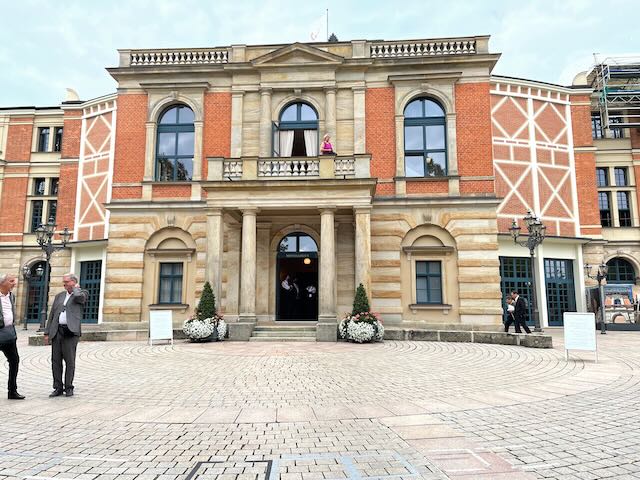
The Festspielhaus at Bayreuth

The Festspielhaus stands at the top of the “Green Hill” which is a famous landmark for any  serious Wagner fan. Again for those not familiar, my Lonely Planet guide explains that “The structure was specially designed to accommodate Wagner’s massive theatrical sets, with three stories of mechanical works hidden below stage. It’s still one of the largest opera venues in the world.”

Interesting facts about the Festspielhaus

  • The building accommodates 1970 patrons per performance, and they are jammed in like sardines.
  • Wagner wanted the seats to be uncomfortable so that no one would fall asleep in them, and he got his wish.
  • There are no subtitles in German or any other language, so unless you speak German, you are SOL when it comes to following the dialogue. The woman who sat next to me (a Dane who had studied in Germany and also spoke English) told me that even for German-speakers, the lyrics in the performance we were watching would have been hard to follow because only two of the main performers (Elisabeth and Tannhäuser) sang their lines as clearly as one might have wished.
  • The orchestra is sunk out of sight below the stage. No photos of the orchestra pit are permitted.
  • The sound created by the configuration of the building is astoundingly good.
  • When the moment arrives for the performance to begin, the doors are closed and the lights are all turned out.
  • A chorus of trombones gives a warning fifteen minutes before the second and third acts begin.
  • If you are late, you are not admitted to the theatre until the next act. (I gather there is a room to which latecomers are consigned, where they can watch a video of what they are missing.)
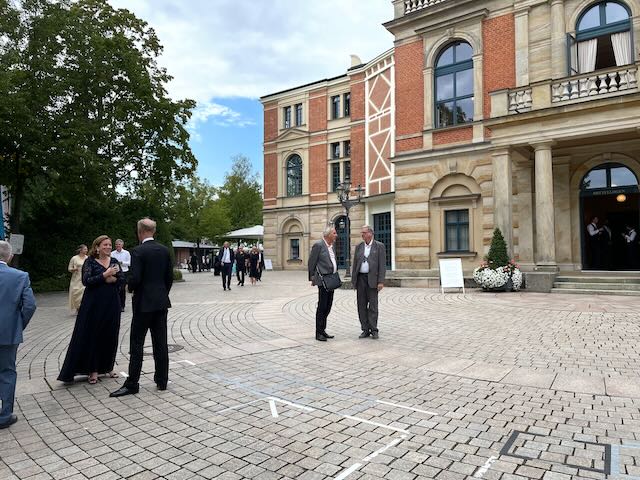
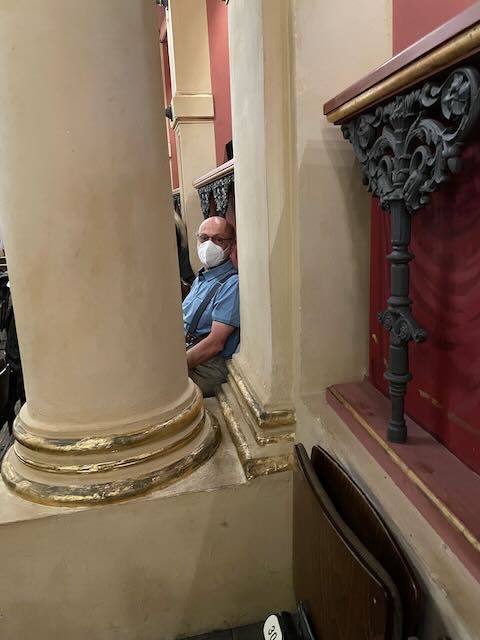
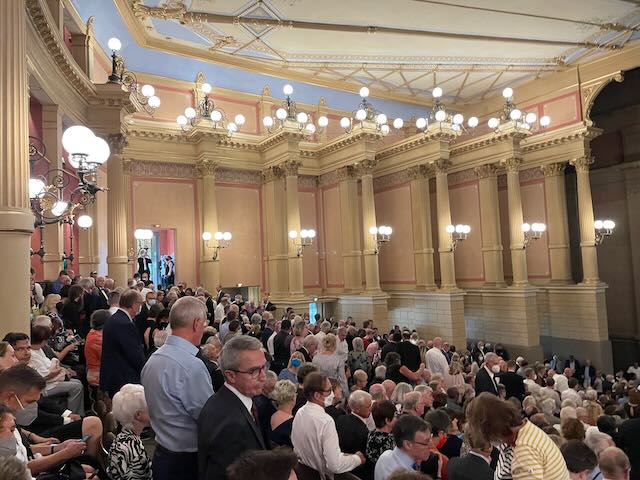
There is an intermission of a full hour between each act, which gives patrons time to drink champagne or beer, wander around the lovely grounds, eat anything from pretzels and bratwurst on a bun to a full dinner, either in the cafeteria-style setting or a comprehensive buffet dinner.

The patrons themselves wear anything from evening wear to nicely groomed shorts and shirts. I saw a lot of lovely evening dresses on the hill, and people-watching is a popular entre-acte activity.

The Festspielhaus and the Jews

During the reign of the National Socialist German Worker’s Party prior to and during World War II, it was not only in keeping with the extreme prejudices of the by-then-deceased Richard and Cosima Wagner, and their son Siegfried and his deeply antisemitic wife Winifred (who were running the festival at the time), it was also in the family’s best financial interests to support and conform with the Nazis’ treatment of the Jews. Hitler kept the festival afloat during the years when Nazi politics led to boycotts from outside the country, and he was a frequent visitor at Wannfried. A failed artist, Hitler apparently loved hanging out with the owners of the Festival and the directors and performers, and to sit by a huge fireplace in Winifred and Siegfried’s home (where he had standing invitation to stay), talking about the arts long into the night. He bought many tickets that were given to Nazi officers in order to help support the Festival, but Alex Ross reports that most of these people were not opera fans and attended only with reluctance. (I hope they suffered during every minute of those very long performances in those very uncomfortable seats.)

Like much of Germany, the Festspielhaus has in recent years chosen to put its ignoble past front and centre, rather than trying to hide or cover it up, an initiative that any right-thinking person must applaud. Since 2012, an art installation entitled “Silenced Voices” has stood just below the opera house on the Green Hill. It is a “tribute to the many singers, musicians, choreographers, and musical directors who, under Wagner’s and succeeding administrations up through the 1930s, were hired to work here, only to face the institution’s bigotry. Most of these artists, for the most part Jewish, a few of them gay, were harassed into resigning, fired, or forced to flee Germany altogether.” Several wound up in the extermination camps.

I appreciated the words on this sign, which is part of the display:

As the sign says, many Wagner fans will try to say (mainly out of desperation) that since Wagner was dead at the time, it was Hitler’s fault not his that Jews were so badly treated in Bayreuth during the Third Reich, and that Wagner’s music was misused to further the insidious goals of the Nazi regime. It is not that simple. However, this exhibit at the Festspielhaus, initiated and supported by the more recent descendants of Wagner, is a step in the right direction.

This Tannhäuser

Far be it from me to dare to review a Wagner opera: Wagnerism gave me some insight into how little I know about Wagner and his music. But I have watched several Wagner operas thanks to the Metropolitan Opera’s live-streaming program which brings operas into movie theatres around the world each season. In addition, during the pandemic, I took an excellent online course entitled “Wagner’s Ring: Music, Motifs, and Magic.” So I’m not a total neophyte.

In preparation for our trip to Germany, I watched a traditional production of Tannhäuser from the Met, performed in 2015 and starring Johan Botha (Tannhäuser) and Eva-Maria Westbroek (Elisabeth), with musical direction by James Levine, so I knew what was happening and had some idea of what to expect.

I did not get what I expected, which turned out to be great.

The version of Tannhäuser we saw in Bayreuth (directed by Tobias Kratzer, conducted by Axel Kober, and starring Stephen Gould as Tannhäuser, Lise Davidsen as Elisabeth, Markus Eiche as Wolfram von Eschenbach, Albert Dohmen as Landgraf Hermann, and Ekaterina Gubanova as a wondrous Venus) turns the traditional story on its head. Tannhäuser himself, in his “Venus world,” is a clown, and Venus – an acrobat – is the leader of a little band of circus folk, which also includes a lovely drag queen named LeGateau Chocolat and a kind and funny dwarf named Oskar.

Unlike in the traditional interpretation, this circus world – the world Tannhäuser wants to flee in order to return to his Elisabeth – is not the world of fantasy but rather is the real world, complete with Burger Kings, run-down camper vehicles and billboards. This gives a lovely twist to the trope in which dissatisfied protagonists “run off to join the circus.” Tannhäuser has clearly done just that, but now he regrets his choice and wants to return to the world from whence he came. This world – the world of the Landgraf and Elisabeth, which in the original opera is the domain of the region’s landholders and the sacred terrain of the Catholic Church – becomes by contrast, in this iteration, the land of make-believe: a theatrical production.

The scenes involving the Landgraf and Elisabeth et al. take place inside the very Festspielhaus in which we, the patrons, are now seated. What is happening to them, which they take to be real, is not; instead, it is the production we’re now watching. The pilgrims, whose chorus is essential to the musical impact of this opera, take various forms: at one point they are theatre-goers, representing us, dressed to the nines and carrying copies of the Tannhäuser program that in reality are available for sale outside the theatre. Later, when they return from seeking absolution in “Rome,” the pilgrims become a troupe of migrants wandering through the town.

In the second act, the deft use of video (deployed throughout the opera – I wondered if its inspiration was the opera live-streaming with which so many of us are now familiar) is used to show characters moving from one world to the other. Before us on the stage we see Tannhäuser, Elisabeth and the others stage the singing competition that is to determine Tannhäuser’s fate, but via video we also watch Venus and her little troupe breaking into the theatre in which we sit: we see them mount a ladder to the second-floor exterior balcony (the same one from which a fanfare warns patrons that the next act is about to start), make their way into and through the backstage area of the theatre, and down to the stage to watch the singing competition. Venus grabs a wig and heads onstage for a closer look while the other two watch mostly from the wings. After various shenanigans engineered by Venus in her efforts to reclaim Tannhäuser (these scenes are mimed because Venus is not in the second act of the original so has no singing lines, and the other two are not in the opera at all) and political protests (including the posting of a huge banner on the aforementioned balcony), the stage director finally summons the police. We watch on video as the local Bayreuth constabulary drive up to the theatre in pursuit of the offenders, soon afterward appearing before our very eyes, on stage.

The playful approach to what is real and what is not extends into the second intermission when we wander outside and see Venus’s ladder propped against the second balcony, alongside the banner that was earlier posted by Chocolat and Oskar.

It was during the third act that I became fully aware of the distance between the focus of the director and that of the composer. In this rendition, Venus and her troupe clearly hold far more sympathetic and higher ground in than does the world of politics and religious sentiment. Elisabeth demonstrates that she understands this truth when she comes out of the fancy theatre and down to the campsite where the circus folk are currently living rough under a billboard, and shares food and conversation with the by-now discouraged and lonely Oskar. Distraught and disillusioned, this is where she meets her end, at her own hand. (Spoiler alert!! Albeit too late.) When Tannhäuser returns soon afterward from his trip to seek redemption, not knowing that Elisabeth is dead, he tears up Wagner’s script in a futile attempt to attain a different outcome for their story. (This is the one place where I really lost track of things due to not speaking German: I had no idea what was being torn to pieces on the stage until I read a review after the evening was over.) So it all ended differently but no less tragically in this version of the opera that it does in a traditional production, but it was far more satisfactory ending from a 2020s perspective on how the world should work.

All in all the production was magical. Venus was astonishing: relatable, funny and demonstrative, and a wonderful singer. Elisabeth, by necessity more restrained, was also powerful. And Tannhäuser was beyond fabulous. The benighted Woolfram whose love for Elizabeth remains forever unconsummated, at least on an emotional and spiritual level, also put in a hugely strong performance. The cautious deployment of circus tawdriness often adds a note of dark mystery to art, and it worked to great effect on that level here.

The curtain calls were lengthy and well deserved, and while there was no standing ovation (probably not a “thing” here) there were many many roars of “Bravo” And “Maestro.” The audience approved, and apparently so did some of the world’s more qualified-than-I reviewers, who have been covering this same production (albeit with different musical­­­­­ directors and cast changes here and there) since it was first mounted in ­2017: See Opera Today or The New York Times or Opera Ramblings for example, for photos and mostly glowing write-ups.


The treatment was playful but the story remains serious and the rendition haunting, and I loved every bit of it. So did my fellow audience attendees: The couple to my right were from Japan and had come all the way to Bayreuth to see not only Tannhäuser, but The Ring Cycle starting the next day. To my left was the couple from Denmark with her mother; they had been to Bayreuth before – the mother several times. They were not sticking around for The Ring Cycle, although they had seen it before at Bayreuth, but were instead leaving for Milan where they would see Aida. All of us were in Germany for one main purpose, and none of us regretted our decision. (Not even the Japanese couple, even though they faced the possibility of a quarantine, still in effect in Japan, after they got home.)
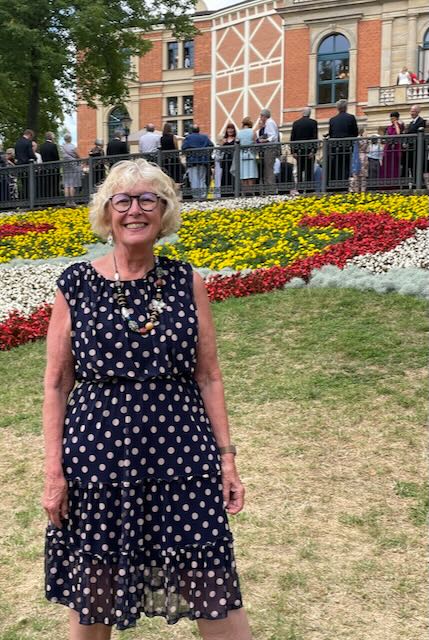
Happy at Bayreuth

Germany 1: Frankfurt

A Lovely, Clean and Friendly City

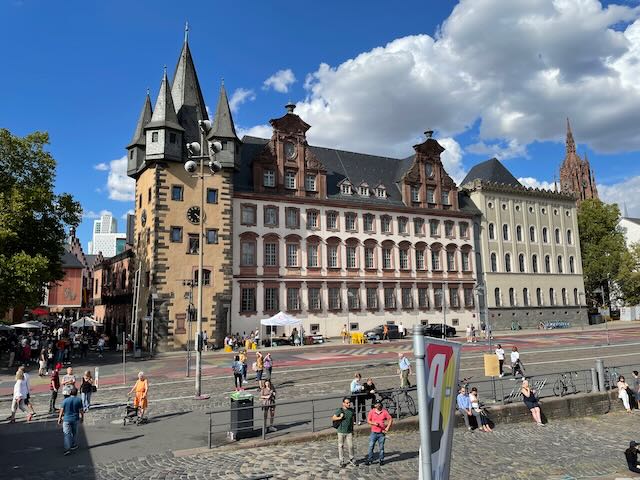
Visiting the city of Frankfurt-am-Main while recovering from jet lag is a perfect way to start a trip to Germany. We arrived at about noon on Saturday, August 20, 2022, checked into our hotel, and had plenty of time to walk the approximately 2k to the north side of the Eiserner Steg (Iron Footbridge) for the 4 p.m. river cruise I had booked for us while still in Canada. In fact, they let us onto the 3:30 cruise as we were a bit early. So on a clear and lovely afternoon we had the best possible introduction to the city of Frankfurt ­– a view of its lovely skyline from the Main River, accompanied by some identification of buildings and a bit of history over the loudspeakers, in English as well as German. We were accompanied by people from all over the world, it seemed, including a few of course who were there only to arrange their beautiful selves against the skyline in a dozen different ways for the purpose of posting photos on Instagram.

We concluded our first day in Germany appropriately – eating schnitzel with Frankfurt’s famous grüne soße (green sauce) on the square in the old city (Altstadt).

Goethe House

On our second day in Frankfurt we began to figure out the transportation system, which is excellent but also confusing if you don’t speak German too well. I think because the whole system of underground and surface trains and buses runs so smoothly, they don’t need too many information people standing around to help those (literally) misguided tourists like us. So a few times, we had to get off a train, go back the way we came, and then set out again. Fortunately, we weren’t in any rush.

We had similar problems trying to use Google maps to walk to our destinations from the subway stops so we did lots and lots and lots of unnecessary steps. At some point, I am going to take the time to watch a YouTube video on the subject of how to go the way you WANT to go when using Google maps, rather than in the opposite or some other unrelated direction. I was glad I had bought a SIM card, given all the times I had to recheck where we were going. At times it seemed that the street signs in Frankfurt and the street names on Frankfurt maps were totally unrelated.

Our first destination was the original home of Johann Wolfgang von Goethe, the poet/playwright/scientist etc. whose Faust (parts One and Two) many years ago permanently expanded my appreciation for the role of literature and drama in the understanding good and evil, not to mention magic and dark thoughts, and gave me an insight into one powerfully creative visionary. (I can still see and feel Goethe’s rendering of Walpurgis Night in my mind’s eye.)

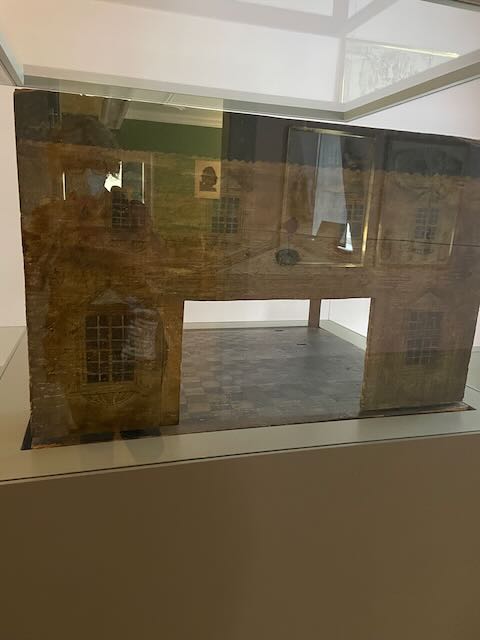
Goethe’s childhood home was large, and the rooms inside it were large, as befitted the social status of his family. The museum into which the building has now been turned is as interesting in its depiction of the era it evokes as it is for what it tells us about Goethe, who lived there for about twenty years. One of the most interesting artifacts to my mind was a puppet theatre he was given as a child that was of great interest to him well into adulthood. It reminds me that what we offer children to stimulate their imaginations can have a lifelong impact. The puppet theatre isn’t much to look at, but that is probably the point of it; drawings hung nearby illustrate what can be done by a child with some ideas who has been given a glass case with a wooden floor.

Goethe’s house was lovely – one of those places that makes you think “If I just had a desk like this in a room like this and was born into a wealthy family that offered me time and space, I could have produced Great Works.” It’s not true, but it is part of the appeal of visiting the homes of creative masters.

Jüdisches Museum

After the Goethe Museum we wandered down toward the river, past Willy Brandt Plaza, and found lunch at a place on the waterfront named “MainNizzo” that had been recommended in my Lonely Planet guidebook. When you eat outside, as we did there and have done several times now, you quickly learn that there are as many wasps in Germany as there are in Canada.

Frankfurt’s “new” Jewish Museum is located in a massively renovated former Rothschild Palace (not much to see of the original interior) and it features three floors of multimedia exhibits that focus on Jewish life in Frankfurt “from the Enlightenment to the present” with a focus on such topics as everyday objects, tradition and ritual, and history and present. One cool thing that is probably common in other museums but that I hadn’t seen before is a digital card that is given to you on admission that you can then hold up near signs next to various displays in order to access additional relevant information online after you get home. Thanks to this feature, I am bringing home a recipe for apple cake (Apfelkuchen) from Anne Frank’s family (there is a whole room of information in the museum about Anne Frank and her relatives, who were from Frankfurt), a recipe for Challah for the grandkids to try out if they are interested, and several other interesting digital artifacts. I was very taken with the “Untitled” tree sculpture by Ariel Schlesinger.

There is also an “old” Jewish museum in Frankfurt. We were unable to see that one as it was closed on Monday, when we could have made time for it. But we were able walk around the very old cemetery behind it. It was badly damaged by the Nazis, but “the oldest extant tombstone dates back to 1272 – the oldest material evidence of Jewish life in Frankfurt.” Its walls are embedded with markers with the names of the many, many Frankfurt Jews whose lives were extinguished during the Holocaust. So many names.

The Film Museum

Foot-weary, we decided to cross the river and see one final museum that day. We chose the Deutsches FilmInstitut Filmmuseum partly out of the hope that it might offer us an opportunity to sit down and watch a bit of film footage. Which it did. We were short on time as well as energy by then, so we didn’t see the feature exhibition, “Rapture of the Deep: Film under Water,” which sounded intriguing. But we did see the permanent exhibitions: one on “filmic vision” and one on “filmic narration.” Both were truly interesting and contained lots of fascinating exhibits.


Kleinemarkthalle

On our final day in Frankfurt, since the museums were closed and our batteries needed recharging, we thought we’d take it easy. We ended up walking over 12,000 steps anyway: that’s the way it goes when you are travelling.

We started at the wonderful city market, Kleinmarkthalle, which offers all the wares of any big city market and was busy with patrons buying fresh produce, meat and fish for consumption at home, and others enjoying food that looked and smelled fabulous right on the premises. Since it was late on a Monday morning, it wasn’t too busy, but I’m sure this place is packed later in the day and week. It was early enough that I was tempted but didn’t make purchases from the vast arrays of hand-made chocolates and magnificent looking baked goods. There were also lots of fresh flowers and plants for sale.

From the market we wandered over to the old Jewish cemetery (see photos above) then down to the central visible attraction of Frankfurt in the old town – the Dom Römer aka St. Bartholemew’s Church aka Kaiserdom. This church contains a lot of religious art and sculpture and even a van Dyck. Wikipedia points out that “It is the largest religious building in the city [but] despite its common English name, it has never been a true cathedral… ” and that “The present church building is the third church on the same site. Since the late 19th century, excavations have revealed buildings that can be traced back to the 7th century.”

After lunch we strolled all the way back to the Nizzo and bought a bottle of water there, then walked back through the park by the riverbank to have dinner in the same restaurant we’d eaten at the first night. We liked it because it was outside, on the square, and the food was very tasty. My pork loin was fantastiche and Arnie enjoyed his goulash.

Before dinner, we had a lovely chat with a young German woman with her cute one-and-a-half-year old in the town square in Frankfurt. (The little boy had toddled right up to me, very eager to tell me where his mama was and to practice climbing some shallow steps.) She was so happy to see Arnie and me travelling around the world at our age (“when you’re older, I mean,” she said, politely). She was at that time of life (mid-thirties, I would guess) where she felt that much as she loved her little one, she was pretty tied down and feared she’d never be able to see and do all the things she’d once dreamed of seeing and doing. She was really lovely and we had a good conversation about life and parenthood. I told her about my solo trip to India when I was 60 and that cheered her up even more.
I guess we’re just a couple of travelling inspirations with sore feet.

Personal Politics

I noticed last weekend that our prime minister had “thrown cold water” on appeals from the German Chancellor Olaf Scholz, who had been visiting Canada to appeal for help in regard to Germany’s energy crisis. I began to wonder if I should stop wearing my little Canadian pin as I travelled around Germany, which I like to do to distinguish myself from our southern neighbours. But then the next day I read that “with a grateful German leader at his side, Prime Minister Justin Trudeau stood firmly behind the controversial decision to export at least one natural gas turbine for a Russian-owned pipeline that is a crucial source of natural gas for Germany and other European states.” So even if he did piss off everyone except Germany, at least I felt it safe to continue to wear my pin.

Otherwise, it’s been nice to be able to ignore politics for a while.

Thanks, Frankfurt for the opportunity to visit your truly lovely city.

Willy Brandt Plaza

Mary and the Mushroom: Psilocybin, Chronic Depression and Me (13)

The Adventure Continues….

To say that this summer has not gone as I had hoped would be an understatement. But following my on-line meeting yesterday with the psychiatrist who is the director of the research study I’ve been participating in – one month after my first dose – I now know my status vis-a-vis the study, and understand my options moving forward.

As you will know if you have been following this journey, I was extraordinarily disappointed following the 25 mg dose of psilocybin I received on July 16. I felt I had not received enough psilocybin to attain the result I had expected, and this outcome plus the continuing withdrawal from the anti-depressants I’ve been on for several decades, plunged me into a state of despair the likes of which I have not experienced for a very long time, if ever. The “jaws of the black dogs” (as John Bentley Mays described them in his Memoir of Depression) were nearly unrelenting, and I did whatever I could to keep myself upright: from long walks in nature, to shorter faster walks, to meditation, to reading, to writing, to movie watching, to attempting to be sociable: you name it. Anything to distract myself from the bleak goings on inside my head.

I knew that I could resume a course of antidepressants at any time and relieve the depression I was feeling, which means that I did bring my state of mind on myself. But I did not want to go back on the antidepressants because I was hoping that despite my disappointing outcome with the first dose, I would secure approval in the study to receive a second. (You can’t and shouldn’t receive a psilocybin dose when you are on Selective Serotonin Uptake Inhibitors, or SSRIs, which is what most modern antidepressants are, including mine. It is believed that SSRIs interfere with, or even repress, the effects of the psilocybin. This is why I tapered off them in the spring, and have been off them now for several months.)

Why, you may ask, would anyone want a second dose after feeling so terribly strung out after the first one? It is a question I have asked myself many times. The answer is in part that I have huge faith (based on a lot of clinical research papers I have read, so it’s not just faith) that psilocybin does work in the treatment of depression, and I felt that perhaps my expectations had been so high and my anticipatory tension had been so great that I had interfered with the effectiveness of the treatment simply by being so uptight about it. (Is “uptight” still a word that anyone understands?) I hoped that I could calm down enough the second time to let the dosing work its magic. I had also read that the same dose can have different effects on the same person at different times. If I were approved for the second dose, I wanted to give it a try. And that meant not resuming the antidepressants until I had a decision from the research team about the second dose.

Second Dose: Not Happening

Yesterday I had my scheduled meeting with the director of the research program, a psychiatrist who works and conducts research in the field of neuropsychopharmacology at the University of Toronto. (He is a genuinely nice guy who actually listens to what patients say to him.) He told me that based on all of the surveys I have done, questionnaires I’ve completed and meetings I’ve attended since the first dose, I am not eligible for a second one. The reasons he gave me make perfect sense: this study is approved by Health Canada which means that all of the protocols set out in the study must be adhered to exactly. And the guidelines say that only participants who have benefitted from a first dose (i.e., had their depression alleviated even a little) and who might find even greater benefit from a second dose are eligible to receive one. My depression had, if anything, intensified following the first dose, so I did not qualify.

The doctor also pointed out that if – as I had suggested to him and to anyone else who would listen to me – a higher dose might have brought me the benefits I sought, he couldn’t have given me more than the 25 mg the study protocol allows anyway.

He pointed out a couple of other interesting things.

While it has always been my hope that the psilocybin treatment would alleviate my depression, I was also very interested in experiencing the consciousness-expanding properties of psychedelics that such writers as Michael Pollan, Sam Harris and many, many others have reported. The 25 mg dose which is standard in most depression studies is not intended to send participants far enough out into the stratosphere that they will find themselves closer to understanding the meaning of life, but is rather intended only to help alleviate their depression, PTSD, end-of-life anxiety, etc.

In other words, I may have been seeking more from this dose than the dose in this study could ever have given me. This theory is reinforced by the fact that the colourful imagery and magnificent soundscapes that I did experience while taking the first dose were similar to those reported by people who DO find their depression alleviated by the session.

So Now What?

My discussion with the researcher/psychiatrist/director has let me to two conclusions.

  1. People with depression should not base their decisions about whether or not to treat it with psilocybin (if and when that option becomes available to them) on what happened to me. The treatment is effective for so many people and has so few negative side effects (mine being almost totally attributable to having gone off antidepressants and having disproportional expectations) that in my estimation, in this context, psilocybin is still a wonder drug.
  2. I am not finished with this.

There are other ways of obtaining a slightly larger dose than the one I received in the research study, some of which are even legal for people in specific mental-health situations. Before I go back on the antidepressants, I am going to explore these other options until I am satisfied that I have done what I personally believe I need to do in order to 1) relieve my depression AND 2) learn more about the nature of consciousness. I will report on my adventures as they continue to unfold – so stay tuned.

In the meantime, I am feeling more optimistic, partly because I am feeling more in control of what happens next, and partly because I found a wonderful psychotherapist online at the Psychology Today website. We conduct our sessions on Zoom, which perfectly suits my needs.

My immediate focus is on a three-week trip to Germany which starts on Friday. I will be reporting on that adventure on this blogsite, as I have previously reported on my/our trips to India, Cuba and Italy.

I also want to draw the attention once again of interested readers to the list I have compiled so far on interesting, useful and scientifically sound resources relating to the use of psilocybin and other psychedelic drugs in the context of mental health and the expansion of one’s mind.

Auf wiederhören!

NOTE: Just came across this article. It’s a good warning, and worth a read. “Psychedelic Clinical Trials and the Michael Pollan Effect.Psychedelic Spotlight, August 9, 2022.

Mary and the Mushroom: Psilocybin, Chronic Depression and Me (12)

What happens when a dose of psilocybin fails to produce the anticipated result

Well, I’ve had the (first) dose. So far it’s taken me a week to recover from it, but I’m gradually feeling better. The reason I needed to “recover” is not because the effects of the dose were so dramatic, but because they weren’t. While I definitely felt as though I was on a path that could take me somewhere interesting during the dosing experience, I never got there. After all the buildup, this left me feeling fairly shattered. This outcome was not the fault of the drug or the research study, nor was it anything I did wrong. It’s just one of those things that happens sometimes and unfortunately for me, this was one of the times it happened.

I have found a quote in the Psychedelic Times that describes the experience I had. It reads, “… some people become anxious at this level of dosage and feel on the crest of ‘breaking through’ to a fuller experience but never do…”. I am not exactly sure what dosage the author is referring to, as I think he is discussing psychedelic mushrooms rather than distilled psilocybin, but the description of what happened is exactly right: while the dose I received is enough for most people to attain “lift off,” that didn’t happen to me. Psychedelics are tricky things. Different people respond differently to the same dose, and the same person can have a different reaction to the same dose on different days. While I think my experience is highly unusual for participants in studies about psychedelics and depression, obviously it happens.

As I’m sure you can imagine after everything I’ve written here, which reflects only a tiny portion of what I’ve read, and listened to, and thought about regarding this journey, I was so devastated with the non-result that my first reaction was to say, “I’m never doing that again!” But after a week, I have come back to my senses (?), and have requested that the study administrators consider me for a second dose.

This post is an overview of what happened to me, but I hope it won’t discourage others from taking advantage of this amazing treatment if they have the opportunity. On the other hand, if anyone else has the experience I did, maybe my account will be of some assistance.

The Build-up

By the time I went for the scheduled dose last week, my anxiety about it – which was exacerbated by the depression and anxiety I was already experiencing following my withdrawal from antidepressants – had intensified to the point where I was in a state of near panic. In fact, I have wondered if the extent of my apprehension before the dose might have interfered with my ability to “break through.” (If so, that part should at least go better next time: no dose I take in future will ever again be my first.)

I had three main fears. First, I was really worried about having a “bad trip,” which I gather is akin to having intensely realistic nightmares that reach into your deepest fears, from which you feel unable to waken, and during which you don’t remember that the experience you think you are having is not real. Guides are usually able to help with this. Just as one does with a person who is actually having a bad dream, they will notice your distress and say a few words or – if you have given them permission in advance – reach out and offer a steadying hand on your arm or shoulder. This is usually all it takes to redirect the thoughts of the person who is having the bad trip and send them in a more positive direction. In addition, since my guides were physicians, they had counteractive treatments at hand if things went really bad. Furthermore, bad trips are not all that common. But even knowing all of this, as the experience approached I kept thinking about the accounts I’d read of people who’d had bad trips, and it didn’t help that, two days before my dose, I listened to a really interesting interview of Roland Griffiths by Sam Harris, to which Sam had appended his account of a trip he recently took (basically because Terence McKenna had thrown down a gauntlet, it seems, which is no reason to do anything as far as I’m concerned) in which he’d consumed 5g of mushrooms all at once. His trip was not “bad,” but it was a very scary ride.

Secondly, although I was sure, and had been frequently reassured, that I would come back in one piece even if I did have a bad trip, I could not get the concern out of my head that I might not come back as the same basic person as I was when I went into the psilocybin session. Some of the benefits of a dose of psychedelics that are widely touted ­– the expansive sense of oneness with nature, the love for humanity, etc. – all sound great, but they do not sound like me. (Well, they do, but they don’t. It’s hard to explain aside from saying I don’t want to lose ALL of my cynicism nor to relinquish my firm grip on reality, downsides and all.)

Finally, I was worried that the dose would not work at all. I have never responded the way most people do to cannabis – no happy, giggly, floaty stuff for me, just paranoia and sleepiness. So what if the dose had no effect on me at all? I had asked those running the study if I could ask for more psilocybin during the dosing session if nothing happened, and of course I was told that I could not receive more than the original dose. This makes sense because this is a research study, and doses need to be the same for everyone.

So given all these fears, the amount of time I had spent thinking about the upcoming experience, and my wonderful imagination, by the time I arrived for the treatment last Saturday, my stomach was in knots and my heart was pounding. I was basically a basket case.

The worst fifteen minutes were the ones I had to go through following the required Covid test, sitting outside the treatment centre in the car with my (heroically patient and probably quite perplexed) husband. If I’d tested positive and could not have been admitted for the treatment, I honestly do not know what I would have done. It would have been a legendary temper tantrum of Hulkian proportions.

Fortunately, I did not have Covid. I was admitted to the centre, and greeted by my two guides. These are wonderful women, both MDs with an interest in psychology and psychedelics. Having two people in the room throughout the trip is unusual, but it adds a layer of protection because in non-controlled study situations there have been some instances of abuse by unethical guides. I’m sure having two people on board also protects the guides, and it probably allows them to confer on participants’ experiences, and their responses to that.

They asked me how I felt, and I told them how scared I was. They reassured me that this was normal, which helped a bit. I had also been thinking of Michael Pollan’s sleepless nights before his doses, so I knew that I was not the only person who had ever felt this way. We talked for a while about what I was hoping to get out of the day’s experience, but this discussion was really just to help me focus, as I’d already discussed my hopes and expectations in great depth with one of the two guides the previous week.

Then I received the dose, 25 mg of psilocybin in about half a cup of liquid. The concoction was fairly tasteless.

The Event

I donned a black mask to keep out light, and put on headphones so I could hear the mixed tape that is apparently the one that Johns Hopkins created for participants in their studies. (BTW, I found the musical selection rather odd: most of the pieces are lovely, but many of them are quite Western and classical, and therefore quite structured. This seems at odds with an experience that is supposed to un-structure everything!)

Once dosed and outfitted, I lay down on the couch, my two guides nearby in armchairs about five feet from my head, and I waited. I was still quite worried. After about 30 minutes, I started feeling like I was on a drug. I’m not sure how else to explain it – I did not feel any more relaxed, but things were definitely not feeling normal. After some additional time, I started seeing things in my head that I can best describe as very much like the images we are getting from the Webb Space Telescope. (I’m not kidding here: the resemblance was uncanny.)

The images in my head grew more personalized as time went on – I thought I saw Yoda in the mists at some point, and a few people I know, and some eyes. It seemed to me that the images that were coming to me were very closely connected to the music: when the music stopped or changed, the images retreated or changed. If the music was majestic I had majestic images (mountains, castles, etc.) and when it was more Eastern, I had images of Mayan- or Hindu-type figures.

This was all very nice and interesting, but I was still fairly nervous because I knew I was not “there” yet, and I was waiting for my “self” to disintegrate (as the literature had told me to expect it would) or at least for my self to become less important. I knew I was not tripping – but I was on my way in that direction. I remember thinking “So this is where cinematic artists got their ideas for the images in sci fi films like 2001: A Space Odyssey and Dune.” I also felt a very deep appreciation for the music that I was listening to. It sounded richer and closer than I had ever heard music sound, and again I felt great appreciation for the composers/creators. I remember thinking as I listened to a piece of flute music that the intake of breath of the flautist was an essential part of the piece – I had never noticed that before. It was lovely. So I was definitely getting stuff from the drug that I do not normally experience.

I had consumed a lot of coffee before I came to the session (next time, I’ll keep my fluid intake to a minimum!) and before too long I had to get up and use the washroom. This was frustrating because it meant I had to leave off from the trip I felt I was beginning to experience, which actually seemed kind of interesting by that point. When I walked to the bathroom, I definitely felt like I was on a drug – it was like moving through a dense but invisible cloud and I had to pay attention to what I was doing. My legs felt a bit rubbery – but I didn’t have any hallucinations or anything. I came back, lay down again, and resumed my journey.

I had to use the washroom a few more times over the next couple of hours, and each time when I got up, I had no feeling that I was in anything more than a mildly altered state. When I came back into the treatment room, I conveyed my frustration to the guides that nothing much was happening. I kept asking what time it was because I was still tense – mostly worried at this point that time was passing and I was not having the experience I came for. They told me the onset was different for everyone, that the trip would come in waves, and that I should just try to let go and let it happen.

And I did “try to let go” (sounds like a contradiction in terms, I know, but as a meditator, I do know how to clear my mind). But these efforts did nothing. About three hours in, I was even thinking, “God, I am so bored. How much longer do I have to lie here?”

I started figuring out how I would describe what I was seeing to people after it was over, and I had no trouble putting words to my visual experiences. An inability to put the experience into words – “ineffability” – is one of the measures that some people have used to describe a psychedelic experience, but I did not see anything that I would call indescribable. Nor was there anything that felt as real as reality (“noetic.” Another measure). And nothing – aside from the music – felt “mystical” (a third measure).

At one point I realized I was hungry so I sat up and ate the lunch they’d suggested I bring with me. By this time I was beginning to suspect the treatment wasn’t “working,” but yet again I tried to give it another shot.

And so it went, until finally I’d had enough. I don’t know what time it was, but I believe that after about four or five hours (which is the length of time these experiences are supposed to last) my sense of being on a drug was gone. I was done with it. It was over. I had never once lost my sense of “self,” or my feeling of being in a room, in my own body, with two guides. I’d had no feeling of euphoria or any pleasant or mystical feelings of any kind.

The Aftermath

Maybe I did have a psychedelic experience, but if that is the case, I don’t understand the hype at all, and it certainly offered me no benefits aside from a greater appreciation for the creators of film and music. Here is the analogy I have since developed for what I feel I experienced: It was like going up one of those way-too-high roller coasters (like the Yukon Striker at Wonderland near Toronto – which I haven’t gone on … yet) – up, up, up to the very top, to the point where you can see the entire landscape ahead of you (I could see what it would be like to be fully launched on the psilocybin trip, and it was certainly scary but also quite lovely and I was really interested to see what was going to happen when I did start the actual ride). But then I realized that my roller-coaster car was stuck at the top, completely stuck, and that I was never going to go over the edge. I was never going to drop. And I had no ability myself, no matter what I did, to move the car forward. Instead, I just had to sit there fearing the heights, and wait it out until my brain cleared and I could figure out how to get myself down again. And that part was traumatic.

I have rarely felt so awful in my life as I did after that experience. I was overwhelmingly disappointed. I felt frightened from having hovered in suspense for so long. I felt grumpy and irritable. Also, I was exhausted. I had trouble sleeping that night, and the way I felt the next day was worse. It was like an experience with quasi-PTSD that I’d had in my 40s after jumping out of an airplane during another one of my adventures. (The actual skydiving part was great but everything around it terrified me – what was I thinking? I am afraid of heights! But that’s a story for another day.)

I had an “integration session” with my two guides at 9 the next morning. They reminded me that the dose I had been given was standard and that it had been determined on the basis of the optimal amount in the treatment of depression. It was not intended to zap me into some alternate universe. In other words, they were telling me that it was what it was, and I needed to work with that and see how it had affected my depression.

Talking to them helped a little, but later in the afternoon I was feeling awful again. I felt threadbare, as though the inside of my brain had been stripped of some protective layer that I was unable to get back. I felt like I should be feeling better after the treatment, but I wasn’t, and I felt as though I had no one to blame but myself.

On Monday, after a good night’s sleep, I came to the realization that it was not my fault, and I started figuring out how to put myself back together again.

Moving Forward

One week after my first dose of psilocybin, I am feeling less disappointed and more optimistic about the outcome if I give this another try. (In AA they talk about the tendency most of us have to try the same approach to resolving problems again and again, hoping for a different outcome. I hope this isn’t that. 🙂)

I feel no less depressed than I did before the dose, no better psychologically in any way, and I still feel deeply disappointed, but after a week of keeping myself occupied with activities that interest me, in order to avoid thinking about my disappointment, I am regaining my sense of direction. I have been meditating every day, trying to get some exercise (when it’s not too hot!), reading some great books, avoiding the news and social media, talking with close friends and relatives, and doing a bit of work on my novel. Anyone who does these things is bound to feel better, and it’s working well for me.

By this point, I am also fairly tired of thinking and talking about my own state of mind and my efforts to improve it, so I’m just going to carry on with my life on my life’s terms until I find out if I am eligible for another dose – and if so, when. I don’t expect it will happen soon — I gather that those who do get a second dose usually need to wait for ten weeks or so. I’m not going to resume the use of antidepressants after going to all the trouble to go off them (still having brain zaps after eight weeks!), unless I get to a point where I have no other options.

So I’m going to stop writing about psychedelics for a while and focus my attention instead on another trip: the one we are taking to Germany next month. But I will keep you posted on what happens with the study. I offer my sincere thanks to so many people who have been cheering me on during this whole experience. I am sorry I couldn’t have delivered you a happy ending without all of these complications. But I’m probably going to benefit from this experience too – even if it takes a bit more time before I see exactly how.

Psychedelics pose threats to powerful groups with vested interests. We need to support initiatives to make them available for therapeutic use.

Part 11 of the series “Mary and the Mushroom: Psilocybin, Chronic Depression and Me”

As I have said too many times since I launched this series of posts, there is increasingly strong evidence that psilocybin, LSD and other psychedelics can help to alleviate depression, addictions, PTSD, and other debilitation mental-health issues after one or two doses, given the right set and setting.*

As I’ve been chronicling my own journey as a participant in a study into the effects of psilocybin on chronic depression, many people have reached out to me, expressing hope that not only will the dose I take be effective for me, but that they will eventually have access to this treatment too. Some researchers in the field now hope that within five years, psilocybin will be approved for use in safe therapeutic settings. (I know! This is an agonizingly long wait if you are suffering.)

However, many researchers, therapists and prospective patients – as well as “healthy normal” people who are interested in safely exploring dimensions of consciousness not usually available to us – have expressed concern, as I am doing here, that before we reach a world in which there is legal access to these substances – within, much less outside of, treatment settings – the drugs will be banned once more, as they were in the 1960s, making it illegal not only to use them but even to continue researching their benefits. If that happens, millions will continue to suffer without access to an option that is showing dramatic, positive results and very few negative side effects.

The Shape of the Threat

If the past few years of watching the news have taught us anything, it is that people with money and power can achieve just about anything they want. They do this directly (e.g., by withdrawing money from funding agencies or by changing laws), and they do it indirectly (e.g., by convincing significant numbers people via social media, community groups and religious institutions that something they don’t want us to have is dangerous). As we have seen over and over again, when special interests have lots of money for lobbying, they can be frighteningly effective in winning government support.

It has been demonstrated beyond a doubt that when properly administered, psychedelics are almost never dangerous – physically or psychologically. To the contrary, they have provided relief to thousands upon thousands of people. Nonetheless, there are plenty of reasons why those with power and money are likely to want to prevent or curtail governmental approval for their therapeutic use.

Here are some of them.

They Are Going to Damage Big Pharma’s Bottom Line

Psilocybin is a chemical that is found in mushrooms, which are cheap. Mushrooms with psychoactive properties can be easily found in nature if you know what you are looking for (and if you look in the right geographical locations) and, given the right spores and media, they can even be grown at home. Even when a production step is added to ensure quality control and ease of consumption, so that people don’t have to chow down actual dried mushrooms, psilocybin itself is likely to remain relatively inexpensive. because no one can control the source.

Further, only one dose of a psychedelic is normally required to attain lift-off and, in most cases, to produce the desired outcome. Even if LSD (a laboratory-developed chemical compound) is used instead of mushrooms, and even if pharmaceutical companies corner the market on LSD, most patients are not going to want or need to take more than one dose – the trips they induce are intense and can be scary, and their effectiveness is diminished with repeated use. These drugs have no effect on the dopamine centre in the brain which is what leads to drug addiction, so they are not candidates for getting people hooked. (Some current research shows that a way to extend the benefits of having dosed with a psychedelic may lie in meditation, of all things, rather than in repeating the psychedelic dose or using other drugs. Meditation is a very inexpensive route to peace of mind.)

Contrast the cost of a psychedelic treatment with the big business of antidepressants, which a whole lot of us have been taking once a day in increasing doses for years and even decades. The benefits of SSRIs tend to diminish over time, and they are very hard to discontinue. (I can attest to this. I’m now six weeks off of duloxetine/Cymbalta and I am still having brain zaps, aching joints, anxiety and, of course, intensified depression and anxiety.)

It seems to me as though it would be a good business strategy for Big Pharma to gain sole legal control of the production and distribution of psychedelics when and if they are approved – and then to mount intense PR campaigns (of the kind some companies once used to insist that opioids were harmless) to get the message out that psychedelics are dangerous and that anti-depressant treatment should be preferred.

They Threaten Those with Financial Stakes in Other Profitable Industries

Psychedelic use tends to make people more aware – on both a short- and a long-term basis – of the deep, life-nurturing and even sacred connections between themselves and others, and between humans and the natural world. This leads to increased concern for the environment and greater interest in fostering peaceful and loving relationships among humans.

If millions of people seek out psychedelics in an effort to lead more stable, productive and creative lives, and end up becoming more loving and peaceful and more intent on protecting our planet, this development will not be welcomed by those who earn their livings through the manufacture and sales of guns and military armaments – nor by those whose futures depend on nurturing interpersonal disputes. Elections would be quite different if voters were more interested in seeking peaceful solutions to their differences than in fighting over them, or beating down the “other” so many of them seem to fear, or trampling others’ rights and freedoms.

To me, it seems quite likely that when rabid conservatives (in particular) discover a political resurgence of “peaceniks,” and decide that this trend is due in part to the availability of a single chemical substance, that substance is suddenly going to become very difficult to obtain. If some fake news needs to be manufactured in order to make that chemical disappear, so be it.

Users and Underground Guides Can Make Psychedelics Look Risky

This morning I came across an article in the New York Times that reports that some people trying out psychedelics purchased on the street have had terrible outcomes for themselves as a result of unethical dealers and guides. This means renewed damage to the reputation of psychedelics. The NYT article links in turn to a whole series of New York Magazine podcasts about the downsides for some people of taking psychedelics, and the abhorrent practices that may be pervasive underground and even in quasi-therapeutic settings.

I am already massively apprehensive about my upcoming dose of psilocybin, and since psychedelics are very suggestible drugs, it would be a dumb idea for me to listen to these podcasts now. ** [Update. I’ve listened to them now, and I’ve commented below.] But from a quick review of the promo bits, it sounds to me like the approach taken in the New York Magazine series will fit perfectly with the goals of those who are opposed to making psychedelics available for therapeutic use (or any other purpose) in the foreseeable future.

As was true in the 1960s, a few acid heads also contribute to the continuing (if largely unsubstantiated) negative reputation of these substances. Research makes it clear that “set and setting” are crucial to successful trips, whether directed toward therapy or consciousness-raising. The trip experience is improved if one is in a quiet place, lying down comfortably, wearing a mask that keeps keep out light, and listening to quiet music on headphones.

It is also of value to talk to a knowledgeable guide (a “dose doula,” to coin a phrase) ahead of time in order to set intentions for what you want to get out of your trip, and for that guide to be physically present when you take the psychedelic. That way, if your trip goes south, someone will see that you are in distress and (with your permission in advance) will reassure you with a touch to your arm or shoulder, or say a few words to remind you of what you are doing, where you are and why. A guide can also help you to integrate the experience afterwards.

People who dose without attention to “set and setting,” and especially those who dose without a guide, can have bad experiences. They may have no awareness that they are on a drug and, lacking anyone to direct them away from their own frightening hallucinations, they may cause harm to themselves or others in their attempts to fight off perceived threats and dangers. These are the kinds of situations that lead – very infrequently but occasionally – to suicides, homicides and other unfortunate incidents for people who are tripping.

In addition, a very small percentage of people are thought to be at risk of being tipped into psychoses by psychedelics. These include people with a genetic predisposition to psychoses and those who are at risk of schizophrenia (often young people in their late teens and early twenties, which is exactly the age group most likely to experiment with psychedelics unsupervised, alone or at raves and parties – exactly the generation Timothy Leary attempted to turn on in the 1960s). Obviously, these bad outcomes attract public interest and media attention, which ultimately also serves the purposes of those who would like to stamp out the use of psychedelics for unrelated reasons.

Licensed Doulas for Psychedelic Trips?

It seems contrary to the very nature of mushrooms (watch Fantastic Fungi if you haven’t done so already) to regulate their use even in therapeutic settings to the point where they are available only to those with therapists. Therapists are themselves regulated by governmental and organizational dictates.

And yet regulation of these substances is the direction in which all research seems to be leading us at the moment, and there is no doubt that some sort of “sturdy societal container,” as Michael Pollan has described it, is probably necessary (selling tabs at the local 7-Eleven or even at cannabis-type stores is not likely to work out well). But where to draw the line? Human nature suggests that the therapists themselves will find it financially beneficial to insist that guides must be licensed by governing bodies of some kind.

To my mind, such a dictate would be as silly as instructing women (as the medical profession essentially did for many years) that they can only have babies when there’s an obstetrician in attendance. Babies will emerge no matter who is on hand. If safety is a concern (and it is, with both childbirth and psychedelics), the equivalent of a midwife or doula should be a legal option – someone who knows what they are doing but is not necessarily part of the medical or psychotherapeutical establishment.

Millions of people already use psychedelics illegally to self-treat or to simply have mind-expanding experiences. They are a relatively inexpensive resource that anyone can use. But if you are required to go through the burgeoning therapeutic system that is already growing up around us, and you want a competent guide, it seems likely that you are going to have to pay thousands of dollars to get one. I like the idea of people being able, at a reasonable cost, to seek out a compatible doula or midwife-type person with some track record or training to guide them through their trip in a warm, safe, home-like setting.

How Do We Prevent a Disastrous Halt to Psychedelic Research, Treatment and Explorations of Consciousness?

I haven’t got a clue. But I hope someone comes up some suggestions soon.

I am worried about this, especially given the political climate that surrounds us now.

Maybe I’m just displaying some of my pre-tripping anxiety, but I doubt that I’m alone in my concern.

* I am not going to litter this article with references. You can read back through my previous posts or just use Google to find links to scientific studies that support everything I’m saying here. If you want a reference for anything I say here, ask me in a comment and I’ll get back to you.

** UPDATE: I have now listened to most of the New York Magazine podcasts and they failed to dampen my enthusiasm for the potential therapeutic benefits of psychedelics. For one thing, they primarily concern the horrific problems that can arise from misguided (very misguided) guides who manipulate vulnerable minds, and offer them quantities and mixtures of drugs that should not be administered to, or consumed by, those in precarious mental states – or, in some cases, by anyone. The series raises no concerns about psychedelics themselves, but it does fail to make the distinction between actual psychedelic drugs and drugs like MDMA and ketamine that are not in that category. This failure to distinguish is a problem that is rampant at the moment, one that arises from sloppy journalism combined with false advertising. Too many treatment centres are offering MDMA and ketamine as “psychedelic treatments,” when they are not true psychedelics. In fact, MDMA and ketamine can be dangerous and addictive. Listening to the series is probably worth your while in order to remind yourself not to get sucked in by snake-oil salespeople, especially if you are emotionally vulnerable or easily swayed and led by false prophets. Incompetent guides can kill you. But nothing in that series raised any alarm bells for me in regard to taking a standardized dose of psilocybin one or two times an a therapeutic setting with one or two competent guides on hand. Nor does it do anything to contradict the valuable resources Michael Pollan has created, although it clearly wishes that it could. In the end, the series just left me feeling very sorry for vulnerable people who will apparently go to any lengths to make themselves feel better, and will listen to anyone who offers them a way of doing that.

A note to readers who have been commenting on my blog:

I have been responding to your comments! But it appears that WordPress doesn’t tell you when I have done so. I am sorry to hear that. I thought you’d get an email or something when I replied to you. I guess you will need to go back to your comments on previous posts if you’re interested in seeing my responses to them.

Also, if you want to write a comment to me, but don’t want the comment made public, say so in the comment, and I won’t approve it. I’ll just read it and then toss it in the trash.

I am grateful for the feedback!

Mary and the Mushroom: Psilocybin, Chronic Depression and Me (10)

Why You Might Want to Read Pollan’s Book Before You Dose. A Rather-Long Book Review.

How to change your mind: What the new science of psychedelics teaches us about consciousness, dying, addiction, depression, and transcendence, by Michael Pollan (Penguin Press, May, 2018. Also available on Audible)

Anyone who has read Michael Pollan’s writing knows that he not only brings an inimitable perspective to subjects that range across the environment, nature, and food, he does so with a virtuosic literary flair. While his approach is authoritative and science-based, his books are as much aesthetic pleasures as they are troves of compelling information. These attributes are part of the appeal of his most recent work, How to Change your Mind: What the New Science of Psychedelics Teaches Us About Consciousness, Dying, Addiction, Depression, and Transcendence.

The book opens with a line from Emily Dickinson – “The soul should always stand ajar” – and Pollan invites us to put that advice to use by exploring a world with which most of us (even most “acid heads,” I would guess) are unfamiliar. His opening paragraph is as much a hook as an introduction.

“Midway through the twentieth century,” he begins, “two unusual new molecules, organic compounds with a striking family resemblance, exploded upon the West. In time, they would change the course of social, political and cultural history, as well as the personal histories of the millions of people who would eventually introduce them to their brains. As it happened, the arrival of these disruptive chemistries coincided with another world historical explosion – that of the atomic bomb. There were people who compared the two events and made much of the cosmic synchronicity. Extraordinary new energies had been loosed upon the world; things would never be quite the same” (p. 1).

It’s a paragraph that may strike the reader as hyperbolic, but thanks to Pollan’s fine blend of compelling writing, intriguing facts and riveting anecdotes, his exploration of the world of psychedelics consistently lives up to this initial promise.

How to Change your Mind unfolds in six chapters that cover, among other subjects: the social history of psychedelic use (from the time of the Aztecs to the present); the natural history of “magic mushrooms” and other true psychedelics; a review of the scientific literature relating to these substances; a discussion of the chemical makeup of psychedelics and current research into what effects they may have on the brain; the drugs’ philosophical and mystical dimensions; the political issues that have plagued the entire field of psychedelic use and study and may threaten them again in future; and, perhaps most importantly in this bat-shit crazy era of human history, the promise offered by these drugs to address depression and addiction and to expand our knowledge about the nature of human consciousness.

Pollan personalizes his story by explaining what drew him to write a book about psychedelics and what happened when he (a “healthy normal,” as he calls himself) tried them out for the first time. And for the second time. And the third. He also offers anecdotes relayed to him by others who have taken psychedelic trips.

Perhaps most relevant to my own decision to participate in a clinical study of psilocybin is the material in Pollan’s book relating to the treatment of depression and anxiety. He details the massive clinical evidence that has accrued to date showing the beneficial effects, which can last for months or years or even longer, of one or two psychedelic treatment sessions on those experiencing chronic and/or serious existential depression, addiction and certain other (non-psychotic) forms of mental-health disturbance.

The protracted effects of a well-managed single dose suggest that these benefits cannot be attributed to the chemical itself, and some of the most fascinating content in this book is the discussion of current research into what effect these substances may be having on the brain. Scientists now believe that psychedelics must cause a “temporary dissolution of the ego,” allowing the wiping away of certain debilitating thinking patterns and allowing new, more positive patterns to be built.

The mind-boggling range of interrelated topics that are covered in this book (I can’t begin to convey the vastness of its scope) to my mind makes this essential reading for anyone with any serious interest in the subject of psychedelics. In this post, I talk about some some of the many issues Pollan raises – not in an attempt to offer a condensed version of the book (which would be impossible anyway), but rather out of a hope that the reader’s interest will be piqued enough that they will find a copy of the book and read it for themselves.

The Context

As many of us know, in the early 1960s Harvard professors Timothy Leary, Richard Alpert (who later renamed himself Ram Dass) and others became so enthusiastic about the potential of LSD to save the world that they decided to try to turn on everybody, or at least an entire generation. The effort had several disastrous outcomes – not because of the drug itself but because of the way it was distributed, mostly underground, and used. The fallout put psychedelics out of legal reach for research or individual use for decades.

Although many who tried LSD at the time had wonderfully transformative experiences or just garden-variety amazing trips, others had more negative and newsworthy outcomes. These ranged from disastrous judgement calls (there were incidences of accidental deaths, suicides and cases of long-term psychosis), through accounts of hallucinations that terrified the trippers, to events that mostly horrified disapproving onlookers and the media – such as kids running naked through the streets. The love of humanity and nature engendered by these substances also led to a widespread disinclination among users to march off to fight a war in Viet Nam. Within a few years, alarm about psychedelic drugs had risen to such a level that President Richard Nixon declared war on them, Harvard fired Leary and Alpert, and all research into this intriguing substance was made illegal. It would be thirty years before clinical investigations into the positive aspects of psychedelics could be resumed – legally, at least.

Disabusing Myths

As it turns out, the actual research from the 1950s and 60s and the extensive clinical investigation since the late 1990s clearly indicate that psychedelics are physically safe. “It is virtually impossible to die from an overdose of LSD or psilocybin… and neither is addictive” (p. 11). Tryptamine, the organic compound that causes the psychedelic effect, is not only not toxic, but it works differently on the brain from substances that do lead to addiction. “What is striking about this whole line of clinical research,” Pollan writes, “is the premise that it is not the pharmacological effect of the drug itself but the kind of mental experience it occasions involving the temporary dissolution of one’s ego that may be the key to changing one’s mind.” (Pollan points out that other drugs that are not true psychedelics, some of which are now being used in clinical settings to relieve depression, and all of which are available on the street – such as MDMA [aka “molly” or “ecstasy”] and ketamine [Special K, KitKat] – can be addictive.)

Research is also showing that with screening and supervision, psychedelics are almost always psychologically safe. The incidences of “bad trips” (which can indeed be terrifying from all reports, and are one of my big worries about my impending dose), can almost always be averted or at least mitigated by attention to set and setting. The “psychotic breaks” that emergency doctors unfamiliar with the drugs identified in those (few) people who were admitted to their care after taking LSD back in the 1960s are now believed to have been primarily panic attacks – which are also less likely to happen when dosing takes place in a safe setting in the presence of a knowledgeable guide. Again there are usage warnings: people with psychosis in their family history and young people who are predisposed to schizophrenia may not be good candidates for psychedelic use.

“Set and setting” are so crucial to the successful therapeutic use of psychedelics that early on, Johns Hopkins developed a set of “flight instructions” that are given to research participants in advance of their treatment doses in order to help them avoid bad trips – or to transform bad trips into good ones. These instructions basically involve trusting that you’re going to be okay, letting go, and remaining open to the experience, and they have become part of the standard protocols of clinical studies into psychedelics everywhere – as has the mixed tape of music that Johns Hopkins researchers developed for participants to listen to while they are tripping.

Psychedelics are highly “suggestible,” which means that setting expectations for a psychedelic experience ahead of time is an extremely important step. (This is the “mindset,” or “set,” part of “set and setting.”) It seems, for example, that those who anticipate a mystical experience in which they feel as though they have made contact with a divine being or a deceased loved one are far more likely to have these kinds of experiences than are people whose intentions are (again, by way of example) to learn more about the self or about the nature of consciousness.

Clinical Evidence

The evidence that psychedelics have a dramatic role to play in the treatment of mental-health issues including chronic depression, end-of-life despair and PTSD includes a 2016 publication from New York and Johns Hopkins universities showing clinically significant reductions in measurable incidences of depression and anxiety in 80% of cancer patients. When researchers applied for funding from the FDA in 2017 to extend a study into the effects of these substances on cancer patients, the results they had already amassed were so impressive that FDA staff asked them to expand the next phase to include depressed patients who did not have cancer. As Pollan points out, they made this request “seemingly undeterred by the unique challenges posed by psychedelic research, such as the problem of blinding, the combining of therapy and medicine, and the fact that the drug in question is still illegal” (p. 375). Similar initiatives have occurred in Europe, where there is also serious concern about the pervasiveness of depression in the general population and the inadequacy of current resources and medications to adequately address the situation.

Way back in the 1950s, before psychedelics became illegal, there was already growing evidence that these substances could help people with addictions. Pollan takes an interesting detour in his historical account to report on a highly successful program in Weyburn, Saskatchewan in the early to mid- 1950s – involving Aldous Huxley among others – that made LSD standard treatment for alcoholism in that province. Even before that, indigenous people in North America were using peyote to treat the rampant alcoholism that had accompanied the European invasion of the “New World.” Since the 1990s, research in the addictions field has resumed both underground and above ground, and is showing promising results, with up to 50% of participants in one Johns Hopkins study having quit smoking following a psychedelic session compared to 10% to 35% who used other treatment options.

Even “healthy normals” who have taken standard therapeutic doses of psilocybin or LSD in settings that approximate the ones being used in clinical studies have reported such benefits as increased focus and greater creativity. In small doses, psychedelics have shown a benefit to the fitness of animals, and the implications for humans in this context are also being investigated.

The Spiritual Element

As well as temporarily dissolving the ego (or “shaking the snow globe” as one scientist quoted by Pollan put it), psychedelics have occasioned what many have described as “mystical experiences.” Science is exploring theories about what makes this happen. This is in itself quite an amazing turn of events: we now have researchers focusing their traditional methods of investigation on efforts to discover what causes phenomena that have zero anchors in reality – such as convictions of the existence of higher powers in which people may have faith, but can show no concrete proof. Obviously, the only way to approach this topic in a way that has scientific resonance is to explore the physical side of it. What effect does tryptamine (which is, as explained above, the psychoactive component of psilocybin, LSD, ayahuasca and other true psychedelics) have on the brain that might lead to hallucinations and mystical experiences?

Many studies in England, the U.S., Canada and other countries are now focussed on the effect of tryptamine on the brain’s default mode network (DMN), which “forms a critically and centrally located hub of brain activity that links parts of the cerebral cortex to to deeper and older structures involved in memory and emotion” (p. 301). Wikipedia describes the DMN, which scientists who study the brain did not even know existed until about 2001, as “being active when a person is not focused on the outside world and the brain is at wakeful rest, such as during daydreaming and mind-wandering. It can also be active during detailed thoughts related to external task performance. Other times that the DMN is active include when the individual is thinking about others, thinking about themselves, remembering the past, and planning for the future.” Scientists are able to get the DMN to “light up” during functional magnetic resonance imaging (fMRI) when subjects are asked certain questions about their selves or given feedback about something they have done (such as receiving “likes” on social media), and with other prompts that involve identification of the sense of self. For this reason, neuroscientists sometimes refer to the DMN as “the Me network.”

The positive effects of the DMN on human thinking and behaviour are multifold. The network essentially acts as a conductor of the orchestra in our brain, whose instruments carry out functions such as smelling, seeing, adding, subtracting, etc. It organizes the instruments in a way that prevents all their necessary activity from leading to cacophonous collisions that would send us into madness. However, the DMN can also create patterns of repetitive thinking that are unproductive, causing our minds to wander around and around dark alleyways (wearing deeper and deeper ruts in our mind) that can lead some of us into cycles of depression and addictive behaviours that we seem unable to escape.

Pollan provides a comprehensive report on the recent history and current thinking related to the DMN, all of which – thanks to his strong writing – is truly interesting. The long and the short of it is that some neuroscientists now think that during psychedelic trips, the DMN or “me network” is knocked out of commission, leading to the dissolution of the ego. This allows the brain to stop processing input as it traditionally does, on the basis of memories and learned emotions, and instead to respond in a way that some have compared to how babies and young children see the world: with amazement and pleasure. Because the DMN is not doing its usual job of telling us “this is impossible,” perhaps tryptamine also lets us encounter visions that we interpret as gods and monsters.

Psychedelics can make even the most cynical of us into fervent evangelists of the obvious. (Pollan, p. 251)

Pollan explains it all much better than I do here, but in short, psychedelics may wipe out the ruts we have created in our thinking, allowing us to see trees and flowers as if for the first time, to love those we love as though experiencing love for the first time, and just generally to become much more open and creative in our ways of interpreting the world. And they may do this simply by taking the default mode network out of commission for a few hours. Herein lies a scientific interpretation that may also explain some magic.

The Psychonauts

There is no doubt that the spiritual component of psychedelics is what is attractive and notable to many who are exploring altered states of consciousness through the use of psychedelics. Indeed, it was for their mystical properties – not to get “high” as one does with alcohol or cannabis – that almost every aboriginal group in the world made use of psychoactive drugs from early times. And it was their mystical effect on users that made LSD seem so dangerous to governments in the 1960s – people who had experienced an explosive love for humanity and the world around them as a result of using psychedelic drugs were no more interested in becoming cogs in the capitalist machine than they were in going off to war. (I imagine that this is not a selling point for psychedelics within the industrial complex.)

Interestingly, it was thanks to a paper published in the journal Psychopharmacology addressing the whole mystical side of psychedelics that revived research interest in the use of psychedelics in therapeutic settings fifteen years ago. Entitled “Psilocybin can occasion mystical-type experiences having substantial and sustained personal meaning and spiritual significance,” it was the result of a study by a highly regarded neuroscientist named Roland Griffiths, a researcher who had grown bored with his previous work after having had a spiritual experience himself on psychedelics.

This aspect of psychedelic use is still of major interest to many, and groups have been established to foster and explore the spiritual experience. Unlike most religious experiences, the contact with higher powers precipitated by LSD and other psychedelics is direct – you don’t need an intercessor (religious leader, shaman, etc.) to tell you about the immutable revelations; you experience them yourself. (I imagine that this is not a selling point for psychedelics among would-be cult leaders – including not only religious leaders, but also some politicians.)

Pollan writes about a whole range of figures from both within and outside of the world of science who are interested in and knowledgeable about the mystical facets of psychedelics – including the aforementioned Roland Griffiths, as well as Bob Jesse (another of the authors on the Psychopharmacology paper and founder of the Council on Spiritual Practices), Rick Doblin (founder and executive director of the Multi-Disciplinary Association for Psychedelic Studies, [MAPS]), Terrance McKenna (creator of the “Stoned Ape Theory” of the evolution of human cognition, including language), and Paul Stamets, a self-taught mycologist who is central to the movement to increase human awareness of the power, ubiquitousness and benefits to the planet of the range of mushroom species (not just those containing psilocybin).

Back to the Neuroscience

“If, as Freud said, dreams are the royal road to the unconscious, is it possible that psychedelic drugs are a superhighway to the unconscious?” (M. Holden, 1980, as quoted in “The entropic brain: a theory of conscious states informed by neuroimaging research with psychedelic drugs,” by Robin Carhart-Harris, Robert Leech, et al.)

I personally found it reassuring that despite all of his research and personal “travels” using psychoactive drugs, Michael Pollan has not turned into a mystic, or completely relinquished his atheism (although he does confess to having “communed directly with a plant for the first time” on his first, unguided trip), but those who are interested in the spiritual aspects of these drugs will find lots of non-judgemental and interesting material in his book.

However, I am at this point more interested in living in the world than lifting off from it on any kind of permanent basis. In fact, one of my big worries about my upcoming trip has been that I will lose my groundedness and sense of purpose, both of which I value highly. So it is reassuring to know that the direct effect of psychedelics on the default mode network is temporary, lasting only as long as the drug is having its most intense effects, which is typically between 6 and 8 hours. Psychedelics do not make people permanently delusional.

The lack of permanent physical change to the brain as a result of psychedelic use is of great interest to scientists. Since the nature of the psychedelic journey does not make people want to have trips on a regular basis (or even more than once, in many cases), and since the effects may wear off within months or years, clinical trials such as the one I am involved with now are working to figure out how to extend the benefits of these trips by means of follow-up integration sessions, meditation, and other non-pharmacological means. (I imagine the fact that only one dose is typically administered is not a big selling point for Big Pharma.)

In Conclusion

This review is so long that I am tempted to just throw the whole thing in the trash despite the hours it has taken me to write it, because I doubt others will be bothered to read the whole thing. Even if they did, their time would be better spent in opening Pollan’s actual book and digging in. But I read How to Change Your Mind far more closely than I would have otherwise because I wanted to to write about it, and that was of great benefit to me. Writing this review, or dissertation, or whatever it is, was also beneficial. It would be a better a literary artifact, and become a more appropriate length for readers of this blog, if I now embarked on a great deal of trimming and restructuring, but I have other things to do.

There are unfinished threads I still want to write about that have arisen from my ingestion of so much material on matters psychedelic – I am concerned abut the future role of these drugs in therapeutics and other consciousness-expanding settings, and specifically about how their potential benefits may be eroded yet again by the machinations of Big Pharma, governments and even therapists themselves who may see little benefit to themselves in the relief experienced thanks to psychedelics by ordinary humans, but I’ll write about that next time.

In the meantime, people who are asking other people and/or the Internet to tell them more about psychedelics, as well as people like me who are contemplating a one-off full-dose psychedelic tour of the inside of their brains, will benefit from reading Pollan. How to Change Your Mind is an extraordinarily rich and interesting resource.

Mary and the Mushroom: Psilocybin, Chronic Depression and Me (9)

Sobbing at the Symphony, an Amazing Film, and Other Trip Preparations

As the date of my first (only?) psilocybin dose moves closer, I find myself suspended between the relative certainty of what is happening now and the mystery of what will happen afterwards. This feeling of suspension (or should I say “suspense”?) is no doubt attributable in part to the aura of unreality that accompanies antidepressant withdrawal, and in part to my efforts to learn everything I can about psychedelic experiences in advance of actually having one.

It has been nearly three weeks now since I took my last dose of the SSRIs I’ve been on for several decades. The side effects of withdrawal, which I also described in my last post, continue, including the unwelcome feeling every few minutes that a series of little electrical-like pulses are shooting through my brain (aka “brain zaps”), a tendency to burst into tears at the slightest provocation, anxiety, and a more-easily-triggered impatience than is typical for me. I feel as though these side effects are diminishing (I hope so), but it’s also possible that I’m just getting used to them.

Tired of Thinking about my Self

Concurrently, I have been reading and listening to and viewing so much material that relates to psychedelic trips, mushrooms in general, and states and conditions of consciousness, that I am growing tired of the whole subject. I tell myself versions of the following: “This is ridiculous! People drop acid all the time without totally immersing themselves in the science, philosophy and history of it all and perusing narratives that chronicle the experiences of other people. Sure, maybe all they get is a little break from reality, but that is all they’ve asked for: they do not expect to emerge with dramatic alterations to their world views. These are just fungi, after all.”

Of course, there’s a fear of disappointment woven into all of this: after all of the preparation, what if mine is a one-day trip that takes me nowhere? Michael Pollan, whose latest book has become a core reference for those who are interested in how psychedelics can “change [their] mind,” emerged from his first two trips – one on LSD, one on psilocybin – feeling somewhat disappointed, and fairly certain that what had happened to him was not likely to have any permanent effect.

On top of everything else, my anxiety often presents itself as a form of self-castigation that I’m sure is familiar to most people who are dealing with mental health issues: What if I am just blowing everything out of proportion? (To which I answer, Of course I am. That’s part of what I am trying to stop doing.) (<– Circular thinking is another symptom of depression, but it also often seems to be a logical and compelling form of discourse.)

On the other hand….

I’m probably just experiencing information overload. The behaviour that’s led to this is typical of me: when I’m going on a real-life journey, I study as much as I can about the destination before I go, and even attempt to acquire a little of the language in advance. I admit that what I’m learning about psychedelics in general and mushrooms in particular has been interesting and useful no matter what the outcome, and writing about it has been helpful. And I’m happy to hear that it’s also helping others who are in similar circumstances.

The psychiatrist who is supervising “my” research study has suggested that, for a couple of weeks before the dose and at least a week after, I avoid engaging too much with the world on this subject (or most others), as I will want to think about my own expectations, and then about the effect the experience has had on me. To that end, I envision two more pre-dose blog posts – one a review of Pollan’s book, and the other an account of what I am looking forward to and concerned about as the dosing date approaches.

The Study

A few people have asked me what it’s like to be in this research study. Up to this point, the experience has primarily consisted of administrative steps (a blood test, a referral from my family physician, etc.) and completing a whole lot of questionnaires about my state of mind, and about the medications I am on and have been on. The same questions keep appearing on new surveys and seem to be designed for easy processing by computer: most of the questions are Yes/No or number-based (e.g., “For how many years have you been [xyz]?”). I expect the same questions will form a significant part of the follow-up as well: that’s how research works.

I get emails about once a week from the study coordinators asking how I’m doing, and I had a good conversation with the psychiatrist about the withdrawal symptoms. This week I received a list of appointments I am expected to attend before and after the dosing. There are about twenty appointments on the list, extending right through December – about half virtual and the rest in person.

A few appointments before the dose will involve discussing my expectations with the two-person team to which I’ve been assigned, and afterwards we’ll talk about how the experience has affected me. There will also be more surveys, and more blood tests.

Fantastic Fungi: A Fabulous Film

Thanks to several enthusiastic recommendations, including from a couple of biologists in the family, this week I watched a film called Fantastic Fungi. I recommend it to you with equal enthusiasm. (Check out the preview here; you can watch the film for “free” if you have Netflix.)

Fantastic Fungi does talk about psilocybin trips, but its primary focus is on the many other “magical” properties of mycelium and the mushrooms that emerge from it. Along with an explanation voiced by Brie Larson (Go, Captain Marvel!) of what fungi are and how they operate (“There is a world under the earth, full of magic and mystery…” she begins), the film features lay and scientific experts in the field of mycology, including Paul Stamets, Roland Griffith, Andrew Weil, Pollan, and nature and food journalist Eugenia Bone.

The film shows us how fungi already fulfil roles in nature that we are only beginning to understand (they serve as networks of communication among plants and trees in very similar ways to those in which humans use the internet), how they can be used to solve immediate problems (termites in your house? Stamets has cultivated a fungus that will destroy them without harming the environment), and how they can help us to address long-term issues affecting the future of the planet (check out the segment that compares traditional ways of cleaning up oil spills and what happens when fungi are introduced to do the same: not only do they clean up the mess, they start whole new colonies of growth and life). There is convincing evidence that after we humans finish destroying ourselves and the environment, the mushrooms will be here to clean up and rejuvenate our planet – a mycelium staff preparing for the hotel’s next set of visitors, a staff that is fully equipped to survive and thrive on their own if new guests don’t show up.)

Fantastic Fungi is entertaining and educational, and watching it might well change your view of the world.

Fears of Tears

This past week I attended a truly magnificent production of Beethoven’s Symphony Number 9 that featured not only the entire Toronto Symphony Orchestra but also the superlative Toronto Mendelssohn Choir and four outstanding soloists flown in for the occasion from around the world. As the concluding movement approached, I felt a growing sense of apprehension: I was watching the hundred-or-so members of the choir sitting quietly above and behind the orchestra, clad in dramatic black-and-white, ecclesiastical-looking robes and black masks, awaiting the moment when they would stand and sing. As almost everyone in the building knew, this was going to happen in the fourth movement of the symphony, which includes the powerful and uplifting anthem to peace, “Ode to Joy.”

I knew that when they rose, my wobbly illusion of emotional stability was going to take a direct hit. I feared I would be so overwhelmed by emotion that I would be unable to avoid contributing loud tuneless sobbing and hiccoughing noises to the soundscape, seriously diminishing the pleasure of those around me.

As it turned out, I was right about the first part: given everything that is happening in the news, no power on earth or anywhere else could have stopped the tears from pouring down my face and into my mask as the movement began and the choir rose to sing. This waterfall continued beyond the final note and through the standing ovation, both extended and passionate, that seemed to launch itself unbidden on cries of “Bravo!!” from the audience. But to my relief, I did not make a scene.

Afterwards, I told my friend Ksenija – my TSO companion and a woman who has enjoyed superbly performed classical music since she was a child in Europe – that I had never been so viscerally moved by a concert, so unable to stop the tears. She said, “But Mary! Tears are perfectly natural when you hear great music.”

She’s right, of course. They are. And in retrospect I think that to have been able to listen to that monumental work in these hard times, and to have been able feel it all – my emotions unobstructed and undulled by antidepressants – was a gift that was both absolute agony and absolutely glorious.

I really hope that my guides choose less staggering music to play when I am launched into the psychedelic universe (music and eye masks are traditional components of a guided psilocybin experience), and that is one of the things that I now intend to ask about ahead of time. But in the meantime, no matter what happens to me as a result of ingesting psilocybin – and even if nothing does – I will have gained one unforgettable experience that I would never have had if I hadn’t become involved in this study.

So there’s that.

TSO and Mendelssohn Choir assembling before Beethoven’s Ninth.

Mary and the Mushroom: Psilocybin, Chronic Depression and Me (8)

An Update: Antidepressant Withdrawal, Brain Zaps and Other Pre-Tripping Diversions

When I was pregnant forty years or so ago, it seemed like the whole world was pregnant. Everywhere I looked there were baby bulges forcing apart the front openings of winter coats and women displaying the latest “maternity smock fashion.” I don’t notice pregnant women so much any more but these days, the same mechanism is at work when it comes to psychedelics. Perhaps because a lot of people are aware that I am planning and preparing for a psychedelic experience, they are referring me to articles, videos, scientific reports, and other materials that they know may be of interest to me. Many tell me stories of their own experiences. (One person told me that she’d been to a wedding recently where, at the reception, the father of one of the central players offered mushrooms to the guests. What??? I don’t think tripping promotes the kind of behaviour one anticipates at wedding receptions! Sociability is one thing, falling in love with the universe during the toast to the groom is another. Bad trips on the dance floor would also be a downer. But what do I know? I’m still a psychedelic virgin.)

On a more serious note, several people have reached out in person, in emails and on social media to say that my blog is relevant to their own depressions or those of loved ones, and has engendered hope in them for a prospective treatment. This pleases me considerably, because that is one of the reasons why I started to write this blog series in the first place.

But it’s not just material that is brought to me by others that I’m noticing: my awareness antennae are up in the same way as they were to “baby bumps” (not that we called them that) back in the day. Thanks to the growing public interest in psilocybin and LSD, these days it seems like I am seeing references to psychedelia everywhere. On May 19, for example, The New York Times Sunday Crossword offered a clue at 28 Down that read “Tab inits [initials].” My first thought was of computer tabs, so I tried “ESC” but I soon realized that the correct answer was “LSD.”

My husband and I watched Nine Perfect Strangers for at least one episode before twigging in to the fact that the plot revolves around the non-consensual administration of psychedelics to the clients at her “health resort” by a very peculiar healer (played to a T by Nicole Kidman), who has more method to her madness than it may at first appear. We did watch the rest of the series, mainly because we couldn’t stop watching it, and we were surprised that as critics we were ultimately satisfied with the outcome, but I was quite unsettled by a lot of it because the whole conceit was far more “oogie boogie” than I am interested in contemplating when it comes to my own psychedelic trip next month. Fortunately Melissa McCarthy was there to cut through the bullshit on a regular basis. (Note: I think there should be a warning to those who contemplate watching Nine Perfect Strangers: if you have endured the agony of losing a child, you should be aware ahead of time that this is an issue that is explored extensively in the series. I have since learned that people on LSD and psilocybin trips often feel as though they are in the company of friends and relatives who have died, but whether this is a beneficial or negative experience is certainly a personal decision.)

Tapering Antidepressants

I am now half way through the tapering of the antidepressants (duloxetine, the generic form of Cymbalta, which is a serotonin-norepinephrine reuptake inhibitor or SNRI) that I have been on for more than a quarter of a century. In the study I am in, going off them is a requirement before receiving a dose of psilocybin. “Tapering” is not fun, and as I must decrease my consumption from half of my former dose to zero at the end of this weekend, I don’t think it’s going to get any more fun for a while.

I am having the kinds of experiences one might expect from being depressed and not being on antidepressants: a tendency to burst into tears at just about everything personal or circumstantial; paranoia and anxiety (yesterday, I was desperately worried that something I’d said on Facebook had offended a dear friend. Fortunately it had not); and even more anger than I normally carry around with me. The news in recent weeks/months has not helped, of course: you’d have to be a psychopath not to be moved to tears and rage by a lot of recent news stories, and I know my response is not unique to those suffering from depression. But I can get into disproportionally massive twists over things I have little capacity to control: such as the fact that a lot of therapists are already making a lot of money from patients who now believe that ketamine is a psychedelic, which is isn’t. As I have said before, there is evidence that ketamine and MDMA administered therapeutically can alleviate depression for a few weeks or months, giving patients some breathing room in which they are able to undertake some cognitive-behavioural or other kinds of therapy, but these substances do not occasion the kind of dramatic and permanent change in awareness reported by many who have used psilocybin or LSD. They can also be addictive, which psilocybin isn’t. I will do whatever I can to straighten out people’s thinking on this subject, but if we can’t even get people to agree that masks prevent Covid transmission, I’m not making it my life mission. I might as well tilt at windmills. (Speaking of which, I wrote a novel a few years ago with my friend John A. Aragon that is based on the great Cervantes tale of Don Quixote. Entitled The Adventures of Don Valiente and the Apache Canyon Kid, it’s funny and heartwarming. Sorry. But I couldn’t just let the windmill metaphor go by without a plug for the wondrous DV, whom my co-author and I continue to cherish.)

Brain Zaps

The worst side effect of the antidepressant withdrawal is a phenomenon called “brain zaps,” a symptom I’ve never before experienced and with which I can’t wait to finish. They are explained at Medical News Today as “electrical shock sensations in the brain. They can happen in a person who is decreasing or stopping their use of certain medications, particularly antidepressants. Brain zaps are not harmful and will not damage the brain. However, they can be bothersome, disorienting, and disruptive to sleep.” The article goes on to say: “In a study that surveyed people who were experiencing brain zaps, people described them as:

  • a brief, electrical shock-like feeling in the brain
  • a short period of blacking out or losing consciousness
  • dizziness or vertigo
  • a zap paired with a buzzing sound
  • “hearing their eyes move”
  • feeling disoriented (a “brain blink”)

I am experiencing the first, third and sixth of these brain zap manifestations almost constantly (thank god I am not “hearing my eyes move”!), and I do not like them one bit. However, I know that with any luck they will go away after a few weeks of total cessation from the medication. The psychiatrist to whom I’ve been assigned in the clinical trial said if they were bothering me too much, I could increase my dosage again for a little while, but I’ve come this far and I am not retreating. I’ve withdrawn from much worse drugs than this (alcohol and nicotine). By the way, I am impressed by the support I have received so far by the investigators on the research team: they check in with me regularly to see how it’s going, and have offered a one-on-one zoom call with the psychiatrist about the withdrawal symptoms, which I have “happily” accepted.

It is only because I am hopeful (albeit also scared. More about all that in a future post) about the psilocybin treatment that I am willing/able to put up with how I feel at the moment. All I can do is move forward, one day at a time, and request the indulgence of my friends and loved ones as I go through this. (They are gentle, kind and understanding, and I am grateful.)

My hope has been fed recently by several things I’ve read. The primary one is Michael Pollan’s book, How to Change Your Mind, which I am reading slowly with an intent to review it in the next post here. Another was an article in The Guardian about the American writer William Brewer, who said of his most recent novel, The Red Arrow, “The writing really got going in 2019 after I finally underwent psychedelic therapy for the depression that had controlled my life for a long time. I was able to write in a way I hadn’t before because my brain had just been so clouded. [….] I was given a dose of psilocybin mushrooms at 10 in the morning, and by 4.30 in the afternoon it felt like a 50 lb tumour had been cut out of my back.” Brewer describes the experience thus: “It isn’t a wild and crazy light show so much as an elegant revelation of how things are connected. Psilocybin, especially, gives you this real sense of momentum, and I wanted that for the book.”

That sounds like an outcome for which I am willing to put up with a few weeks of brain zaps.

Mary and the Mushroom: Psilocybin, Chronic Depression and Me (7)

It’s Getting Real, and I’m Getting Nervous.

I have been given a date for my first dosing of psilocybin! This news produced in me a curious blend of excitement and nervousness that continues whenever the issue pops into my head. (If you’re just tuning in, you can get the background on my upcoming adventure by reading the first post in this series.)

I am disinclined to share the actual date of the procedure, as I think it would add pressure to the experience if I knew that people were waiting to find out what happened. But I will receive the first dose in July, which isn’t that far off any more.

It seems that ever since the researchers gave me a date, I’ve read and heard about nothing but bad trips, so that has made me apprehensive. So does my inability to imagine what it would be like to be considerably altered by one dose of a drug: it seems impossible and nerve-wracking at the same time. Of course, nothing may happen at all. And on the third hand (?), maybe all the projections and hopes will be realized and I will gain a new lease on life and a new sense of purpose: depression alleviated. Since, according to Michael Pollan, no drug is as suggestible as a psychedelic, if I focus on potential positive outcomes, rather than negative ones, that will probably help. There is a lot of evidence that bad trips can be mitigated if care is taken with “set and setting,” which I discussed in a previous post (scroll down to the heading of that name).

Tapering

Which brings me to my other concern. As of today, May 1, I need to start tapering off the antidepressants. This means cutting the dose in half now and eliminating the medication (duloxetine/Cymbalta) completely in early June.

I have been on anti-depressants of one sort or another for about 35 years, so this is not nothing. I have read that withdrawal can be very difficult; hence the tapering. My research team has advised me that potential withdrawal symptoms include “anxiety, irritability, brain zaps and flu-like symptoms.”

My temptation is to grab a few bags of munchies (both sweet and savoury) and to take to my bed for a month or two with a few books and a remote so I can stream some riveting tv programs and streaming series until the withdrawal passes. I know this is not a good idea as such behaviour is more likely to plunge me deeper into depression than is the withdrawal experience itself. So instead I’m resolving to meditate every day and to get out into the woods every couple of days at least.

Resources

I have started to compile a list of books and articles I’ve read, and programs and podcasts I’ve watched and heard, that relate to the potential benefits of psychedelics in the treatment of depression. I will update this page as I come across new material that I believe will be of relevance to people besides myself who are interested in this issue.

Between now and the first dose, I plan three updates here: I will be briefly reviewing two books: Pollan’s How to Change Your Mind and The Psychedelic Explorer’s Guide by James Fadiman. I am also going to write a post as the time gets closer about what I am expecting from this treatment, and what I am still worrying about. If other topics occur to me, I’ll write about those as well. (Let me know if there’s anything relevant you’d like me to investigate, report and/or confess.) (I’m joking about that last one. I write confessions only when I’m so inclined.)

In the meantime, I am working on a new novel… and worrying about what happens if its author “changes her mind” completely before it is done. I’ll be posting a few chapters of that work of fiction as invented by my pre-psychedelic-treated brain (🙂) on another of my blog sites as they are completed. Because if I don’t post them, I will never write them. (← confession)

I am very happy with the positive feedback I’ve had from readers of this blog. There seems to be a fair amount of interest in the subject. Nice to know I’m not alone.

Mary and the Mushroom: Psilocybin, Chronic Depression and Me (6)

The Meditation Connection

A note to new readers: I have recently applied to be included in a Health-Canada-approved study into the use of psilocybin in the management of treatment-resistant depression (TRD). I have survived the first few stages of the screening process and I hope to join the study in a couple of months. I will share the experience with interested readers here. In the meantime, how I got to this point is the subject of this series of blog posts.

My goal in this post is to try to put into words what I have learned from meditating, and then to explain how I hope to apply that knowledge to my experience with psychedelics.

Meditation and Me

In the several decades before I learned to meditate, I took up a lot of other activities, hobbies and personal-improvement strategies that were intended to raise my spirits, improve my health, and/or increase my knowledge. I took on projects intended to overcome bad habits (with greater or lesser success, depending on the habit), took courses and lessons (sewing, piano, Spanish, you name it), travelled when I could. I made friends, joined groups, and attended cultural and recreational events. I wrote – fiction and nonfiction. But always there remained something bleak inside of me from which none of these activities could ever completely distract me.

As I mentioned in a previous post, I had always thought of meditation as a bit “out there,” but by the time I got around to considering it seriously (i.e., ran out of other options), science was getting serious about it too. In addition to the great numbers of individuals who were talking about how meditation had improved their lives, reports on actual research studies into its physical and psychological effects began to appear. To address self-improvement goals in the past, I had generally chosen interventions that been proven to be of merit scientifically (e.g., nicotine patches) or had strong track records (e.g., Weight Watchers); in general, my trust in science and statistics had been vindicated. So when I started meditating, in addition to testing the waters for myself, I started to read the literature.

Research into Mindfulness

Not only have scientists from a multitude of disciplines taken an interest in mindfulness in recent years, research centres with meditation as their focus have now been established at several universities – the Center for Mindfulness Science at the University Southern California (USC), for example. Such cooperative ventures allow researchers in fields ranging from the social sciences to the clinical sciences to work together to investigate the effects of various forms of mindfulness on human health and well being. Faculty at the USC centre include “Buddhist scholars, world-renowned experts on the neuroscience of feeling, emotion, and cognition as well as national experts in self-report science, social science, educational science and research across a wide range of clinical disciplines.”

In a conversation entitled “The Science of Mindfulness,” posted in two parts on Sam Harris’s Waking Up site, Harris and Jonas Kaplan, associate director for mindfulness and neuro-imaging at the USC centre, agree that research into mindfulness and meditation is not an easy task. The many challenges include: reaching agreement about the definition of such terms as “mindfulness,” “meditation” and “meditation practitioner”; finding enough very-long-term meditators (40,000 lifetime hours, for example) with whom scientists can compare mental and physiological status to those with little or no experience; the perennial problems of self-reporting when it comes to conditions of well being (“one man’s meat is another man’s poison,” and all that); and the constraints of current technology when it comes to measuring changes deep inside the brain.

Studies relating to mindfulness that avoid such pitfalls have been published, such as one in Nature regarding the effects of mindfulness training on the brain’s insula networks, but we are still at the very early stages of scientific investigation in this field. Enthusiasm for the potential of meditation has grown to the point where practice has in some cases moved ahead of the science; Kaplan says that meditation has been used in the treatment of psychiatric disorders for which its benefits have not (yet) been shown.

What we do know so far is that there are differences in the way the brain behaves when people are meditating and when they are not, and that there are differences between the brains of long-time meditators and those who do not meditate. What is not clear is what these differences mean.

The Half-Full Part

Kaplan points out that the research undertaken at USC and in many other places is not being done to prove the value of meditation, but instead to look objectively at the measurable effects of the practice. This is not to say that there are no obvious benefits to meditation: masses of anecdotal evidence suggest that it may alleviate depression and anxiety. (Here Sam Harris interjects a caveat, noting that meditation can also have negative effects, both physically and psychologically, depending on the type of meditation and the person.)

Harris says that measurable benefits such as stress reduction may be unimportant to practitioners anyway: for many, the main benefit of meditation is the awareness that we are not identical to your thoughts. This awareness, in itself, helps to relieve a lot of guilt, anxiety and other forms of suffering. So even when we are so new to the practice that we are unable to sustain our independence from thought for more than a few moments, the fact that we know it can be done is likely to make us feel better.

It takes many years to reach a stage of true proficiency in meditation, just as it does with any worthwhile enterprise, but the journey in that direction can add value to our lives. “You can recognize the benefits yourself long before they show up in the world,” Harris says.

In a Big Think video entitled “How Meditation Can Change Your Life,” Emma Seppälä, scientific director at the Stanford University Center for Compassion, tells us that research shows that our minds typically wander at least fifty percent of the time, and that when our minds are wandering, we are never as happy as when when our minds are in the present moment – “even if [we’re] doing a task [we] don’t particularly like.” She adds (and this is a big plus for me) that learning to focus better means that “you’ll naturally be more productive.”

What Meditation Has Taught Me

For much of my life, the number of negative or even merely distracting and time-consuming thoughts that normally arise in my mind and prompt me to dwell on them has been a significant barrier to my productivity and my happiness. Meditation has helped me to separate myself from those thoughts at least once or twice a day. That doesn’t sound like much, to me it is huge. And I know that I can increase the extent and power of that relief if I keep practising. It takes a very long time to become truly proficient.

I have been meditating for ten minutes a day for a couple of years or so. At the beginning I was rigorous about meditating every day, but as is typical of me, it became every other day, then once a week. Then a couple of weeks or more would pass. But when things got tough inside my head, I’d remember meditation and give it another go. Now that I can see the benefits and know what I am working to achieve, I meditate increasingly often. Even if I don’t remember it all the time, I have reached a point where I absolutely recognize that every thought and memory and emotion that comes into my awareness is impermanent. It will go away again. And I have also learned to recognize what remains when no thought is present – no thought, no feeling, nada. That is pure “consciousness.”

What It’s Like

After trying out Headspace, Calm, Ten Percent Happier, and other meditation apps, all of which had (for me) their strengths and drawbacks, I have settled happily into the Waking Up platform, due to the wealth of options, resources, voices, and points of view it offers. In addition to meditations guided by long-time practitioners with areas of interest that range from “Loving Kindness” to “The Koan Way,” there is a “theory” section with talks on such interesting-to-me subjects as “Mind and Emotion,” “Free Will,” and “Mind and Brain.”

Sam Harris, the creator of Waking Up and my favourite meditation guide these days, suggests that consciousness is kind of like physical space. If there is a chair in my office, the physical space in my office does not stop at the edge of the chair. The chair is part of the office space. I can add books, a desk and other things to my office, but that does not change the space itself. The physical space around me is kind of like the backdrop into which everything else may come and go. And it extends away forever: through the walls and out beyond them and on and on and on. Thoughts, feelings and emotions are like the chair, the books, a pen. They are “impermanent.”

To use another analogy, the sky does not stop and start where there are clouds or comets. These things occupy the sky but they come and go. The sky is permanently the sky. So too with consciousness: it is inside, outside, everywhere. It is not located in my big toe or my elbow. Although it can feel as though it is located in my head, it’s not there either.

My consciousness is also timeless: there is really only now. That is all I have. This moment. And this one. And this one.

Everything is just happening. So too with thoughts. Notice these internal sounds and images that appear like waves on the surface of your mind.

Sam Harris

To truly recognize that consciousness is permanent and everything else is impermanent has offered me a form of liberation. I have learned to recognize a thought when it appears in my mind, to see it as separate from me, and to watch it simply flatten and disappear. Then I can go back to resting in the space of consciousness that remains.

When I do attain this uninterrupted state of awareness for a few moments (that’s all I get, being a relative newbie), it is restorative. This is partly because in order to reach a state of “resting in consciousness,” I do not need to work or strive in any way. I just let go. I can do this with my eyes open or shut, and I can do this with a guide talking into my headphones or I can do it in a silent meditation.

Even though thoughts continue to appear while I am meditating (ranging from “My ankle itches” to “Oh my god, Ukraine“), I am getting much better at letting them go, and for longer and longer moments. This gives me a mini-break from negative emotions and even physical sensations. And as a person who has worried about everything for her whole life, this is no small matter.

I’m also learning how to let go like that even when I’m not meditating. Whether I am dithering over whether I might have offended someone on Facebook or despairing over a loss I experienced twenty years ago, I can occasionally remind myself that these thoughts are appearing in my consciousness, but they are not my consciousness. They are not “me.” They have come, they are not bad or good, and I can let them go.

“Thoughts are like soap bubbles,” says John Kabat-Zimm, professor emeritus at UMASS Medical School.

The Bigger Picture

I have not chosen to practice one of the forms of meditation that is rooted in spirituality and based in centuries of Buddhist or Hindu teachings. Nor does my interest lie in a wholly secular practice, intended only to help me relax, lower my blood pressure, and avoid what some of us call “stinking thinking.” The objective of the type of mindfulness I am striving to attain is, in Sam Harris’s words, “to radically transform [my] sense of who and what [I am],” and to gain “fundamental insights into the nature of [my] mind – insights that change [my] whole approach to life.”

It is to expand on this kind of knowledge that I am also interested in the psychedelic experience. Practitioners of meditation who have taken psychedelic journeys have said that psychedelics help you to reach the same state of awareness about the nature of consciousness as meditation does, but faster. Since I (probably) don’t have 40 years to do it the long, slow way (by becoming a guru or even by sitting with one for days on end), nor do I have the interest, this seems like a promising alternative.

I am very curious to know whether the potential benefits of psychedelics in the treatment of depression, anxiety, addiction and so on are related to the principles that I am investigating as I practice meditation, including awareness of the impermanence of thoughts and feelings, and the permanence nature of consciousness.

Note: I am still waiting to hear back with a scheduling date for my experience with psilocybin, but I do not expect that it will be before the first of June. In the meantime, I intend to review a couple of books about psychedelics, and I am creating a page of resources for others who are interested in reading what I’ve read. So stay tuned….