Mary and the Mushroom: Psilocybin, Chronic Depression and Me (3)

A note to new readers: I have recently applied to be included in a Health-Canada-approved study into the use of psilocybin in the management of treatment-resistant depression (TRD). I have survived the first few stages of the screening process and I really hope to be admitted to the study. How I got to this point will be the subject of this series of blog posts. By the time I’ve written a few of them, I should have learned whether or not I am admitted to the study. If I am, I intend to share the experience with interested readers here.

Ketamine? I’ll Pass

A drug called “ketamine” (street names include “Special K” and “Kit Kat”) has shown almost instant reported benefits in as many as 70% of patients suffering from depression and PTSD. Clinics offering ketamine as a treatment for these disorders are popping up all over North America. The dosing (often by intravenous infusion, although oral options are now available) is typically administered several times over a period of weeks, interspersed with intensive sessions of psychotherapy.

Many of these treatment clinics, and the media that cover them, have given the impression that ketamine is a psychedelic substance – containing properties like those contained in psilocybin (found in “magic” mushrooms) or LSD (a chemical compound that has similar effects to psilocybin). When I first heard about ketamine treatments, I was keen to try them, because the psychedelics I was actually more interested in trying are currently illegal in most (not all) places, even in clinical settings. However, after reading a few articles about the use of ketamine for depression and PTSD, I decided that this was not the route for me, and I withdrew from a treatment program into which I had applied and been accepted.

I’m sharing here what I discovered about ketamine that made me decide against it.

My Interest Is Piqued

By the time I watched a CTV W5 program Psychedelic Healing, which was broadcast in October of 2021 and is embedded at the end of this post, I had already started serious investigation into the effects of psychedelic substances in the treatment of addiction, chronic depression, end-of-life depression and PTSD. As was the case with cannabis before its legalization in Canada, despite their (il)legal status, lots of people are finding ways to obtain psychedelic mushrooms, and are experimenting with “micro-dosing” and even full-scale “tripping” on their own, so there are plenty of anecdotal reports. However, psilocybin is not legally available for therapeutic use in most of Canada or the U.S., with some exceptions in certain states and now in at least one province.

Late last year I started noticing an avalanche of media interest in a drug named “ketamine” for treating depression and PTSD – not only was it covered exensively in the W5 program, but suddenly there were mentions of it everywhere (e.g., this article in the New York Times). I had heard of ketamine as a recreational drug (not for nothing had I watched Russian Doll) but this was the first time I became aware of its use as a therapeutic.

Ketamine is a “dissociative anaesthetic,” and veterinarians have been sedating animals with it for years. Unlike psilocybin mushrooms and LSD, therapists in North America have been able to use it to treat depression and PTSD for quite some time and, from all reports, the immediate results have been amazing.

Much as I have always known to mistrust “silver bullets,” it is in my nature to still hope that one exists out there that will perfectly address my specific problem – and then to think that I’ve just happened to come across it. And so of course I immediately found myself a ketamine treatment program right here in Toronto – one that looked solid (i.e., employed accredited medical practitioners and psychotherapists; offered an extensive therapy program to complement the dosing; had been in business for a while; etc.). After attending one of their webinars and reading their website carefully, I applied, and was accepted. I looked forward with great interest and hope to the day of my first session.

In the meantime, I started investigating ketamine.

Ketamine Is Not a True Psychedelic

From my initial cursory reading and watching, I had received the impression that ketamine was a psychedelic. Although it seemed like a lot of the promotional materials for ketamine clinics, and media coverage of them, made little or no distinction between the psychedelic properties of psilocybins/ LSD and those of ketamine, I did wonder why Michael Pollan didn’t even mention it in his book How to Change your Mind (which I am currently reading and will review in a future post). So I kept digging.

I soon became aware that ketamine is not considered to be a true “psychedelic,” although the two types of mind-altering substances do share certain neurobiological effects. For one thing, since ketamine is a “dissociative anaesthetic,” if the drug is not properly administered and professionally supervised, it is possible to overdose on it, and ketamine can also be addictive. (Psilocybins and LSD are almost impossible to overdose on, and almost never lead to addiction.)

I rationalized (and continue to assume) that one of the major reasons for taking ketamine in a therapeutic setting – with a knowledgeable guide nearby and a psychotherapist on board – would be to mitigate such risks. But there was another issue with ketamine that concerned me even more.

Ketamine Benefits Don’t Last

Studies to date indicate that in most cases the positive effects of a ketamine dose wear off within a month or less. This was a huge stumbling block for me.

Recent initiatives in clinics such as the one where I’d registered include investigating such related issues as: 1) whether repeated doses of ketamine are more effective in the long term than just one; 2) whether combining ketamine with psychotherapy is more effective in extending the effect than using ketamine alone; and 3) whether taking ketamine orally has a longer-term benefit than intravenous infusions. As yet there is no proof (or even any real indication) that any of these measures will improve the situation.

A peer-reviewed meta study conducted at U Exeter and released in late December 2021 indicates that “Symptoms were reduced as swiftly as one to four hours after a single treatment, and lasted up to two weeks. Some evidence suggested that repeated treatment may prolong the effects, however more high-quality research is needed to determine by how long.” This reflects the findings of other studies I have read.

This means to me (Please note: I am not a doctor, I am not a pharmacist, and I am not a psychotherapist. In fact, I am a fiction writer. So beware of taking anything I say as actual advice) that a ketamine treatment makes sense for those who are so depressed or stressed that they cannot even get any “talk” therapy underway: they are in the absolute pits of despair, desperate, and possibly even suicidal. For such individuals, to get even a few weeks of respite would be an astonishing relief: they might find themselves grounded enough to talk constructively with a therapist and to begin the necessary long-term work on their recovery. The possibility of an immediate release for those mired in PTSD or a drug or alcohol addiction is almost beyond comprehension. But for someone like me who is looking for a long-term treatment for a life-long depression, a two- to three-month period of relief is not the silver bullet I was looking for.

Some, also like me, might decide that to attain a state of mind that is freed from PTSD or deep depression is worth the investment, even if it means getting another job, digging every dime out from the couch cushions, and stretching the limits of the credit card. But if you were going to spend that much money, you’d want the effects to improve things on a somewhat permanent basis. Ketamine, at least on its own, does not appear to do that. (See the Comments section for the story of someone who did find a ketamine treatment program that was worth the money.)

Ketamine Treatments Are Expensive

Aside from an actual funded research setting such as the one at St. Michael’s Hospital, ketamine treatments are not cheap. Ketamine itself is not expensive. It is the therapeutic context that costs money.

Since most clinics offering this therapy strive to maximize the positive benefits by combining doses of the drug with ongoing “talk therapy,” a patient in such a program normally has several one-on-one sessions with a licensed therapist both before and after each dosing session. During these face-to-face sessions (conducted virtually in the Covid era), the issues the patient is hoping to resolve are identified, and expectations for the outcomes are set, modified and monitored.

Each dosing session (done in person, needless to say, usually with the patient reclining, wearing headphones and a eye mask) is approximately two hours long, and each one of those plus the several hours of talk therapy associated with each dose can cost $800 to $1000. (This is according to my cursory survey on the Internet. I have since learned that in some places it may be cheaper, so look around if you are interested in investigating this option.) It is anticipated that patients will need four to six doses over a period of weeks or months, bringing the total cost to $4000 to $6000 or even more. While some health insurance programs may help to defray the costs of the psychotherapy part, the expense is still beyond the budgets of many.

Note: I posted a link to this post on Reddit (in the Psychedelic Therapy subreddit) and a person who has really benefited from ketamine – and obtained this treatment at a very reasonable price at a location in the US – posted an extended response there. I asked if they would add it as a comment to my blog post, and I am so grateful that they agreed to do so. It is a comprehensive and useful response, and I have adjusted a couple of points in this blog post to reflect the new information I gained from it. Thanks Nicky! (BTW: There is an interesting discussion about depression on that thread, and in many other places, on Reddit.)
Psychedelic Therapists in Training?

In my investigation of ketamine, I also read some of the transcript of a panel at the Center for the Neuroscience of Psychedelics at Mass General that included Michael Pollan as a guest. They mentioned ketamine as a useful intervention until scientists can start legally investigating actual psychedelics, but suggested that it was not a long-term solution.

I found Franklin King’s words (about 1:13 in the transcript) noteworthy: “Well, I think the other interesting thing about ketamine is that it not only sort of fills the space, but I think it also allows opportunities for clinicians and other people who are interested in working with psychedelics to sort of get their feet wet and get a little bit of experience working with patients in a clinical setting under non ordinary states of consciousness.”

In other words, it sounds like some ketamine clinics are in part therapeutic treatment centres that are gearing up for the time when they can use actual psychedelics.

In the next post, I’ll explain what attributes of psilocybin made it sound like a better fit for me.

P.S. I welcome your comments on this blog! Please note that I have settings that permit me to approve comments before they are posted (I went viral on another blog once, and I don’t really want to re-experience the downsides of that kind of attention again!) so your comments may not appear until the day after you have posted them.

Mary and the Mushroom: Psilocybin, Chronic Depression and Me (2)

A note to new readers: I have recently applied to be included in a Health-Canada-approved study into the use of psilocybin in the management of treatment-resistant depression (TRD). I have survived the first few stages of the screening process and I really hope to be admitted to the study. How I got to this point will be the subject of this series of blog posts. By the time I’ve written a few of them, I should have learned whether or not I am admitted to the study. If I am, I intend to share the experience with interested readers here.

From There to Here

Despite my normally adventurous (some would call it “foolhardy”) spirit (e.g., I’ve skydived… once. Never again… and travelled to India on my own), if I had seen an invitation to join a study into the use of psychedelics in the treatment of depression even five years ago, I might not have submitted an application. Then, I probably would have been worried that: 1) the treatment would do nothing, and I’d be further demoralized, and/or 2) (at the other end of the spectrum) my mind would change so much that I wouldn’t be “me” any more (specifically, that I wouldn’t feel the need to write any more), and/or 3) that my friends and family would disapprove.

It is not that my fears have gone away – in fact I’ve acquired some new ones since I first contacted the study administrators, and I intend to write a whole post about them when I get closer to the actual experience. But my knowledge about mind-altering substances has increased considerably in the past five years. This learning journey started in an effort to find a meditation program that was suited to my needs and I’m recounting that experience here not because I think other people should learn to meditate, but only to explain how for me, that investigation led me from where I was in regard to psychedelics to where I am now.

Several years ago, a person who is close to me said that he was giving serious attention to the practice of meditation, and he’d found it was giving him some relief from the uproar of the world in general and daily life in particular. He was telling me about it because he thought I might be interested. Even though many people I know have found meditation helpful – most notably my sister, who is actually a meditation guide – I have always resisted it. I used to say, “I’ll have time to sit and do nothing when I’m dead” (totally ignoring how much time I spend sitting and doing nothing even without meditation). But since I was deep in my blue ocean at the time, I decided to give it a shot. He’d been reading Dan Harris’s Ten Percent Happier so I started there as well: first with the book and then with the app, and I used the app fairly consistently for several months.

I loved a lot about Dan Harris’s wildly popular program (which thousands if not millions have found helpful) but I had some issues with it: the spiritual dimensions and something about the tone just weren’t right for me. I was grateful for the introduction to Joseph Goldstein and a few other leaders in the field, and I admired the “heart” and generosity at the foundation of Dan Harris’s meditation program. But I was not interested in becoming a buddhist or a saint, and I decided to investigate what else was out there. I tried Headspace for a while, then Calm.

In the meantime, I had become a regular listener to Sam Harris’s Making Sense podcasts. (Sam Harris is totally unrelated to Dan Harris, by the way.) I know there are people who love Sam Harris’s outlook and some who absolutely do not, but I have always appreciated his (usually) rational approach to issues, his intelligence, and his wide range of interests. I don’t always agree with him, but in recent years particularly, I have found him a reasonable and interesting voice in this increasingly distressing – and often downright frightening – world.

Sam Harris had often talked about meditation on his podcasts, but I’d mainly skimmed or skipped those until now. I went back and started listening to his interviews with others in the field (including Dan Harris and Joseph Goldstein), and I learned that Sam now had his own meditation app. Entitled Waking Up, it was pricey compared to other meditation apps, but it offered a lot of other resources I was interested in as well (more talks by interesting people on psychology, philosophy, etc.). I decided to give it a shot.

In the immortal words of Goldilocks, for me Waking Up turned out to be “just right.” It was not too mystical and “oogie-boogie” on the one hand; nor, on the other, was it too bare bones, intended only to relieve my daily stresses and help me learn how to fall asleep. It went deep and made demands of me. I now meditate several times a week and after quite a bit of practice, I’m finally getting the hang of it to the extent that I do feel better when I do it. I’m seeing the world in a new way, and the possibilities continue to intrigue me.

In the meantime, I continued listening to the Making Sense podcast. I realized that several of the guests Sam Harris interviewed, as well as Sam himself, had begun talking seriously about psychedelic experiences they’d had in the past and, as time went on, ones they’d had more recently. They frequently talked about these experiences in terms of what they had learned from meditating. By now I had a high degree of trust in Harris, and I found the guests he was talking to (Tim Ferriss and Michael Pollan, for example) equally sincere, intelligent and rational. I knew they were respected in their fields, and so my ears perked up when they started talking about recent findings regarding the use of psychedelics in the treatment of addiction, depression, and PTSD. They also reported that psychedelics were showing great promise in alleviating end-of-life fears among those with terminal illnesses, freeing them to more fully engage with the world in the time that they had left.

Of course, psychedelics are not available for therapeutic use in Canada, and many of Sam Harris’s guests had cautioned against using them without a knowledgeable and honest guide on hand (there are sleezeballs out there. More about that in another post). So, even though I found several places online where I could apparently order “magic” mushrooms or the spores to grow my own, I was not about to try something that could actually cause me damage.

Late last year – increasingly frustrated to know that they might help but that I could not access them – I began to look more seriously for someone in my geographic area who might be using psilocybin or other psychedelic substances for therapeutic purposes. When a close friend of ours was dying, someone suggested he check out a CTV W5 program on psychedelic healing. As it turned out, our friend didn’t need it (he was not afraid of dying), but I watched it carefully. Twice. I was amazed to learn that treatments using ketamine to treat depression are available in Canada and the U.S., and that clinics that combine ketamine dosing with psychotherapy are opening in many cities. Soon after that, with the support of my family, I registered to attend a ketamine clinic in Toronto.

Ketamine has been showing astonishing, almost overnight, results for people with depression – estimates of those finding relief after using it have been as high as 70%. As you may have noticed, suddenly this approach to treating PTSD and depression is being written about and broadcast everywhere. However, it wasn’t until after I had been accepted into the program that I started reading the scientific literature about ketamine, and a few weeks ago, before my treatment program had begun, I decided to withdraw.

I’ll write about ketamine next time.

P.S. I welcome your comments on this blog! Please note that I have settings that permit me to approve comments before they are posted (I went viral on another blog once, and I don’t really want to re-experience the downsides of that kind of attention again!) so your comments may not appear until the day after you have posted them.

Mary and the Mushroom: Psilocybin, Chronic Depression and Me (1)

Some Background

I have recently applied to be included in a Health-Canada-approved study into the use of psilocybin in the management of treatment-resistant depression (TRD). I have survived the first few stages of the screening process and I really hope to be admitted to the study.

How I got to this point (including my decision against trying ketamine instead of psilocybin) will be the subject of my next few blog posts. By then I should learn whether or not I am admitted to the study. If I am, I intend to share the experience with interested readers here.1

I have been depressed for as long as I can remember. During decades of psychotherapy with a wonderful psychiatrist (who has now retired), I recognized that my depression was chronic and was rooted in my childhood. My father died of colon cancer when I was two, leaving my mother to single-handedly raise my younger sister and myself while also working. When I was about eight, my mom was diagnosed with breast cancer and, despite several years of surgery and other nasty treatments, she died when I was thirteen. This was not an era when bereaved children received any kind of counselling, and my family didn’t talk much about what was happening to us all.

My sister and I were “left” to an aunt and uncle who lived in a prairie city about 2000 miles from where we had grown up, and these two – in their mid-thirties when their own children had been born – were none-too-pleased to have two young teens join their household. They were especially unhappy with the elder one, me, who was ungrateful and a bit precocious. I finished Grade 12 at the age of 16 and started university the same year, so I mostly hung out with teens who were at least two years older than I was. I taught my cousins about the Beatles, the Stones and other cultural phenomena their parents felt their primary-school children were too young to hear about, but I also taught them about rage and disobedience. I spent every other weekend grounded and, by the time I was 17, I was no longer living at home.

I’ve had lots of happy times in the decades since, but those times have floated on the surface of a deep grey-blue ocean of sadness and hopelessness that has always been there, always. Sometimes it’s been overwhelming, sometimes it has been something I’ve been able to ignore. But it has always been there. (Note: Although I have considered suicide, I’ve considered it only to ultimately reject the idea. I’m fortunate to have always been able to think clearly enough to recognize what a terrible effect such an action would have on those who love me. Now I have reached an age where I trust myself not to become actively suicidal, and I am very glad of that. If you have suicidal thoughts, get help right now.)

When I was younger, my depression and related issues contributed to anxieties and phobias that I have largely learned to overcome, or at least suppress. Today, stubbornly resistant to the unconditional love of an utterly wonderful family and an abundance of hugely supportive friends, my depression manifests itself primarily in procrastinating on the things I like most to do – like writing – as well as in an increasingly persistent awareness of the size of the ocean of blue inside me, and its longevity. I am tired of it, and I want it to go away.

In addition to counselling and psychotherapy, I have tried many remedies and coping mechanisms over the years. When I was very young I found I felt better when I was smoking and drinking – preferably both at the same time. These activities also made me far more sociable than was my actual nature. So I smoked and drank with increasing dedication for decades, until I finally admitted to myself that these two addictions were no longer making me feel better; instead they were eroding my physical health and making my mental-health issues considerably worse. Recovery from nicotine and alcohol became my newest hope for emotional stability and after many years of trying, when I was fifty I finally managed to quit both.

I have always considered it fortunate that I never had access to “recreational drugs,” but over the years I’ve been prescribed various sedatives and anti-depressants (one of which I continue to take, but want to ditch). I have seen counsellors, psychologists, a hypnotist, and the aforementioned wondrous psychiatrist, among others. I have found the benefits, albeit temporary, of physical exercise and I have taken up meditation in a fairly serious way. Many of these options have helped relieve one symptom or another, but not the big ones (the deep sadness and the procrastination) that I feel are preventing me from living to the fullest the life I want to lead (and am, thank god, still physically and mentally capable of living). I still have three (THREE!) novels I want to write.

I am a pretty good dissembler and most people don’t know that I am perennially depressed. Despite all the therapy, I have always suspected that everyone feels the same way I do, and been certain that it is really my own fault that I have not managed to attain a more cheerful and positive outlook on life. I still think this may be true. In the past few years, with political instability, climate crises and the pandemic always in the news, I have been certain that we’re all in the same boat. Or rather in the same grey-blue ocean, to extend my own metaphor.

However, in the past few years, I have also become interested in some promising results associated with the use of psychedelics in the treatment of PTSD and chronic depression. Not only am I reading some amazing anecdotal accounts of almost-immediate “cures,” the science is also building a case for the use of “magic” mushrooms or a synthetic compound you’ve probably heard of (lysergic acid diethylamide, or LSD), often combined with therapy, in the treatment of these disorders. Although I came of age in the Sixties and early Seventies, somehow I missed out on the psychedelics, so I had no background experience with which to compare what I am now hearing on podcasts, and reading about in articles and books, about these “trips” and their effects. The benefits of “microdosing” these substances is also of great interest to me. Unlike many, I have no negative convictions about such mind-altering substances – and so, unlike most other recreational drugs, I am open to at least giving this a try.

Since prescribing psilocybin is currently illegal in Canada, as is purchasing it for personal use, I was stumped as to how to access this treatment that had so piqued my interest. What I learned in my efforts to track down a source of psilocybin and someone knowledgeable and trustworthy enough to help me use it properly will be the subject of my next posts.

1 The study administration has said that they are fine with my blogging about the experience, whether I get in or not, provided I include no photos of the actual treatment or treatment setting.

My First Sleep Test, Part 2: Thoughts on Sleep Apnea and Other Stuff

I’ve learned a bunch of things from the responses I received when I posted about my first experience with a sleep test.

First, I learned that I should have explained what a sleep test is — not everyone knew. A “polysomnography” or sleep study is primarily intended to determine whether or not the subject has sleep apnea. “Obstructive sleep apnea” occurs when your throat muscles relax when you are sleeping, obstructing your airways, causing your breathing to stop and start while you are asleep. It is usually associated with snoring – those who have heard someone with sleep apnea will recognize the silence in the middle of a snoring session followed by a huge intake of breath in an extended snort.

Sleep apnea can lead to all kinds of cardiovascular problems and other health issues, as well as daytime sleepiness. Researchers have recently identified a link between sleep apnea and an increased risk of dementia. (As I told my son, who pointed this study out to me, nothing is more likely to get seniors to comply with a health recommendation than the threat of dementia.) The major snoring associated with the condition also causes distress to those who have to sleep next to it (or, in really bad cases, anywhere in the same house).

A CPAP (continuous positive airway pressure) machine corrects the problem: it involves a face mask and a steady stream of air. A friend of mine has pointed out that APAP (automatic positive air pressure) machines are now available. These adjust to the particular sleeper’s breathing patterns rather than releasing a continuous stream of air. An internet search reveals that there are also BPAP machines (!. They will eventually take over the whole alphabet!) that increase air pressure when you inhale, and reduce it when you exhale.

Since those who have sleep apnea don’t get enough restful sleep, they are often tired the next day. If you have a sleep test and are diagnosed with sleep apnea, you may not be legally allowed to drive unless you are using a CPAP machine, because of the danger that you might fall asleep at the wheel. Therefore, if you have sleep apnea, by using a CPAP machine you may be avoiding a ticket, saving your own life, preserving your brain, and reducing the risk of running your vehicle into other people and objects. Up to nine percent of adults have been diagnosed with sleep apnea but it is likely that many more have it and are undiagnosed. Therefore, having a sleep test when indicated is a Very Good Idea and my whining post should not discourage you. End of Public Service Announcement, but here’s more if you want it: https://www.mayoclinic.org/diseases-conditions/obstructive-sleep-apnea/symptoms-causes/syc-20352090

Here are other (related) things I have learned in recent days:

  1. In the provinces of Alberta and British Columbia, several of my Facebook friends have had “remote” sleep tests where they attach monitors to themselves at home and these are tracked remotely from the sleep lab at the hospital (or wherever it is located). At least those sleep-study subjects get to sleep in their own beds. I don’t know why they don’t do this in Ontario.
  2. People in the United Kingdom don’t seem to be sent for this test as often as people in North America. Several Facebook friends in the U.K. had never heard of a sleep test, while most of those who responded from North America had.
  3. A lot of people I know have had the test, and a lot of people have been diagnosed with sleep apnea and are now using CPAP machines. After they got used to them, most users love them because they sleep so much better with them, and they feel more rested during the day. I’m guessing that many of their sleep partners also love them: in addition to eliminating snoring, CPAP machines are great “white-noise” makers, as I can personally attest.
  4. I wish I had stock in a CPAP company and, now that William Shatner is promoting them, CPAP Machine Sanitizing Systems might be a good investment too. (Not the sanitizing machines themselves: they’re too expensive and likely not covered by insurance. I mean stock in the company that makes them.)

Finally, here is a video of Phyllis Diller — to whom I referred in my previous post — sharing some early-1970s humour and looking sort of the way I did on Monday night hair wise, except that she has no wires.

My First Sleep Test: Hope It’s my Last

I’m sure a lot of readers have had sleep tests. I am far more sympathetic to you today than I was yesterday. I don’t know how long it will be before I get the results, but I hope I never need another “polysomnography” again.

I got to the hospital at 8 p.m. last night and checked in to the sleep lab. They attached wires everywhere, including to a fingertip, my neck, my legs, my chest, below my nostrils, and a bunch of places on my head, using both goop and tape. There were also a couple of devices to wear for a study some students were doing (about sleep tests! They are hoping to create a system you can use at home. Good plan.) They gave me three long questionnaires to complete (seriously. About 15 pages total). Then at about 10:45 p.m., the technician, Steven, a gentle and patient man originally from Ghana, said “Do you have to go to the bathroom before sleeping?” So I walked to the bathroom trailing all my wires. I must have looked like an overfull colander of spaghetti walking down the hall. Managing in the bathroom was quite a trick, as I’m sure you can imagine.

Back in my room, I told Steven that the room was freezing, and he kindly brought me three more sheets, but I was still not warm enough. So in addition to the equipment, I had four sheets, socks and a bathrobe plus my sleep wear, and my hair stood up like Phyllis Diller’s. (Look it up, kidlets.) I felt like a car wired for a boost, and I was a sight for sore eyes, I tell you. Should have taken a selfie.

At 11 p.m., Steven hooked the wires up to the monitoring system and turned out the lights. Despite a sleeping pill, I tossed and turned. I tossed. I turned. I tried listening to podcasts but they were too interesting, and I couldn’t get Spotify (where I sometimes listen to the sounds of rain or ocean waves). So I gave up on that. I tried meditating. It didn’t put me to sleep, and I wasn’t feeling too zen so I probably didn’t do a very effective job of it. In fact, I was about ready to rip off all the wires and tell poor Steven to F*** the test: I was going to sleep without them. At about 2 a.m. I had to go to the bathroom again, so Steven came back in and disconnected me and then when I returned he reattached all the wires I’d disconnected with my tossing and turning and bathrooming.

At about 3 (I think) I finally fell asleep and at 6 a.m., Steven came in and said cheerfully, “Time to get up!” He pulled all the wires off, ripping off a thin layer of skin on my face, neck, chest along with the tape (“Sorry, Sorry, Sorry”), and gave me another questionnaire. There was goop all over me because of how they attach the things that hold the wires, but they can’t let people have showers because of COVID so I left the hospital goopy. Arnie (my guardian angel) was waiting outside at the appointed hour (7) and he drove me to McDonalds for breakfast (we ate in the car), then we came home and I went to bed and slept for three hours. It was a night to remember.

The last question on the last questionnaire was “Do you have any comments?” I said, “The room was too cold.” I figured the rest of the problems came with the territory, but I had to complain about something.

Thanks, but…

I think I’ll have to bail

I really do mean the “Thanks” part. I’m grateful to everyone who sent me messages of support. I wouldn’t have covered nearly as much ground as I had if you hadn’t been cheering me on. Also thanks to you, if intentions had been actions, I’d have covered a lot more territory.

But with two weeks ahead of me before my foot surgery, and a week of swimming and canoeing but no jogging behind me, I am giving up my running aspirations for the nonce. (Nonce = maybe just for six months, and maybe for longer. Time will tell.)

I’m not stopping because of my age: I know (because I have several friends who are doing it) that being over seventy is no reason not to run, unless there are actual physical restrictions. Which fortunately, I do not have. Essentially, in my case, given my appointment with the foot surgeon, I should have started this program in the spring.

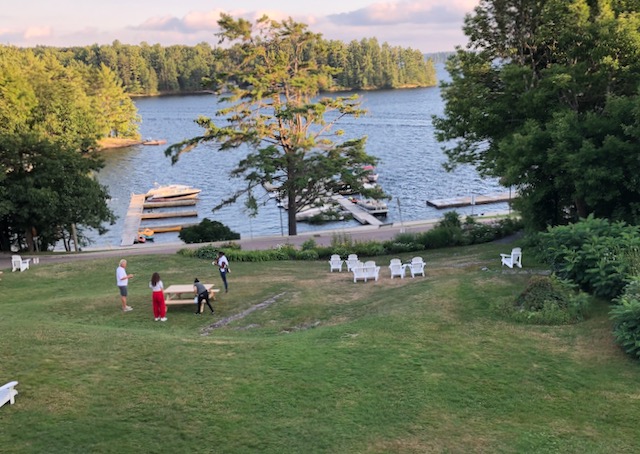
On the positive side, my appreciation for walking has increased. 🤓 When you walk, you can take pictures more easily – like the ones I took (below) last week in Muskoka. So that’s what I’ll be doing for a while. Except when I’m sitting on the couch with my foot up.

Special thanks to Dan, for the words of support, and the running chart. At this point, I’m optimistically filing it for next year.

Slog Slog Slog

Week Two, Day Seven

Just a quick update tonight because we are out of town on a mini-holiday and it’s hard to focus on writing a blog post when you’re sitting on your hotel balcony looking out at a Muskoka Lake. Maybe by tomorrow I’ll have grown used to the change of scenery but after four months (!) of being mostly at home, it is a sweet break.

During Week Two (which ends today), running continued to be a challenge. I promised myself part way through it that if it doesn’t get easier within another week or two, I will switch to (fast) walking. My sister is doing that — five to eight km a day! – and has been since the pandemic began. I am so impressed with her. Mind you, she is a LOT younger than I am (not really. Just 18 months) but obviously she is staying in great shape and keeping her spirits up by striding all over the west coast, while I drag my sorry butt around a few city blocks in Toronto.

It wasn’t all bad. I did notice a bit of improvement: for a couple of minutes on my second and third running days, I did manage to find that elusive “zone” where I find it as easy to run as to walk. But it has been much harder to reach that zone this time around than on any of my previous attempts to re-start my running program. I am hoping that Week Three is the turning point where I finally start looking forward to going out.

In the meantime, for a few days I can swim! I love being in the water, and I have always preferred a lake over a pool. I grew up in London, Ontario and when I was a kid, many summers we came up to Muskoka for camp or to visit friends and relatives who had cottages. After spending decades in Alberta, where they don’t have what I think of as “real” lakes, I have thoroughly enjoyed the opportunity to revisit Muskoka since I moved back to Ontario. It’s just the perfect place for me: evoking long-lost memories as well as making new ones.

The First Week Is the Hardest, Baby. (Or maybe not.)

Week 2, Day 1

As Week 2 began, I was hoping that I would be able to announce how much easier the second week was than the first. The start was promising: it was a lot easier getting up early than it was last Monday. In fact, I set my alarm for eight (since it was a holiday and all) but I woke up at 7, so I got up. In spite of that, it was almost noon before I prodded myself out the door for my run, and it was warmer and muggier out there than I had anticipated.

It’s cooler this week than it was last week, but it’s still warm when the sun is out. Between the heat and the humidity, plus the fact that the running time on my training schedule had increased from 2 minutes run/3 minutes walk (times six) to 3 minutes run/ 2 minutes walk (times six), it was a huge struggle to complete my assignment for the day.

But I did it. (My musical accompaniment was Pink.) And today I went for my walk, dodging raindrops. So I’m still on track.

Tomorrow I’ll go out when I get up. Difficult as it is, it’s really the only way, at least as long as the summer heat is on us.

I found an article in The Guardian last week that certainly might help get me out the door if my brain were functional enough at 6:30 in the morning to think about scientific evidence of any kind, which normally it is not. It concerns a report from the Lancet Commission on dementia prevention, intervention and care in the UK that reviewed a lot of existing literature and added some new studies of its own on the subject of dementia. The Commission determined that by addressing certain lifestyle factors, “up to 40% of dementia cases worldwide could be delayed or prevented.” Physical inactivity is only one of twelve risk factors mentioned in the report, but it’s one of the ones that individuals can do something about — unlike, say, pollution. (Note to younger readers: exercise is particularly beneficial in this regard when practised starting in middle age.) Since the report points out that depression is also associated with dementia, and since exercise definitely helps to lift the spirits, physical activity may thwart dementia on two fronts.

I am very grateful to my friends and followers for the positive feedback I’ve been getting on this undertaking. It helps a lot.

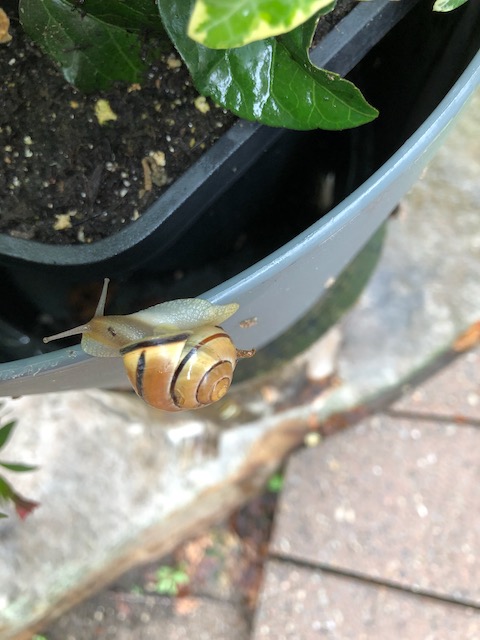
Photos from my walk today include an unidentified flowering tree and a snail – both enjoying the rain.

Week One, Day Four

Run a Day, Walk a Day

My goal at the outset of this new regimen is to get out there every other day for a total of three runs a week. I have read that muscles need an opportunity to recover, and for that reason running every day is not recommended. (Those who offer such advice are probably talking to people who run five k in half an hour, which isn’t me. But I figure I might as well keep the wear and tear on my aging joints to a minimum.)

However, running only three days a week creates a problem. I know that if I don’t get up at the same time on the other days as I do on my running days, I will never develop the getting-up-early habit, and rolling out of bed will continue to be a battle. So I’ve decided to try to get up at the same time on the other days as well and instead of going for a run, go out for a walk.

Guess what? Going for a walk turns out to be far less onerous than going for a run. You have more time to check out cloud formations and you can smell the trees. You can even give yourself permission to stop to take pictures of interesting things, which you can’t do when you’re running. Take this chair set in the back of someone’s yard, looking out on Sheppard Ave. It’s the kind of chair I’d love to sit in: it’s far from human activity on three sides, well shaded, and looks out on the traffic going by on a pretty busy street (albeit somewhat less busy during a pandemic than usual).

I also found a path heading off into the woods from that busy street, and I was very tempted to see where it led.

So far this week, I’ve done two runs and two walks. This is a definite improvement over last week, and the week before that, and the one before that, etc. Many steps in the right direction. I am grateful to all those people who I imagine are reading this blog, because you’re the ones who got me out there! Onwards.

Just fyi, my first week’s schedule is 2 minutes of running plus 2 minutes of walking, repeated six times, plus a warmup and cool down at five minutes each. The first day out I was accompanied by Queen, and the second time by Chris Isaak.

This little guy has been the highlight of my outings so far. I paused on the path when I saw him and asked if he’d stay where he was if I moved a bit closer to take a picture. Keeping his eyes on me, he sat still until I’d snapped this photo.

Well, That Was Dumb

or maybe not….

Your overheated scribe, post-run. Note steam rising from head.

So the alarm went off at 7 o’clock this morning, and I did what I always do: I turned it off and I went back to sleep.

When I woke up for real at 8, my immediate thought – of course – was that I had promised myself and the small corner of the universe that reads my blog that I would get up and go for a run, and I had failed to do that. Guilt set in immediately. My one hope was that no one had read the blog post yet… maybe I could take it down and repost it today and everyone would think tomorrow (Tuesday) was the day I had promised myself to start this new regimen.

No such luck, of course. My WordPress dashboard indicated that quite a few people had clicked on the post during the night (in addition to those who get the post whether they want it or not because they are subscribers). Someone had even commented already.

Although my first instinct was to throw myself off a very high escarpment somewhere, that seemed a bit dramatic even to me. My more realistic choices were: a) to confess in my post today that I had failed to get up and go for a run, and to say I would try again tomorrow (we’re all human, blah blah blah); or b) to go for a run today at some later hour than 7 a.m., and then to confess in today’s post that I might have failed to get up, but at least I had gone for a run.

The Don River was high and fast today due to the heavy rains, but it didn’t cool the air much.

There was, obviously, only one option available to me, and that was Option B. But the problems associated with Option B were almost enough for me to seriously contemplate settling for Option A. The first problem was that I could not go out until an hour after I’d eaten breakfast (because I don’t like running on a full stomach. I am such a delicate flower) and the temperature was already nearly 30° (that’s 86°F). By the time my oatmeal had settled, it would be several degrees higher. I was going to bake out there. Sunstroke. Ambulances. I visualized them all.

Don’t be a wuss, I told myself.

The next problem arose just after the oatmeal had found its happy place. This one took the form of a Severe Thunderstorm Watch that had now appeared on the Environment Canada website. I could see the clouds moving in. I weighed the heroics of having been killed by lightning because of my determination to get some exercise against the horror of having to admit defeat (see Option A).

Sure enough, we got a huge downpour — and then it was time for lunch.

And so it went all afternoon — heat and stormy weather. But by five p.m., I could delay no longer. It was still more than 30° and the Thunderstorm Watch was still in effect (as it is even as I write this post at 9 p.m.), but by now I knew I could not face this blog tonight if I had not gone for a run.

Not too many people were out on the trails today.

So off I went. I went down into the ravine by the Don River, where it was marginally cooler than on the paved streets above, and most of the trail was shaded. But it was still the hottest run I can remember doing in about ten years – and that one was in Edmonton, which is in a much drier climate. I was drenched with sweat when I got back. But I did manage to attain my tiny beginner goal for Week 1, Day 1: run (or “wog.” Thanks for that term, Lee. That is in fact what I did) for two minutes, walk for two minutes, six times. With a five minute warmup (hah!) at the beginning and a five-minute cool-down (hah!) at the end.

As I was dragging the weary puddle I’d turned into back up from the ravine, it occurred to me that given the heat and the weather warnings, I would never have gone out today — never never never — if it hadn’t been for this blog, and the people I knew had read it. So the trap I set for myself has worked, at least for today. I just hope that I have enough sense to avoid putting myself into such a hot, humid and embarrassing position again. Tomorrow is a walk day, rather than a run day, and I swear I am going out at 7, when it is still cool.

I do have an extra nudge to get me up and moving tomorrow. The first comment I received on last night’s post was from my son Dan, who does a hit on Radio 1010 about science and technology every morning at 6:50 a.m. He suggested I listen to the hit live (instead of tracking down the recording online once I am awake, as I usually do), and then head out the door. Thanks, Dan. If you can get up in time to do the segment, I can get up in time to hear it.

I think I can.

I hope I can.

P.S. Thanks to Lee and Ruth for their very supportive comments, too. Your feedback helped so much!!