Starting Out with a Zero to 5K Running App
 When I began to run the first time, at about the age of 40, I took a “Learn to Run” course at the Running Room in Edmonton. It was a great way to start, and I highly recommend taking a course like that if you haven’t run before and one is available nearby.
There are many good reasons for taking a course. One is the information you receive during the pre-run talks on such topics as nutrition, hydration, pacing, buying shoes, etc. Another (very important) benefit of running courses is the camaraderie. Running with other people is highly motivating. In addition, running-course instructors know how to manage groups so that newbies minimize their chances of getting injured, and how to raise the spirits of those at the back of the pack.
Group runs in learn-to-run courses typically start off with “one-minute run, one-minute walk, repeat 10 times,” and then gradually build up over 8 to 10 weeks until the group is doing one-minute walk, ten-minute run, repeat three times” (or something to that effect). You’re expected to do a couple of runs between each weekly class.
In the years following that first running course, I signed up for several other courses – each of which had a target race at the end of it. I took the 5k course, the 10k course and the half-marathon course. When I moved to Saskatoon, after a long layoff from running, I signed up for the 5k course at the Running Room there, and met a whole new group of runners. Most of the courses have the same classroom content, of course, so after the first one or two, the main value is the motivation of being in a group to get out there and run: to run longer and longer distances, to run faster, to run hills, etc. And every instructor puts their own spin on it, so you are always acquiring new tips.
When I moved to Toronto at the age of 60, I signed up for another 5k course but by this time enough years had passed since I’d done any serious running, and enough arthritis had set in, that I felt I was slowing down the group. Please note that the group did not make me feel this way, and neither did the instructor: it was all in my own head. But I quit after a few weeks, discouraged.
I didn’t want to get discouraged by a group of younger runners and quit again. Most of all, I didn’t want to be embarrassed.
On reflection, I suppose I should have started again with the learn-to-run course rather than the 5k class. But I was also getting tired of spending money to get the same “chalk talk” I’d heard several times before. Another option would have been to simply join the drop-in run clubs that go out from most running stores each week (check local listings for run times) — no charge for those — but I was feeling heavy and slow and old, and I didn’t know anyone who I could run with (i.e., not anyone as slow as I was).
When I decided to start running again this past August, I was living too far away from a run club to make that option viable, and I was also quite certain that I was not going to be able to keep up with anyone else at all. There are many people who walk faster than I could run. I didn’t want to get discouraged by a group of younger runners and quit again. Most of all, I didn’t want to be embarrassed.
So I decided that this time I would use a “Couch-to-5k” app for guidance and motivation instead of an instructor-led group. There are several apps that offer different options depending on what you want from them as you build your endurance, most importantly at this stage being verbal reminders of when it is time to stop running and take a walk break. Most also offer motivational bits of chit-chat (“Good for you for getting out for a run today!” Fortunately you can usually turn this feature off if you don’t want it).
Running apps are also useful for keeping track of where you ran, how far you went, how long it took you, etc., but keep in mind with your first app that it is going to help you achieve a definite goal: running 5k, for example, or running for 30 minutes without a walk break. After this stage, you will want another app as you continue to run further and faster. So the long-term dashboard options are less important in the first app than they will be in the one to which you will graduate after the first ten weeks or so.
My First Running App
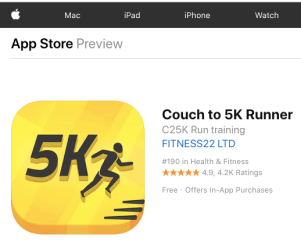
I started with the Couch to 5k Runner. It starts out with 25 to 30 minutes of exercise in total, starting and ending with a 5-minute warmup/cool-down walk. As you work through the eight-week program, you go from from 1.5-minute walks alternating with 1.5-minute runs until you reach 30 minutes of straight running, and then you increase your running time until you are (ideally) at 5k.
I wasn’t that fast. But it didn’t matter. I went as far as I could in the allotted time, and stuck with the program, which was the most important part. By the time I’d finished with this app, I was able to run 30 minutes without a break. I started with a two to three minute warm-up walk and a similar time for a cool-down walk.
It’s important to note that the couch to 5k app never presented me with more of a challenge than I could manage. The only hard part was getting out the door.























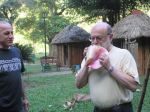





 This morning Arnie and I went our separate ways: he to do a horseback trip through the Viñales valley, and me to join a walking tour of a few farms in the same area. We compared notes after we met up again and discovered that we’d both watched the owners of different tobacco farms make cigars by hand. We’d learned about the different leaves that go into the creation of the perfect cigar, and been told that the finer the cigar, the lower the level of nicotine. We’d been advised that inhaling is not a recommended part of the cigar-smoking experience anyway. After the demonstration, each member of both groups was given a Cuban cigar to smoke. Arnie smoked all of his. I just took one puff.
 Rain had pounded down all night and into the day, to the point where when a few members of our group stepped out into a Viñales street after breakfast, they found water going over the tops of their trekking boots. Their feet were wet all morning. I didn’t get wet feet until I started walking around the countryside, but when I did it was not only wet but red. I assume a high iron content in the soil, but I forgot to ask about that.
 Our guide did tell us that the soil here is very good for tobacco growing and that they use no pesticides or fertilizers. The farm workers plant all the seeds, pick all the leaves, and harvest the leaves by hand. It takes three to four months to grow a tobacco crop and the farmers in this area sell 90% of their crops to the government and turn the rest into cigars with their own brands. (Our host said his were called “Geraldo’s cigars” but I think that was a joke.)
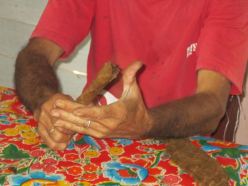 The inside leaves that are high in nicotine content are fed to animals. The better leaves are soaked in honey, guava and rum, and then put into home-fashioned humidors (made of plastic wrap) to cure for a year or two. The result is a cigar that tastes wonderful and has very little nicotine. (Geraldo pointed to his 70-year-old mother who was smoking a very large Cuban cigar as evidence that cigar smoking will not harm your health. [See slide show album below for photo of her.] I was not impressed, as 70 seems very young to me. Show me your 100-year-old mother. Then I will pay attention.) Geraldo hand wraps approximately 100 cigars a day.
 In addition to tobacco crops and drying barns, we saw fields and groves of mango, bananas, coffee beans (arabica), black beans, calabash (from which maracas are made), taro and cassava. I have discovered here in Cuba that I love taro, which is the basis for arrowroot and according the locals cures almost everything. (And anything it doesn’t cure is cured by the root of the royal palm so it is all covered here. Although there is also excellent health care in Cuba if anything else is required.)