Countdown to 3 a.m. departure

Cuba: Day 1 Minus 1

Screen Shot 2016-01-02 at 5.28.26 PMOur house is in a state of disarray as we pack suitcases and attempt to get all of those things organized that it is necessary to organize before one goes away for any length of time.

Our plane leaves at about 6:30 a.m. tomorrow, and the airline says we have to be at the airport three hours ahead of time – which seems ridiculous, but there you have it. So we will be leaving the house at 3 a.m., which means that we will be trying to get to sleep REALLY early tonight. And that in turn means that all the packing and sorting and checking of lists needs to be done before early evening. We’ll see how that goes, since it is almost early evening already and I haven’t packed anything yet.

Tomorrow we fly from Toronto to Varadero, Cuba, and then take a bus from the airport at Varadero to our hotel in Havana, where we are meeting with our group for dinner. Even though Havana is in the same time zone as we are here in Toronto, it is going to be a long day. But I am so excited that I probably won’t sleep at all tonight.

In preparation for this trip, in addition to the copious materials sent to us by our tour guides, I have read the introduction to the Lonely Planet travel guide to Cuba, and I am looking forward to reading the entries for our particular destinations as we approach them. Our trip will include stops in Bay of Pigs/Playa Girón, Cienfuegos, Santa Clara, Trinidad, Vinales and Havana, and will wind up with a couple of days at an all-inclusive in Varadero. I will post something about each place we see, but not necessarily as we go, as I understand that internet is iffy in Cuba, and that wireless internet is almost non-existent.

Screen Shot 2016-01-02 at 5.33.34 PMIn addition to the Lonely Planet book, I’m taking the Wallpaper City Guide to Havana, a gift from Arnie’s nephew Paul Resnick (thanks, Paul!). And as far as communicating while we are there, I’ve downloaded a Spanish-English dictionary onto my iPad and iPhone and I am hoping that this – combined with the past couple of months of refreshing my Spanish on Duolingo – will see us through.

In regard to Duolingo, I love the app/site and think I will take up German next. My biggest problem with Spanish (aside from being only about half way through the course now that it’s time to leave) is remembering vocabulary, and trying to change verbs to the past tense. But I can stumble along. I am looking forward to hearing Cuban Spanish, which is I’m sure much different from the Spanish I heard in Mexico and the southern U.S. – and to what I heard on Duolingo.

On my last day on Duolingo, I wrote this on Facebook: “I am now ready to go to Cuba. According to Duolingo, I can say ‘This car has no battery’ perfectly in Spanish.”

The next day I posted this  (utterly unrelated) thought:

I have been looking over my travel insurance in preparation for my trip to Cuba.  I am wondering why it is that if something really awful happens to you when you are out of the country and they have to ship the pieces of you back to Canada, they refer to the process as “repatriation.” The word makes me feel as though the insured, demised though she may be, is expected to rouse herself on arrival back in her home country at least to the point where she is able to salute.

So on that upbeat note, here we go.

Hasta luego.

I Am Cuba: A Cinematic Gem

Screen Shot 2015-10-16 at 5.03.42 PMSoy Cuba / I Am Cuba

A week or so ago, we watched a remarkable Soviet propaganda film that was made by the Russian director Mikail Kalatazov in 1964. Co-written by the Cuban novelist Enrique Pinada Barnet and the Russian poet Yevgeny Yevtushenko, Soy Cuba (I Am Cuba) is a strange mix of cinematic genius, poetry, romanticized Cuban history and America-bashing. It is also the only film I have ever seen that is narrated in one language (Spanish), dubbed in another (Russian, which often obscures the Spanish), and then subtitled in a third (English).

The film as a film is mesmerizing. It is exquisitely made in black and white, which not only serves a dramatic purpose but reinforces the melodrama of the film. I Am Cuba opens with a passionate introduction by the narrator to her beloved country as the camera pans from ocean to beach, from village to city. (You can watch the first five minutes on YouTube, albeit without the English subtitles). The film then traces its version of Cuba’s history during the first half of the 2oth century, as the country is exploited by rapacious, drunken, greedy, godless American capitalists who strip the nation of its innocence and self-respect.

As Roger Ebert pointed out when I Am Cuba was first released in English in 1995, the film demonstrates some amazing cinematic feats that were not only distinctive during the era in which they were produced, but would have been tricky maneuovres even in the mid-1990s. This probably explains at least in part why I Am Cuba attracted the attention of Martin Scorcese and Francis Ford Coppola, who are responsible for the film’s availability today. One shot very early in the film (it is part of the clip at the link above) pans across a hotel rooftop high above Havana’s harbour before dropping slowly down to a lower pool deck, where it skims past groups of carefree and care-less (American) tourists before following a sunbather from a deck chair right into the swimming pool – all in an apparent single take. The segment recalls nothing more than one of the many brilliant unbroken shots for which Scorcese himself is deservedly admired. (As far as the feel of the film itself, David Lynch kept coming to my mind.)

Such remarkable panoramas are interspersed with symbol-drenched, wonderfully over-the-top vignettes about individual Cubans whose lives have been stripped of self-respect, income (and almost, in one case, physical innocence) by the American invaders, along with their puppet president/dictator Fulgencia Batista and his henchmen – a combined force that has led them into prostitution, drug dealing, humiliation, despair and destitution. Soy Cuba then depicts, also in highly romantic terms, the bloody and violent student protests against Batista and capitalism, and the rise of a heroic communist leader who changed the course of Cuba’s history in part by broadcasting calls to action to his people from a pirate radio station in the Sierra Maestra mountains.

Clearly, Soy Cuba is not a film on which to rely for an unbiased history of the Cuban revolution, and further investigation on my part will be required. (I was only eleven when “The Bay of Pigs” occurred so I won’t be relying on my memory, either.) More important than its contribution to world history, however is the contribution this film makes to cinematic history. From an artistic point of view, it’s a must-see.

We’re Going to Cuba!

¡Hola Cuba!

I am very happy to announce that my (new) husband and I are embarking on my next (also his next, but our first) adventure early in January, 2016. We are going to Cuba! I have always wanted to go there, and now that Cuba and the USA have re-established diplomatic relations, I want to get there before the improving trade situation allows the export of whatever makes Cuba Cuba (which I have some theories about already, but no real knowledge), and the import of what does not. I hope that in the long run, the détente is going to be good for the average Cuban, but as Canadians well know, exposure to our powerful neighbour to the south (and Cuba’s north) can overwhelm what makes a nation distinctive.

As was the case with my trip to India, I will start by reading about the country I am about to visit: the Lonely Planet guide to Cuba is waiting for me at the post office as I write this. I am also brushing up on my Spanish, using an app called Duolingo. I have taken Spanish before – many times, in fact. I studied it at university for a year, and have taken conversational Spanish classes a couple of times since then. I am not sure how Cuban Spanish varies from that of other Spanish-speaking countries (of which, so far, I’ve visited only Mexico), but I will probably find out and write a post about it. In the meantime I am learning such useful terms as “The monkey sleeps above the parrots,” and “I eat in the basement,” which I am sure I will be using regularly on my trip.

I found the tour we are taking online at Responsible Travel, as I did with the India tour. Responsible Travel is dedicated to directing travellers to small, local travel companies that work to improve or at least contribute to the sustainability of the countries in which they are located. We have chosen a small-group tour from Locally Sourced Cuba, that involves local modes of transport, and accommodation with Cuban families at casas particulares.

My husband’s experience with travel has mostly involved renting a car, staying in hotels, and driving around at his own pace, so this will be a new approach for him.

We are leaving in early January, and we will be travelling for ten days. The actual tour leaves from Havana and includes the cities of Cienfuegos, Trinidad, Santa Clara, and Vinales, before returning to Havana. At that point we will go to Varadero on our own for a few days of sun. I learned on my last trip that the perfect way to end an intensive tour is to take some time for total relaxation before returning home. That will give us some time to process everything we’ve seen (and allow me to catch up on my blog posts).

I gather that internet access is almost non-existent in most places in Cuba, so although I will be writing about each day’s travel, I have no idea when I’ll be able to post my various installments. Perhaps not until I get home.

All that is still a long way in the future. In the meantime, I’ll be keeping you posted on my preparations.

¡Vamonos!

A very New Mexican miracle or two

Screen Shot 2013-03-18 at 9.46.19 AMI wrote this bit of fiction/satire in 2009, shortly after I returned to Saskatoon, SK, where I was living at the time, following a trip to New Mexico. I keep losing it on my computer so I thought I’d post it here where I can find it if I need it again. And others can read it if they want to.

There has been a miracle. There have been TWO miracles, in fact. Ever since I was in Santa Fe last month (was it only last month? I have been searching western Canada for a decent (aka New Mexican) enchilada. There is nothing like a New Mexican enchilada – my mouth waters at the recollection of them. In NM, I ate them with green chile sauce and I ate them with red chile sauce and I ate them with both (Christmas).

Last night I finally found an ancient New Mexican who had started an enchilada restaurant here in Saskatoon but no one ever came to eat there, a) because he did no advertising and b) because no other Saskatoonies knew of the wonders of the New Mexican enchilada. It was a cab driver who told me about him, and the cab driver (a Pakistani-Canadian) dropped me at the door of the restaurant, just as the poor old New Mexican (Jose Chavez) was hanging up his Closed Forever sign.

He was so shocked to have someone who actually appreciated his enchiladas that he slaved for hours in the kitchen to get them exactly right. (He wouldn’t let me watch. It is a secret recipe that only New Mexicans know. All you can dream of in your life is to have a real New Mexican come to your house and cook you enchiladas. You will never want to eat anything else again.)

Jose put the plate on my table, poured me a glass of tequila (not knowing I don’t drink) and then stood back to await my response.

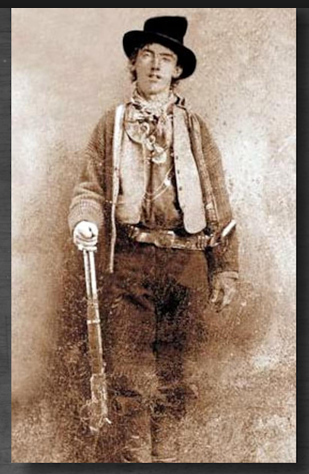
But then — here is the second miracle! I looked down at my plate and there, in the plate of enchiladas, clear as anything, was the figure of Billy the Kid!!! How could I eat that?? I had no need to explain my dilemma to Old Jose — everyone in NM knows Billy, who loved the Spanish. So now my enchiladas with the face and body of Billy (a Winchester–which I think might be a chile stem–loose in his hand, its butt against his boot), are in my fridge, and I have taken a picture and I am posting it on ebay, and when it sells for a million dollars Jose and I are running away to Guanajuato where we will live forever, me writing, him cooking me enchiladas.

Really.

______________________

(P.S. Check out the fine novel, Billy the Kid’s Last Ride by John Aragon, who is also co-author with me of  The Adventures of Don Valiente and the Apache Canyon Kid.)

Anguilla Lit Fest: Day One, Breakfast Presentation by Lasana Sekou, Hill Harper and Sheryl Lee Ralph

Okay, so it’s not really Day One any more. I admit it. The whole conference is over. But since Anguilla’s first lit fest really got underway on Friday morning at the magnificent Paradise Cove Resort, I’ve been going, going, going – which left no time for blogging, blogging, blogging. On both Friday and Saturday, I had a couple of hours off each afternoon, and I came back to my room planning to take a nap before dinner because I was too tired to move. But I could not nap: my mind was going a thousand miles a minute. That’s the sign of a great literary festival and conference.

I’m going to tell you about all the sessions and receptions I attended (and show you pictures) but it’s probably going to take me all week or even longer, mostly because if I write about more than one session at a time, the post will be too long. Plus there were a few people who weren’t even on the agenda who knocked me flat, and I want to tell you about them, too. I feel like this festival has changed something deep inside me and I hope I can convey some of the magic to you: one session at a time.

More…

Anguilla Lit Fest: Day One, Breakfast Presentation by Lasana Sekou, Hill Harper and Sheryl Lee Ralph.

Watch. Listen. Learn. (India 15: Final thoughts)

I guess one way to tell that your trip to India is over is that you stop having to take malaria pills, and for me that happened over a month ago. But in fact my trip did not feel “over” until I finished writing about it. And now that I have done that too, I long to call the whole experience back to the present, but I am also eager to start thinking about my next writing projects, and my next adventures.

This post is a summary of some lingering thoughts I’ve had while reflecting on my three weeks in India, which was also my first major solo trip abroad – thoughts that I didn’t really cover in the previous posts, but ones that are too brief and transitory to merit their own posts.

The Best Part

A few people have asked me what was the “best part” of my trip to India, and I honestly can’t give an answer to that question. Instead of disparate memories of different locations – Delhi, the Taj Mahal, Pushkar, the wildlife reserve in the Arivalli Hills – it all merges together in my head to become one big wonderful thing called “India.” Or, more specifically, “Some of Northwestern India.” It’s a feeling. And a good one. I want to go back.

Where Next?

A few people have also asked me where I’m going next – now that clearly I’ve  been bitten by the travel bug. For a while I was thinking “Spain,” because I’ve been longing to go to Spain (and France, and Germany, and Italy, and Greece) since I was in university, or even before that. I studied French and Spanish In school and keep trying to brush up on those languages in case I get a chance to use them.

But now I’m thinking that if I’m going to be more flexible (mentally as well as physically) in the next thirty years than I will be in the thirty years after that, and since travelling through Europe (and Australia and New Zealand) is likely to be easier on an older person than travelling through other parts of the world, maybe I should go to the more challenging places first. So I think Peru is my answer at the moment. Or Cambodia.

Jet Lag

I didn’t have jet lag on the way to India: when I got to Delhi, I was ready to hit the pavement. That may  have been because I was in a new place and was full of curiosity, excitement, and a bit of fear. Or maybe it was because after travelling for 36 hours, I arrived just in time to go to bed. I just got up the next morning and started going. And kept going. And going.

On the way back, I arrived in Toronto at noon after about the same number of hours of travel time – and in the same direction, by the way: I’d gone to India via Hong Kong but I came back via Brussels. I tried to stay awake until night arrived when I got home but it was impossible. I fell asleep against my will at about 4 p.m. and I was totally messed up for about a week.

I have since read that jet lag may be as much related to digestion as to sleeping patterns. That makes some sense to me because when I’d wake up in the middle of the night during that week after my return, I was ravenous.

The pundits with the food-and-jet-lag theory suggest eating nothing while in transit. That would certainly be a variation on this trip, where I felt as though I were eating constantly while I was getting to India and getting home again. As soon as I’d board a plane I’d get dinner, and then four hours later I’d get breakfast: two planes each way. And on the layovers between flights (seven hours in Hong Kong and four in Brussels), I ate. What else was there to do?

I guess it couldn’t hurt to try to fast while flying. Consuming lots of water also seems to be a good idea.

Of course, if I go to Peru next time, jet lag won’t be a problem: Peru is in the same time zone as Toronto. And I think I can use some of my Spanish there.

How long should a trip to one country be?

Three week feels like about the minimum amount of time it takes to start to get a sense of a new place – longer would be better, but may not be possible if you have a real life underway back home and aren’t able to just become permanently itinerant.

I think you need to stay in a new place for long enough that what looks really strange when you arrive starts to look normal: for me, in India, this included the sight of cattle wandering the roadways, and of women in saris riding side-saddle on the backs of motorcycles with their arms wrapped around the drivers (I saw this everywhere, from the centre of the city to the middle of the desert). I got so used to these things that I barely noticed them by the time we left.

Ongoing effects of my trip to India

I could go on for pages on this subject, but I can also summarize fairly briefly my sense of what has changed in me as a result of my visit to India.

Elephant bathing ghat at Sahakari Spice Farm, Goa

I have always been attracted to the multifaceted “idea” of India but now I feel as though the country is a part of me. Granted, it’s a small part; in three short weeks I was only able to nibble at the edges of that vast empire. But India is with me now in a way it never was before, and as long as my brain is still functional, I will never have to let it go. When someone says the word “Mumbai” to me, it has a personal meaning now. When they say “chai-wallah,” I can see one in my mind’s eye. The word “ghat” has a physical representation in my mind that no photograph can give me – I’ve seen several, including one reserved for a family of elephants, and walked down one in Pushkar in bare feet. I know how to pronounce “Udaipur” properly, and I know what really great fish vindaloo tastes like at an outside table in Baga.

I also find myself far more interested in Indian news than I was before. I have followed with interest an excellent series on caste and women in India in the Globe and Mail. I was intrigued by the story of a man named Anna Hazare who went on a hunger strike to protest corruption in India’s government. I reflected on how similar were the frustration of speakers of the Konkani language in Goa at the increasing influence of English to the dismay expressed by aboriginals and Quebecois in Canada. When I see the word “India” in the news,  I read.

This blog

Yes, did name this blog to echo the title of Eat. Pray. Love. I wanted to stress that I was not going to India to try to find anything inside myself — I was going there to learn about India. And I did.

Here are links to the earlier posts on my India travel blog, in case you missed them:

Then there were the posts about

Onwards

This is only the first, I hope, of many travel blogs. When I’m not travelling (which is, obviously, most of the time), I do write about other things that catch my interest here at I’m All Write, so subscribe if you think you might be interested. And I write about writing-related things at The Militant Writer.

Until the next post, नमस्ते (namaste).

 *  *  *  *  *

Watch. Listen. Learn. (India 14: Shopping)

The travel challenges of a Not-a-Shop-A-Holic

I am not a good shopper at the best of times. I dither and dither and then make impetuous decisions that I later regret. As a result, I often need to take back things I’ve bought.

I don’t like returning things, either – especially to smaller stores. Returning something requires me to summon all of my courage because I feel as though taking something back to a store is tantamount to criticizing one of the salesperson’s offspring, or at least impugning his or her tastes. I therefore usually end up buying something else I don’t want while I’m there, just to cheer up him or her. Logically I know that the salesperson is an employee of the store and doesn’t give a rat’s ass about the fact that the handbag I’m returning turned out to be too small for my purposes, but for me, logic has nothing to do with the shopping experience.

In short, I am the Ultimate Non-Shopaholic – and that is true even in a country where the prices of things are clearly marked, where I have time to think about what I’m doing, and where the staff speak the same language I do and are generally nowhere to be found (which is just where I like them). It turns out that I am much worse at shopping in foreign countries where I need to bargain about prices with salesclerks who hover and hover and respond to the words “No, thank you,” by bringing out a dozen other things they are sure I’ll want to look at – salesclerks who implore customers who walk away empty-handed by saying, “You come back tomorrow, Lady?” and when you answer, “Yes, tomorrow,” respond, as though their hearts will break, “You promise?”

After my trip to India (and yes. It’s true: I do have the nerve to travel by myself half way around the world to see a country I’ve never been to, but not the courage to return a leaking mug to Starbucks. Go figure), I have decided that I am never again going to try to bring anything back from anywhere with me. I have learned my lessons. I think.

The Albatross

As those of you who have been reading earlier posts will know, my first shopping misadventure in India occurred in Jaipur, where I was not intending to buy anything at all. But the tuk-tuk driver who took me to the Amber Fort, which I ended up accidentally climbing past in favour of the Jaigarh Fort, thereby totally wearing myself out, was a very good guy. First he told me how to avoid being ripped off by other drivers and souvenir sellers. Then he waited for me even though I was gone for at least three hours, and he didn’t charge me any extra for the wait. In short, I was as grateful to him by the end of my adventure, which had been undertaken for the most part in hot sun, without water, and on an upward incline, as I would have been if he’d just donated his left kidney to me. And all the dear man asked in return was that I spend fifteen minutes looking at the goods his friend sold. How could I refuse?

He drove me to a textile shop, a really classy place, where the vendor served me chai masala and showed me how the textile makers put vegetable dye marks on fabric and how they wove rugs– and then showed me around his massive showroom.

I felt no pressure as the owner showed me bedspread after bedspread, starting with the cheapest one first, asking his assistant to fling open one after another of increasing quality and opulence atop its predecessor. I worried about how they could ever sell all the fabrics that they had on display there: walls and walls of shelves full of folded beautiful fabrics. I fell in love with everything he showed me, and—thinking of all the people who had had to work so hard for mere pennies a day to create these lovely pieces (true, although on reflection I doubt any of them was related to the owner)–I did not negotiate much.

I bought a beautiful bedspread with hundreds of tiny reflective spangles, each one sewn in separately, and a spectacular wall hanging pieced together by hand from stiff pieces of aged fabric to create the image of an elephant – in my favourite colours, deep red and green. It is true that these items would have cost much more in Canada, if they were available here—but they might have cost far less in any other store in India, and could have cost even less if I had offered less. In addition, I was on a budget and could not afford them, even at the prices I paid. So although I was delighted with my purchases as the vendor had them plastic-wrapped and taped and then sewn into a cotton sack for me so I could ship them home, by the time I got back to my hotel I was feeling guilty. That’s why I called the sack “The Albatross “– because of my guilt (which was, admittedly, slightly smaller than that endured by the Ancient Mariner, as were the repercussions) and embarrassment that I had not argued for a better price. With further echoes of Coleridge, since it was at least a week before I found a post office to mail the package from, I had to drag this 6.7 kg reminder of my shopping stupidity around with me everywhere I went.

Souvenir Shopping

When I finally did divest myself of The Albatross in Mumbai, I still faced other shopping obligations, which I’d need to do in Goa.

It wasn’t a long list. I wanted to get a few souvenirs for my kids and grandkids and a couple of small things for myself. But having avoided shops everywhere else I went in India, I’d left souvenir shopping to the last minute,  and that was a mistake.  By then I had perfected the skill of avoiding the pleading eyes and  the hawking calls of shop-owners who came out in the street to try to draw me in by telling me of the remarkable quality and range of wares they had on sale, and who were not easily discouraged by any word except “Tomorrow.” On the day when I was carrying The Albatross back from the post office to my hotel in Udaipur, after finding that the post office was closed on Sunday, even then retailer after retailer begged me to stop and shop with them as I struggled down the street. I indicated my arms and my burden – “How could I carry any more?” I asked them, but they just smiled and said, “Okay, then. You come back tomorrow. You promise.” (They were friendly. All of them were friendly. But they were hard to refuse.)

(I had also been taught my lesson about crafty sales pitches for a second time in Udaipur when a friendly man at the Jagdish Temple invited me to see his art school [he was small. I could have squashed him. Stop worrying, my sons] and I learned it was another store front—this time for expensive works of art. This time after looking at the wares in his classy little store, I just said “No, thanks,” and left.)

The upshot was that I knew I would actually have to look a vendor in the eye if I were going to get any shopping done, and I would need to actually enter a shop of my own free will. I chose my shop by skimming my eyes across the available alternatives along the main street of Calangute, as though I weren’t actually interested in any of them. Once I stepped inside, I knew I would be sunk.

And I was. I either picked the wrong shop or there were no right shops anywhere because once I got in there, there was nothing I wanted, and yet I bought and bought and bought. T-shirts. Handbags. Leggings. A dress or two. The kitchen sink. I knew the same things were available elsewhere, and I knew I should not pay more than half of what the shopkeeper was asking, and I even wondered if maybe some of the things I was looking at might not be for sale back in Toronto. But it was all so cheap that I filled my backpack and did not dicker very much because the woman had so much less than I do (another kind of guilt that comes into play when shopping in places like India), and then when I got back to my room I realized that most of the clothes I’d purchased for myself were never going to fit me because I’m twice the size of your average Indian woman, and so most of it was heading for the Goodwill. Also, by then I was hot and aggravated. I’d spent about $30 on about $5 worth of salvageable merchandise that would have cost me hundreds in Canada except that I’d never have bought it in Canada. I’d have honestly been happier (much happier) if I had been able to just give the $30 to the woman who sold me all these things, without having to actually take any of her products away with me.

So that was that.

Resolutions for Future Travels

Next time I go travelling, I am going to relieve the pressure on myself by purchasing only postcards.

At least that’s what I think now. Because the problem is that now it has arrived, I’m pretty happy with the bedspread and the wall hanging. And I find myself quite attached to a small carved wood Ganesh that I bought at a five-and-dime type place for about 25 rupees (50 cents). The kids seem to like the tea I gave them. And if I hadn’t gone into any stores at all, I wouldn’t have those things, either.

The funny thing is that I had promised my children I would bring them back each an elephant from India to put in their living rooms so they could have something not to talk about. The central image on my wall hanging, when I finally find a living room large enough to hang it in, is going to make me laugh.

This is what my wall hanging looks like, but the colours on mine are quite different (see below). I took this photo of a similar hanging after mine was already wrapped. Now all I need is the right wall.

Inner wrapping, Albatross

Unwrapping The Albatross

Bedspread

Detail: Wall hanging

A portion of my elephant wall hanging

Watch. Listen. Learn. (India 13: My Travel Buddies)

In Praise of Travelling With Younger People

(This post is dedicated to Beth, Gemma, Liam, Jenny, Emma, Mark, Terri, Kelly, Naj, Antonia, Alyx, Janine, Ricky and Abhi)

I was sixty years old when I started to book my trip to India, and I was going to be leaving Canada on my own. Aside from England and Mexico, which I’d visited in the company of other people, and the USA, which is mostly like staying with the neighbours, I’d never gone on this kind of adventure before. My inexperience in international travel has not been caused by a lack of wishing: I’ve always longed to go everywhere. I’ve just never had the money or the time. Now I am determined to see as much of the world as I can before I drop dead – which I hope doesn’t happen for a long time, because there’s a lot I need to see.

As keen as I was for a solo adventure, I knew that going to India all by myself was not a good idea. So I signed up for a tour. On the recommendation of my elder son and his wife, who are interested in sustainable travel and had just returned from a wonderful trip to Morocco, I used the Responsible Travel network (“Travel Like A Local”). I settled on a Gap Adventures tour because the price was very reasonable, it went where I wanted to go when I wanted to go there, and it was billed as a “small group adventure.”

I knew from the company’s name that its primary market was the “gap” age group—those kids who are taking a year off between high school and university (although very recently the company has been renamed “G Adventures,” so maybe it wants to expand its reach). [*Update – I was wrong in my assumption about the name of GAP Adventures — see first comment below — but since I’m sure I’m not the only one who made the mistake, I’ll not editing it out.*] Still, the photo of the woman with the elephant on the page where my tour was described (Delhi to Goa) reassured me that not everyone was going to be a teenager. As did the agents when I called to ask, and with whom I ultimately booked the tour.

Although I knew that the majority of my travelling companions would be younger than I am, it was still a bit of a shock to discover at our first meeting in Delhi that all 12 of them were well under forty, most were less than thirty, and some were still not yet twenty. The closest fellow traveller in age to me was about the same age as my older son. The group leader was 29, and the group-leader-in-training who accompanied us was younger than that.

Despite still being glad to have companions and a group leader, I was now quite apprehensive, because I felt that these people were not going to want to have an old lady hanging around with them. Amazing as it seems to me – because I feel about the same as I ever did, and I know I am slower than I used to be but I certainly do not feel “old” – I have begun to run into ageism here and there. So I was wary. And sympathetic: I do remember from my own younger years that hanging around with people thirty or forty years older than I am was  – with a few exceptions – not my idea of a good time. I always figured they would need to be spoken to slowly and clearly, and/or taken care of when they came apart at the joints.

In addition to the age thing, aside from two people in their thirties and one cheerful 19-year-old, everyone was already travelling with somebody else with whom they’d come from home, so they didn’t really need a third wheel tagging along with them. And the two people in their thirties soon enough started travelling together too.

My strategy at the outset was to stay away from the others in the group except for meals and other group activities. I guess I dealt with them the way I do other people’s pets or children–I do my own thing, and leave it to them to come to me if they should wish to do so.

This approach was not difficult: in fact, it suited me just fine. I am a (sociable) solitaire – a writer, an observer. I normally prefer to be alone. So I booked optional tours for one, and wandered around by myself (which is one of the reasons I ended up at Jaigarh instead of Amber Fort).

I have no idea what the other members of the group thought of me, dragging along my suitcase on its little wheels as they lofted huge, heavy packs onto their backs and exchanged notes about their trips to Thailand, Cambodia, Australia, Africa, Europe, South America. But gradually over the first week or so we got to know one another a bit better, and they separated themselves from one another in my mind. A couple of them were veteran solo travellers who’d been to dozens of places. A few had been travelling with their families since they were infants, and were on their first adult adventures. Others were somewhere on the continuum between well travelled and untravelled.  Some were great partiers, others were less inclined to stay out half the night. Some were vegetarians, three were health professionals (hi, Gemma, Beth, and Naj!). Most were just starting out their adult lives. All of us were on our first trip to India, and all of us had to make adjustments to the unfamiliar aspects of that country. We were such a diverse group that I doubt we’d have ever come together – especially every day for more than two weeks – in any other context, but we had India in common. And that was plenty.

Side note: I was totally delighted to see that almost every last one of them had brought a book or two along with them – mostly novels, and literate ones at that. I wanted to drag all the doom-and-gloomers from the writing and publishing communities out of their internet caves to show them that the need for good writers is not dead: there are young people out there who still can – and do – read entire books!

As time went on, I found my fellow travellers to be as distinct in their travel interests, goals, and approaches from one another as I was from them. But all of them were resilient and friendly –  game to go anywhere and do anything (except when they were doubled up from food poisonings, hangovers, or both) and more than willing to include me in their activities. They came from Ireland, Australia, Sweden, and England (Ricky – group leader in training –  and Abhi – group leader extraordinaire – came from India, of course), and we talked to one another about our home countries as well as other places we had visited. They were open-minded and tolerant, and loved to laugh.

I have so many wonderful memories of them – Emma reading the future in others’ palms at dinner in Pushkar, Liam looking ready to adopt the subcontinent as his second home as he happily settled into the saddle of his camel, Naj joining in a Hindu wedding procession in the streets of Jaipur, Mark begging Terri to stop sharing her impressions of the Kama Sutra so loudly on the plane to Goa, Antonia and Janine cheerfully setting off to buy food from a road-side stand while the rest of us panicked that the bus would leave before they got back on board, Abhi counting heads in Hindi everywhere we went.

Aside from the two who left early, no one seemed fazed by the dirt, the crowds, or the ailments we all came down with. They were an absolutely fabulous group to travel with. Every single one was a good sport, friendly and eager to see, learn and do. They were energetic, curious and (for the most part) sensible.

I began to appreciate them soon after we arrived in India, even before I really got to know them. We were in Agra in our various tuk-tuks, bumping knees with motorcycle riders, swerving around cattle and bicycles, pedestrians and trucks, catching our breaths and holding them as once again we came within whiffing distance of an open sewer. At some point near the Taj Mahal, I looked up to see an air-conditioned bus going by, all sealed off from the air, the noise and the dirt, filled with people who, on the basis of age, it would have been more appropriate for me to travel with than the group of “kidlets” I was with. And I knew that I did not want to be on that bus.

It turned out that my concerns about fitting in were all in my head and not in the heads of my travelling companions. In fact, it was two of them, Mark and Naj (thanks, guys) who insisted that I cancel my plans to return to Mumbai at the end of the journey and join them at the Presa di Goa for my last three days in India.

Next time I go travelling, I will try to find a group that includes a few people who are closer to my age, but the only other adjustment I plan to make is to bring my backpack instead of a suitcase. I don’t mind being older in the least, but I don’t want anyone thinking that I should be riding on that bus.

Watch. Listen. Learn. (India 12: Goa)

Nov. 17-22, 2011

Goa: the India-Portugal Connection, and the End of my trip

Goa – about 600 miles south of Mumbai on the west coast of India and about 15 degrees north of the equator  (approximately the same latitude as the Caribbean, by the way) – is a popular tropical tourist destination with two different personalities. I experienced the first for two days, and the second for three, and I’m glad I didn’t do it the other way around. Doing it the other way around would have been like starting our tour of India in Goa and ending up in Delhi, which all of us agreed would have been a trek in the wrong direction: we’d have reached more challenging and less familiar (less Western) environments at a time when we were tired from travelling, and less patient.

The first Goa I encountered was at the crowded major beach towns of Calangute and Baga. They were hot, rough-edged, garbage-littered, packed with bars, shops and hawkers (of drugs as well as t-shirts, from what I understood, although for some reason none of the drug-purveyors seemed to think I would be interested). This is party town, and I think this area must also be the tattoo-parlour-capital of the universe, although who might have the nerve to get a tattoo in India is beyond me. The streets here are tricky to navigate, thanks to speeding motorcycles and taxis, and the normally droll Rough Guide cautions readers about the state’s “notoriously corrupt traffic cops.”

We were told that Western women and even men are wise not to walk on the main beaches at night, even in groups. During the day Westerners who stroll down the crowded garbage- (and who-knows-what-else-) strewn sand toward the bath-warm Arabian Sea are pestered at every step to rent a motorboat, have a picture taken, go kite-sailing. “Please, lady. You will like.”

On the Other Hand

The other Goa is a relaxed, quiet resort area, hilly and green with bursts of bright colour from huge banks of flowers, and splendid ocean views. There we found reasonably priced accommodations that extended to luxury standards, friendly and hard-working people (fishing and mining are big industries here, along with tourism), and all kinds of delicious Goan food.

Local taxi drivers and hotel staff are eager to point out that Goa should not be judged on the basis of the main beach areas, which they say have fallen under the influence of unsavoury and greedy types from other parts of India and other countries, particularly Russia. They say that there are lovely deserted beaches away from the more populated areas, and that even a few kilometers inland from the beaches, peace and harmony prevail.

I found this to be true.

The State of Goa

Goa is not a city, as I had thought until I got there: it is a state. There are 28 states in India, plus seven union territories, and during my three weeks in India I visited four states: Uttar Pradesh (where Agra is located); Rajasthan (Jaipur, Pushkar, Udaipur and Ranakpur); Maharashtra (Mumbai); and Goa. Delhi is a union territory.

Goa was occupied by the Portuguese in the 1500s, and Portugal continued to run the show until Indian Prime Minister Jawaharlal Nehru sent in troops to “liberate” the state in 1961. Thanks to the influence of the Portuguese arm of the Roman Catholic Church, more than one quarter of the population here is Christian (compare to about 2.3% for India as a whole). The colonial influence is visible in the design and architecture of many of the homes and commercial buildings, and particularly in the baroque facades in the churches in the town of Old Goa.

When Portugal’s fortunes fell, there was a lot of unrest in Goa, and it continued from the 1800s until Independence. During this time, the state built up its relationships with other countries, including Pakistan and Sri Lanka. Goa is almost inaccessible by land, and all of this close contact with other nations helps to explain why its culture is so different from that of other parts of India. Its food is different too: Goan food is generally hotter (i.e., spicier) than that of the North, but no less diverse and tasty. The world-famous “vindaloo” originated here, and one of the best Goan dishes is fish curry.

The water's great – once you get to it!

Goa has been a tourist destination, particularly for the British, for centuries. During the late 1960s and 1970s, the state was inundated with hippies from all over the world; ever since, officials have been working to eradicate its reputation as the perfect place for young stoned Westerners to gather on the beach to witness the miracles that occur there almost every day, such as sunsets. Now, an estimated two million visitors of all ages come to Goa annually, particularly from Europe and Russia (although the taxi drivers said the number of tourists was down considerably this year, no doubt because of Europe’s economic problems.)

On the Beach

After a one-hour flight from Mumbai, our group arrived in Goa for our last two days together. We stayed at the Hotel Alor in Calangute, another basic but secure and friendly hotel. (The first photo in this blog post was taken from my balcony there, facing west toward the sea.) Many of our group members did spend these final days “on the beach”: sipping drinks under beach umbrellas during the day, going bar-hopping at night, taking yoga classes, having manicures, and just generally recovering from the crazy travel schedule of the previous fifteen days.

I had decided to stay in Goa an additional three days so I spent some time checking out alternative accommodation, sorting out flight changes, and cancelling the hotel in Mumbai that I had previously booked. Now relieved of the Albatross, I also attempted to do a bit of shopping before I returned to Canada.

Our group had two wonderful last dinners together in Goa and we parted with many hugs on the morning of November 19. About half of us stuck around the area for a few days after the tour ended – most moving to other beaches. At the suggestion of Mark, a travelling companion who was also going there, three of us went ten or fifteen minutes farther south to Nagoa, away from the water, to the beautiful resort of Presa di Goa.

Lazy Days

At the Presa di Goa, especially compared to all of our previous accommodation in India, I’d have felt as though I were staying at the Ritz even if I had not been upgraded to a larger room due to some minor renovations. Presa di Goa is a restored country house that has been furnished in antiques in the Portuguese style. It features manicured gardens, swaying palm trees, a stone swimming pool, a spectacular range of meals prepared with talent and artistry (available as room service or outside, at the thatch-roofed dining pavilion), a four-postered bed with lots of pillows and clean sheets, a balcony with a table and wi-fi reception, newspapers delivered to the door each morning, and water that was clean enough to drink right from the tap. Although, of course, I didn’t. All this for about Cdn $60/night (excluding meals, which were also very reasonable).

Lunch, at Presa di Goa

I sank onto a lounge chair beside the pool with a book, and decided I didn’t ever want to move again.

Churches and Spices

Despite our reluctance to stir, the three of us who were staying at the resort did rouse ourselves enough one day to take a couple of tours, since we knew we’d likely never get another chance. The first was to Old Goa, where St. Francis Xavier founded a Jesuit Mission in 1542, and where he is entombed.

Thanks to the religious leaders of the Portuguese occupation, for more than 200 years the Inquisition wreaked havoc on Goa, during which time many Hindu temples were destroyed, and all faiths aside from Catholicism were banned. When the Portuguese left, many beautiful churches (not to mention a lot of Christians, and families who’d renamed themselves “D’Sousa,” “Rodrigues,” “Carvalho,” etc.) remained, and several of the old churches have been preserved. We could have spent days just touring the churches of old Goa, but the pool at the Presa di Goa called to us.

On the way back to Nagoa, Naj and I popped into the Sahakari Spice Farm near Ponda for a tasty lunch and a most interesting tour of a plantation that grows a lot of things I’d only ever seen before in tiny bottles on a spice rack – including allspice, cinnamon, cardamom, ginger, vanilla, nutmeg, turmeric, and pepper.

Mary and Naj do lunch at the spice farm. Photo: Najla Chatila

Bananas, guava, papaya, mango and pineapple, as well as betelnut and coconut palms are also cultivated there. I understand that the plantation is a haven for many species of birds (84, the brochure says) and I know that there is at least one major spider there because I took a photo of it, as well as a family of elephants.

I spent the final two days of my trip resting up for the return flight to Mumbai, Brussels and Toronto, reading and relaxing, eating and swimming, and resolving that whenever I go anywhere again, I will always again seek out all the adventures I can find, but then I will again also try to spend two days at the end of my trip in quietness and comfort.

There couldn’t have been a better way to conclude my (first) trip to India.

Notes:

Link to more photos from Goa:

I will be writing a couple more wrap-up posts to summarize some random thoughts about my trip to India that didn’t seem to fit into any one of the posts so far, but this basically concludes the travelogue. Thanks for following along. 🙂

Watch. Listen. Learn. (India 11: Mumbai)

Nov. 16-17, 2011

Sampling a huge city – and The Albatross finally takes wing

There is no way to see Mumbai in 1.5 days. Not even the important bits.

In addition to what I did see (info below. You can skip ahead to that if you like), I wanted to see (and still want to see): the University of Mumbai, the Crawford Market, the Chor Bazaar (“Thieves Market”), the inside of the Taj Mahal Palace Hotel (“The Taj”), the city’s business district (Nariman Point), the Cuffe Parade (an upscale shopping area), Malabar Hill and the Hanging Gardens. I wanted to see a cricket match (or at least part of one) at the Oval Maidan, walk at sundown on Chowpatty Beach, and visit a museum and an art gallery. After that, I wanted to start in on all the stuff I should see in Mumbai but didn’t even know I wanted to see.

Our train arrived at Mumbai’s Bandra Station on the morning of Wednesday, November 16, and we left again the next afternoon by plane for Goa. The reason our visit was so short was in part because Mumbai is expensive for a group of frugal travellers which meant, among other things, that our accommodation was fairly basic. However we made the best of the few hours we had – a dinner at a restaurant near the Leopold Café (which is now unfortunately famous for being one of the sites – along with the The Taj and the Oberoi Trident hotels, the Chhatrapati Shivaji Terminus railway station and several other buildings – that were targeted in the terrorist attacks in November, 2008, plus it also plays a significant role in the novel Shantaram, which several people have told me I must read) served the tastiest chicken biryani ever, which was a lovely coincidence as on the train I had just read in Arivand Adiga’s new novel about two older men who went out for dinner once a week and always ordered chicken biryani: they were in search of the best rendition in Mumbai. They didn’t know about this place we went to, clearly, or they could have stopped looking.

Chhatrapati Shivaji Terminus (formerly Victoria Terminus)

Because I knew we wouldn’t have enough time in Mumbai to see all the places I wanted to see on the tour, I intended to come back after Goa, and had booked a hotel there for my final three nights in India. Unfortunately, a glitch arose with the company with which I had made preliminary plans to do walking tours of the city: after two exchanges of emails, they did not respond again when I attempted to actually book the tours I wanted. My emails to them must have started going into their spam folder, although at the time, when I heard nothing back in response to my increasingly worried messages, I thought maybe they had gone away from their computers for Dawali or were over-booked or something. I did not want to wander Mumbai on my own, and when I could not get hold of the company, I ended up cancelling my plan to return to Mumbai and stayed in Goa (which turned out very well as you will see in my second-to-final post, which is coming soon, believe it or not). But do I need to go back to Mumbai some day to see some of the many things I missed.

A Bit of History

Mumbai (known as Bombay from the mid-1600s until 1996) is a huge city. Originally an archipelago of seven islands, the main section of the metropolis covers 603 sq. km. or 233 sq. mi., and the population is 12 million – fourth largest of any city in the world, and most dense in population. The extended metropolitan area has 20 million residents, and I have read that 500 newcomers arrive in the city daily from other parts of India.

Mumbai is much more Western than the Indian cities we visited to the north—there are more women in western wear, actual adherence to traffic signs and road markings, more English is spoken, and the streets are cleaner and freer of cattle (I don’t think I saw any cattle in Mumbai, in fact). According to the entry at Wikipedia (from which I also got the population and area stats), Mumbai is the richest city in India, but it seems likely that most of each day’s 500 newcomers end up in the city’s extensive and now world-famous slums. Most of the Indian people I asked cannot imagine how the country’s growing prosperity will ever be of real benefit to its poorest citizens.

“public facilities”

The Mumbai region is believed by archeologists to have been occupied by humans since the Stone Age. Like many other parts of India, it has been ruled by invaders from a whole range of different cultures and nations, from Buddhists through various indigenous dynasties and Muslims to the Mughals and the Portuguese. The British had a significant role in the development of Mumbai as it is today (particularly South Mumbai) between the late 1600s when the British East India Company moved its headquarters to Bombay, until Independence in 1947.

How the other half live: The Taj Mahal Hotel, Mumbai

The British influence is clear in the Gothic Revival architecture of many of the buildings in the Colaba district of south Mumbai, including the aforementioned Taj Hotel (which I saw only from the outside, but my friends Naj and Mark went in there for a drink and brought back pictures. It looks extraordinarily opulent. You can take a virtual tour here), and the railway station (long known as Victoria Terminus, it is now called the Chhatrapati Shivaji Terminus), as well as in many other hotels and other buildings in the downtown area.

What We Did See

Gateway of India

After dropping off our luggage at the hotel and eating breakfast, we went as a group on an “orientation tour” of Mumbai near the Gateway of India (completed in 1924, it is made of basalt and concrete and is a magnificent blend of Muslim and Hindu architectural styles). From there, about six of us set off by ferry for the Elephanta Caves, which I wanted to see, and a few others were interested in checking out as well.

The Elephanta Caves on Elephanta Island (named by the Portuguese for a colossal stone elephant found there that was later moved to the Bhau Daji Lad–formerly Victoria & Albert  – Museum in Mumbai) are about an hour by slow boat, churning through some of the most disgusting-looking sea water imaginable – cloudy and slippery-looking, with garbage and dead fish floating around in it, it resembles very bad soup. There was a marvelous view of the Mumbai skyline and the Gateway as we moved away from shore, and we passed some interesting looking ships and off-shore edifices, but those were about the only things to recommend the voyage to a group of people who were hot, tired, and short-tempered after the train ride the night before.

The walk in the hot sun from the arrival dock at Elephanta Island to the caves was long and tiresome – first along a jetty and then across a low dam (you can take a decorative train/shuttle, but we didn’t: it looked hot as well – and again I was thinking, if this is November, what would India in July be like?), then up a very long set of stone steps roofed in blue tarps. The steps were wide and lined along both sides with dozens of vendors who wanted us to buy buy buy . . .  everything from carved wooden and stone Ganeshis and other gods to t-shirts to jewelry to textiles. In addition to being generally irritable due to heat and weariness, most of us by then had just about had it with hawkers, and to add to the aggravation, the wildlife on Elephanta Island seemed to have turned on us—or at least on one member of our group, which unsettled the rest of us as well.

Mean Monkey

At the first snack vendor we came to after the ferry, most of us had bought water and pop and chips—our usual fare when we didn’t have Abhi with us to warn us what was safe to eat and what was not. Before we had even reached the tarp-shaded stairway, a crow had swooped down on Liam, normally an even-tempered and fun-loving song-writer from London, and taken an entire bag of potato chips he’d just opened right out of his hands and flapped away with it. He was not amused. Then, when we emerged  from the blue shade into an open area at the top of the stairway, a colony of aggressive monkeys came at us and one grabbed Liam’s open bottle of pop, not only “stealing” it but also drenching him, and leaving him with no snacks or fluids. By that point we were all worried about the monkeys (there were signs to warn us that they could be nasty), but we carried on.

Fortunately, the Elephanta Caves are both remarkable and cool – and, best of all, the monkeys seemed disinclined to come inside them. The columns and the carvings of gods and humans and animals within the caves date from between the sixth and seventh century, one group of them carved by Buddhists and another by Hindus. Some were damaged when the Portuguese arrived (a perhaps-apocryphal tale says that they fired a canon into the caves to ensure that the structure was stable and destroyed a lot of the carved columns in the process).

After about half an hour of touring the caves, which did not do them justice, we descended again to the docks and returned to the mainland. It was by now late afternoon, but on the way back to our hotel we took a bit of time to check out the Chhatrapati Shivaji Terminus, which—modelled after St. Pancras Station in London—is magnificent, elaborate and huge. Outside, I ran into Naj and Mark and as the three of us stood snapping photos I thought about how interesting it was that all three of us came from countries that had been “colonized” by the British to various extents (they are from Australia and Ireland respectively, and I’m Canadian), and that there we were in India – which has also had more than its share of British rule. Still, the Brits did know how to build a spectacular building (and railway system, for that matter).

I Bid Adieu (but not Farewell) to The Albatross

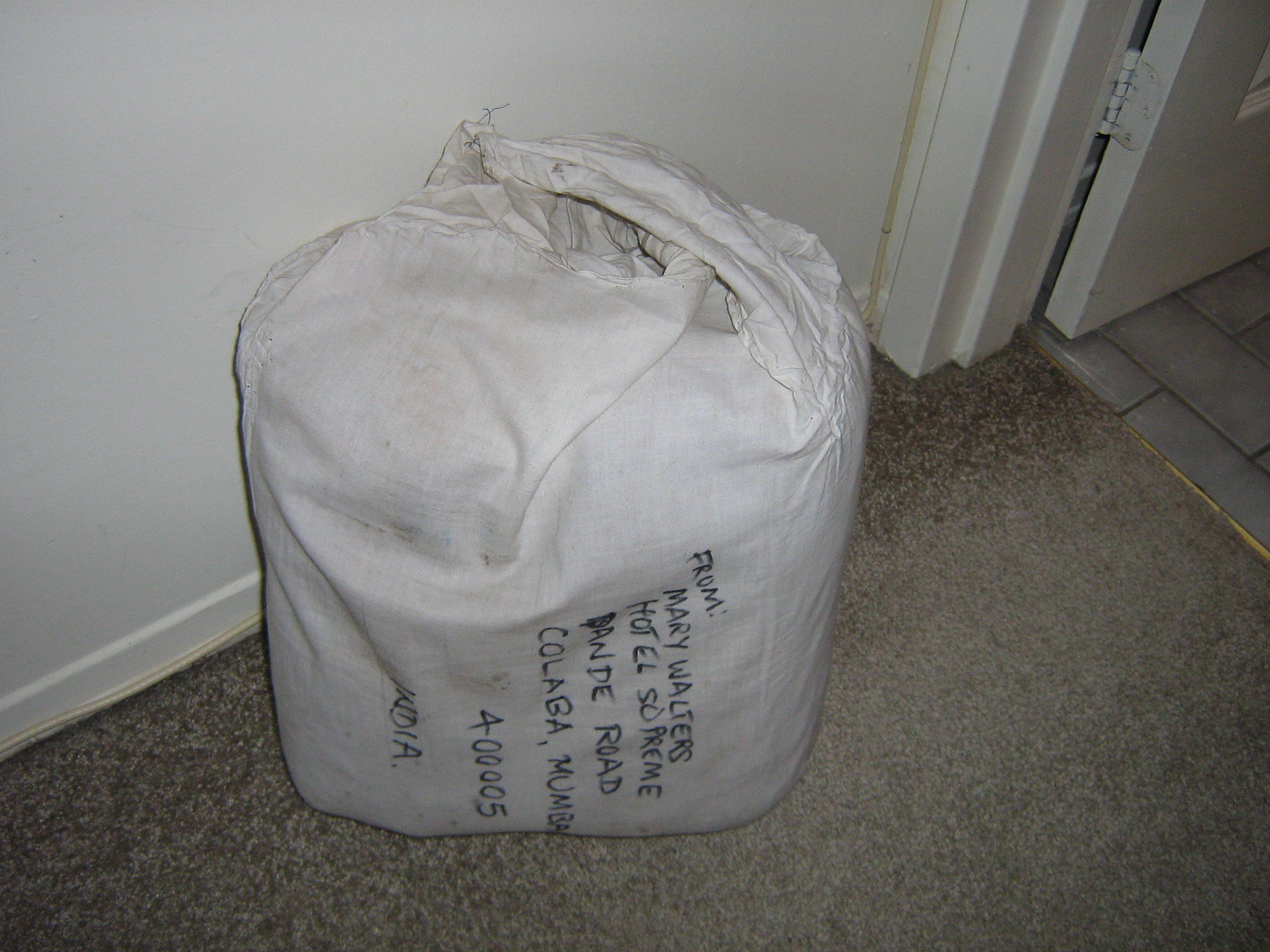
The Albatross, on arrival in Toronto (I whited out my street address so no one sends me any other albatrosses)

At the General Post Office (GPO) in Mumbai, I finally got rid of the package that so many of us have now come to know as “The Albatross.” I promise the “big reveal” of photos of its contents in the final installment of this blog. (I’m not being coy. I simply can’t bring myself to open it, even though it has now been sitting in my living room for two weeks.)

As I mentioned several months ago, I had read in my Rough Guide: “Sending a parcel from India can be a performance. First take it to a tailor to have it wrapped in cheap cotton cloth, stitched and sealed with wax. Next, take it to the post office, fill in and attach the necessary customs forms, buy your stamps, see them franked and dispatch it. Surface mail is incredibly cheap and takes an average of six months to arrive – it may take half or two times that, however.”

On the morning of the 17th of November, after being told by the front desk staff at the hotel that the small post office down the street would not be able to handle my big bundle, I took a taxi to the GPO downtown. The taxi driver, a man who has been picking up fares from in front of the Hotel Supreme on Panday Road almost every day for 30 years, he told me, took the personal interest in my welfare that I found so frequently in India. He was very kind: he knew exactly what I needed to do to get the Albatross out of my life for a while, and he was going to make sure I got it done. As a bonus, he pointed out local sights as we drove by them.

When we arrived at the post office – yet another enormous, impressive building  (why did I choose that day to leave my camera at the hotel? The whole experience was fascinating and photo-worthy. Now I need to go back to Mumbai so can I mail something else, and take pictures), my driver led me across the street (St. George, I think) to a row of booths where men were arranging the complex preparation of parcels for shipment for a few hundred rupees per parcel (about $5)  prior to their being taken to the post office.  One of the specialties of these packagers (I shall call them parcel wallahs, although I’m not sure if this term is correct or not) is the sewing of cloth wrappers for parcels to be mailed, and they weren’t impressed that I’d brought my own cloth wrapper, which had been quickly sewn together for me in Jaipur when I bought the things inside it. They felt their cloth would have been superior, and I am sure it would: I promised to use their system next time.

A senior parcel wallah then set to work with a very long needle and thick white thread to sew the package more securely so that the corners did not flap as they had when I handed it to him, when the parcel had been more like a small pillow inside a large closed pillow-case, which made the whole thing easier to carry around India because I could make a knot of the top of it. (I have read online that the sewing of packages is primarily to prevent pilfering, but it also makes them smooth and taut for shipping). After that, the parcel wallah filled out part of a customs form and then got me to fill in the rest of the information. He also gave me a felt pen so I could put my “return” address in India on one side of the package, and my home address on the other.

Then he got up from behind his bench and took me across the street (where my taxi was parked, its driver patiently waiting). He came into the post office with me and led me up to a wicket at the far end of the enormous main foyer of the GPO (25,000 served a day), where we waited together for at least ten minutes for a postal worker’s computer to start working again. (No one ever seems to charge for waiting in India, which is amazing because there is so much of it.) Finally the system came back on-line and the postal worker weighed my package and determined the cost of shipping.

It turned out I did not have enough rupees with me to pay the postage, and the post office took neither American money or VISA. So the parcel wallah patiently led me back out of the post office, back across the busy street, and returned me to the packaging area, where he sent one of his coworkers away with the $50 U.S. I had given him. (Interestingly, I felt no concern – I knew he’d come back with the change, and he did, within a few minutes, having even managed to get a good exchange rate for me.) The parcel wallah then led me back to the postal wicket where, at last, to my utter amazement, the Albatross was taken from me and tossed into a big bin. I actually didn’t care if it took six months to get back to Canada. I gave the parcel wallah a big tip. Well, “big” by Indian standards: another couple of hundred rupees.

My grandson and me with the Albatross – so you can see the size of it

(Note: As it turned out, it was only two weeks after I returned from India before the Albatross came back to me. When it arrived at my apartment, I missed the Canada Post delivery worker because I was in the shower. This meant that I had to walk five blocks to the postal outlet and carry the damned parcel home through the streets of Toronto with my arms wrapped around it. Seemed inevitable somehow that it should end that way.)

Despite the long wait, my taxi driver charged me no more than his original quote to get me back to the hotel (and when we arrived, I gave him a tip as well). As we drove back—with me feeling like I’d been released from some sort of bondage—he explained to me at some length why arranged marriages are a good thing. I thought he made some excellent points.